
This is an independent analysis by Nico Digital. Swiggy is not a client, and no non-public information was used. Swiggy is listed, so the figures below come from its quarterly press releases and earnings materials, its IPO documents as reported, and the business press, with the publication and date noted inline.
Swiggy and Zomato run nearly identical food delivery businesses, charge the same platform fee and compete for the same restaurants. In the quarter ended September 2026, Zomato's parent Eternal reported a net profit of ₹125 crore (Inc42, October 2026). Swiggy reported a net loss of ₹922 crore (Inc42, October 2026). The gap is not food. It is groceries, and it explains almost everything about Swiggy's model, its spending and its next two years.
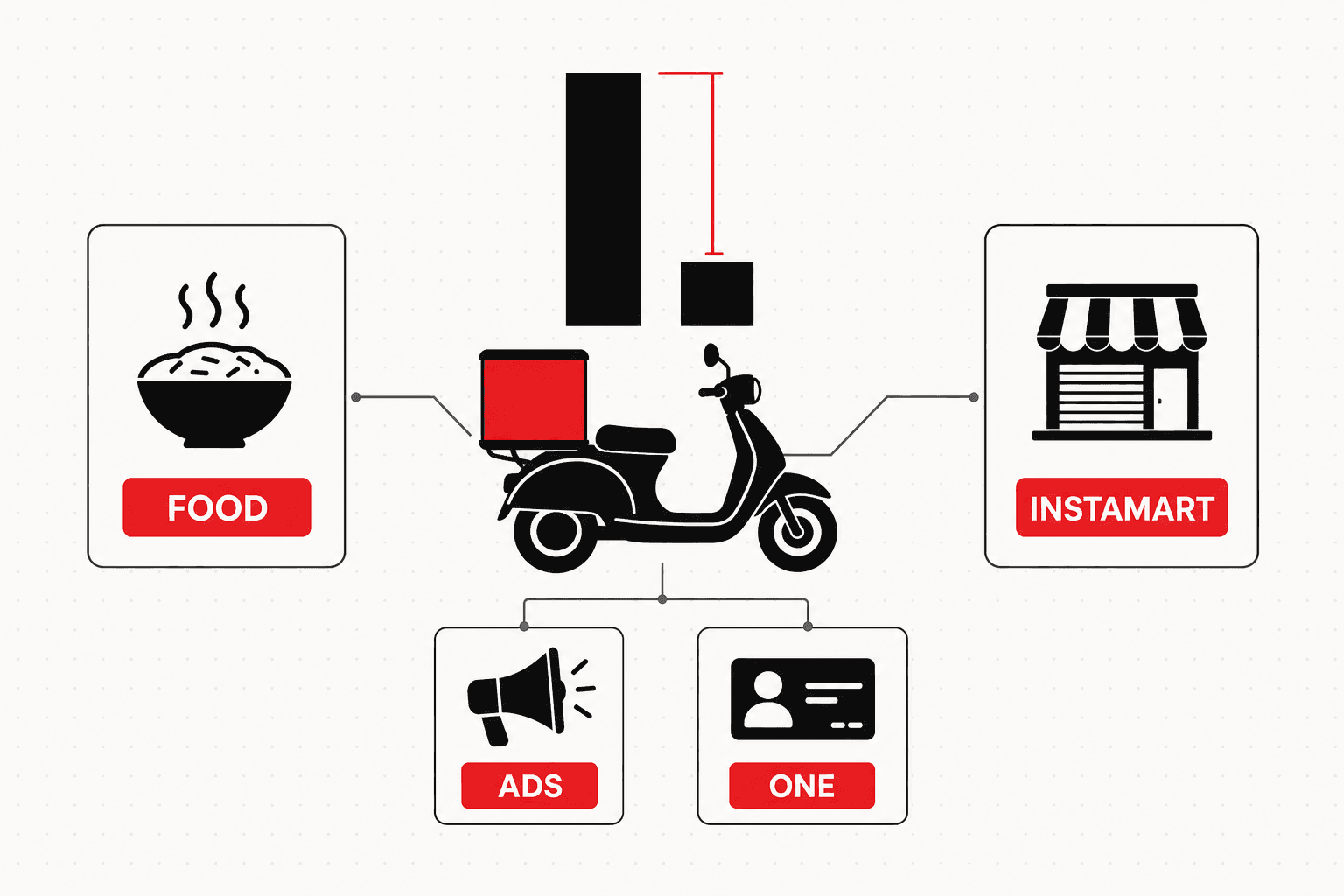
Short answer: Swiggy earns from restaurants (commission and advertising), from customers (platform fee, delivery charges and Swiggy One) and from brands that sell or advertise on Instamart, its quick commerce arm. Food delivery is profitable, with adjusted EBITDA of ₹341 crore, or 3.4 percent of gross order value, in the September 2026 quarter; Instamart lost ₹895 crore at the same level (Swiggy press release, October 2026). Revenue from operations was ₹7,571 crore in that quarter (Inc42, October 2026).
One app, two very different businesses
Swiggy was founded in 2014 and works with more than 2.7 lakh restaurants in 750-plus cities, served by over 7.6 lakh delivery partners (Swiggy press release, October 2026). It listed in November 2024 at an issue price of ₹390, raising ₹11,324 crore in an issue subscribed 3.59 times (Inc42, November 2024). In December 2025 it raised another ₹10,000 crore through a qualified institutional placement at ₹375 a share (Entrackr, December 2025), and it had earlier sold its stake in Rapido for ₹2,399.5 crore (Entrackr, September 2025).
The platform had 27.8 million monthly transacting users in the September 2026 quarter, with 19.8 million using food delivery and 14.8 million using Instamart (Inc42, October 2026). The overlap is the strategy: one customer, one app, several categories.
How Swiggy makes money
Swiggy reports four main segments. The September 2026 quarter shows how unevenly the money is made.
Food delivery: the take rate and the fee ladder
Food delivery gross order value was ₹10,054 crore in the September 2026 quarter, up 17.7 percent, with adjusted EBITDA of ₹341 crore, the segment's highest ever (Swiggy press release, October 2026). Reported food delivery revenue was ₹2,338 crore (Inc42, October 2026), about 23 percent of GOV by our arithmetic. HDFC Securities puts the take rate on adjusted revenue at 26.0 percent of GOV, up 23 basis points on the year, driven by ad-led monetisation (HDFC Securities, October 2026).
That take rate has four parts. Restaurant commission is the largest; Swiggy publishes no rate card, and restaurant bodies say commissions run at 25 to 35 percent plus other charges (Inc42, July 2026). Delivery charges are paid by customers. Advertising is sold to restaurants, and Swiggy names ads as a driver of food delivery margins (Swiggy press release, October 2026). The fourth is the platform fee, a flat charge per order that did not exist before 2023.
The fee launched at ₹2 in April 2023 and rose to ₹3 that October (Inc42, October 2023), then to ₹6 in July 2024, ₹10 in October 2024 and ₹14 in August 2025 (Business Today, August 2025). It touched ₹15 before GST in September 2025 (Angel One, September 2025) and was set at ₹14.99, or ₹17.58 including GST, in March 2026, matching Zomato (Business Today, March 2026). Because the two move in step, neither loses customers to the other over it. Our Zomato business model teardown traces the same ladder from the other side.
Speed is now part of the product. Bolt, Swiggy's fast food-delivery format, and the 99-Store value range together account for more than a quarter of food delivery volumes (Open Magazine, October 2026).
Instamart: dark stores and losses
Instamart's gross order value was ₹9,230 crore in the September 2026 quarter and its net order value ₹6,594 crore, up 31.4 percent on the year. Its contribution margin was minus 1.0 percent of GOV, and its adjusted EBITDA loss was ₹895 crore, or minus 9.7 percent of GOV. It ran 1,240 dark stores in 133 cities covering 5.2 million sq ft, after adding 69 stores in the quarter (Swiggy press release, October 2026). The average order was ₹708 on GOV (HDFC Securities, October 2026), and each active store handled about 1,192 orders a day, up from 1,089 (Open Magazine, October 2026).
Dark stores are a fixed cost: rent, staff and stock are paid whether orders arrive or not, so profit depends on orders per store. Management says Instamart's losses peaked in that quarter (Open Magazine, October 2026). Having qualified as an Indian owned and controlled company, Swiggy will move Instamart to an inventory model from the middle of the December 2026 quarter, over two to three quarters, for about 80 basis points of contribution margin (Inc42, October 2026). It expects ads, product mix and own brands to deliver about two-thirds of the improvement in contribution per order (Open Magazine, October 2026).
Swiggy One, Dineout and other bets
Swiggy One is the only membership in India spanning food, quick commerce and dining out, by Swiggy's own description (Swiggy press release, October 2026). The entry tier, One Lite, launched at ₹99 for three months with ten free food and ten free Instamart deliveries above minimum order values (Business Today, October 2023), and an invite-only tier, One BLCK, costs ₹299 for three months (Inc42, December 2024). Swiggy does not disclose member numbers.
Dineout, acquired from Times Internet in May 2022 (Business Today, May 2022), sits with the Scenes events business in the out-of-home segment: ₹1,508 crore of GOV in the September 2026 quarter, up 34.9 percent, and a seventh straight profitable quarter at a 0.5 percent margin (Swiggy press release, October 2026). The other bets have been pruned hard. Genie was suspended in about 70 locations (Business Today, May 2025), Minis was shut in August 2025 (Entrackr, July 2025), Pyng in October 2025 (Inc42, October 2025) and the 15-minute app Snacc in 2026 (Kotak Neo, August 2026). Toing, a budget-meals app, is the current bet; platform innovations lost ₹162 crore at the adjusted EBITDA level in the September 2026 quarter (Inc42, October 2026).
Revenue and losses, as disclosed
Revenue from operations was ₹8,265 crore in FY23 and ₹11,247 crore in FY24, and the net loss narrowed from ₹4,179 crore to ₹2,350 crore over those two years, according to its IPO filing (Inc42, September 2024). Then quick commerce expansion reversed the trend: FY25 revenue was ₹15,227 crore with a net loss of ₹3,117 crore, and FY26 revenue rose 51 percent to ₹23,053 crore while the net loss rose to ₹4,154 crore (Bajaj Broking, May 2026). Food delivery's adjusted EBITDA crossed ₹1,000 crore for FY26 (Swiggy Q4 FY26 press release, May 2026), so the core business is not the problem.
Compare the September 2026 quarter at Eternal. Zomato's food delivery made ₹627 crore of adjusted EBITDA, 5.5 percent of net order value, and Blinkit turned a ₹184 crore profit on ₹20,940 crore of net order value from 2,751 stores (Inc42, October 2026). The bases differ, since Swiggy reports margins on gross value and Eternal on net value, but the direction is clear. Blinkit has more than twice Instamart's stores and roughly three times its net order value. By our arithmetic, that is about ₹7.6 crore of net order value per Blinkit store in the quarter against about ₹5.3 crore per Instamart store, so Blinkit spreads its fixed costs across far more sales. We cover those economics in the Blinkit business model, and the third player's brand in the Zepto marketing strategy.
Swiggy's marketing strategy
Unlike Zerodha, which grew on almost no advertising, Swiggy buys growth. Advertising and sales promotion expense was ₹2,501 crore in FY23 and ₹1,851 crore in FY24 (Inc42, September 2024), then ₹4,207 crore in FY26 (Bajaj Broking, May 2026). In the September 2026 quarter it was ₹1,298 crore, up 24.9 percent on the year (JM Financial, October 2026), about 17 percent of revenue by our arithmetic. Of the ₹10,000 crore raised in December 2025, ₹2,340 crore was earmarked for brand marketing (Outlook Business, December 2025).
The app is the cross-sell. With 27.8 million monthly users across categories, the food app is Instamart's cheapest acquisition channel, the same lever Zomato uses for Blinkit.
Membership ties the categories together. Swiggy One is priced to pull food customers into Instamart and Dineout, and its lower tiers lower the cost of trying it.
Speed and price as brand. Bolt and Toing are product decisions that work as marketing: one promises speed, the other affordability. Swiggy says two of every three new Toing users were new to food delivery itself (Swiggy press release, October 2026).
What a marketplace brand can copy
-
Fund new bets from a profitable core, with an exit test. Swiggy shut Minis, Pyng and Snacc and suspended Genie in about 70 locations, while keeping Dineout, which is now profitable. Decide in advance what a new line must prove, and by when.
-
Add fees after the habit, not before. The platform fee climbed in small steps over three years, in step with the competitor. Brands that add charges before repeat behaviour exists are taxing a relationship they do not have yet.
-
Sell visibility to your supply side. Swiggy expects ads, mix and own brands to drive most of Instamart's margin repair. Any ecommerce marketplace aggregating demand can sell sponsored placement to the sellers who want it.
-
Do not fight a scale war you cannot win on density. Instamart's problem is sales per store. A smaller brand should win a niche where it already has density before it buys more fixed cost.
For more Indian marketplace models, see the Meesho business model, the Urban Company business model and the Lenskart business model.
Frequently Asked Questions
How does Swiggy make money?
Swiggy's food delivery business earns commissions from restaurants, a platform fee and delivery charges from customers, and advertising from restaurants that pay for visibility. Brokers estimate its food delivery take rate at about 26 percent of gross order value. Instamart, its quick commerce arm, earns margins and fees on groceries sold through 1,240 dark stores, plus advertising from brands. Swiggy One membership, Dineout table bookings and event ticketing through Scenes add smaller lines.
Is Swiggy profitable?
Not as a company. Its food delivery business is profitable, with adjusted EBITDA of ₹341 crore, or 3.4 percent of gross order value, in the quarter ended September 2026. Instamart lost ₹895 crore at the adjusted EBITDA level in the same quarter, and Swiggy reported a consolidated net loss of ₹922 crore. For FY26 it reported revenue of ₹23,053 crore and a net loss of ₹4,154 crore.
Why does Swiggy lose money when Zomato makes a profit?
Mostly because of quick commerce. In the September 2026 quarter, Eternal's Blinkit made an adjusted EBITDA profit of ₹184 crore on ₹20,940 crore of net order value from 2,751 dark stores, while Instamart lost ₹895 crore on ₹6,594 crore of net order value from 1,240 stores. Zomato's food delivery margin is also higher, at 5.5 percent of net order value against Swiggy's 3.4 percent of gross order value, although the two use different bases.
What is the Swiggy platform fee?
It is a flat charge on every food order, separate from delivery charges. It launched at ₹2 in April 2023, rose to ₹3 in October 2023, ₹6 in July 2024, ₹10 in October 2024 and ₹14 in August 2025, briefly reached ₹15 before GST in September 2025, and was set at ₹14.99, or ₹17.58 including GST, in March 2026, matching Zomato.
What is Swiggy's marketing strategy?
Swiggy spends heavily on advertising and uses its app to cross-sell. Its advertising and sales promotion expense was ₹4,207 crore in FY26 and ₹1,298 crore in the September 2026 quarter. It set aside ₹2,340 crore of its December 2025 share sale for brand marketing. Swiggy One membership spans food, Instamart and dining out, and speed formats such as Bolt carry the brand promise into food delivery.
What can a marketplace brand learn from Swiggy?
Protect the profitable core and fund new bets from it, but set a clear point at which a loss-making line has to prove itself; add small fees only once the habit is formed; sell visibility to the supply side; and use one membership to tie categories together. Swiggy's own lesson is the cost of being second at scale: each Instamart dark store carries less order value than a Blinkit store, so the same model loses money.

Aditya Kathotia
Founder & CEO
CEO of Nico Digital and founder of Digital Polo, Aditya Kathotia is a trailblazer in digital marketing. He's powered 500+ brands through transformative strategies, enabling clients worldwide to grow revenue exponentially. Aditya's work has been featured on Entrepreneur, Economic Times, Hubspot, Business.com, Clutch, and more. Join Aditya Kathotia's orbit on LinkedIn to gain exclusive access to his treasure trove of niche-specific marketing secrets and insights.
More in Marketing Strategy
- Paytm Business Model: Payments, Devices and Lending After the RBI Ban
- PhonePe Business Model: How a Free UPI App Makes Money
- Physics Wallah Business Model: How Low-Fee Edtech Makes Money
- Rapido Business Model: How a Bike Taxi App Makes Money
- boAt Business Model: How an Audio Brand Built a D2C Empire
- Nykaa Business Model: Content-Led Beauty Commerce Explained