

This is an independent analysis by Nico Digital. Paytm is not a client, and no non-public information was used. Paytm's parent, One 97 Communications, is listed, so the figures below come from its results releases and investor materials, its exchange filings as reported, RBI and NPCI announcements, and the business press, with the publication and date noted inline.
Paytm listed in November 2021 with an ₹18,300 crore IPO at ₹2,150 a share, India's biggest at the time (Reuters, November 2021), and opened 9.3 percent below its issue price (Money9, November 2021). On 31 January 2024 the RBI barred its associate Paytm Payments Bank from taking new deposits and top-ups (Business Today, February 2024). Within five months Paytm had lost a quarter of its monthly users (Business Insider India, July 2024). Two years after the order, in FY26, it posted its first full-year profit, ₹552 crore (Inc42, May 2026). The business that recovered is not the one that listed: it is a merchant payments, devices and loan distribution company with a consumer app attached.
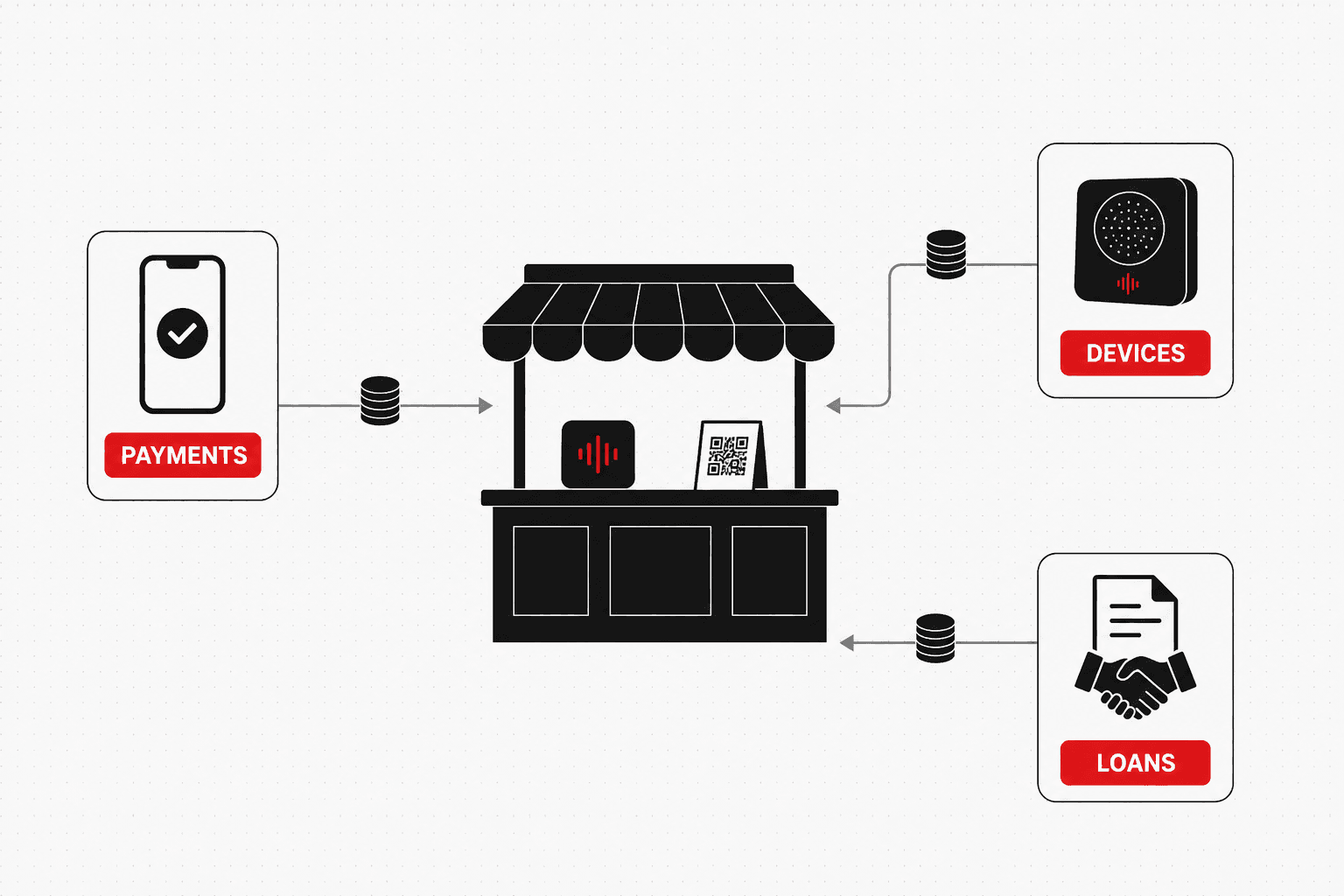
Short answer: Paytm makes money from merchants more than consumers. Payment services, which include fees on card and wallet payments, government incentives on UPI and monthly Soundbox and card machine rentals, earned ₹4,646 crore in FY26. Financial services, mostly fees for distributing loans made by partner lenders, earned ₹2,593 crore and grew 52 percent. Total revenue from operations was ₹8,437 crore and profit after tax ₹552 crore (Inc42, May 2026; Paytm FY26 results release, May 2026).
How Paytm makes money
Payments: thin margins on a huge volume
Merchants pay a fee, the merchant discount rate, on card, wallet and net banking payments, and consumers pay platform fees on some bill payments and top-ups; UPI is free for merchants, and the government pays incentives on UPI payments instead (Paytm investor relations, May 2025). Paytm keeps what is left after paying banks and card networks. In its own explainer, which uses FY23 data, it put the net payment margin at 7 to 9 basis points of payment value overall, 3 to 4 on UPI and 15 to 18 on other instruments (Paytm investor relations, May 2025).
The scale makes those basis points matter. In FY26 payment services revenue was ₹4,646 crore, of which ₹2,573 crore went out as payment processing charges (Inc42, May 2026). In the September 2026 quarter, merchant payment value was ₹7.1 lakh crore and net payment revenue, excluding the government incentive, was ₹644 crore, up 21 percent; that incentive itself fell to ₹12 crore from ₹74 crore a year earlier (Inc42, October 2026), a reminder that the subsidy is not something to build on.
Soundbox: rent on the counter
The Soundbox is a small speaker that reads out every payment a shop receives. Paytm has described the fee as about ₹100 a month per active device, with high-end devices commanding up to ₹250 a month (Paytm investor relations, May 2025). Because UPI itself is free for merchants, the monthly rental is how Paytm earns from a shop that only takes UPI.
The base has grown steadily: 58 lakh merchants paid device subscriptions in December 2022 (Paytm investor relations, May 2025), 1.51 crore in the March 2026 quarter (Paytm FY26 results release, May 2026) and 1.64 crore in the September 2026 quarter, 27 lakh more than a year earlier (Inc42, October 2026). The device also tells Paytm how much a shop sells, which is exactly the data a lender wants.
Financial services: distribute, do not lend
Paytm does not lend from its own balance sheet. It sources borrowers, mostly its own merchants and app users, for partner banks and NBFCs and earns a fee, an asset-light model (Inc42, May 2026). Financial services revenue was ₹2,593 crore in FY26, up 52 percent, and repeat borrowers made up more than half of merchant loan disbursements in the March 2026 quarter (Paytm FY26 results release, May 2026). In the September 2026 quarter the line earned ₹912 crore, up 49 percent (Inc42, October 2026).
The line was rebuilt after a setback. When the RBI tightened rules on unsecured consumer credit in late 2023, Paytm said it would scale down loans below ₹50,000, which made up 70 to 73 percent of its postpaid loans, and work with its seven NBFC partners on larger personal and merchant loans instead (Business Today and BQ Prime, December 2023).
What Paytm sold
In August 2024 Paytm agreed to sell its movie, sports and events ticketing business to Zomato for ₹2,048 crore; that business had earned ₹297 crore of revenue in FY24 (Business Today, August 2024). It now runs inside Zomato's going-out arm, covered in our Zomato business model teardown. Paytm chose cash and focus over a consumer line it could not grow.
The 2024 RBI action and its aftermath
On 31 January 2024 the RBI acted against Paytm Payments Bank under Section 35A of the Banking Regulation Act, citing persistent non-compliance and continued material supervisory concerns. It barred the bank from accepting deposits, credit transactions and top-ups in customer accounts, wallets and FASTags after 29 February, and on 16 February extended that deadline to 15 March 2024 (Business Today, February 2024).
The fix was to move the payments business onto other banks. On 14 March 2024 NPCI approved One 97 Communications as a third-party UPI app with Axis Bank, HDFC Bank, State Bank of India and Yes Bank as its partner banks, with Yes Bank as the merchant acquiring bank and the new home of the @paytm handle (Business Today, March 2024). New UPI customers had to wait: NPCI allowed Paytm to onboard them again only from 22 October 2024 (The Week, October 2024).
The damage showed in the numbers. Monthly transacting users fell from about 10.4 crore in January 2024 to 8.9 crore in March and 7.8 crore in June (Business Insider India, July 2024). In the June 2024 quarter revenue fell 36 percent to ₹1,502 crore and the loss widened to ₹839 crore (Business Standard, July 2024). For FY25 as a whole, revenue fell 30.8 percent to ₹6,900 crore (Storyboard18, May 2025).
Revenue and profit, as disclosed
Revenue from operations rose 24.8 percent to ₹9,978 crore in FY24, from ₹7,990 crore in FY23 (YourStory, May 2024), while the loss narrowed to ₹1,422.4 crore from ₹1,776.5 crore (Free Press Journal, May 2024). In FY25 revenue fell to ₹6,900 crore and the loss narrowed to ₹663.2 crore (Storyboard18, May 2025). In FY26 revenue grew 22 percent to ₹8,437 crore, EBITDA turned positive at ₹502 crore and profit after tax was ₹552 crore (Paytm FY26 results release, May 2026).
Two caveats. First, part of the profit is interest. Other income was ₹854 crore in FY26, about 47 percent more than the profit before tax of ₹582 crore, on a year-end cash balance of ₹13,315 crore (Inc42, May 2026). Second, the September 2026 quarter's tenfold profit jump, to ₹225 crore from ₹21 crore, compares with a weak base; the June 2026 quarter had already earned ₹220 crore (Inc42, October 2026). The operating trend is real all the same: revenue grew 28 percent to ₹2,648 crore in that quarter, EBITDA rose 90 percent to ₹270 crore and monthly transacting users climbed back to 8.5 crore, still below the 10.4 crore of January 2024 (Inc42, October 2026).
Paytm's marketing strategy
Cricket for national reach. Paytm first won BCCI's title sponsorship for India's home cricket in 2015 for ₹203.28 crore, and renewed it in August 2019 for ₹326.80 crore, or ₹3.80 crore a match, covering September 2019 to March 2023 (BCCI, August 2019). It exited early: Mastercard took over the rights from India's home series against Australia in September 2022 (Onmanorama, September 2022). Compare the CRED business model, which also used cricket to buy fame quickly.
Spending less once distribution exists. Advertising and promotion expense fell from ₹922 crore in FY24 to ₹659.4 crore in FY25 (Storyboard18, May 2025) and ₹536 crore in FY26 (exchange4media, May 2026), about 6 percent of revenue by our arithmetic. The decline came while revenue recovered, which says the growth now comes from the sales force and the devices, not media.
The device is the billboard. Every Soundbox on a shop counter announces payments in the shop, in front of customers, all day. Paytm has said the subscription model drives device adoption, which in turn drives payment volumes and subscriptions (Paytm investor relations, May 2025). It is closer to a field sales and retention engine than an ad campaign, and it is the opposite of Zerodha's approach, which spends almost nothing and relies on referrals and free education.
What a fintech brand can copy
-
Charge for the relationship when the transaction is free. UPI is free for merchants, so Paytm rents a device that sits on the counter every day. A fintech brand facing zero-fee rails needs a subscription, a service or a data product that the customer pays for monthly.
-
Distribute what you cannot safely hold. Paytm earns loan fees without carrying the loans. That keeps capital needs low, although it still ties Paytm's growth to its partners' appetite for risk, as the 2023 cut in small loans showed.
-
Treat compliance as product. One regulator's order cost Paytm a quarter of its monthly users in five months and nearly a third of a year's revenue. No marketing budget buys that back quickly.
-
Use one trusted touchpoint to sell the next product. The Soundbox tells Paytm a shop's sales, and repeat borrowers now make up more than half of merchant loan disbursements. The first product's job is to earn the right to sell the second.
Next: see how Paytm compares with other fintech companies in India. For the rival that overtook it on UPI, see the PhonePe business model.
Frequently Asked Questions
How does Paytm make money?
Paytm, run by One 97 Communications, earns from three areas. Payment services brought in ₹4,646 crore in FY26: fees merchants pay on card, wallet and net banking payments, government incentives on UPI, and monthly subscriptions for Soundbox and card machines. Financial services brought in ₹2,593 crore, mainly fees for distributing loans that partner banks and NBFCs make. The rest came from marketing services and other lines, for total revenue from operations of ₹8,437 crore.
Is Paytm profitable now?
Yes, on its reported numbers. Paytm posted its first full-year profit in FY26, ₹552 crore on revenue of ₹8,437 crore, against a ₹663 crore loss in FY25. In the September 2026 quarter it earned ₹225 crore on revenue of ₹2,648 crore. Part of the profit comes from other income: in FY26 other income was ₹854 crore, more than the profit before tax of ₹582 crore, largely interest on a cash balance of ₹13,315 crore.
What happened to Paytm Payments Bank?
On 31 January 2024 the RBI, citing persistent non-compliance and supervisory concerns, barred Paytm Payments Bank from taking deposits, credits and top-ups in customer accounts, wallets and FASTags after 29 February, a deadline it later extended to 15 March 2024. Paytm moved its UPI business onto four partner banks, Axis Bank, HDFC Bank, SBI and Yes Bank, under an NPCI approval of 14 March 2024, and was allowed to add new UPI users again from October 2024.
How much does the Paytm Soundbox cost merchants?
Paytm has described its device fee as about ₹100 a month per active device, with high-end devices commanding up to ₹250 a month. The subscription matters because UPI payments are free for merchants, so the device rental is how Paytm earns from a small shop that only takes UPI. Merchants paying device subscriptions rose from 58 lakh in December 2022 to 1.64 crore by the September 2026 quarter.
What is Paytm's marketing strategy?
In its growth years Paytm bought national visibility, holding BCCI's title sponsorship for India's home cricket from 2015 and renewing it in 2019 for ₹326.80 crore until 2023, before handing it to Mastercard in 2022. Since then it has cut spend: advertising and promotion fell from ₹922 crore in FY24 to ₹659 crore in FY25 and ₹536 crore in FY26. Its most visible marketing today is the Soundbox on shop counters, which announces every payment.
What can a fintech brand learn from Paytm?
Earn recurring revenue from the merchant even when the payment itself is free; distribute regulated products through licensed partners rather than carrying the risk yourself; treat compliance as part of the product, because one regulator's order cut Paytm's monthly users by a quarter in five months; and cut brand spend once distribution, such as devices on counters, does the work.

Aditya Kathotia
Founder & CEO
CEO of Nico Digital and founder of Digital Polo, Aditya Kathotia is a trailblazer in digital marketing. He's powered 500+ brands through transformative strategies, enabling clients worldwide to grow revenue exponentially. Aditya's work has been featured on Entrepreneur, Economic Times, Hubspot, Business.com, Clutch, and more. Join Aditya Kathotia's orbit on LinkedIn to gain exclusive access to his treasure trove of niche-specific marketing secrets and insights.
More in Marketing Strategy
- PhonePe Business Model: How a Free UPI App Makes Money
- Physics Wallah Business Model: How Low-Fee Edtech Makes Money
- Rapido Business Model: How a Bike Taxi App Makes Money
- boAt Business Model: How an Audio Brand Built a D2C Empire
- Nykaa Business Model: Content-Led Beauty Commerce Explained
- Swiggy Business Model: Food Delivery, Instamart and the Margin Gap