

This is an independent analysis by Nico Digital. CRED is not a client, and no non-public information was used. CRED is unlisted, so the figures below come from its annual financial results as reported by Entrackr and Inc42, and from news reports, with the publication and date noted inline.
CRED is the most talked-about fintech brand in India and one of the hardest to explain. Paying a credit card bill through it is free. Members are rewarded for doing so. For years it spent heavily on cricket advertising for an app most of India was not allowed to join. And yet it reported ₹2,735 crore of operating revenue in FY25 (Entrackr, January 2026). The model makes sense once you stop looking at what members pay and start looking at who pays to reach them.
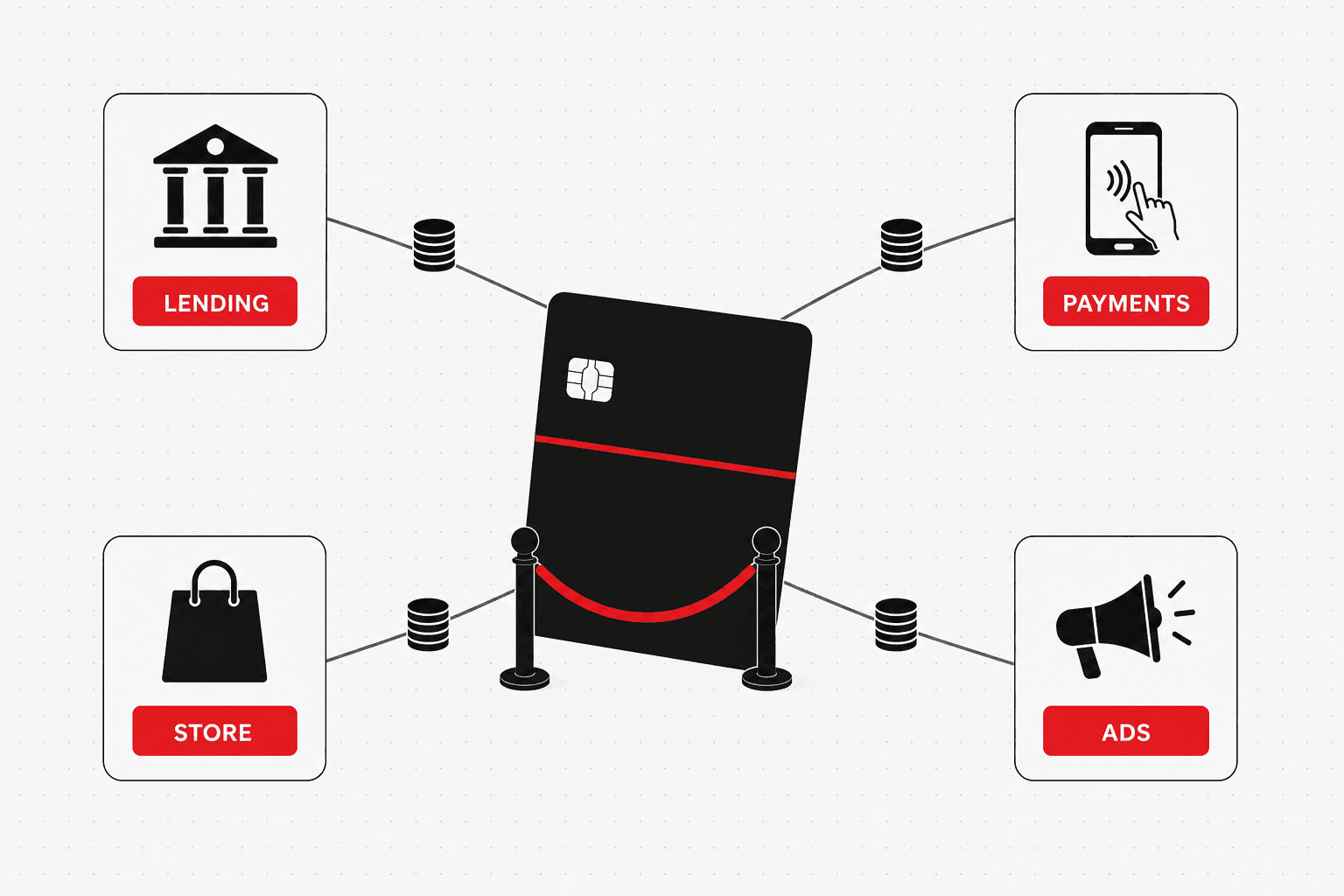
Short answer: CRED makes money from the companies that want its members, not from the members themselves. Lending is the main engine: CRED sources and services loans for partner banks and NBFCs and earns fees and interest income. Brands pay for advertising, listings and placement in CRED Store and CRED Pay, and CRED earns fees on rent and other card payments. It reported operating revenue of ₹2,735 crore and an operating loss of ₹298 crore in FY25 (Entrackr, January 2026).
A members' club built on credit card bills
Kunal Shah founded CRED in 2018 (Reuters via The Star, June 2026). It originally admitted only users with a credit score of 750 or above (Inc42, July 2026), and the gate was the strategy. Paying a credit card bill is a monthly, unavoidable habit; a credit score above 750 is a filter for people banks want to lend to. CRED offered the first for free to collect the second.
By mid-2026 the company said it had 17 million monthly members and processed more than 40 percent of India's credit card bill payments (Reuters via The Star, June 2026). In June 2026 Meta agreed to invest $900 million for a minority stake at a $4.5 billion valuation, below the 2022 peak of $6.4 billion, with no access to CRED's customer data. Shah stepped down to lead WhatsApp globally, and Miten Sampat, CRED's head of strategy and finance since 2020, became interim CEO (same source).
How CRED makes money
CRED does not publish revenue by business line. Its FY23 financial statements described the sources as facilitating rental transactions, interest income on P2P loans, processing fees on loans, advertising space and listing fees (Entrackr, October 2023), and Inc42 described lending as the main revenue engine in July 2026.
Lending through partners
Lending is where a 750-plus credit score becomes money. The model is to find the borrower, run the app and the first assessment, and let partner lenders underwrite and fund the loan. Its most visible partner is NewTap Finance, an NBFC in which CRED holds 25.2 percent and Kunal Shah indirectly 74.5 percent. CRED acts as NewTap's lending service provider, handling customer acquisition and technology, while NewTap handles underwriting, pricing and compliance; about 90 percent of NewTap's assets under management come from borrowers with credit scores above 750, and most of the book is co-lent with banks and other NBFCs (Inc42, August 2026).
The scale is in the managed book. CRED managed lending assets of ₹22,000 crore for partners during FY25 (Entrackr, January 2026) and about ₹24,000 crore by June 2026 (Inc42, July 2026). In February 2025 it added Cash+, credit against mutual funds, as part of a product release it called Svalbard (Inc42, February 2025).
Payments: rent, bills and CRED Pay
Bill payment itself is free, but adjacent payments are not. Facilitating rent payments by card is one of the revenue sources named in CRED's FY23 statements (Entrackr, October 2023). CRED Pay, launched in December 2020 with Razorpay and Visa, lets members spend CRED coins as discounts at partner merchants; CRED pitched it to brands as a cheaper alternative to pay-per-click advertising (Inc42, December 2020). CRED Pay volumes grew 254 percent in FY24, and total payment value reached ₹6.87 lakh crore that year (Entrackr, September 2024) and ₹8.5 lakh crore in FY25 (Entrackr, January 2026). In UPI, where everyone is free, CRED is small: about 0.75 percent of UPI transactions and 2.24 percent of value in August 2025 (Inc42, September 2025), though its average ticket is high: about ₹3,881 per UPI transaction in June 2026 (Inc42, July 2026).
Ads, listings and CRED Store
Brands pay to sit in front of members. Advertising space and listing fees appear among CRED's revenue sources (Entrackr, October 2023), and CRED Store sells products from Indian and international D2C brands and FMCG companies to members who redeem coins (Inc42, December 2020). For a young D2C brand, that is a direct line to high-spending customers.
CRED Mint: the line regulation slowed
Mint launched in August 2021 as a peer-to-peer lending product with LiquiLoans, letting members put ₹1 lakh to ₹10 lakh into a pool spread across 200-plus borrowers for returns of up to 9 percent a year (Business Today, August 2021). After the RBI tightened its P2P rules in August 2024, Shah told ET that the offering had slowed (as reported by Inc42, February 2025).
Revenue and losses, as reported
CRED's revenue has grown nearly sevenfold in three years. Its losses have barely moved, and the operating loss has fallen sharply.
Operating revenue grew from ₹393.5 crore in FY22 to ₹1,400.6 crore in FY23 (Entrackr, October 2023), ₹2,397 crore in FY24 (Inc42, September 2025) and ₹2,735 crore in FY25 (Entrackr, January 2026). Including other income, CRED put FY24 revenue at ₹2,473 crore (Entrackr, September 2024). The net loss was ₹1,279.5 crore in FY22, ₹1,347 crore in FY23, ₹1,644 crore in FY24 and ₹1,457 crore in FY25 (same sources), while the operating loss fell from ₹1,024 crore in FY23 to ₹609 crore in FY24 and ₹298 crore in FY25. The FY23 loss included about ₹300 crore of non-cash ESOP cost (Entrackr, October 2023). Entrackr attributes the FY24 and FY25 figures to CRED's own announcements.
Efficiency is the real story. In FY22 CRED spent ₹4.33 for every rupee of operating revenue; in FY23 it spent ₹2.02 (Entrackr, October 2023). In FY25 it reported a gross margin of about 70 percent, 1.26 crore monthly transacting users making 14.4 transactions a month each, about 45 percent of active members using three or more products, and an average revenue per user of about ₹2,000 (Entrackr, January 2026). By our arithmetic, 1.26 crore users at about ₹2,000 each is roughly ₹2,500 crore, close to the reported revenue, so the ARPU figure is consistent.
CRED said it was aiming for full profitability in FY26 (Entrackr, January 2026), and Inc42 reported in July 2026 that it had posted its first profitable quarter, without the period being disclosed. Audited FY26 figures were not public at the time of writing.
CRED's marketing strategy
CRED's advertising is famous; its marketing strategy is the decision about when to stop.
Buy fame on the biggest stage, once. CRED became an official IPL partner for 2020 to 2022, reportedly committing about ₹120 crore over the three seasons (Social Samosa, December 2024). In FY21 its other expenses rose 43 percent to ₹418 crore, driven by IPL and advertising spend, against revenue of ₹95.5 crore (same source). That is more than four rupees of those expenses for every rupee of revenue, and it was deliberate.
Make the ads the conversation. The 2020 IPL films, tagged "Not Everyone Gets It", cast Anil Kapoor, Madhuri Dixit and Bappi Lahiri in absurd auditions. In 2021 Rahul Dravid played an enraged commuter shouting that he was the "Indiranagar ka Gunda", which drew 4 million YouTube views in four days; later films cast Jackie Shroff and Kumar Sanu against type (Social Samosa, December 2024). The ads rarely explained the product; they made CRED something people talked about.
Then step back, loudly. In 2023 CRED ran an outdoor campaign in Bengaluru, Gurugram and Delhi titled "Our Only Ad This Year", and its 2024 IPL films focused narrowly on UPI with Leander Paes, David Warner and S.S. Rajamouli (Social Samosa, December 2024). In FY24 it cut marketing expenses by 36 percent and customer acquisition cost by 40 percent (Entrackr, September 2024). The brand was built; the money moved to products.
Exclusivity is the positioning. The 750 credit score gate (Inc42, July 2026) did the work that most fintech ads try to do with copy. Being let in was the reward, and every member who got in became a reason for the next one to want to.
What a fintech brand can copy
Most fintechs cannot afford an IPL partnership. The structure underneath is more transferable than the ads.
-
Define a narrow, valuable customer and make access feel earned. CRED's gate was a credit score, which is also the exact filter its lending partners care about. A fintech brand that picks a sharp segment, whether salaried professionals, small exporters or first-time investors, can make qualifying part of the appeal.
-
Give away a frequent habit and monetise what it makes credible. Bill payments are free and monthly; lending, insurance and wealth are where the money is. The free product earns the right to sell the paid one.
-
Let regulated partners carry the balance sheet. CRED sources and services loans while banks and NBFCs underwrite and fund them. For most fintechs, owning acquisition and experience is the defensible part; holding the risk is not.
-
Spend on brand until the brand is known, then shift to compounding channels. CRED cut marketing by more than a third once awareness was built. Our Groww teardown shows the compounding alternative: education content and search that keep acquiring users after the budget stops.
-
Watch the regulatory dependency. Mint slowed when the RBI rewrote P2P rules. Any line whose economics rest on one reading of a regulation needs a plan for when that reading changes.
Next: the opposite end of Indian consumer internet, a marketplace that charges sellers nothing and makes money on shipping, in the Meesho business model; and how small fee lines and membership work at scale, in the Zomato business model.
Frequently Asked Questions
How does CRED make money?
CRED earns from the businesses that want to reach its creditworthy members, not from the members' bill payments. Lending is the main engine: CRED acts as a lending service provider for banks and NBFCs and earns fees and interest income on loans. It also earns fees on rent and other card payments, money from brands for advertising space and listings, and margins from CRED Store and CRED Pay merchants. Its company-reported operating revenue was ₹2,735 crore in FY25, with an average revenue per user of about ₹2,000.
Is CRED profitable?
Not on an annual basis yet. CRED reported an operating loss of ₹298 crore in FY25, down 51 percent from ₹609 crore, and a total loss of ₹1,457 crore including ESOP costs and depreciation. It said it was aiming for full profitability in FY26, and Inc42 reported in July 2026 that CRED had posted its first profitable quarter, without a period being disclosed. Audited FY26 figures were not public at the time of writing.
How much revenue does CRED make?
CRED's operating revenue grew from ₹393.5 crore in FY22 to ₹1,400.6 crore in FY23, ₹2,397 crore in FY24 and ₹2,735 crore in FY25. Including other income, CRED put FY24 revenue at ₹2,473 crore. Its net loss was ₹1,279.5 crore in FY22, ₹1,347 crore in FY23, ₹1,644 crore in FY24 and ₹1,457 crore in FY25, according to figures reported by Entrackr and Inc42.
What is CRED's marketing strategy?
CRED built its brand through IPL television advertising and then cut back once the brand was known. It was an official IPL partner from 2020 to 2022, reportedly committing about ₹120 crore over the three seasons, and ran comic films with unexpected celebrities, most famously Rahul Dravid as the 'Indiranagar ka Gunda' in 2021. In 2023 it ran an outdoor campaign titled 'Our Only Ad This Year', and in FY24 it cut marketing expenses by 36 percent and customer acquisition cost by 40 percent.
Who owns CRED and who runs it now?
CRED was founded in 2018 by Kunal Shah. In June 2026 Meta agreed to invest $900 million for a minority stake at a $4.5 billion valuation, and Shah stepped down as CEO to lead WhatsApp globally while keeping his personal shareholding. Miten Sampat, who had run strategy and finance at CRED since 2020, became interim CEO. Meta does not get access to CRED's customer data, according to Reuters.
What can a fintech brand learn from CRED?
Four things: pick a narrow, valuable customer and make access feel earned; give users a free, frequent habit and monetise the adjacent products that habit makes credible; let regulated partners carry the balance sheet while you own acquisition and experience; and spend on brand only until the brand is known, then shift to organic and referral growth. The weakness to avoid is CRED's own: a premium base that is expensive to monetise if each product line stays small.

Aditya Kathotia
Founder & CEO
CEO of Nico Digital and founder of Digital Polo, Aditya Kathotia is a trailblazer in digital marketing. He's powered 500+ brands through transformative strategies, enabling clients worldwide to grow revenue exponentially. Aditya's work has been featured on Entrepreneur, Economic Times, Hubspot, Business.com, Clutch, and more. Join Aditya Kathotia's orbit on LinkedIn to gain exclusive access to his treasure trove of niche-specific marketing secrets and insights.
More in Marketing Strategy
- Paytm Business Model: Payments, Devices and Lending After the RBI Ban
- PhonePe Business Model: How a Free UPI App Makes Money
- Physics Wallah Business Model: How Low-Fee Edtech Makes Money
- Rapido Business Model: How a Bike Taxi App Makes Money
- boAt Business Model: How an Audio Brand Built a D2C Empire
- Nykaa Business Model: Content-Led Beauty Commerce Explained