

This is an independent analysis by Nico Digital. Meesho is not a client, and no non-public information was used. The figures below come from Meesho's IPO prospectus (as summarised in brokerage IPO notes and the business press) and from its quarterly results since listing, with the publication and date noted inline.
"Zero commission" is the most quoted fact about Meesho and the least understood. Meesho does not take a cut of the sale price from its sellers, and it does not charge shoppers a platform fee. It still booked ₹12,626 crore of revenue in FY26 (Inc42, May 2026). The money comes from somewhere else: from shipping every order, from selling visibility to sellers, and increasingly from brands. To understand Meesho you follow the parcel, not the price tag.
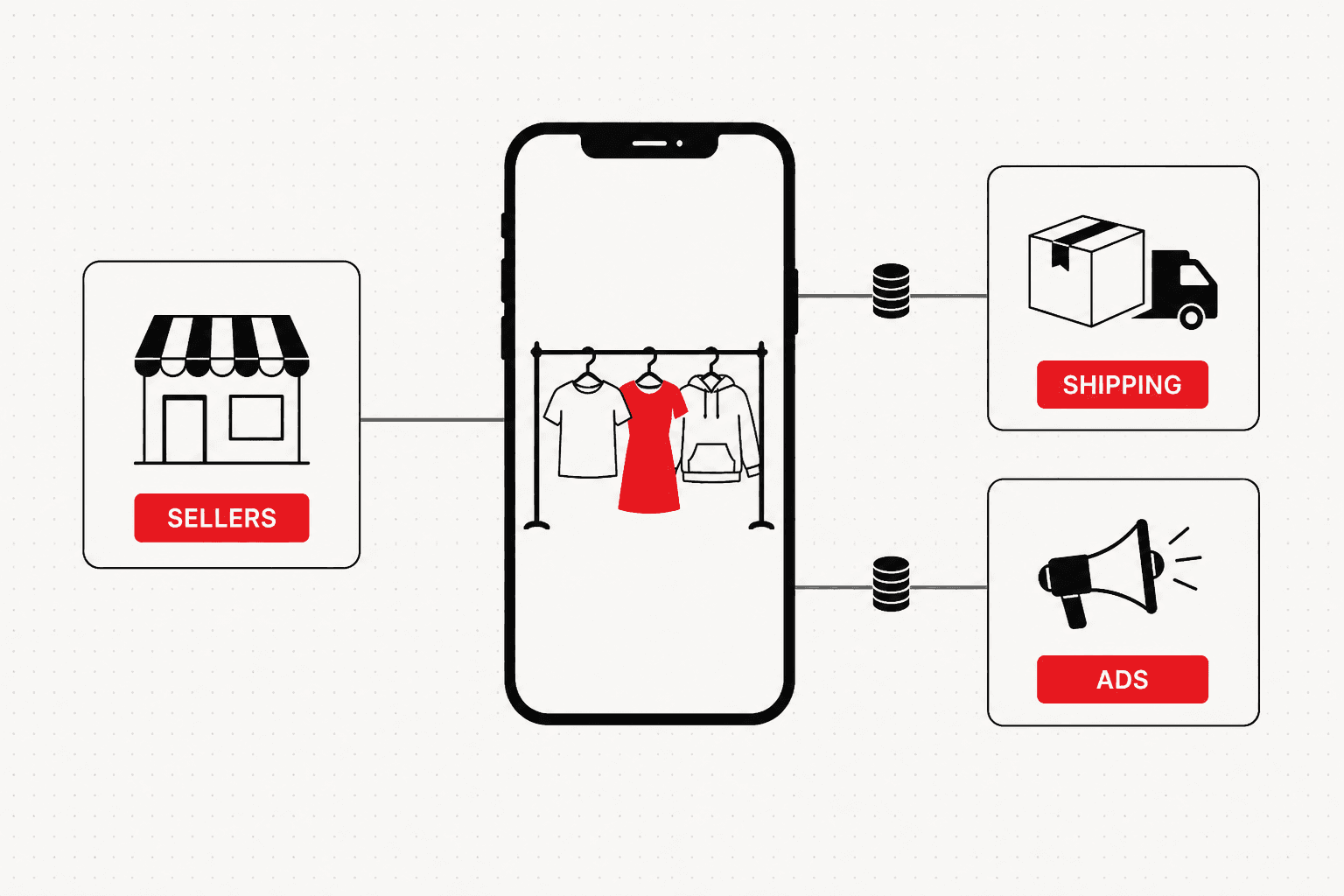
Short answer: Meesho earns almost all its revenue from services it sells to sellers: fulfilment and logistics charges on every order shipped, advertising that lifts a seller's listings in the feed, and commissions from branded sellers on Meesho Mall. Unbranded sellers pay no commission and shoppers pay no platform fee. In the quarter ended September 2026 Meesho reported revenue of ₹4,131.6 crore, up 34 percent, and a net loss of ₹132.4 crore, down from ₹411.4 crore a year earlier (Inc42, October 2026).
From WhatsApp resellers to a listed marketplace
Meesho was founded in 2015 and began as FashNear, a hyperlocal fashion app, before it found its real users: women in Tier 2 and Tier 3 towns in states such as Gujarat, Uttar Pradesh and Rajasthan who ran "WhatsApp boutiques", sharing catalogues with their own contacts and adding a 10 to 20 percent margin plus shipping (Entrepreneur India, January 2026). Those resellers were the company's distribution: trusted, free, and already inside the chat app every customer used.
The reseller layer was also a ceiling. In 2021 Meesho moved to a marketplace model (Entrepreneur India, January 2026), and today it charges unbranded sellers no commission at all. Four years later it listed. The IPO priced at ₹111 a share, the top of a ₹105 to ₹111 band, for an issue of up to ₹5,421.2 crore (HDFC Securities IPO note, December 2025), and the shares opened at ₹162.5 on the NSE on 10 December 2025, a 46 percent premium (Entrackr, December 2025).
The reseller years still shape the product: personalised feeds, browsed like a WhatsApp catalogue, drove 73 to 75 percent of placed orders in FY25 and the first half of FY26 (HDFC Securities IPO note, December 2025).
How Meesho makes money without a commission
The prospectus describes three ways Meesho earns from sellers: fulfilment, advertising and insights, with no commissions and no consumer platform fees (HDFC Securities IPO note, December 2025). In practice, two lines do the work.
Fulfilment: the line that looks like revenue
Every order a seller ships through Meesho carries a forward shipping charge, and returns carry a return charge; Meesho books both as marketplace revenue (Inc42, July 2026). Because Meesho arranges the delivery, most of what it bills sellers goes straight out again to logistics partners. That is why the revenue line is large and the margin thin.
Valmo: turning the cost line into an advantage
Valmo, launched in August 2022, is not a courier. It is a technology layer that lets thousands of small operators, from first-mile pickup and sorting centres to last-mile riders, compete for individual legs of a shipment (Apparel Resources, October 2025). Its share of Meesho's shipped orders rose from 1.83 percent in FY23 to 48 percent in FY25 and 64.5 percent in the six months to September 2025 (Upstox, December 2025). Meanwhile, fulfilment cost per order fell from ₹50.45 in FY23 to ₹37.70 in the June 2025 quarter (Apparel Resources, October 2025).
The flywheel: cheaper logistics means lower seller charges, cheaper listings, more buyers and more volume for logistics partners. The prospectus claims Meesho's fulfilment costs 35 to 61 percent less than peers', citing Redseer (HDFC Securities IPO note, December 2025).
Advertising: the margin line
Sellers pay per click to push their listings higher in feeds and search (Inc42, July 2026). Ads cost almost nothing to serve, so each rupee of ad revenue is close to pure margin. Meesho does not report ad revenue separately, and management has said it expects advertising to become a more meaningful share of net merchandise value from FY28 (Inc42, November 2026).
Meesho Mall and new initiatives
Branded D2C sellers on Meesho Mall do pay commission, at rates sources describe as lower than Amazon's and Flipkart's (Inc42, July 2025). Mall had about 1,800 brands and grew net merchandise value 81 percent year on year in the September 2026 quarter (Inc42, November 2026). New initiatives, including financial services and local logistics, earned ₹11.7 crore that quarter against a ₹41.6 crore loss (Inc42, October 2026): experiments, not yet revenue lines.
Unit economics: ₹51 per order, and almost all of it spent
The RHP lets you see a Meesho order from the inside.
In FY25 Meesho made ₹51.17 in revenue per placed order. Logistics took ₹40.08, employees ₹4.62, advertising and sales promotion ₹3.51, technology ₹3.38 and other costs ₹0.17, leaving an operating loss of ₹0.59 per order across about 1.83 billion orders (INDmoney, December 2025). Logistics alone took about 78 percent of revenue, by our arithmetic. The margin for error is measured in paise.
The average order is small and getting smaller: ₹336.71 in FY23, ₹274.27 in FY25 and ₹265.50 in the first half of FY26 (Upstox, December 2025). By our arithmetic, ₹51 of revenue on a ₹274 order is roughly 19 percent of order value, most of it shipping. A shrinking basket is not a failure of the model; it is the model. Cheaper fulfilment makes a ₹200 kurta worth shipping, and those are exactly the orders the large marketplaces struggle to serve profitably.
The better health measure is contribution margin, revenue minus the costs that scale with each order. It rose from 2.9 percent of net merchandise value in FY23 to 4.9 percent in FY25 (Apparel Resources, October 2025), and reached 6.0 percent in the September 2026 quarter against 3.3 percent a year earlier (Inc42, October 2026).
Profitability, as disclosed
Meesho's revenue has compounded steadily. Its reported losses have not, and the reason matters.
Revenue grew from ₹5,734.5 crore in FY23 to ₹7,615.2 crore in FY24 and ₹9,389.9 crore in FY25 (HDFC Securities IPO note, December 2025, from the RHP), then to ₹12,626 crore in FY26 (Inc42, May 2026). Reported net losses swung from ₹1,671.9 crore in FY23 to ₹327.6 crore in FY24, ₹3,941.7 crore in FY25 and ₹1,357.7 crore in FY26 (same sources).
The FY25 figure is almost entirely one-off. Merging the US parent, Meesho Inc., into the Indian company produced a ₹2,486.8 crore tax charge, and restructuring plus accelerated vesting of promoter ESOPs added ₹1,346.4 crore of exceptional costs (INDmoney and HDFC Securities, December 2025), about ₹3,833 crore in total. Before those items, the FY25 loss before tax was ₹108.4 crore.
FY26 shows a different choice: Meesho spent to grow. Its marketplace adjusted EBITDA loss widened to ₹1,178 crore from ₹117 crore, and indirect marketing spend roughly doubled to ₹990 crore from ₹489 crore (Inc42, May 2026). By the September 2026 quarter the marketplace loss was back down to ₹130.5 crore, and the quarter produced ₹345 crore of positive free cash flow (Inc42, November 2026).
The Tier 2+ buyer
Of Meesho's 19.87 crore annual transacting users in FY25, 17.44 crore, about 88 percent, lived outside India's top eight cities (Upstox, December 2025). The base reached 284 million users in the twelve months to September 2026 (Inc42, October 2026).
The product is tuned to that buyer. Regional brands and unbranded products make up more than 75 percent of Indian retail, per Redseer, and small sellers can list without GST registration, using catalogues generated from phone photos (HDFC Securities IPO note, December 2025). Even the branded side follows the same map: Meesho Mall's net merchandise value from Tier 3 and smaller markets grew 89 percent in the September 2026 quarter (Inc42, November 2026).
Meesho's marketing strategy
Three choices do the work.
Price is the message. The annual Mega Blockbuster Sale is Meesho's biggest marketing moment. The 2024 edition ran five films with Kapil Sharma and Tamannaah Bhatia under the line "Aise Kaise?", a shopper's disbelief at the prices (afaqs, September 2024). In 2025 the sale opened on 19 September, days before Amazon's and Flipkart's festive events (Outlook Business, September 2025), so the price-led buyer saw Meesho first.
Spend moves in deliberate cycles. Advertising and sales promotion fell from ₹928 crore in FY23 to ₹459 crore in FY24 as Meesho chased profitability, then rose to ₹644 crore in FY25 (INDmoney, December 2025). Indirect marketing hit ₹990 crore in FY26 (Inc42, May 2026), and the IPO earmarked ₹1,020 crore of fresh-issue proceeds for marketing and brand initiatives (HDFC Securities IPO note, December 2025).
Creators replaced resellers. Meesho now leans on short videos, live streams and creator-led commerce (Outlook Business, September 2025). Content commerce grew net merchandise value 160 percent in the September 2026 quarter, with 2.2 million pieces of content generating orders (Inc42, November 2026). It is the reseller instinct in a new format: someone the buyer trusts shows the product.
What a marketplace or D2C brand can copy
You cannot copy Meesho's 284 million users. You can copy the logic behind its decisions.
-
Charge for a service, not a slice. Meesho bills for shipping and visibility, which sellers can see and value, instead of a percentage that feels like a tax.
-
Own the cost that blocks your cheapest orders. Valmo exists because shipping cost decided which products were worth listing. For most brands the equivalent is customer acquisition cost: the cheaper you can win an order, the lower the price point you can profitably sell.
-
Sell visibility once you have demand. Advertising is Meesho's high-margin line and it only works because the buyers are already there. Build the audience first, then sell placement to the people who want to reach it.
-
Build for the buyer competitors under-serve. Meesho chose the Tier 2+ shopper and made every product decision for them, from regional languages to a ₹265 basket. A D2C brand that picks a specific, under-served buyer and designs pricing, packs and language for them will usually beat one that targets everyone.
-
Let trusted people sell for you. Resellers built Meesho and creators now carry the same trust. Affiliate and creator programmes compound in a way paid reach does not.
Next: how a marketplace adds fee lines after habit forms, in the Zomato business model; how quick commerce sells visibility to brands, in the Blinkit business model and the Zepto marketing strategy; and how a premium app monetises the opposite end of the market, in the CRED business model. For an omnichannel brand that owns its supply chain, see the Lenskart business model. For a brand that grew on marketplaces without owning a factory, see the boAt business model.
Frequently Asked Questions
How does Meesho make money if it charges zero commission?
Meesho earns from services it sells to sellers, not from a cut of the sale price. The largest line is fulfilment: shipping and return charges on every order. The highest-margin line is advertising, sold per click. Branded sellers on Meesho Mall also pay a commission. In FY25 Meesho earned ₹51.17 of revenue per placed order, of which ₹40.08 went out again as logistics cost.
What is Valmo?
Valmo is Meesho's logistics technology platform, launched in August 2022. It is not a courier: it lets small operators bid for individual legs of a shipment. Its share of Meesho's shipped orders rose from 1.83 percent in FY23 to 64.5 percent in the six months to September 2025, and fulfilment cost per order fell from ₹50.45 to ₹37.70 by the June 2025 quarter.
Is Meesho profitable?
Not yet at the net level, but the gap is small. Meesho reported a net loss of ₹132.4 crore in the quarter ended September 2026, down from ₹411.4 crore a year earlier, on revenue of ₹4,131.6 crore, and generated ₹345 crore of positive free cash flow. For FY26 the net loss was ₹1,357.7 crore on revenue of ₹12,626 crore.
Why did Meesho report a ₹3,942 crore loss in FY25?
Almost all of it was one-off. Merging the US parent, Meesho Inc., into the Indian company produced a ₹2,486.8 crore tax charge, and restructuring plus accelerated promoter ESOP vesting added ₹1,346.4 crore. Before those items, the FY25 loss before tax was ₹108.4 crore on revenue of ₹9,389.9 crore, per its RHP.
Who are Meesho's customers?
Mostly value-seeking shoppers outside India's largest cities. Of Meesho's 19.87 crore annual transacting users in FY25, 17.44 crore, about 88 percent, lived outside the top eight cities. Its average order value fell from ₹336.71 in FY23 to ₹274.27 in FY25, because cheaper fulfilment makes low-priced, mostly unbranded products worth shipping.
What is Meesho's marketing strategy?
Meesho's marketing sells price, not brand. Its annual Mega Blockbuster Sale is its biggest moment, with celebrity films such as the 2024 Kapil Sharma and Tamannaah Bhatia campaign. Spend moves in cycles: advertising and sales promotion fell from ₹928 crore in FY23 to ₹459 crore in FY24, then indirect marketing reached ₹990 crore in FY26. Creators now carry the trust that resellers once did.

Aditya Kathotia
Founder & CEO
CEO of Nico Digital and founder of Digital Polo, Aditya Kathotia is a trailblazer in digital marketing. He's powered 500+ brands through transformative strategies, enabling clients worldwide to grow revenue exponentially. Aditya's work has been featured on Entrepreneur, Economic Times, Hubspot, Business.com, Clutch, and more. Join Aditya Kathotia's orbit on LinkedIn to gain exclusive access to his treasure trove of niche-specific marketing secrets and insights.
More in Marketing Strategy
- Paytm Business Model: Payments, Devices and Lending After the RBI Ban
- PhonePe Business Model: How a Free UPI App Makes Money
- Physics Wallah Business Model: How Low-Fee Edtech Makes Money
- Rapido Business Model: How a Bike Taxi App Makes Money
- boAt Business Model: How an Audio Brand Built a D2C Empire
- Nykaa Business Model: Content-Led Beauty Commerce Explained