

This is an independent analysis by Nico Digital. Lenskart is not a client, and no non-public information was used. Every figure below comes from Lenskart's DRHP and RHP as reported in the business press, from its post-listing quarterly results, or from contemporaneous news coverage, with the publication and date noted inline.
Most explainers describe Lenskart as an online eyewear store that opened shops. The filings describe a manufacturer that owns its retail: the margin is made in the factory, the customer is won in the test room, and the repeat purchase is engineered by a membership.
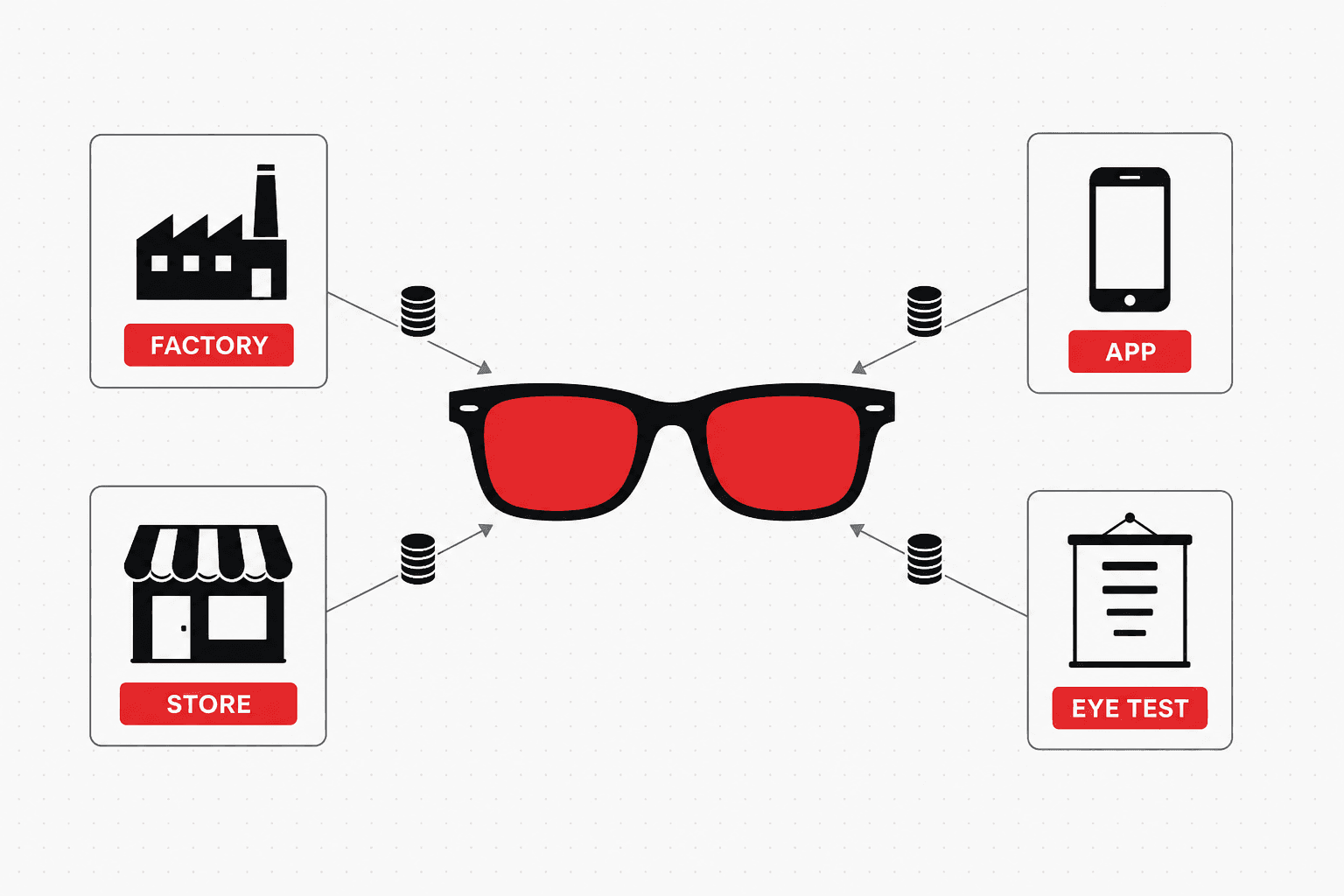
Short answer: Lenskart designs and makes most of its own glasses, sells them through about 3,600 stores and its app, and keeps the margin that a traditional eyewear chain splits across five intermediaries. In the July to September 2026 quarter it reported ₹2,845 crore in revenue and ₹232.5 crore in net profit, with 2,868 stores in India and 756 abroad (Inc42, November 2026). Its gross margin was 67.9 percent in FY25 (ICICI Direct IPO review, October 2025).
From online store to listed manufacturer-retailer
Lenskart was founded in 2010, and by 2016 it was running about 3,500 home eye check-ups a day and expanding through franchise stores, in which a franchisee invested around ₹25 lakh and earned about 30 percent of each order (Retail4Growth, May 2016). The company it became is mostly company-run.
The IPO opened on 31 October 2025 at a price band of ₹382 to ₹402, for a ₹7,278 crore issue that included ₹2,150 crore of fresh capital and valued the company at ₹69,726 crore at the upper end (Inc42, October 2025). It was subscribed 28.26 times but listed on 10 November 2025 at ₹395 on the NSE, about 1.7 percent below the issue price (Entrackr, November 2025). That valuation was roughly 237 times FY25 earnings (Outlook Business, October 2025).
Vertical integration: the margin lives in the factory
A traditional pair of prescription glasses passes through a manufacturer, an importer or brand owner, a wholesaler, a distributor and finally a retailer. Lenskart's RHP describes collapsing that chain in two steps: first acting as importer, wholesaler, distributor and retailer at once, and now moving to a manufacturer-to-consumer model in which it makes frames and lenses itself (ICICI Direct IPO review, October 2025).
The numbers show the effect. Nearly 70 percent of the prescription eyeglasses Lenskart sold in FY25 were made in its own plants at Bhiwadi in Rajasthan and Gurugram in Haryana, and the Bhiwadi plant is about 75 percent automated (Outlook Business, October 2025). Gross margin rose from 63.9 percent in FY23 to 67.3 percent in FY24 and 67.9 percent in FY25 (ICICI Direct IPO review, October 2025). In FY25, material costs were ₹2,134 crore against ₹6,653 crore of operating revenue (Entrackr, July 2025), roughly 32 paise per rupee of sales.
The integration is still deepening. In the September 2026 quarter Lenskart made 36 lakh frames in-house, up 71.7 percent, and 20 lakh lenses, up 52.2 percent, and it is building a centralised facility in Hyderabad (Inc42, November 2026). Central production also means stores hold no lens inventory; the pair is made centrally, with next-day delivery in 78 cities (Inc42, May 2026).
The store-plus-online model
The channels do different jobs. The store is where the eye test and fitting happen; the app is where people browse, try frames virtually and reorder. Over 45 percent of sales are digitally influenced (Storyboard18, December 2025).
The store network has also shifted decisively away from franchising.
| Stores | FY23 | FY24 | FY25 | June 2025 |
|---|---|---|---|---|
| India, company-operated | 1,036 | 1,417 | 1,749 | 1,823 |
| India, franchise | 380 | 368 | 318 | 314 |
| International, company-operated | 383 | 433 | 475 | 488 |
| International, franchise | 160 | 171 | 181 | 181 |
| Total | 1,959 | 2,389 | 2,723 | 2,806 |
Source: Lenskart RHP, as tabulated in ICICI Direct's IPO review, October 2025.
About 80 percent of stores are company-operated (ICICI Direct IPO review, October 2025). Company-run stores cost more to open, but they let Lenskart control the eye test, the staff and the conversion rate. By the September 2026 quarter the network stood at 2,868 stores in India and 756 abroad, with India same-store sales growth of 20.8 percent (Inc42, November 2026).
The eye test is the acquisition engine
Whoever tests your eyes usually sells you your glasses. Lenskart built the business around owning that moment, first through home eye check-ups and then in-store clinics. Services revenue, including memberships, home eye check-ups and training, was ₹133 crore in FY25 (Entrackr, July 2025): small, but it is the top of the funnel.
The constraint on growth is testing capacity. Lenskart's answer is remote optometry: a customer sits in a store clinic while an optometrist conducts the test over video, and self-eye-test machines had been deployed in 129 stores globally by March 2025 (ICICI Direct IPO review, October 2025). In the September 2026 quarter it ran 70 lakh eye tests in India, up 44.1 percent, against 86 lakh eyewear units sold, and spent ₹187 crore of capital on stores, refurbishments and remote optometry (Inc42, November 2026). Tests are growing faster than sales: the funnel is widening.
Gold: a membership that sells the second pair
Lenskart Gold launched with a ₹500 enrolment fee and a year-round buy-one-get-one offer on its John Jacobs and Vincent Chase brands, usable by family members through the enrolled mobile number (MediaInfoline, April 2018). Members grew from 68 lakh in March 2025 (Entrackr, July 2025) to 90 lakh in FY26 and more than 1 crore active members in India in the first half of FY27 (Inc42, November 2026).
Buy-one-get-one is only affordable because of the factory. At a 67.9 percent gross margin the second pair costs Lenskart roughly its material cost, while the customer sees a full-price product. The membership turns a margin advantage into a frequency advantage.
International: Owndays and the overseas playbook
In June 2022 Lenskart agreed to buy a majority stake in Japan's Owndays, in a deal that a person familiar with it said valued Owndays at $400 million; Owndays had over 350 shops across Asia, and the combined company reached 13 Asian markets (TechCrunch, June 2022). It also owns 51 percent of a Chinese manufacturing joint venture (Inc42, August 2025).
International revenue was ₹2,638 crore in FY25, about 40 percent of the total (Entrackr, July 2025). The segment is now growing faster and becoming profitable: in the September 2026 quarter international revenue rose 36.5 percent to ₹1,201.1 crore and segment profit rose from ₹31.1 crore to ₹97.2 crore (Inc42, November 2026). The logic is pricing. Prescription eyewear in the Middle East costs two to three times what it does in India (Storyboard18, December 2025), while Lenskart's cost base is set by Indian and Chinese factories.
Revenue and profitability, as publicly disclosed
Operating revenue rose 22.6 percent from ₹5,428 crore to ₹6,652.5 crore in FY25 and the company swung to a ₹297.3 crore profit from a ₹10 crore loss in FY24 (Inc42, July 2025). In FY26 revenue rose 33 percent to ₹8,814 crore, 62 percent above FY24, and profit rose 69 percent to ₹500.9 crore, with 3,327 stores at year end (Inc42, May 2026).
In July to September 2026 revenue rose 35.7 percent to ₹2,845 crore and net profit rose 124.7 percent to ₹232.5 crore. EBITDA was ₹624 crore, a 21.9 percent margin, though that figure includes the lease accounting effect of Ind AS 116; on a pre-Ind AS 116 basis EBITDA was ₹394 crore. India contributed ₹1,667.9 crore of revenue and ₹208.4 crore of segment profit, and return on capital employed reached 22.5 percent in the first half of FY27, up from 14.6 percent in FY26 (Inc42, November 2026).
Lenskart's marketing strategy
Lenskart spent ₹448 crore on marketing in FY25, up 27 percent from ₹352 crore in FY24, and earmarked ₹320 crore of IPO proceeds for brand building through FY29 (Storyboard18, October 2025). The more telling number is the ratio: marketing fell from 9.7 percent of revenue in FY23 to 7.5 percent in the first half of FY26 (Storyboard18, December 2025). Four things do the work.
Glasses as fashion. A Kiara Advani campaign urged people to change frames as often as outfits, and licensed collections such as Hello Kitty and Harry Potter pull in younger buyers (Storyboard18, October 2025).
The founder as the price argument. Co-founder Peyush Bansal appeared with Karan Johar in a campaign on fair pricing (Storyboard18, October 2025).
Stores as media. Every company-run store is a branded shopfront and the place the test happens, so it does brand building and conversion at once.
Retention through Gold and the app. More than 1 crore active Gold members (Inc42, November 2026) are customers Lenskart does not pay to reach again.
What an omnichannel D2C brand can copy
You cannot copy Lenskart's factories. You can copy the order of its decisions.
-
Own the step where the margin sits. For Lenskart it was manufacturing. For a smaller brand it may be private-label sourcing or in-house fulfilment. Find the intermediary taking the biggest cut.
-
Put the trust moment in a human channel. Eyewear needs a test; beauty needs a shade match. A D2C brand that adds a store, home visit or video consultation at that moment converts customers a product page never would.
-
Price your membership off your gross margin. A benefit that costs you only material cost is a frequency engine; a discount you cannot afford is a liability.
-
Move from franchise to company-run once the format is proven. Franchising funded Lenskart's early spread; control mattered more once the eye test became the core.
-
Make the marketing ratio fall. Lenskart's spend rose in rupees but fell as a share of revenue because stores, the app, search and repeat customers carried more demand. That is the test of whether a brand owns its customers or rents them.
Next: how a platform built fee lines on top of habit, in the Zomato business model; how density decides profitability in quick commerce, in the Blinkit business model; how a challenger built a brand on a single promise, in the Zepto marketing strategy; and how a services marketplace earns from both sides of a booking, in the Urban Company business model.
More teardowns: the Meesho business model and the CRED business model. For brands built on marketplaces, see the boAt business model and the Nykaa business model.
Frequently Asked Questions
How does Lenskart make money?
Lenskart makes money by designing, manufacturing and selling its own eyewear through company-run stores and its app, so it keeps the margin that importers, wholesalers, distributors and opticians normally split. Product sales were ₹6,360 crore of its ₹6,653 crore FY25 operating revenue, with services such as memberships and home eye check-ups adding ₹133 crore, according to Entrackr's July 2025 analysis of its DRHP.
Is Lenskart profitable?
Yes. Lenskart turned a ₹297.3 crore profit in FY25 after a ₹10 crore loss in FY24 (Inc42, July 2025), earned ₹500.9 crore in FY26 on ₹8,814 crore of revenue (Inc42, May 2026), and reported ₹232.5 crore of profit on ₹2,845 crore of revenue in the July to September 2026 quarter alone (Inc42, November 2026). Its India business is the larger profit pool, but the international segment's profit tripled year on year in that quarter.
Does Lenskart manufacture its own glasses?
Mostly. Nearly 70 percent of the prescription eyeglasses Lenskart sold in FY25 were made in its own plants at Bhiwadi in Rajasthan and Gurugram in Haryana (Outlook Business, October 2025). In the September 2026 quarter it produced 36 lakh frames and 20 lakh lenses in-house across India, China and Thailand, and it is building a centralised facility in Hyderabad (Inc42, November 2026). In-house manufacturing is the main reason its gross margin rose to 67.9 percent in FY25.
What is Lenskart Gold?
Lenskart Gold is a paid membership built around a buy-one-get-one offer on Lenskart's own eyewear brands. It launched with a ₹500 enrolment fee and buy-one-get-one on John Jacobs and Vincent Chase, shareable with family through the registered mobile number (MediaInfoline, April 2018). Members grew from 68 lakh in March 2025 (Entrackr, July 2025) to more than 1 crore active members in India in the first half of FY27 (Inc42, November 2026).
What is Lenskart's marketing strategy?
Lenskart reframes glasses as fashion so people buy more often, uses its founder and celebrities such as Kiara Advani and Karan Johar in campaigns, runs licensed youth collections, and leans on its stores and the Gold membership for repeat purchases. It spent ₹448 crore on marketing in FY25, up 27 percent (Storyboard18, October 2025), but marketing fell from 9.7 percent of revenue in FY23 to 7.5 percent in the first half of FY26, with over 45 percent of sales digitally influenced (Storyboard18, December 2025).
What can an omnichannel D2C brand copy from Lenskart?
Own the step of the value chain where the margin sits; put the moment that needs trust, such as an eye test, into a store or a human visit; price a membership off your gross margin; prefer company-run stores once the format is proven; and make the marketing ratio fall by building demand you own through search, the app and repeat customers.

Aditya Kathotia
Founder & CEO
CEO of Nico Digital and founder of Digital Polo, Aditya Kathotia is a trailblazer in digital marketing. He's powered 500+ brands through transformative strategies, enabling clients worldwide to grow revenue exponentially. Aditya's work has been featured on Entrepreneur, Economic Times, Hubspot, Business.com, Clutch, and more. Join Aditya Kathotia's orbit on LinkedIn to gain exclusive access to his treasure trove of niche-specific marketing secrets and insights.
More in Marketing Strategy
- Paytm Business Model: Payments, Devices and Lending After the RBI Ban
- PhonePe Business Model: How a Free UPI App Makes Money
- Physics Wallah Business Model: How Low-Fee Edtech Makes Money
- Rapido Business Model: How a Bike Taxi App Makes Money
- boAt Business Model: How an Audio Brand Built a D2C Empire
- Nykaa Business Model: Content-Led Beauty Commerce Explained