

This is an independent analysis by Nico Digital. Urban Company is not a client, and no non-public information was used. Every figure below comes from Urban Company's DRHP and RHP as reported in the business press, from its post-listing quarterly results, or from its own published earnings index, with the publication and date noted inline.
Urban Company is usually explained as an app that sends a beautician or a plumber to your door. The filings describe a marketplace that turns an unorganised trade into a standard product, takes a cut from both sides of each booking, and, since 2025, spends the profit of that core on a new bet.
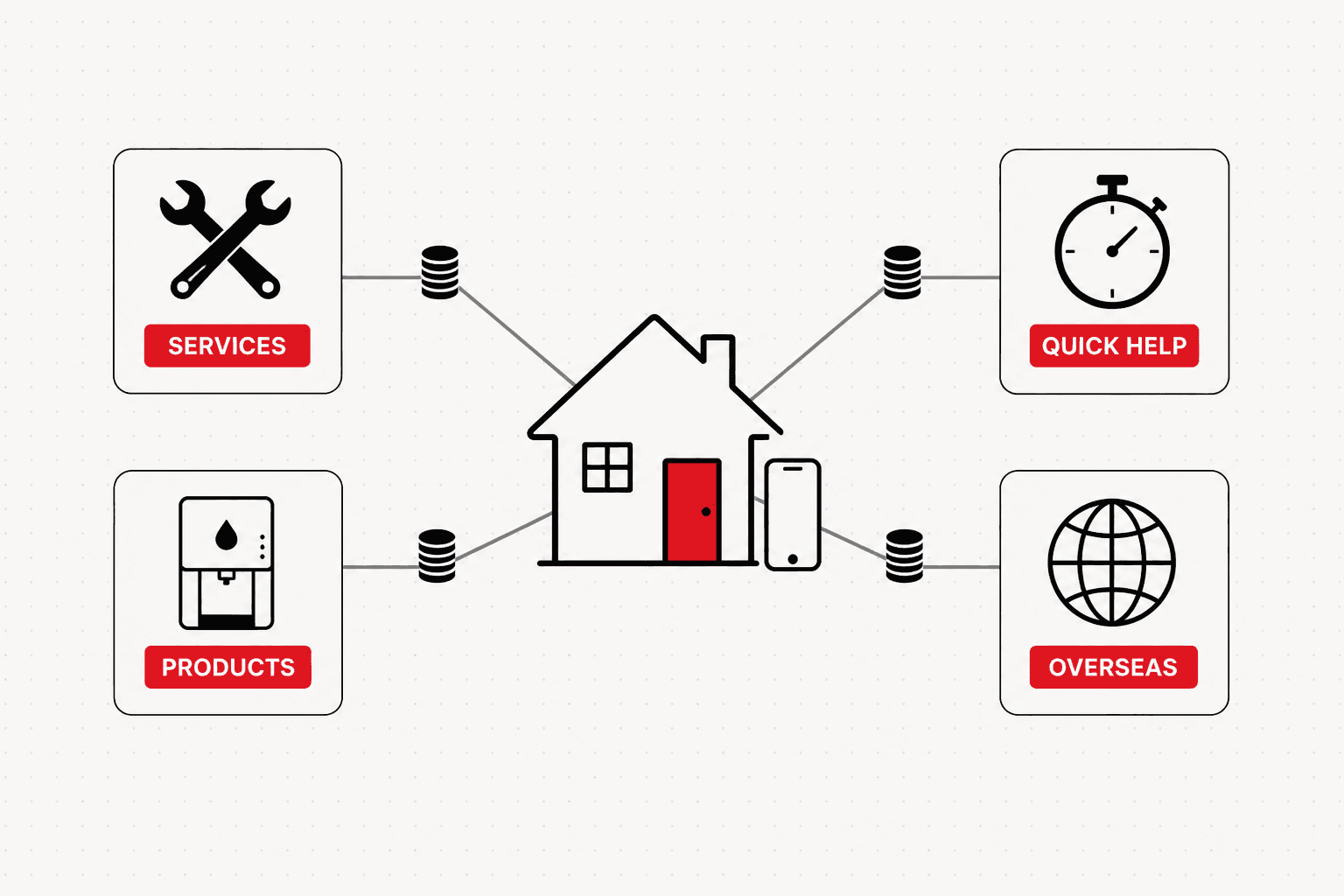
Short answer: Urban Company earns commissions and fees from service professionals, convenience and membership fees from customers, and product revenue from consumables and Native appliances. In FY26 it reported ₹1,555.5 crore in revenue and a ₹234.8 crore net loss, almost all of it from its InstaHelp home-help service (Inc42, May 2026). Excluding InstaHelp, the business earned ₹106 crore in adjusted EBITDA that year (Outlook Business, May 2026).
From UrbanClap to a listed marketplace
Urban Company, which began life as UrbanClap, runs in 51 cities across India, the UAE and Singapore, 47 of them in India, not counting cities served through its Saudi joint venture (ICICI Direct IPO review, September 2025). Its ₹1,900 crore IPO was priced at ₹103 a share, subscribed 108.98 times, and listed on 17 September 2025 at ₹162.25 on the NSE, a 57.5 percent premium (Entrackr, September 2025).
FY25, the year before listing, was profitable after a ₹93 crore loss in FY24 (Free Press Journal, June 2025): revenue rose 38 percent to ₹1,144 crore and profit before tax was ₹28.5 crore (Entrackr, September 2025). Reported net profit was ₹240 crore, but ₹211 crore of that was a tax credit; net transaction value, the total customers paid through the platform, was ₹3,115 crore (Free Press Journal, June 2025).
The take-rate model: earning from both sides of a booking
Net transaction value (NTV) is what customers pay; revenue is the part Urban Company books. It does not disclose a single take rate. Customers pay a convenience fee at booking, professionals pay commissions and platform fees, and members pay a membership fee (Inc42, September 2026). Commissions and fees made up 28.3 percent of service professionals' average gross earnings in the nine months to December 2025, which Inc42 notes is not the same as the overall take rate (Inc42, September 2026).
In FY25 India consumer services booked ₹2,667.2 crore of NTV and ₹881.39 crore of revenue, of which ₹694.8 crore came from services and ₹186.6 crore from products. Adjusted EBITDA was ₹87.9 crore, or 3.3 percent of NTV, from 6.5 million annual transacting customers and 45,619 average monthly active service professionals (ICICI Direct IPO review, September 2025). Services revenue was therefore about 26 percent of NTV, by our calculation.
Two smaller lines matter more than their size suggests: membership fees of ₹98 crore in FY25 (Free Press Journal, June 2025), and tools and consumables sold to professionals, a revenue line most marketplaces never build.
Service partner economics
According to the company's own earnings index, active professionals earned an average of ₹28,322 a month net in the nine months to December 2025, up from ₹26,489 a year earlier, for about 91 hours of platform work a month, or roughly ₹313 an hour. The top 5 percent earned ₹51,673 a month (Free Press Journal, February 2026). Those are company-reported figures, not audited ones.
The professional pays about 28.3 percent of gross earnings in commissions and fees (Inc42, September 2026) and gets demand, standard prices, training, tools, financing and insurance in return (ICICI Direct IPO review, September 2025). The bargain holds only while the hourly rate beats offline work, which is the tension inside InstaHelp: management targets ₹130 to ₹160 an hour there (Inc42, September 2026), less than half the core average.
Trust and quality systems
The product Urban Company sells is predictability: a known price, a vetted professional and a remedy if something goes wrong. The RHP describes a selective network of background-verified professionals with in-house training, standard operating procedures, and company-supplied tools and consumables (ICICI Direct IPO review, September 2025).
Quality has a cost line. In April to June 2026, direct expenses including payment gateways, communications and background verification were ₹17 crore, and support, refunds and AI costs were a further ₹45 crore (Inc42, September 2026). The DRHP disclosed 43.1 lakh complaints received in FY24, of which 42.7 lakh were resolved (Storyboard18, May 2025). A complaints system at that volume is what lets a customer try an unknown professional at all.
Retained customers generated about 82 percent of India NTV in FY25, up from 76.4 percent in FY23, and about 86 percent in the April to June 2025 quarter (ICICI Direct IPO review, September 2025).
Native: products sold through the service network
Native started with water purifiers in FY23, rated for 12,000 litres over two years, and added camera-equipped smart door locks in FY24 (ICICI Direct IPO review, September 2025). Its FY25 adjusted EBITDA loss was ₹39 crore (ICICI Direct IPO review, September 2025). By the July to September 2026 quarter its NTV was ₹132 crore, up 35 percent, revenue ₹105 crore, up 40 percent, and the adjusted EBITDA loss had narrowed to ₹9 crore, or 6.8 percent of NTV from 9 percent a year earlier (Inc42, October 2026).
The logic is distribution: Urban Company already has a technician in the home to install and service the purifier, and filters are a repeat purchase.
InstaHelp: the bet that turned the P&L red
InstaHelp launched in March 2025 as a Mumbai pilot called Insta Maids, offering home help booked in about 15 minutes at prices as low as ₹49 an hour, and was renamed after a social media backlash (Inc42, March 2025). It competes with Pronto and Snabbit (Inc42, December 2025).
In the January to March 2026 quarter it fulfilled 2.7 million orders and lost ₹447 per order, an adjusted EBITDA loss of ₹119 crore (Inc42, May 2026). In April to June 2026 the average order was ₹138 and management estimated InstaHelp needs about ₹300 to break even (Inc42, September 2026). By July to September 2026 it fulfilled 6.2 million orders on ₹20.5 crore of revenue, with the loss per order down to ₹279 but the adjusted EBITDA loss up to ₹174 crore (Inc42, October 2026).
In April to June 2026, core India consumer services earned ₹73 crore of adjusted EBITDA and international ₹3 crore, while Native lost ₹9 crore and InstaHelp ₹132 crore, for a consolidated adjusted EBITDA loss of ₹65 crore (Inc42, September 2026). Management calls the spending deliberate, and there is a marketing case for it: InstaHelp accounts for around 45 percent of new users in the micro-markets where it runs alongside the core services (Inc42, October 2026).
International: the UAE, Singapore and the Saudi joint venture
International booked ₹147 crore of revenue and a ₹36.8 crore adjusted EBITDA loss in FY25 (ICICI Direct IPO review, September 2025). In Saudi Arabia, Urban Company formed a joint venture, Waed Khadmat Al-Munzal for Marketing, with Saudi Manpower Solutions Company (Inc42, October 2024), and wound down its own Saudi subsidiary after it failed to reach profitability (Inc42, December 2025).
International revenue rose 89.4 percent to ₹57.9 crore in the January to March 2026 quarter (Inc42, May 2026), and in July to September 2026 international NTV rose 66 percent to ₹267 crore with operations in the UAE and Singapore profitable (Inc42, October 2026). The UAE suits the model because its home services market resembles India's, with a large Indian diaspora (ICICI Direct IPO review, September 2025).
Revenue and profit, as publicly disclosed
FY26 revenue rose 35.9 percent to ₹1,555.5 crore, the company swung to a ₹234.8 crore net loss, ended the year with ₹2,021 crore in cash, and set a target of group adjusted EBITDA break-even by the October to December 2027 quarter (Inc42, May 2026).
In July to September 2026 revenue rose 41 percent to ₹537.3 crore and the net loss widened to ₹182.5 crore. The adjusted EBITDA loss was ₹144 crore, but excluding InstaHelp adjusted EBITDA was a ₹30 crore profit, up 213 percent, and the board approved raising up to ₹2,500 crore (Inc42, October 2026). In April to June 2026, on ₹1,465 crore of NTV and ₹528 crore of revenue, contribution profit of about ₹239 crore was outweighed by ₹146 crore of employee costs, ₹80 crore of customer marketing and ₹78 crore of other overheads (Inc42, September 2026).
Urban Company's marketing strategy
Advertising was ₹167.7 crore in FY22 and ₹173 crore in FY24, falling from 38.34 percent to 20.92 percent of revenue, and ₹80 crore of IPO proceeds were earmarked for marketing (Storyboard18, May 2025). Customer marketing was ₹80 crore in April to June 2026, about 15 percent of revenue by our calculation. Four things do the work.
Retention before acquisition. Retained customers drive 82 to 86 percent of India NTV.
Standards as the brand. Fixed prices, trained professionals and a complaints process are the message, in a category whose main fear is a stranger doing bad work at home.
New categories as acquisition. InstaHelp is a cheap, frequent service that brings people onto the platform before they are cross-sold salon, cleaning or repair work.
Local search coverage. Urban Company's site carries city-level pages for its services, such as one for electricians in Hyderabad, so it can appear for searches such as "electrician in Hyderabad".
What a services or local business can copy
-
Standardise the job, then sell the standard. Publish fixed prices for common jobs and write down how each is done. Predictability is what customers pay a premium for.
-
Make trust visible. Put verified staff, a written guarantee and a complaints route on the booking page, not in the terms.
-
Earn from what your team uses. Parts, consumables and products your technicians install are margin beyond the labour charge.
-
Track repeat share of revenue. It tells you whether you are building a customer base or renting one.
-
Own every service-and-place search. A page for each service in each area you cover is how Urban Company captures local demand, and it is the core of local SEO for service businesses, the cheapest acquisition channel a local business has.
Next: fee lines layered on habit in the Zomato business model, density economics in the Blinkit business model, a single-promise brand in the Zepto marketing strategy, and vertical integration in the Lenskart business model.
More teardowns: the Meesho business model and the CRED business model. For a platform that charges providers a flat daily fee instead of commission, see the Rapido business model.
Frequently Asked Questions
How does Urban Company make money?
Urban Company earns from both sides of each booking: professionals pay commissions and platform fees, customers pay a convenience fee, and members pay a membership fee. It also sells consumables to professionals and Native water purifiers and smart locks to consumers. In FY25 platform services earned ₹742 crore of its ₹1,144 crore revenue, memberships ₹98 crore and water purifiers ₹116 crore (Free Press Journal, June 2025).
What commission does Urban Company charge service professionals?
Urban Company does not disclose a single take rate. Commissions and platform fees made up 28.3 percent of service professionals' average gross earnings in the nine months to December 2025 (Inc42, September 2026), but customers also pay convenience and membership fees. In FY25 India services revenue of ₹694.8 crore was about 26 percent of ₹2,667.2 crore in India net transaction value (ICICI Direct, September 2025).
How much do Urban Company service partners earn?
According to the company's own earnings index, active service professionals earned an average of ₹28,322 a month net in the nine months to December 2025, up from ₹26,489 a year earlier, for about 91 hours of work a month, or roughly ₹313 an hour. The top 5 percent earned ₹51,673 a month (Free Press Journal, February 2026). These are company-reported figures.
Is Urban Company profitable?
Its core business is; the group currently is not. After a ₹240 crore FY25 profit helped by a ₹211 crore tax credit, it lost ₹234.8 crore in FY26 on ₹1,555.5 crore of revenue as it invested in InstaHelp (Inc42, May 2026). In the July to September 2026 quarter the group lost ₹182.5 crore, but adjusted EBITDA excluding InstaHelp was a ₹30 crore profit (Inc42, October 2026).
What is Urban Company InstaHelp?
InstaHelp is Urban Company's on-demand home help service for household chores, booked by the hour. It launched as a Mumbai pilot called Insta Maids in March 2025, priced from ₹49 an hour, and was renamed after a social media backlash (Inc42, March 2025). By the July to September 2026 quarter it fulfilled 6.2 million orders, but lost ₹279 per order and ₹174 crore at the adjusted EBITDA level (Inc42, October 2026).
What is Urban Company's marketing strategy?
Urban Company relies on retention: retained customers generated about 82 percent of India net transaction value in FY25 (ICICI Direct, September 2025), and advertising fell from 38.34 percent of revenue in FY22 to 20.92 percent in FY24 (Storyboard18, May 2025). It sells quality standards as the brand, uses InstaHelp to bring in first-time users, and keeps city-level service pages for local search.

Aditya Kathotia
Founder & CEO
CEO of Nico Digital and founder of Digital Polo, Aditya Kathotia is a trailblazer in digital marketing. He's powered 500+ brands through transformative strategies, enabling clients worldwide to grow revenue exponentially. Aditya's work has been featured on Entrepreneur, Economic Times, Hubspot, Business.com, Clutch, and more. Join Aditya Kathotia's orbit on LinkedIn to gain exclusive access to his treasure trove of niche-specific marketing secrets and insights.
More in Marketing Strategy
- Paytm Business Model: Payments, Devices and Lending After the RBI Ban
- PhonePe Business Model: How a Free UPI App Makes Money
- Physics Wallah Business Model: How Low-Fee Edtech Makes Money
- Rapido Business Model: How a Bike Taxi App Makes Money
- boAt Business Model: How an Audio Brand Built a D2C Empire
- Nykaa Business Model: Content-Led Beauty Commerce Explained