

This is an independent analysis by Nico Digital. Blinkit is not a client, and no non-public information was used. Every figure below comes from Eternal's quarterly results as reported in the business press, with the publication and date noted inline.
Most analysis of Blinkit gets the model backwards. Quick commerce is not a delivery business with a grocery problem. It is a dense retail network with a delivery feature, and the economics are decided before a rider leaves the store: by how close the store is, how much the customer orders, how much of the basket Blinkit owns, and how many brands pay for the top of the search results.
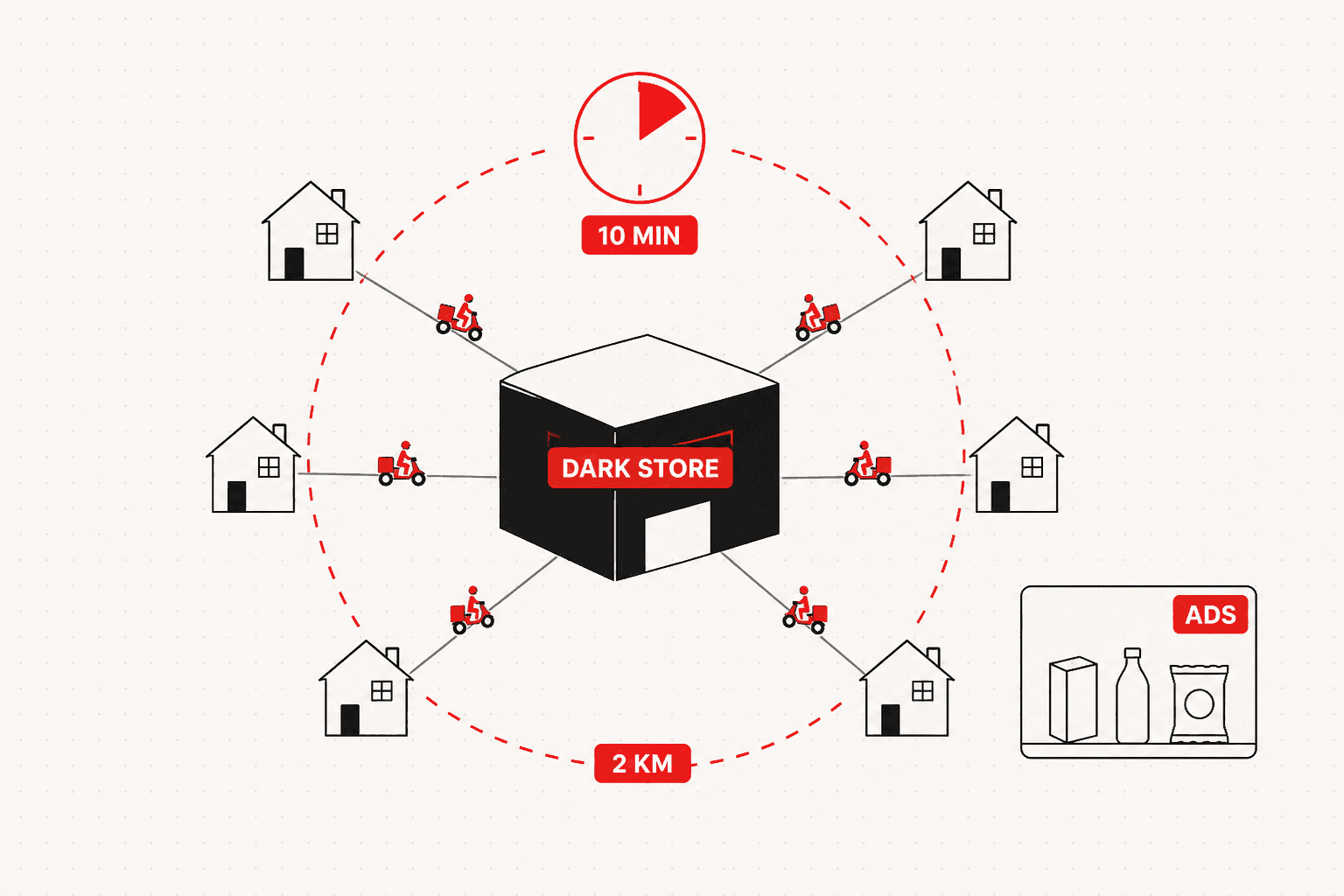
Short answer: Blinkit makes money from the retail margin on goods it now buys and sells itself, from delivery and handling fees on each order, and from advertising sold to the brands on its shelves. The model works only at density: thousands of small dark stores, each serving a short radius, each doing enough orders per day to cover rent, staff and riders. In the quarter ended September 2026 it reported net order value of ₹20,940 crore and an adjusted EBITDA profit of ₹184 crore (Angel One, October 2026), after years of losses.
From Grofers to Eternal's largest business
The company began in 2013 as Grofers, a scheduled grocery delivery service, rebranded as Blinkit in late 2021 when it pivoted to ten-minute delivery, and was bought by Zomato in June 2022 in an all-stock deal valued at ₹4,447 crore (Hindustan Times, June 2022). Zomato issued about 629 million shares at ₹70.76 each for the business (India Infoline, June 2022), and its share price fell roughly 5 percent on the news because investors saw a loss-making distraction.
Four years on, it looks like the company's best decision. In FY26, Blinkit reported revenue of ₹37,779 crore on 916.6 million orders, against 640.2 million for Zepto and 412.2 million for Instamart, nearly as many as both rivals combined (Outlook Business, July 2026). By the September 2026 quarter its net order value of ₹20,940 crore was almost twice that of Zomato's food delivery business. The parent renamed itself Eternal in 2025 partly to reflect that fact; we cover the group structure in our Zomato business model teardown.
The dark store: the unit everything is built on
A dark store is a small warehouse, closed to the public, stocking a few thousand fast-moving products for customers within a short radius, typically around two kilometres. Blinkit's economics are a function of how many it has and how hard each one works.
Blinkit had 791 stores in September 2024, 1,544 by June 2025 and 1,816 by September 2025 (Business Standard, October 2025); 2,243 by March 2026 and 2,443 by June 2026 (Outlook Business, July 2026); then added 308 in a quarter to reach 2,751 in September 2026, with guidance of more than 3,500 by March 2027 and about 5,000 by March 2028, mostly in Tier 2 and Tier 3 cities (Kotak Neo, October 2026).
Each store handled about ₹9.02 lakh of net order value per day in the September 2026 quarter (Angel One, October 2026). That is throughput per fixed-cost unit: rent, staff, electricity and the base rider pool are roughly fixed per store, so every additional order spreads them thinner. A new store opens loss-making and climbs toward the average as the neighbourhood learns the habit, which is why the business can be profitable in aggregate while hundreds of young stores still lose money.
Average order value: why ₹525 matters more than ten minutes
Blinkit's average net order value was ₹525 per order in the September 2026 quarter (Angel One, October 2026). Net order value is the amount after discounts, the number that matters for margin.
Delivery is the big variable cost, and it is a cost per order, not per rupee: a rider costs about the same whether the bag holds ₹300 or ₹900. Zepto, which must disclose such things ahead of its IPO, reported a delivery cost of ₹45.74 per order in FY26 (Inc42, August 2026). Blinkit does not break out its own, but the arithmetic is the same: at a ₹300 basket, a ₹45 delivery cost is 15 percent of the order; at ₹525 it is under 9 percent. Adding categories customers did not expect from a grocery app, from electronics to apparel, is less a brand extension than a margin strategy.
Management has said orders in smaller cities average 85 to 90 percent of metro order values with comparable retention (Kotak Neo, October 2026), the number that justifies the Tier 2 and Tier 3 push.
Delivery economics: the path from minus 1.3 percent to plus 0.9
Blinkit's quarterly margin is the clearest public record of how quick commerce turns profitable.
In the September 2025 quarter Blinkit lost ₹156 crore, about 1.3 percent of net order value (Entrackr, October 2025). It turned a ₹37 crore adjusted EBITDA profit in the March 2026 quarter on net order value of ₹14,386 crore (Outlook Business, July 2026), roughly 0.3 percent, then ₹102 crore at 0.6 percent in June 2026 and ₹184 crore at 0.9 percent in September 2026 (Angel One, October 2026).
Two changes drove the turn: density, meaning more orders per store per day, and the shift from the June 2025 quarter to an inventory-led model in which Blinkit buys goods from brands and sells them itself instead of taking a marketplace commission. That is why its reported revenue leapt from ₹1,156 crore to ₹9,891 crore between the September 2024 and September 2025 quarters (Inc42, October 2025) and why FY26 revenue was ₹37,779 crore against ₹5,206 crore the year before (Outlook Business, July 2026). The jump is mostly accounting, but the model matters: owning inventory gives Blinkit the retail margin, control of assortment and pricing, and a direct commercial relationship with every brand, which is the foundation of the advertising business.
The margin is thin on purpose: management is prioritising store expansion over near-term EBITDA, which only works because food delivery earns a 5 to 6 percent margin and funds the build-out.
Advertising: the margin line Eternal does not break out
Eternal does not disclose Blinkit's advertising revenue; it sits inside the quick commerce segment. But the structure is visible and a competitor's numbers show the scale. Zepto's advertising revenue grew from ₹49 crore in FY24 to ₹651 crore in FY25 and ₹1,636 crore in FY26, 7.2 percent of its operating revenue, from 2,468 brand partners (Outlook Business, June 2026). There is no reason to think Blinkit, with a larger order base, monetises its shelf less aggressively.
Retail media in quick commerce works like Amazon's: brands pay for sponsored positions in search and category pages, banners and sampling in the bag, at near-zero cost to serve. When a quick commerce business reports a 0.9 percent margin, the honest reading is that product sales and delivery run at a loss and advertising pulls the whole thing above zero. Category expansion therefore matters twice: a wider range raises the basket and brings more brands who will pay for visibility.
Blinkit's marketing strategy
Blinkit's marketing is unusual in that the product makes the claim and the advertising mostly repeats it. Four things do the work.
The promise is the campaign. Ten minutes is specific, testable and talked about. Every delivery that lands inside the window is an impression the company did not pay for, and the first delivery to a new neighbourhood tends to generate its own word of mouth.
Spend concentrates in launch markets and festivals. Eternal's advertising expense rose 80 percent year on year to ₹937 crore in the December 2025 quarter (exchange4media, January 2026) and reached ₹945 crore in the June 2026 quarter (exchange4media, July 2026). The increases are mainly Blinkit's new-store openings: new neighbourhoods are seeded with offers and free delivery until density takes over.
The Zomato app is the acquisition channel. Blinkit is cross-promoted to Zomato's 27 million monthly transacting food delivery customers, who already have the payment method and the address saved (Inc42, July 2026). That is cheaper than any paid install, and it is the structural advantage a standalone competitor cannot replicate.
Range as marketing. Adding unexpected categories, from smartphones to clothing, generates coverage and search demand on its own. Business Today described Blinkit in July 2026 as "coming for Amazon's shelf", which is a headline that functions as a brand campaign.
What a D2C brand can copy
A D2C brand will not build dark stores. It can borrow the logic.
-
Compete on a measurable promise. "Ten minutes" is a claim the customer can verify on every order. Pick one thing your category is bad at (delivery time, returns, fit, freshness) and make a number out of it.
-
Density before breadth. Blinkit grew by saturating neighbourhoods, not by being thinly present everywhere. The D2C brands we see grow fastest do the same with channels: dominate one, then add the next.
-
Raise the basket before you cut the cost. A ₹45 delivery cost is a problem at ₹300 and not at ₹525. Bundles, thresholds and category adjacencies move the basket; renegotiating with the courier only moves the cost.
-
Own the customer relationship. Blinkit's cheapest acquisition is a Zomato customer it already has. The equivalent for a brand is organic demand and a retention list: customers who come through search and come back without a coupon. Paid is for topping up a base you own, not for building one.
-
Sell visibility once you have demand. If you sell through a marketplace or quick commerce platform, budget for retail media the way you budget for Meta. If you aggregate demand of your own, think about who would pay to be seen by it.
Next: how the parent group and its fee ladder fit together, in the Zomato business model, and how Blinkit's closest rival built a brand on the same promise, in the Zepto marketing strategy.
Frequently Asked Questions
How does Blinkit make money?
Blinkit earns in three ways. Since mid-2025 it buys and sells most of its groceries itself, so it earns a retail margin on each product. It charges customers delivery and handling fees on each order. And it sells advertising to the brands on its shelves, which is the highest-margin line. In the quarter ended September 2026 the business reported net order value of ₹20,940 crore and an adjusted EBITDA profit of ₹184 crore, according to Angel One's coverage of Eternal's results.
What is a dark store and why does Blinkit need so many?
A dark store is a small warehouse closed to walk-in customers that stocks a few thousand fast-moving products and serves a radius of roughly two kilometres. Blinkit needs thousands of them because a ten-minute promise only works when the store is minutes from the customer. It ended September 2026 with 2,751 stores and has guided to more than 3,500 by March 2027 and about 5,000 by March 2028, per Kotak Neo's coverage of Eternal's results.
What is Blinkit's average order value?
Blinkit's average net order value was ₹525 per order in the quarter ended September 2026, and each store handled about ₹9.02 lakh of net order value per day, according to Angel One's coverage of Eternal's results. Management has said orders in smaller cities average 85 to 90 percent of metro order values, with similar customer retention.
Is Blinkit profitable?
At the adjusted EBITDA level, yes, and only recently. Blinkit lost ₹156 crore in the September 2025 quarter, about 1.3 percent of net order value, then turned a ₹37 crore profit in the March 2026 quarter, ₹102 crore in June 2026 and ₹184 crore in September 2026, a margin of 0.9 percent of net order value. The parent, Eternal, is profitable overall largely because food delivery earns a 5 to 6 percent margin that funds Blinkit's store expansion.
How much did Zomato pay for Blinkit?
Zomato acquired Blink Commerce, the company behind Blinkit (formerly Grofers), in an all-stock deal valued at about ₹4,447 crore in June 2022, issuing roughly 629 million shares at ₹70.76 each. Zomato's stock fell about 5 percent on the announcement. By FY26, Blinkit reported revenue of ₹37,779 crore and 916.6 million orders, nearly as many as Zepto and Instamart combined, according to Outlook Business.
What can a D2C brand copy from Blinkit?
Three things. First, compete on a promise you can measure (ten minutes) rather than on a feeling. Second, treat density as the growth lever: concentrate on the areas you can serve best before spreading thin. Third, once you have demand, sell visibility to your suppliers; retail media is the margin line that makes thin-margin commerce work. For most D2C brands the practical version is to own the customer relationship through search and retention so that paid acquisition is a top-up, not the engine.

Aditya Kathotia
Founder & CEO
CEO of Nico Digital and founder of Digital Polo, Aditya Kathotia is a trailblazer in digital marketing. He's powered 500+ brands through transformative strategies, enabling clients worldwide to grow revenue exponentially. Aditya's work has been featured on Entrepreneur, Economic Times, Hubspot, Business.com, Clutch, and more. Join Aditya Kathotia's orbit on LinkedIn to gain exclusive access to his treasure trove of niche-specific marketing secrets and insights.