

This is an independent analysis by Nico Digital. Zepto is not a client, and no non-public information was used. Every figure below comes from Zepto's draft IPO prospectus as reported in the business press, from funding announcements, or from on-record interviews, with the publication and date noted inline.
Zepto is the only one of India's three quick commerce leaders that had to build its brand from nothing. Blinkit had Zomato's app and balance sheet; Instamart had Swiggy's. Zepto, founded in 2021 by two nineteen-year-olds, had a promise, a lot of venture capital and a marketing team that was told to make noise without spending like an incumbent.
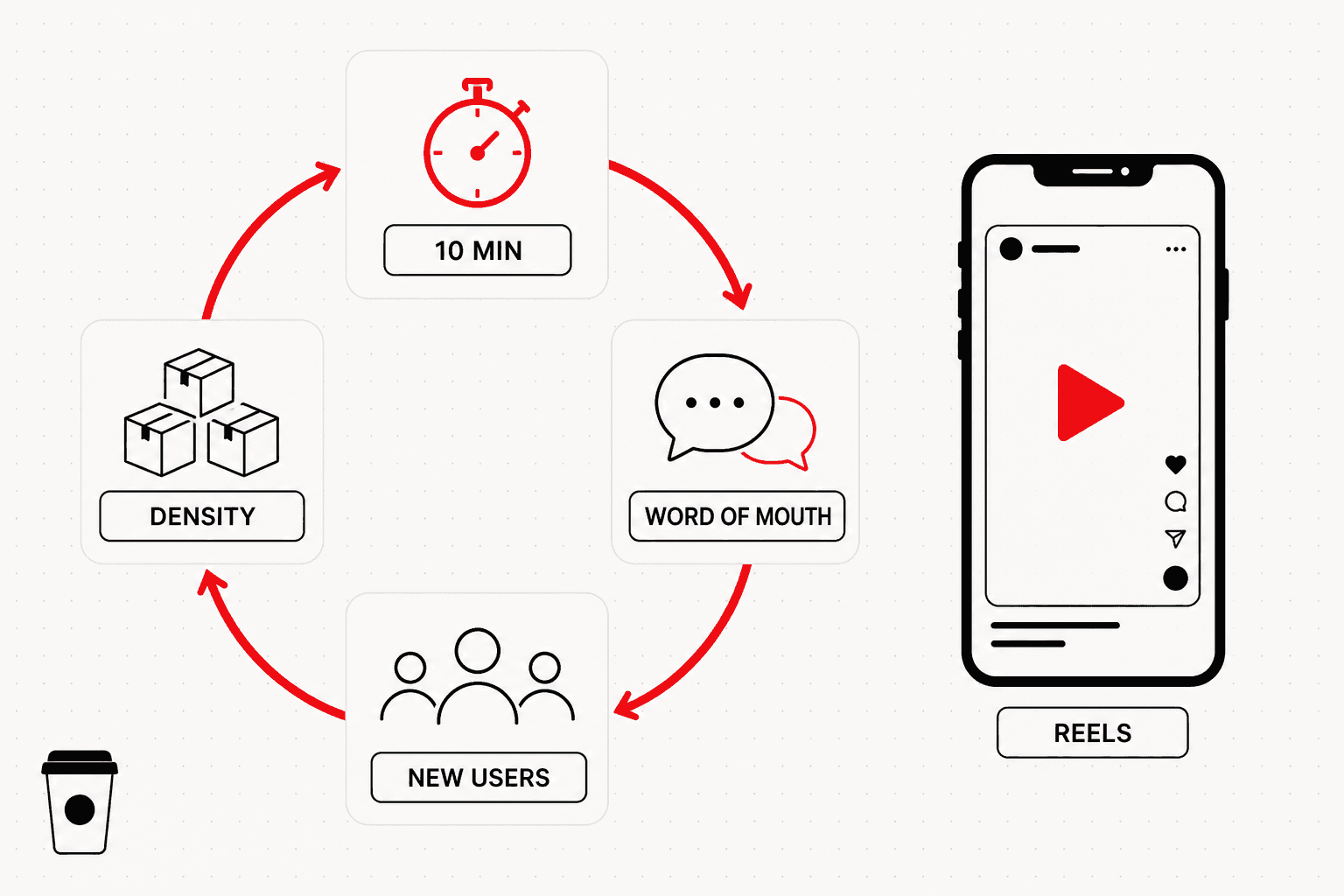
Short answer: Zepto grows through a product loop (ten-minute delivery creates word of mouth, which brings new users, which justifies more dark stores, which makes delivery faster) and markets it with two teams: performance, buying orders on Google and Meta, and brand, which treats every campaign as a content piece and tests it on whether it will earn media. In FY26 the company spent ₹1,389 crore on advertising, about 6.1 percent of operating revenue of ₹22,623 crore, and lost ₹5,905 crore (Inc42, August 2026; Outlook Business, June 2026).
Zepto in brief
Zepto was founded in 2021 by Aadit Palicha and Kaivalya Vohra, who left Stanford to build it. It raised $665 million in June 2024 at a $3.6 billion valuation (Entrackr, June 2024), followed by a $350 million domestic round led by Motilal Oswal's private wealth arm, taking the year's total to about $1.3 billion (Inc42, December 2024). In October 2025 it raised another $450 million at a $7 billion valuation, led by the US pension fund CalPERS (Business Standard, October 2025).
In June 2026 it filed an updated draft prospectus for an IPO with a fresh issue of ₹8,010 crore (Outlook Business, June 2026). That filing is the source of most public numbers on its economics: FY26 operating revenue of ₹22,623 crore, up from ₹11,110 crore; a net loss of ₹5,905 crore, up from ₹4,695 crore; and 1,139 dark stores at the end of March 2026, against Blinkit's 2,243 (Outlook Business, June and July 2026). Its stores handled about 23.3 lakh orders a day in the March 2026 quarter (Inc42, August 2026).
The growth loop: speed makes the marketing
Zepto's growth is a loop, not a funnel. The ten-minute promise is what people tell each other about; word of mouth brings new users in a neighbourhood; more users justify a dark store closer to them, which makes delivery faster, which generates more word of mouth. Paid marketing accelerates the loop; it does not create it.
The public numbers show the loop working at the unit level even as the total loss widens. Inc42 reported in December 2024 that Zepto's contribution margin had improved from negative ₹8 per order at the end of 2023 to negative ₹0.5 by April 2024, at the cost of monthly cash burn rising to about ₹250 crore after the June 2024 raise. The prospectus shows net loss per order falling from ₹136.15 in FY25 to ₹78.75 in FY26 (Outlook Business, June 2026), and delivery cost at ₹45.74 per order in FY26 (Inc42, August 2026). Zepto expanded from 7 cities at the end of 2023 to more than 35 by the end of 2024 (Inc42, December 2024) and to about 70 by late 2025 (Storyboard18, November 2025). The loss grows because each new city restarts the loop from zero.
Performance marketing: Google and Meta buy the orders
Zepto's chief brand officer, Chandan Mendiratta, told Storyboard18 in November 2025 that "many performance ads" run on Google and Meta, handled by a separate media team focused on customer acquisition, while brand storytelling lives mainly on Instagram and LinkedIn.
The scale is visible in the filing. Zepto's advertising expense was ₹1,389 crore in FY26, about 6.1 percent of operating revenue (Inc42, August 2026). For context, Eternal, parent of Zomato and Blinkit, spent ₹945 crore in the June 2026 quarter alone (exchange4media, July 2026). Zepto is outspent by its biggest rival but spends a larger share of revenue, as you would expect from a challenger with no parent app to cross-sell from.
The performance team is buying first orders in served neighbourhoods: category and brand search on Google, install and offer-led campaigns to lookalike audiences on Meta, both priced by the market, not by Zepto. Our Google Ads cost in India benchmarks show where Indian CPCs sit by category, and our Google Ads vs Facebook Ads comparison covers why a discovery-led product leans on Meta for new users and on Google for the branded search it generates. The discipline Zepto appears to apply is the one that matters: performance is judged on cost per order, brand on something else.
Brand: campaigns built to earn media, not buy it
Zepto's brand strategy is the part most often imitated and least often understood. Mendiratta describes the team as working "like a content creator's studio", with one test for every idea: will it generate earned media? He declined to share spend figures but said the brand "doesn't spend much" on marketing relative to its visibility (Storyboard18, November 2025).
The campaigns he cites show the pattern. A Diwali comeback story built around Soan Papdi, the sweet everyone regifts. A follow-up "Mithai Wars" with Haldiram's, where customers received mystery mithai boxes and voted in the app. A "Fake Shaadi" event aimed at Gen Z's enthusiasm for wedding season. A 2024 calendar printed on the delivery bag that ended up on people's walls. Empty Amul butter packets with a card for Janmashtami. A Father's Day film about a son practising saying "I love you" (Storyboard18, November 2025).
None of these are media-heavy. They are small, frequent, culturally timed activations, cheap enough to lose and designed to be screenshotted. Mendiratta's argument is that running many micro-festival activations raises the odds of a viral moment even though nobody can predict which one will hit. That is a portfolio approach to brand, fitted to a core audience of 25 to 45 in Tier 1 and Tier 2 cities (Storyboard18, November 2025). It is also how Zomato built its own voice a decade earlier; see our Zomato business model teardown for the parallel.
Zepto Cafe: a frequency product dressed as a new business
Groceries are a weekly habit at best. Coffee is a daily one. Zepto Cafe, a ten-minute food and beverage service, was piloted in 2022 and launched as a separate app in 2024, with plans at the time to open 100 cafes a month across six cities; it had completed 30,000 orders by December 2024 (Inc42, December 2024). By February 2025 Palicha was claiming one lakh daily orders, about 4 percent of volume, and an annualised gross merchandise value of around $100 million (Inc42, August 2026).
The logic is frequency and basket: a cafe order is a reason to open the app on a day you do not need groceries, and a snack added to a grocery order raises the basket without adding a delivery. The risk is complexity: preparing food inside a dark store is a different operation from picking packaged goods. Inc42 noted in August 2026 that the business had since been scaled back in some areas and that the $100 million figure was more than a year old. Read it as a retention experiment still being priced, not a proven second business.
The business model underneath the marketing
Marketing only matters if the orders it buys can eventually be sold at a profit. The FY26 revenue mix shows what Zepto actually sells.
Product sales were ₹17,588 crore in FY26, 77.7 percent of operating revenue. Services made up the rest: warehousing, packaging and last-mile fees of ₹2,780 crore, advertising of ₹1,636 crore (7.2 percent), platform services of ₹564 crore and subscription fees of ₹28 crore (Inc42, August 2026). Advertising revenue grew from ₹49 crore in FY24 to ₹651 crore in FY25 to ₹1,636 crore in FY26, from 2,468 brand partners, with ₹543 crore booked in the March 2026 quarter alone (Outlook Business, June 2026).
Set ₹1,636 crore of advertising revenue against ₹1,389 crore of advertising expense and you see the model's second loop: the demand Zepto buys from Google and Meta is resold to brands as shelf visibility, at a margin. It is the same structure as Blinkit's, covered in our Blinkit business model teardown, and the reason both keep adding categories: more brands on the shelf means more advertisers.
What a growth-stage brand can copy
-
Split performance and brand, and judge them differently. Zepto's performance team answers for cost per order; its brand team answers for earned media. Most D2C brands run one team with one number and get neither. Use honest CAC benchmarks, like our Google Ads cost in India data, so the performance number is real.
-
Make the promise specific. "Ten minutes" is repeatable, testable and short. "Premium quality" is none of those. If your promise cannot be said in three words and checked on delivery, it will not travel by word of mouth.
-
Many small bets beat one big campaign. The Soan Papdi, Fake Shaadi and calendar-bag ideas were cheap. Running a dozen micro-moments a year gives you a dozen chances at a hit; one annual film gives you one.
-
Let Meta create demand and let Google catch it. Quick commerce is a discovery category: install and offer campaigns on Instagram and Facebook do the acquisition, and branded search on Google harvests what the brand work generates. A Meta ads programme for new customers, with Google for intent capture, is the right default for discovery-led D2C products.
-
Build a frequency product. Zepto Cafe exists to give customers a daily reason to open the app. Your version might be a replenishment subscription, a consumable add-on or a content habit. Frequency is what makes a customer worth the CAC you paid.
Next: the economics of the stores behind the ten-minute promise, in the Blinkit business model, and how the incumbent built the group Zepto competes against, in the Zomato business model.
Frequently Asked Questions
What is Zepto's marketing strategy?
Zepto runs two marketing engines side by side. A performance team buys customer acquisition on Google and Meta and is judged on cost per order. A brand team, led by a chief brand officer, builds campaigns designed to earn media rather than buy it: Diwali mithai contests, a fake-wedding event for Gen Z, a calendar printed on a delivery bag. The test for every brand idea, per a November 2025 Storyboard18 interview, is whether it will generate earned media. Underneath both sits the product itself, where the ten-minute promise does most of the word-of-mouth work.
How does Zepto make money?
Mostly from selling groceries. In FY26, product sales were ₹17,588 crore, 77.7 percent of operating revenue, according to Inc42's analysis of the IPO filing. The rest came from services: warehousing, packaging and last-mile fees of about ₹2,780 crore, advertising of ₹1,636 crore, platform services of ₹564 crore and subscription fees of ₹28 crore. Advertising is the fastest-growing and highest-margin line, up from ₹49 crore in FY24.
Is Zepto profitable?
No. Zepto's updated draft IPO prospectus, reported by Outlook Business in June 2026, showed FY26 operating revenue of ₹22,623 crore and a net loss of ₹5,905 crore, wider than the ₹4,695 crore loss in FY25. The per-order loss did improve, from ₹136.15 in FY25 to ₹78.75 in FY26, which is the trend investors are being asked to extrapolate.
How much funding has Zepto raised?
Zepto raised about $1.3 billion in 2024 alone, including a $665 million round in June 2024 at a $3.6 billion valuation and a $350 million domestic round led by Motilal Oswal's private wealth arm, per Inc42's year-end review. In October 2025 it raised a further $450 million at a $7 billion valuation led by CalPERS, per Business Standard, and in June 2026 it filed an updated draft prospectus for an IPO with a fresh issue of ₹8,010 crore.
What is Zepto Cafe and why does it exist?
Zepto Cafe is a ten-minute food and beverage service, piloted in 2022 and launched as a separate app in 2024. Its purpose is frequency: a coffee or snack order is a reason to open the app that groceries do not give you every day. Inc42 reported 30,000 orders completed by December 2024, a claim of one lakh daily orders by February 2025 (about 4 percent of volume), and in August 2026 noted the business had since been scaled back in some areas.
What can a D2C brand copy from Zepto?
Separate performance from brand and judge them differently: performance on cost per paying customer, brand on earned reach. Make the product promise specific enough to be repeated. Run many small cultural moments rather than one big campaign, so you have more shots at a viral hit. And build a frequency product, your version of Zepto Cafe, that gives customers a reason to return without a discount.

Aditya Kathotia
Founder & CEO
CEO of Nico Digital and founder of Digital Polo, Aditya Kathotia is a trailblazer in digital marketing. He's powered 500+ brands through transformative strategies, enabling clients worldwide to grow revenue exponentially. Aditya's work has been featured on Entrepreneur, Economic Times, Hubspot, Business.com, Clutch, and more. Join Aditya Kathotia's orbit on LinkedIn to gain exclusive access to his treasure trove of niche-specific marketing secrets and insights.