

Most budget arguments between Google Ads and Facebook Ads are really arguments about the wrong number. One side says Meta is cheaper because its leads cost ₹40 and Google's cost ₹600. The other side says Google is better because its return on ad spend in the dashboard is 6x and Meta's is 2x. Both numbers are real. Neither one tells you where the next ₹1 lakh should go.
The question that settles it is simpler: does the demand you need already exist as searches, or do you have to create it? Google Ads, meaning Search and Shopping, can only show your ad to someone who has already typed what they want. Facebook and Instagram ads can reach almost anyone, but they reach people who were not looking. Pick the wrong one for your category and the ads still run, the dashboards still fill up, and the money still goes.
In this guide we answer that question with data instead of opinion. We measured monthly Google India search demand and suggested cost per click for 24 product and service categories in October 2026, then worked out how many orders search alone could deliver in each. After that we cover the cost trap that makes Meta leads look cheaper than they are, a starting budget split for ten business types, minimum budgets for each platform, a 90-day test plan and the mistakes we see most often in Indian accounts.
The short answer
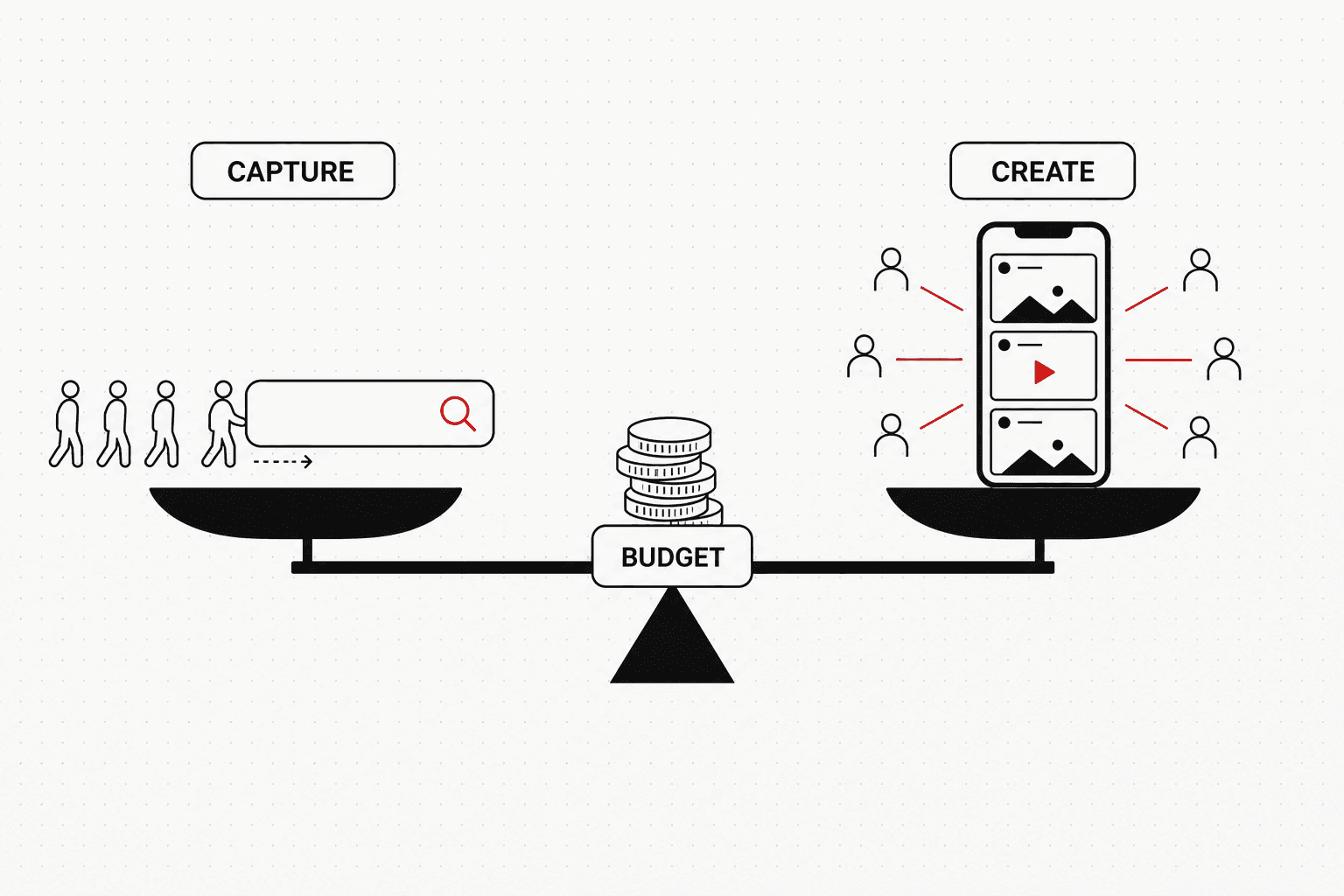
Put your budget where your customers' demand already is, then use the other platform to grow it. Google Ads captures existing demand: it wins when people search at the moment of need, as with home services, insurance, loans, healthcare and B2B software. Facebook and Instagram ads create new demand: they win when the product is visual, bought on impulse or new enough that few people search for it by name, as with most D2C brands. Our Google India data shows why the choice matters. The median suggested cost per click across ten service searches was about ₹81, against about ₹14 across fourteen consumer product searches. But for a niche product like mushroom coffee, which had 2,400 searches a month, even a well-run campaign could expect about 10 orders a month from category searches. Judge the two platforms on cost per paying customer, not cost per click or cost per lead. Start search-led businesses near 80/20 Google to Meta and discovery-led products near 20/80. Then move budget in small steps toward whichever platform delivers the cheaper next customer.
Not sure your split is right? We will review both accounts, check your tracking, estimate the search ceiling for your category and show where your next ₹1 lakh would earn the most. Request a paid media audit
What we measured: 24 categories on Google India
Most Google Ads vs Facebook Ads guides list features: Google has keywords, Meta has interests, Google is "intent", Meta is "awareness". That is true, but it does not tell a specific business what to do. So we measured the thing that decides the answer: how much search demand exists for different kinds of products and services, and what it costs.
Method. On 31 October 2026 we pulled 12-month average search volumes, suggested cost per click and advertiser competition for Google India (English) from the DataForSEO Google Ads endpoint. We grouped 24 searches into two sets:
- Search-led categories: services and considered purchases people search for when a need arises, such as "packers and movers", "term insurance" and "crm software".
- Discovery-led categories: consumer products people often buy after seeing them, including newer categories, such as "mushroom coffee", "sleep gummies" and "smart ring".
Rupee figures use ₹84 to the dollar, the same rate as our Google Ads cost in India benchmarks.
| Search (Google India) | Type | Monthly searches | Suggested CPC | Competition |
|---|---|---|---|---|
| dentist near me | Search-led | 450,000 | ₹54 | Medium |
| home loan | Search-led | 110,000 | ₹108 | Low |
| term insurance | Search-led | 110,000 | ₹337 | High |
| packers and movers | Search-led | 90,500 | ₹79 | Medium |
| ca near me | Search-led | 74,000 | ₹24 | Low |
| ac repair near me | Search-led | 74,000 | ₹34 | Low |
| pest control near me | Search-led | 60,500 | ₹81 | Medium |
| crm software | Search-led | 60,500 | ₹211 | Low |
| hair transplant cost | Search-led | 49,500 | ₹113 | Medium |
| ielts coaching | Search-led | 3,600 | ₹81 | Low |
| perfume for men | Discovery-led | 201,000 | ₹6 | High |
| hair growth serum | Discovery-led | 165,000 | ₹18 | High |
| smart ring | Discovery-led | 27,100 | ₹16 | High |
| a2 ghee | Discovery-led | 27,100 | ₹21 | High |
| matcha powder | Discovery-led | 22,200 | ₹12 | High |
| period panties | Discovery-led | 22,200 | ₹18 | High |
| korean skincare | Discovery-led | 12,100 | ₹11 | High |
| sleep gummies | Discovery-led | 9,900 | ₹11 | High |
| cold brew coffee | Discovery-led | 6,600 | ₹7 | Low |
| protein chips | Discovery-led | 5,400 | ₹3 | High |
| weighted blanket | Discovery-led | 5,400 | ₹20 | High |
| bamboo toothbrush | Discovery-led | 5,400 | ₹3 | High |
| meal replacement shake | Discovery-led | 2,900 | ₹24 | High |
| mushroom coffee | Discovery-led | 2,400 | ₹29 | High |
Four findings shape the rest of this guide.
1. Service clicks cost about six times more than product clicks. The median suggested CPC across the ten search-led terms was about ₹81. Across the fourteen consumer product terms it was about ₹14. Service searches are expensive because one customer is worth a lot: a term insurance policy or a CRM contract can be worth tens of thousands of rupees, so many advertisers can afford ₹300 a click.
2. Cheap product clicks are crowded clicks. Thirteen of the fourteen product searches showed high advertiser competition, despite their low CPCs. That combination usually means Shopping ads and marketplaces such as Amazon, Flipkart and Nykaa are bidding on every product query. The click is cheap because the shopper is comparing several sellers, not because the auction is empty.
3. Search demand for a new category is small. "Mushroom coffee", "meal replacement shake" and "protein chips" each drew fewer than 5,500 searches a month across all of India. A brand in one of those categories cannot buy more searches than exist, however high it bids.
4. Search demand swings with the season. "ac repair near me" ranged from 22,200 searches in its quietest month to 165,000 at the summer peak, a 7.4x swing. A Google budget for a seasonal service has to flex with the calendar; Meta can be used to build demand before the peak.
The core difference: capturing demand vs creating it
Here is the difference between Google Ads and Facebook Ads in one table.
| Google Ads (Search and Shopping) | Facebook and Instagram Ads (Meta) | |
|---|---|---|
| What triggers the ad | A search the person types | Who the person is and what they do online |
| Demand | Captures demand that already exists | Creates demand that did not exist |
| Buyer's state of mind | Looking for a solution now | Scrolling, not looking for anything |
| What does the selling | Keyword match, ad copy, landing page | Creative: the video, image and first three seconds |
| Typical cost model | Pay per click | Charged per 1,000 impressions (CPM) by default |
| Typical India cost | ₹3 to ₹340 per click in our sample | ₹50 to ₹300 per 1,000 impressions |
| Volume ceiling | Capped by how many people search | Capped by audience size and creative fatigue |
| Speed to first results | Days | Days, but one to two weeks to exit learning |
| Lead quality | Usually higher intent | Usually lower intent, more volume |
| Best for | Urgent needs, high-consideration services, B2B, brand defence | Visual products, impulse buys, new categories, retargeting |
Two things blur the line, and both are worth knowing before you plan.
Google also sells interruption ads. YouTube, Demand Gen campaigns, Discover and the Display Network show ads to people who are not searching, much like Meta. When this guide says "Google Ads" it means Search and Shopping, because that is what most businesses compare with Meta. If you run YouTube or Demand Gen, judge them as demand creation, not as search.
Meta also captures intent, a little. Retargeting people who visited your site, engaged with your Instagram profile or added to cart is demand capture, and it is often the most efficient spend in a Meta account. Advantage+ campaigns blend prospecting and retargeting automatically, which is one reason Meta's reported results can look better than the new demand it actually created.
The search ceiling: when Google simply runs out
The most useful single calculation when choosing between the two platforms is what we call the search ceiling: the most orders or leads that Google Search could realistically deliver from your category's own searches.
Search ceiling = monthly category searches × your realistic share of clicks × your conversion rate
For the chart below we assumed a well-run account wins 10 percent of all clicks on the category search and converts 4 percent of those visitors. Both assumptions are generous for a new brand. That makes the ceiling roughly 0.4 percent of monthly searches.
The chart turns a vague debate into an arithmetic one.
If your ceiling is far below your target, Google cannot be your main growth channel. A mushroom coffee brand that needs 1,000 orders a month can get about 10 of them from people searching "mushroom coffee". The other 990 have to come from people who have never heard of mushroom coffee, and the only way to reach them at scale is to show them an ad they were not looking for. That is Meta's job.
If your ceiling is close to your target, Google should get first call on budget. A packers and movers firm needing 300 leads a month can find most of them in searches that already happen. Spending heavily on Instagram to persuade people to move house would be expensive and slow.
The ceiling grows as you create demand. Successful Meta campaigns show up later as branded Google searches. A brand whose name is searched 20,000 times a month has a Google opportunity that did not exist when it launched, which is why the split shifts toward Google as a D2C brand matures.
Two refinements make the calculation more honest for your own business. Use the searches for your exact offer and location: a dental clinic in Pune should count Pune's share of dental searches, not India's 450,000. And add the related searches that would also convert, such as "best mushroom coffee brand" or "mushroom coffee benefits", because a real account bids on a cluster, not a single term.
The cost trap: cheap leads that lose money
Once you know which platform suits your category, the next mistake is comparing them on the wrong cost. Here is a worked example of ₹1 lakh spent on each platform by a lead-generation business in India. The rates are typical of the accounts we audit, not a guarantee.
| Step | Google Search | Meta Instant Form |
|---|---|---|
| Spend | ₹1,00,000 | ₹1,00,000 |
| Price | ₹60 per click | ₹150 per 1,000 impressions |
| Clicks | 1,667 | 6,667 (1% click-through, about ₹15 a click) |
| Leads | 117 (7% of visitors) | 400 (6% of form openers) |
| Cost per lead | ₹855 | ₹250 |
| Share of leads that become customers | 20% | 4% |
| Customers | 23 | 16 |
| Cost per customer | ₹4,348 | ₹6,250 |
On cost per lead, Meta wins by more than three to one. On cost per paying customer, Google wins by about 44 percent. A marketing team reporting cost per lead would move budget to Meta and watch sales fall.
The reverse also happens. Meta can win on cost per customer when the form is designed to filter, when the sales team calls fast and when the product suits a feed. In our Nivi Loans campaign, Meta Instant Forms delivered 480 personal loan leads at ₹8 to ₹10 each, as part of 662 leads at an average cost per lead of ₹11.8. By comparison, Google Search in Indian lending often runs at ₹150 to ₹500 or more per lead. Meta was the right primary channel there because the targeting, the creative and the follow-up process were built for it.
The point is not that one platform produces bad leads. It is that the only fair comparison is cost per paying customer, ideally measured against profit, not revenue. To get that number you need lead outcomes from your CRM flowing back to both platforms, which we cover in the tracking section below.
How to raise Meta lead quality
If Meta leads are cheap but rarely buy, fix the lead before you cut the budget:
- Use the "higher intent" form type. It adds a review screen before submission, which cuts accidental and impulse sign-ups.
- Add one qualifying question that a serious buyer answers easily and a casual tapper skips, such as budget range, city or timeline.
- Call within five minutes. Meta leads go cold far faster than search leads because the person was not actively looking.
- Send outcomes back to Meta through the Conversions API, marking which leads qualified and which bought, so the algorithm learns to find more of the right people.
- Test a landing page against the Instant Form. Fewer people convert on a page, but the ones who do tend to be more serious.
Where to put your budget: starting splits for 10 business types
The table below gives a starting split of paid budget between Google and Meta for common Indian business types. It is where we would begin a 90-day test, not where we would end it. The right split for your business is the one your own cost-per-customer data shows after testing.
| Business type | Meta | Why | |
|---|---|---|---|
| Local and emergency services (pest control, AC repair, packers and movers) | 80% | 20% | People search when the need arises; Meta mostly for retargeting and seasonal reminders |
| High-consideration services (dental implants, hair transplant, legal, CA) | 65% | 35% | Search captures intent; Meta builds trust with testimonials and before-and-after content |
| B2B software and services | 70% | 30% | Buyers search for solutions; Meta for retargeting and lookalikes of best customers |
| Lending, insurance and fintech | 50% | 50% | Search for high intent, Meta for volume with strict lead filtering |
| Real estate projects | 40% | 60% | Meta lead forms drive launch volume; Google for project-name and locality searches |
| Education and coaching | 50% | 50% | Search for course intent; Meta for reach before admission seasons |
| D2C, new or niche category | 20% | 80% | Search ceiling is too low; demand has to be created in the feed |
| D2C, established category with brand demand | 40% | 60% | Shopping and Performance Max capture brand and category searches |
| Ecommerce with a large catalogue | 60% | 40% | Shopping covers thousands of product searches; Meta for catalogue retargeting and prospecting |
| Travel, hospitality and events | 50% | 50% | Destination searches are large; Meta sells the experience visually |
Three adjustments move a business away from its default row:
- Strong brand search moves budget toward Google. If your brand name already draws thousands of searches a month, and competitors or marketplaces bid on it, protect it with a brand campaign. Our guide to bidding on your own keywords covers when that pays.
- Weak creative capacity moves budget toward Google. Meta needs a steady supply of new videos and images, often four to eight a month for a small account. If you cannot produce them, Meta performance will decay within weeks, whatever the split says.
- High ticket size moves budget toward Google. The more a customer is worth, the more you can pay per click, and the more a high-intent lead matters. Use our CPC benchmarks by industry to check whether your margins can fund search clicks in your category.
Want a split built on your numbers instead of averages? Our PPC team will model your search ceiling, your break-even cost per customer and a 90-day test budget across Google and Meta. Book a free strategy call
How much budget each platform needs to work
A budget that is too small does not just produce fewer results. It produces misleading ones, because both platforms' bidding systems need data to work. These are the practical minimums we plan around for Indian accounts.
Meta: the learning phase sets the floor
Meta's delivery system is in a "learning phase" until an ad set records about 50 optimisation events in a week, such as 50 purchases or 50 leads. Until then, costs are less stable and results are harder to read. That gives a simple floor:
Minimum weekly budget per ad set ≈ 50 × your expected cost per result
| Optimising for | Expected cost per result | Weekly budget per ad set | Monthly |
|---|---|---|---|
| Instant Form leads | ₹100 | ₹5,000 | about ₹22,000 |
| Website leads | ₹300 | ₹15,000 | about ₹65,000 |
| Purchases | ₹800 | ₹40,000 | about ₹1.7 lakh |
If you cannot afford the floor for purchases, optimise for an earlier event that happens more often, such as add to cart or initiate checkout, and consolidate into fewer ad sets. Advantage+ campaigns help here because they pool learning across audiences.
Google: stay visible all day, then feed Smart Bidding
Google Search has no learning-phase threshold of the same kind, but it has two practical limits. First, your daily budget should keep your ads showing for your core keywords through the whole day; if Google reports "limited by budget", you are missing searches. Second, Smart Bidding strategies such as Target CPA and Target ROAS work better with more conversion data, and we aim for 30 or more conversions a month per campaign before switching to them. Our guide on choosing between tCPA, tROAS and Maximise Conversions covers the thresholds in detail.
Rule of thumb: for most Indian businesses, about ₹50,000 a month is the least that lets one platform work properly, and about ₹1.5 lakh a month is where running both becomes worthwhile. Below that, put everything into the platform that matches your category and get it profitable first. Remember that both platforms add 18% GST to Indian invoices, so plan spend net of tax.
Tracking first: the setup that makes the comparison fair
Both platforms report their own results, and both claim credit generously. Google Ads usually counts a conversion when someone clicked an ad and then converted. Meta also counts people who only saw an ad and converted within a day, by default. Add the two platforms' reported conversions together and you will often get more sales than you actually made.
Before you compare the two, set up four things:
- GA4 with clean conversion events, so you have one view of every sale or lead that does not belong to either ad platform.
- Google Enhanced Conversions and offline conversion import, so Google learns from real sales rather than form fills. Our guide to Enhanced Conversions walks through the setup.
- Meta Conversions API, which sends events from your server or CRM rather than relying only on the browser pixel. Browser tracking now misses a meaningful share of conversions because of ad blockers, iOS privacy settings and cookie limits.
- A CRM field for lead source and outcome, so you can calculate cost per qualified lead and cost per customer by platform. HubSpot, Zoho CRM and LeadSquared all support this.
Then use a blended measure as the final check: total revenue divided by total ad spend across all platforms, sometimes called the marketing efficiency ratio. No platform can inflate it. If Meta reports a great month but total revenue is flat, Meta's report is wrong. Our explainer on marketing attribution covers the models and their blind spots.
A 90-day plan to find your split
Here is how we run the test for a new client, adapted for a business running it in-house.
Days 1 to 14: fix tracking and set baselines. Set up the four items above. Record your current cost per customer and blended revenue-to-spend ratio by month for the last six months. Calculate your search ceiling. Run a Google Ads audit on any existing account to remove waste before you add budget.
Days 15 to 45: launch the starting split. Use the row from the table that fits your business. On Google, start with exact and phrase match on your highest-intent keywords, a brand campaign if competitors bid on your name, and Shopping or Performance Max if you sell products. On Meta, run one prospecting campaign with three to five creative concepts and one retargeting campaign. Do not change budgets or bids more than once a week.
Days 46 to 75: move money at the margin. Every two weeks, move ₹10,000 to ₹20,000 from the platform with the higher cost per customer to the one with the lower. Watch the cost of the next customer, not the average: the cheapest customers on any platform are bought first, so each extra rupee buys a slightly more expensive one.
Days 76 to 90: test incrementality. Pause Meta prospecting in a few cities for two weeks, or run a Meta conversion lift study if your spend qualifies, and see how much total revenue actually falls. Do the same for Google brand campaigns. The revenue that disappears is what the channel was really producing.
Signals that tell you to move budget
| Signal | What it means | Move budget toward |
|---|---|---|
| Google Search impression share on core terms above 85% | You are already showing for almost every search; more budget buys little | Meta |
| Google reports "limited by budget" on profitable campaigns | You are missing searches you could win at a profit | |
| Meta prospecting frequency above 3 to 4 a week with rising CPM | Audience is saturated or creative is tired | Google, or new creative first |
| Branded Google searches rising month on month | Meta and other awareness work is creating demand | Google brand and Shopping to capture it |
| Meta cost per customer below Google's for two months running | Discovery is working for your category | Meta |
| Search ceiling below 20% of your monthly target | Google cannot deliver your growth alone | Meta |
Seven mistakes we see in Indian ad accounts
- Comparing cost per lead across platforms. As the worked example shows, the cheaper lead can be the more expensive customer. Compare cost per paying customer.
- Judging Meta by last-click GA4 reports. GA4's default attribution gives little credit to the ad someone saw on Instagram before searching your brand on Google. Use blended numbers and lift tests instead.
- Running Meta with one or two creatives. On Meta the creative does the targeting work. Accounts that test a few new concepts every month outperform those that run one ad until it dies.
- Running Google broad match without negatives. Broad match with Smart Bidding can work, but without a negative keyword list it spends on loosely related searches. Review search terms every week in the first month.
- Splitting a small budget across both platforms. ₹30,000 split two ways leaves each platform below the data it needs to learn. Win on one first.
- Sending ad traffic to the homepage. Both platforms need a landing page that matches the promise of the ad. Our PPC landing page audit lists the problems that kill conversion most often.
- Letting brand campaigns flatter Google's numbers. Brand campaigns report the highest return in almost every account because they catch people already looking for you. Report brand and non-brand separately, or Google will look better than it is.
A related risk on Meta is account restriction. Indian lending, health and some D2C categories trip Meta's ad policies often, and a disabled ad account can stop a campaign overnight. Our guide on avoiding a Facebook ad account ban covers the safeguards.
Two examples from our accounts
Homebytes: a search-led business, split heavily to Google. Homebytes is an IRCTC e-catering partner delivering meals to train passengers, a need that arises at a specific moment and is searched for on the spot. We put ₹29,000 into Google Search and Performance Max and ₹3,000 into Meta, about a 90/10 split. The campaign produced 1,500+ enquiries and 110 confirmed orders, plus 15 bookings from Meta. Read the Homebytes PPC case study.
Nivi Loans: a lending business where Meta led. For personal loan leads from Tier 1 and Tier 2 cities, precise behavioural targeting of employed professionals aged 23 to 45, with Instant Forms and fast follow-up, delivered 662 leads at an average of ₹11.8 each. Meta led because the product, the audience and the qualification process were built for the feed. Read the Nivi Loans case study.
The two businesses are both lead-led, and they ended up at opposite ends of the split. That is the argument of this guide in miniature: the platform follows the category, not the other way around.
Tools for planning and running both platforms
| Tool | What it is for |
|---|---|
| Google Keyword Planner | Search volume and CPC estimates for your category; the starting point for your search ceiling |
| Google Ads Transparency Center | See which ads competitors are running on Google Search and YouTube |
| Meta Ad Library | See every active ad a competitor is running on Facebook and Instagram, and how long each has run |
| Meta Events Manager | Set up and check the pixel and Conversions API |
| GA4 | One neutral view of conversions across both platforms |
| Looker Studio | Combine both platforms' spend with CRM revenue for blended reporting |
| HubSpot, Zoho CRM or LeadSquared | Track lead source, qualification and sale, then send outcomes back to both platforms |
| DataForSEO or Semrush | Search volume, CPC and competition at scale when you are sizing many categories |
KPIs to track every month
- Cost per paying customer by platform, using CRM data, not platform-reported conversions.
- Blended revenue-to-spend ratio across all paid channels.
- Contribution margin after ad spend, because revenue is not profit. Our ecommerce SEO vs PPC breakdown shows how to calculate break-even ROAS from your margin.
- Google Search impression share on your core non-brand keywords.
- Meta frequency, CPM and hook rate (the share of impressions that watch the first three seconds), the earliest signals of creative fatigue.
- Branded search volume in Google Search Console and Keyword Planner, the clearest sign that demand creation is working.
- Lead-to-customer rate by platform, the number that explains most of the gap between cost per lead and cost per customer.
If you also run brand campaigns or awareness video, our guide on performance marketing vs branding explains how to judge spend that is not meant to convert this month.
Key takeaways
- Google Ads captures demand; Facebook and Instagram ads create it. Decide which your category needs before you decide the budget.
- Calculate your search ceiling. Monthly category searches × 10% × 4% gives a rough maximum for orders from search. If it is far below your target, Meta has to carry growth.
- Service clicks cost about six times more than product clicks on Google India in our sample: a median of ₹81 against ₹14.
- Compare platforms on cost per paying customer. A Meta lead at ₹250 can cost more per customer than a Google lead at ₹855.
- Start from a split that fits your business, from 80/20 Google to Meta for local services to 20/80 for new D2C categories, then move money at the margin.
- Respect the minimums. Meta needs about 50 results per ad set per week; Google needs enough budget to stay visible all day. Below ₹1.5 lakh a month, master one platform first.
- Fix tracking before you compare. Send CRM outcomes back to both platforms and check everything against blended revenue.
Running both platforms and still unsure which one is working? Our Google Ads and Meta Ads specialists will audit both accounts, rebuild your tracking around paying customers and set a budget split you can defend. Get a free paid media audit
Frequently asked questions
Which is better, Google Ads or Facebook Ads?
Neither is better in general, because they do different jobs. Google Ads, meaning Search and Shopping, shows your ad to people already searching for what you sell, so it captures demand that exists. Facebook and Instagram ads show your ad to people who were not looking, so they create demand. Google usually wins for urgent or high-consideration needs such as home services, insurance, B2B software and healthcare. Meta usually wins for visual, impulse or new-category products where few people search for the product by name. Most businesses spending more than about ₹1.5 lakh a month need both.
Is Google Ads cheaper than Facebook Ads in India?
Per click, Meta is usually cheaper. In India, 1,000 Facebook or Instagram impressions typically cost ₹50 to ₹300, which often works out to ₹5 to ₹25 per click, while Google Search clicks for services in our October 2026 sample had a median suggested CPC of about ₹81 and reached ₹337 for term insurance. But price per click is the wrong comparison. A Google searcher has already told you what they want, so they usually convert at a higher rate. Compare the platforms on cost per paying customer.
How should I split my budget between Google Ads and Meta Ads?
Start from how your customers buy. If they search when the need arises, as with packers and movers, pest control or a CA, start around 80 percent Google and 20 percent Meta. If your product is new, visual or bought on impulse, flip it to about 20 percent Google and 80 percent Meta. Lending, insurance, education and travel usually start near 50/50. Treat these as starting points for a 90-day test, then move budget toward whichever platform has the lower cost per paying customer at the margin.
What is the minimum budget for Google Ads and Meta Ads in India?
Meta needs about 50 optimisation events per ad set in a week to leave the learning phase, so an ad set optimising for leads at ₹300 each needs roughly ₹15,000 a week, about ₹65,000 a month. Google Search needs enough daily budget to stay visible for your core keywords all day, and Smart Bidding works better with 30 or more conversions a month per campaign. For most Indian businesses that means about ₹50,000 a month for one platform done properly, and ₹1.5 lakh or more to run both well.
Are Facebook ads good for B2B?
As a supporting channel, yes; as the main channel, rarely. B2B buyers search on Google when they have a problem to solve, with terms like "crm software", which had 60,500 monthly searches on Google India in our data. Meta's job-title targeting is weak compared with LinkedIn, so cold B2B prospecting on Facebook tends to produce leads that do not qualify. Meta works for B2B in retargeting, reaching small-business owners and promoting lead magnets to lookalikes of your best customers. See our B2B lead generation services for the full channel mix.
Should a small business start with Google Ads or Facebook Ads?
Start with the platform that matches how your customers find you, and run only one until it works. A local service business such as a clinic, repair service or CA practice should usually start with Google Search, because people search with "near me" when they need it; "dentist near me" alone had 450,000 monthly searches in India. A small business selling a product people discover by seeing it, such as handmade jewellery, home decor or a new snack, should usually start with Instagram and Facebook ads.
Is Google Ads or Facebook Ads better for ecommerce?
Both, in different roles. Google Shopping and Performance Max capture people searching for a product type or your brand. Meta is where most D2C brands find new customers, because a scroll-stopping video can sell a product the viewer did not know existed. In our data, 13 of 14 consumer product searches on Google India showed high advertiser competition at a median suggested CPC of only about ₹14, so those clicks are cheap but crowded with marketplaces. Our ecommerce PPC services and D2C growth programme run both together.
Why are Facebook leads cheaper but lower quality than Google leads?
Because the lead is created differently. A Google lead searched for your service, clicked, read your page and filled in your form. A Meta lead, especially from an Instant Form, saw an ad in a feed and tapped a pre-filled form without leaving the app. That makes Meta lead forms cheap, often ₹8 to ₹50 a lead in India, but fewer of those people answer the phone and buy. Use the higher-intent form type, add a qualifying question, call within five minutes and send CRM outcomes back to Meta.
Can I run Google Ads and Facebook Ads at the same time?
Yes, and most growing businesses should once their budget allows it, because the two reinforce each other. Meta creates awareness that later shows up as branded Google searches, and Google visitors who do not convert can be retargeted on Instagram and Facebook. The mistake is starting both at once with a small budget. Get one platform profitable first, then add the second with enough budget to exit its learning phase.
How do I know whether Google or Meta actually drove a sale?
You cannot fully trust either platform's own reports, because both claim credit for the same sale. Send real outcomes from your CRM or store back to both platforms through Google's offline conversion import or Enhanced Conversions and Meta's Conversions API. Track a blended number, total revenue divided by total ad spend, which no platform can inflate. Then run incrementality tests, such as pausing a channel in some cities, to see how much revenue actually disappears.
Are Instagram ads part of Facebook Ads?
Yes. Instagram ads are bought through the same Meta Ads Manager as Facebook ads, using the same targeting, pixel, budget and campaign structure, and Meta places ads across Facebook, Instagram, Messenger, Threads and the Audience Network unless you restrict placements. For most Indian D2C and lifestyle brands, Instagram Reels and Stories now deliver a large share of results, so build creative vertical-first. Our social media marketing team handles the organic side of the same accounts.

Aditya Kathotia
Founder & CEO
CEO of Nico Digital and founder of Digital Polo, Aditya Kathotia is a trailblazer in digital marketing. He's powered 500+ brands through transformative strategies, enabling clients worldwide to grow revenue exponentially. Aditya's work has been featured on Entrepreneur, Economic Times, Hubspot, Business.com, Clutch, and more. Join Aditya Kathotia's orbit on LinkedIn to gain exclusive access to his treasure trove of niche-specific marketing secrets and insights.