

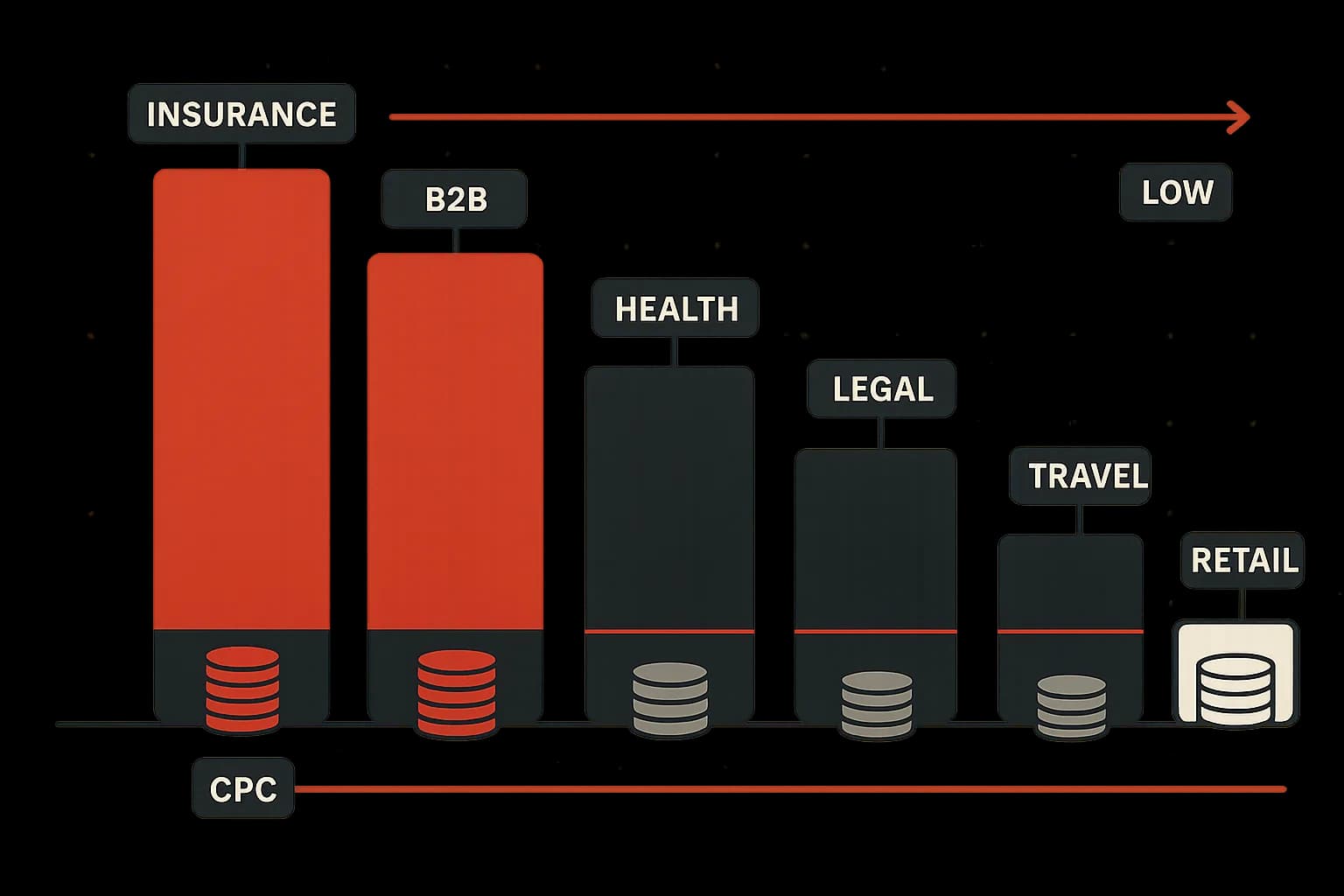
The first question every business owner asks before launching Google Ads is the wrong one. They ask, "How much does Google Ads cost?" expecting a price, a package, a monthly figure they can write into a budget line. There isn't one. Google Ads has no rate card. It runs on a live auction, and the price of a single click is decided fresh, millions of times a day, by how many advertisers want the same searcher you want.
That is why a furniture retailer in Pune can buy clicks for ₹15 while an insurance broker two streets away pays ₹400 for a click on the same platform. Same Google, same country, same month. The thirty-fold gap is not a glitch. It is the market pricing the value of a customer in each industry, and it is the single most important thing to understand before you spend a rupee.
This guide gives you the number you actually came for: real average cost-per-click benchmarks for India in 2026, grouped by industry, built on Google Keyword Planner data for Indian search rather than US figures converted into rupees. But CPC is only the entry point. The cost that decides whether Google Ads makes you money is the cost per lead, and getting from one to the other is where most budgets quietly bleed. By the end of this you will be able to estimate what a click costs in your category, what a lead will cost once you account for conversion rate, and what monthly budget it takes to make the channel work at all.
Why Google Ads Has No Fixed Price
Google Ads is an auction. Every time someone searches, Google runs an instant auction among all the advertisers bidding on that query and decides which ads show, in what order, and what each one pays. You set a maximum bid, the most you are willing to pay for a click, but you almost never pay your maximum. You pay just enough to beat the advertiser ranked below you.
Three forces set the price of a click in your category:
- Demand for the keyword. The more advertisers competing for a search term, the higher the auction clears. High-intent commercial terms like "term insurance" or "personal loan" attract dozens of deep-pocketed bidders, so the price climbs.
- The value of a converted customer. Advertisers can only sustain a high CPC if the customer is worth it. An insurer earning ₹40,000 in lifetime commission from one policy can happily pay ₹400 a click. A retailer earning ₹300 of margin on a saree cannot. The auction reflects this, which is why CPC tracks customer lifetime value more than anything else.
- Your own Quality Score. Google multiplies your bid by a relevance score, so two advertisers bidding the same amount can pay very different prices. This is the one force you control directly, and it is the difference between paying the top of an industry's CPC range and the bottom of it. We cover it in detail below, and in depth in our guide to cutting CPC with Quality Score.
Hold those three in mind as you read the benchmarks, because they explain every number in the table that follows.
Google Ads CPC Benchmarks by Industry in India (2026)
The chart below shows indicative average cost per click across major Indian industries, drawn from Google Keyword Planner data for broad commercial keywords targeting India, converted to rupees at approximately ₹83.5 to the US dollar. Treat these as planning ranges, not quotes. Your own CPC will land somewhere inside the range depending on keyword intent, city, competition, and Quality Score.
Here is the same data as a planning table, with the representative keywords behind each range so you can sanity-check where your own terms sit.
| Industry | Representative keywords | Avg CPC (USD) | Avg CPC (₹) | Why it sits here |
|---|---|---|---|---|
| Insurance | health, term, car insurance | $3.70–5.50 | ₹310–460 | Highest customer LTV, dozens of funded bidders |
| Education | online MBA, study abroad, IELTS | $3.50–4.60 | ₹295–385 | High course fees, long decision cycle |
| Real Estate | property in pune, flats, developer | $0.59–3.92 | ₹50–330 | Huge deal value, hyperlocal competition |
| Finance / Lending | personal loan, business loan, demat | $0.77–3.24 | ₹65–270 | High LTV, regulated, heavy competition |
| B2B SaaS / Tech | CRM, ERP, cloud hosting | $2.45–3.05 | ₹205–255 | High contract value, global advertisers |
| Healthcare | hair transplant, dental implants | $1.10–2.50 | ₹95–210 | High-ticket procedures, local intent |
| Legal | injury lawyer, divorce, immigration | $0.62–1.52 | ₹50–130 | High case value, lower search volume |
| Home Services | pest control, packers, AC repair | $0.30–0.90 | ₹25–75 | Moderate ticket, high volume |
| Travel | hotels, holiday packages, flights | $0.17–0.35 | ₹14–30 | Thin margins, OTA-dominated |
| Automotive | used cars, two-wheeler loan | $0.10–0.28 | ₹8–25 | High volume, low per-click intent |
| Ecommerce / Retail | furniture, apparel, footwear | $0.03–0.24 | ₹3–20 | Low margin, Shopping-driven, high volume |
The pattern is unmistakable. Click cost tracks the value of the customer, not the size of the business. A two-person insurance brokerage faces the same ₹400 clicks as a national insurer, because the auction prices the keyword, not the advertiser. That is exactly why understanding the economics below the CPC matters more than the CPC itself.
CPC Is Not the Cost That Matters — Cost Per Lead Is
Here is the trap that sinks more Google Ads budgets in India than any other: founders compare CPCs and conclude their industry is "too expensive." A ₹400 insurance click sounds ruinous next to a ₹15 retail click. But the click is not what you are buying. You are buying customers, and a click only becomes a customer after it survives your landing page and your sales process.
The number that decides profitability is cost per lead, and the formula is simple:
Cost per lead = Cost per click ÷ Landing-page conversion rate
Run the same CPC through two different conversion rates and the economics flip completely.
This is the most underused insight in Indian PPC. Founders obsess over shaving ₹10 off their CPC while ignoring a landing page that converts at 1.5 percent when it could convert at 4 percent. Fixing the page does not lower the CPC by a rupee, yet it can cut cost per lead by more than half. If your campaigns are pulling clicks but not enquiries, the problem is almost never the bid; it is the page the click lands on. Our breakdown of the conversion killers hiding in PPC landing pages is where to start.
Take it one step further to cost per acquisition (cost per lead ÷ lead-to-customer close rate) and you have the only metric that tells you whether Google Ads is actually profitable. A ₹2,000 cost per lead at a 25 percent close rate is an ₹8,000 cost to acquire a customer. Whether that is brilliant or disastrous depends entirely on what that customer is worth to you, which is the same logic that set the CPC in the first place.
What a Realistic Monthly Budget Looks Like in India
Once you understand CPC and cost per lead, budgeting stops being guesswork. The constraint is not "how much can I afford" but "how much do I need to spend to gather enough conversion data for Google's algorithms to optimise." Modern Google Ads bidding is machine-learning-driven, and it needs roughly 30 or more conversions per month per campaign to find its footing. Below that, you are paying for clicks but starving the system of the data it needs to get cheaper.
Work backward from conversions:
- Local service business, single city (home services, clinics, salons, small legal or accounting practices): clicks at ₹25–150, a 3–5 percent conversion rate, targeting 30–50 leads a month. Realistic media budget: ₹30,000–₹75,000 per month.
- Mid-market service or B2B (SaaS, education, larger healthcare, multi-city services): clicks at ₹150–300, longer funnels, targeting qualified leads not just form fills. Realistic media budget: ₹1,00,000–₹3,00,000 per month.
- High-CPC categories (insurance, lending, competitive real estate): clicks at ₹250–460 mean even ₹1,00,000 buys only a few hundred clicks. Realistic floor to learn anything: ₹2,00,000–₹5,00,000+ per month, which is why these categories favour advertisers who can commit.
- Ecommerce / retail: clicks are cheap (₹3–25) but you need volume and Shopping campaigns. Budget scales with catalogue and ROAS targets; many start at ₹40,000–₹1,00,000 per month and scale on return.
Three budgeting rules save more money than any bidding trick:
- Budget media separately from management and creative. The CPC numbers above are pure media. Agency management, landing pages, and creative are line items on top. Folding them together is how businesses underfund the media and then conclude "Google Ads doesn't work."
- Concentrate, don't spread. A ₹50,000 budget split across five cities and forty keywords gives every campaign too little data to optimise. The same ₹50,000 aimed at one city and a tight keyword set compounds. This is the most common budget mistake we see.
- Plan for a learning period. The first 30–60 days are tuition. CPCs start high, conversion data is thin, and the algorithm is calibrating. Budgets that get pulled in week three never reach the efficiency that arrives in month two or three.
Not sure what budget your category actually needs? We build Google Ads plans backward from your target cost per acquisition — modelling realistic CPCs for your industry and city, the conversion rate your landing pages need to hit, and the media budget required to gather enough data to optimise. Request a Google Ads plan
The City Multiplier: Why Mumbai Clicks Cost More
The benchmarks above are national averages, but Google Ads is priced locally. The same keyword can cost two to three times more in a Tier-1 metro than in a Tier-2 city, because more advertisers compete for higher-spending audiences. A real-estate or legal keyword in Mumbai or Delhi NCR routinely clears at a multiple of the same term in, say, Indore or Coimbatore.
This cuts both ways. If you only serve Mumbai, you pay the Mumbai price and there is no way around it. But if your business can serve Tier-2 and Tier-3 markets, those geographies often deliver materially cheaper clicks and thinner competition. Geo-targeting and bid adjustments by location let you pay the real local price in each market instead of one blended bid that overpays in cheap cities to fund the expensive ones. For businesses building in specific cities, this is also where local SEO and Google Business Profile work compounds, lowering blended acquisition cost over time. Our city-level guidance, like the playbook behind a revenue-driven SEO and PPC programme in Bengaluru or Kolkata, treats geography as a lever, not a fixed cost.
How to Pay the Low End of Your Industry's CPC Range
Every industry range above has a top and a bottom. Whether you pay ₹460 or ₹310 for that insurance click is not fixed by your industry; it is decided by how well you play the auction. Here are the levers, in order of impact.
1. Quality Score — the relevance multiplier. Google multiplies your bid by a Quality Score from 1 to 10 to decide rank and price. Move a keyword from a 4 to an 8 and its actual CPC drops 30–40 percent at the same position, no bid change required. This is the single biggest cost lever in the entire platform, and it is won with tight ad groups, keyword-matched ad copy, and intent-matched landing pages. The full mechanics are in our guide to the Quality Score lever that cuts CPC.
2. Negative keywords — stop paying for the wrong searches. Broad and phrase match will show your ad on searches you never intended to buy. Every click on an irrelevant search is pure waste. An aggressive, continuously updated negative-keyword list is the fastest way to stop the leak, and it is the first thing we look at in any Google Ads wasted-spend audit.
3. Match type discipline. Broad match maximises reach but invites expensive, low-intent clicks. On your costliest keywords, exact and phrase match keep you in front of searchers who actually want what you sell, which lifts conversion rate and lowers cost per lead even if the headline CPC is similar.
4. Long-tail keywords. Head terms like "personal loan" are the most expensive clicks in the auction. Specific long-tail variants ("personal loan for self-employed in pune") cost less, face less competition, and convert better because the intent is sharper. Shifting budget down the tail lowers blended CPC and CPL simultaneously.
5. Ad scheduling and device bids. If your leads close on weekday business hours, paying full freight for 2 a.m. clicks is waste. Dayparting and device-level bid adjustments concentrate spend where it converts.
6. Smarter bidding, used correctly. Target CPA and Target ROAS bidding can lower acquisition cost once you have enough conversion data, but they fail when fed thin or untrustworthy conversion tracking. Get conversion tracking right first, then let automated bidding optimise. The trade-offs between tCPA, tROAS, and Maximize Conversions are covered here.
Pull these levers together and the same campaign that started at the top of its industry CPC range settles toward the bottom, while conversion rate climbs. That is the entire discipline of paid search cost control: not "spend less," but "waste less and convert more."
Common Google Ads Cost Mistakes in India
The most expensive errors are not in the bidding; they are in the strategy around it.
- Judging the channel on CPC instead of CPA. A high CPC in a high-LTV category is fine. A low CPC that never converts is not. Always measure on cost per acquisition.
- Sending paid clicks to the homepage. A homepage answers no specific search intent. Every campaign deserves a dedicated landing page that matches the keyword, or cost per lead balloons.
- Underfunding the media to pay the agency. If management fees eat the budget, the media never gathers enough data to optimise. Fund the media first.
- Pausing in the learning period. The first month is the most expensive and least efficient by design. Killing campaigns in week three throws away the tuition without collecting the payoff.
- Ignoring conversion tracking. Without accurate conversion data, smart bidding optimises toward noise and you cannot calculate cost per lead at all. It is the foundation everything else sits on, and the first thing that lowers customer acquisition cost when fixed.
- Running Google Ads in isolation. Paid search captures existing demand; it does not build it. Pairing it with SEO and content lowers your blended cost per acquisition over time as organic traffic reduces dependence on paid clicks.
Google Ads vs Other Channels: Where the Rupee Works Hardest
Cost is only meaningful relative to what a channel does. Here is the honest comparison Indian businesses need before allocating budget.
| Channel | Cost model | Speed to results | Cost over time | Best for |
|---|---|---|---|---|
| Google Ads (Search) | Pay per click, variable | Immediate | Roughly constant per lead | Capturing existing high-intent demand now |
| Meta Ads | Pay per impression/click | Fast | Variable, creative-driven | Demand generation, retargeting, visual products |
| SEO | Fixed investment, compounds | 3–9 months | Falls over time | Lowering blended CPA, durable organic traffic |
| Google Shopping / PMax | Pay per click, feed-driven | Fast | Scales with ROAS | Ecommerce catalogues with margin to fund clicks |
The strategic read: Google Ads is the right tool when you need controllable, high-intent leads this quarter and you have the margin to pay for them. It is the wrong tool to rely on forever, because the per-lead cost rarely falls and you are always renting the traffic. The businesses that scale profitably in India use paid search to buy demand today while SEO and content lower their cost of acquisition tomorrow. If you only ever pay for clicks, your cost of growth never compounds down. For most categories, the answer is not Google Ads or SEO; it is the sequencing of both, which we lay out in our PPC services approach.
How to Estimate Your Own Google Ads Cost in 5 Steps
You do not need a tool to get a usable estimate before you spend anything.
- Find your industry's CPC range in the table above, and bias toward the higher end if you are in a Tier-1 metro.
- Estimate your landing-page conversion rate. If you have no data, use 2–3 percent for a decent page, 1 percent for a homepage, 4–5 percent for a strong dedicated page.
- Calculate cost per lead: CPC ÷ conversion rate. A ₹150 click at 3 percent is a ₹5,000 lead.
- Apply your close rate to get cost per acquisition: a ₹5,000 lead at a 20 percent close rate is a ₹25,000 customer.
- Compare to customer value. If a customer is worth ₹1,00,000 to you, a ₹25,000 acquisition cost is excellent. If they are worth ₹20,000, the math does not work yet, and your job is to lower CPC, lift conversion rate, or improve close rate before scaling.
That five-step chain is the entire economics of Google Ads. Master it and you will never again ask "how much does Google Ads cost" as if it had one answer. You will ask "what does a customer cost me, and is that less than what a customer is worth," which is the only question that matters.
Frequently Asked Questions
How much does Google Ads cost in India in 2026?
There is no single price, because Google Ads runs on an auction, not a rate card. The average cost per click in India ranges from roughly ₹3 in low-intent ecommerce categories to over ₹450 in health and term insurance, with most service businesses sitting between ₹25 and ₹250 per click. A serious lead-generation campaign in a competitive service category needs a working media budget of at least ₹50,000 to ₹1,50,000 per month to gather enough conversion data to optimise, on top of management and landing-page costs. The number that actually matters is cost per lead, which is your CPC divided by your landing-page conversion rate.
What is the average cost per click on Google Ads in India?
Average CPC clusters by industry. Insurance and lending are most expensive at ₹250–460 per click. Education, B2B software, and real estate run ₹200–380. Healthcare, legal, and professional services fall between ₹50 and ₹210. Home services, travel, automotive, and most retail ecommerce sit under ₹75, often under ₹25. These are Google Keyword Planner averages for broad terms; your actual CPC depends on keyword intent, Quality Score, city, and seasonality.
Why is Google Ads so expensive for insurance and finance in India?
Because the lifetime value of a converted customer is very high, advertisers can profitably bid hundreds of rupees per click. When many well-funded advertisers bid aggressively on the same high-intent keywords, the auction price rises. A health-insurance click can clear ₹450 because a single policy may be worth tens of thousands in commission and renewals. The CPC is high because the prize is large.
How do I lower my Google Ads cost per click in India?
The biggest lever is Quality Score, Google's relevance multiplier on your bid. Raise it with tight ad groups, keyword-matched ad copy, and intent-matched landing pages. Beyond that, build an aggressive negative-keyword list, use exact and phrase match on expensive terms, schedule ads to hours that convert, and shift budget toward long-tail keywords that cost less and convert better than head terms.
What is a realistic monthly Google Ads budget for a small business in India?
For a local service business in a single city, ₹30,000–₹75,000 per month is a realistic starting media budget, enough to generate the 30-plus monthly conversions Google's bidding needs. Competitive categories like insurance, education, or real estate need ₹1,00,000–₹3,00,000+ because high CPCs mean a smaller budget buys too few clicks. Always budget media separately from management fees and creative.
Is Google Ads or SEO cheaper in India?
They have different cost structures. Google Ads is variable: you pay per click and traffic stops when you stop paying. SEO is a fixed investment that compounds: results take three to nine months, but a ranked page generates clicks at near-zero marginal cost for years. Google Ads buys immediate demand; SEO builds an asset that lowers blended acquisition cost. Most businesses that scale profitably run both.
Does Google Ads cost more in metro cities like Mumbai and Delhi?
Yes. CPCs in Mumbai, Delhi NCR, Bengaluru, and other Tier-1 metros run meaningfully higher than the same keywords in Tier-2 and Tier-3 cities, because more advertisers compete and purchasing power is higher. The same keyword can cost two to three times more in Mumbai. Geo-targeting lets you bid differently by city so you are not overpaying in expensive markets.
What is the difference between CPC and cost per lead in Google Ads?
CPC is what you pay per click. Cost per lead is what you pay per actual enquiry, and it equals CPC divided by your landing-page conversion rate. A ₹100 CPC at 2 percent conversion produces a ₹5,000 cost per lead; the same CPC at 5 percent produces ₹2,000. This is why landing pages matter as much as bidding. Always evaluate Google Ads on cost per lead and cost per acquisition, never on CPC alone.
Want a Google Ads cost model built for your business, not a generic benchmark? We map realistic CPCs for your industry and city, model the cost per lead your landing pages need to hit, and size the budget required to reach your target cost per acquisition profitably. Talk to our performance team
Cross-Linked Resources for Paid Search and Growth
Estimating cost is the first step; spending it efficiently is the work. These guides cover the surrounding programme:
- Google Ads Agency for ongoing management that keeps cost per acquisition falling
- PPC Services for multi-platform paid strategy across Google, Meta, and beyond
- Quality Score: The Lever That Cuts CPC by 40% for the single biggest CPC reduction tactic
- Google Ads Audit: Cut Wasted Spend to find the budget already leaking out of your account
- PPC Landing Page Audit: Conversion Killers to lower cost per lead without touching your bids
- How to Reduce Customer Acquisition Cost for the full CAC-reduction framework
- tCPA vs tROAS vs Max Conversions for choosing the right automated bidding strategy
- SEO Services to build the organic asset that lowers your blended cost of acquisition over time

Aditya Kathotia
Founder & CEO
CEO of Nico Digital and founder of Digital Polo, Aditya Kathotia is a trailblazer in digital marketing. He's powered 500+ brands through transformative strategies, enabling clients worldwide to grow revenue exponentially. Aditya's work has been featured on Entrepreneur, Economic Times, Hubspot, Business.com, Clutch, and more. Join Aditya Kathotia's orbit on LinkedIn to gain exclusive access to his treasure trove of niche-specific marketing secrets and insights.