

There is a moment in every Google Ads account where the operator faces a quiet, expensive choice. Manual CPC has stopped scaling. The team has accumulated enough conversion data to switch the campaign over to Smart Bidding. And four different strategies are sitting in the dropdown, each one promising better results than the last.
Pick the wrong one and the next ninety days look like this: cost per click drifts upward, conversion rate softens, the cost per acquisition spikes, and the team has to roll back to Manual CPC having burned a quarter of pipeline budget. Pick the right one and the same account, with the same budget, the same offer, and the same product, starts producing twenty to forty percent more conversions inside a month.
The choice between Target CPA, Target ROAS, and Maximize Conversions is the most consequential single decision a paid media operator makes after the structural work covered in the wasted-spend audit playbook and the Quality Score lever. It is also the most commonly defaulted decision, because all three sound similar in the interface and the documentation hides the consequences behind jargon.
This is the operator's framework for choosing the right strategy for the conversion volume, margin profile, and growth stage you actually have. It covers the data requirements each strategy assumes, the failure mode each one hides, the migration plan that gets a Manual CPC account onto Smart Bidding without burning the learning period, and the diagnostics that tell you when to switch from one strategy to another.
Why The Bid Strategy Decision Is Bigger Than It Looks
Most account audits I run treat bid strategy as a configuration toggle. It is not. It is the objective function the entire campaign optimizes against, and the choice of objective rewards a specific business shape.
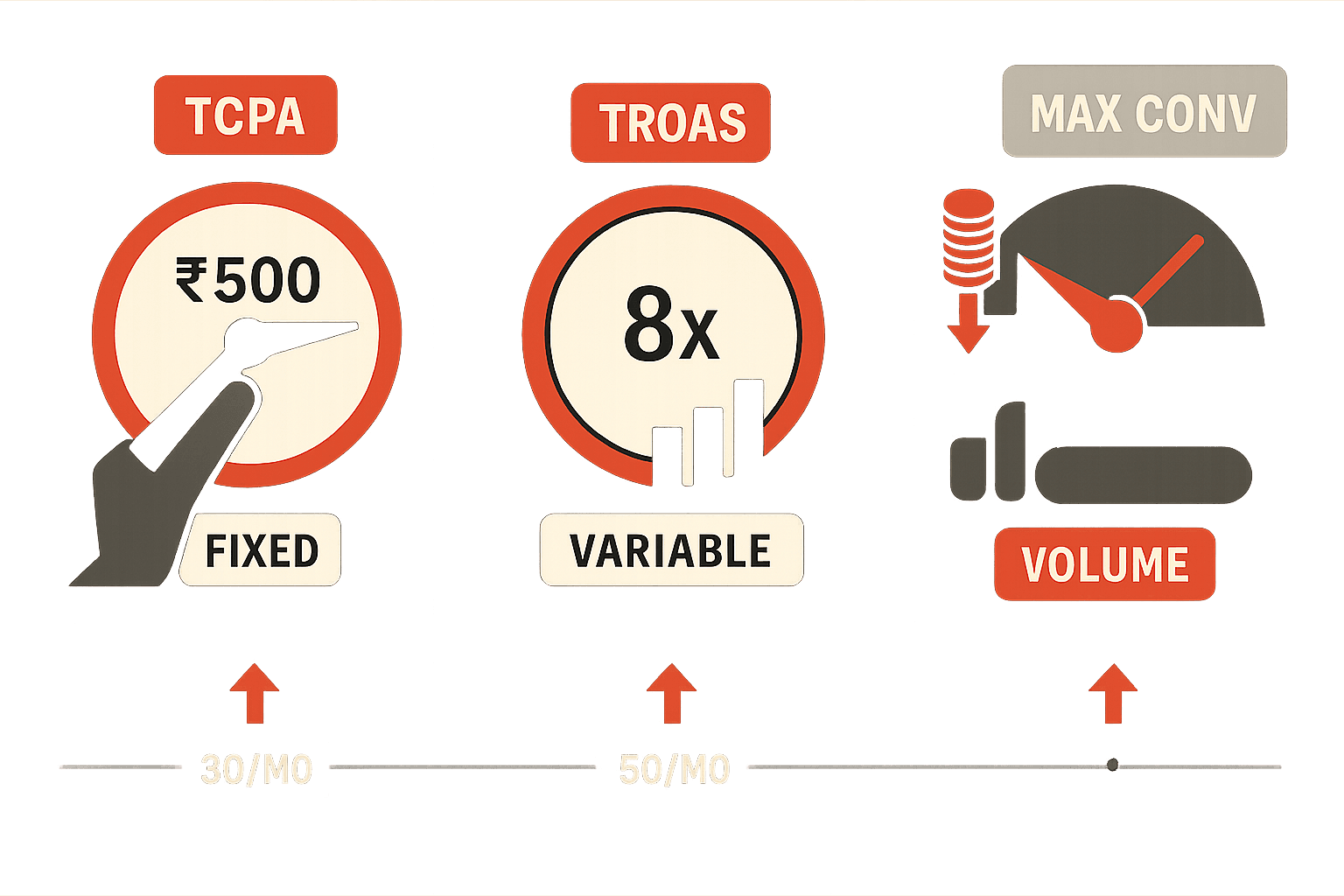
Target CPA optimizes for a fixed unit cost. The algorithm spends whatever it takes per auction to keep the average cost per conversion at the number you set, no matter how the auction landscape moves. This works when every conversion is broadly worth the same to your business: a lead is a lead, a signup is a signup, a download is a download. B2B and lead-gen accounts almost always live here.
Target ROAS optimizes for a fixed revenue ratio. The algorithm bids more aggressively for the auctions likely to produce high-value orders and bids less for low-value ones, holding the average revenue per rupee of spend at the ratio you set. This works only when conversions carry different revenue values and your tracking actually captures those values. Ecommerce, marketplaces, and subscription businesses with real LTV models live here.
Maximize Conversions optimizes for raw volume against a fixed daily budget. The algorithm spends the budget down to zero in pursuit of as many conversions as possible, with no constraint on unit cost. This is correct as a learning strategy or for the very early life of a campaign that has not yet accumulated enough data to support a target. It is rarely the right long-term home for serious spend.
Each strategy is right in a specific business shape and wrong in every other. The mistake operators make is treating them as interchangeable defaults. They are not. The same campaign on Target CPA, Target ROAS, and Maximize Conversions will produce three very different sets of trade-offs, and the right answer depends on what you are willing to pay for and what your conversion data can actually tell Google.
Target CPA: The Default For Lead-Gen And B2B
Target CPA is the right home for any campaign where every conversion is broadly worth the same to the business. A demo request from one prospect is mechanically identical to a demo request from another prospect, and the sales team is the one who differentiates them downstream. The bidding algorithm has no useful signal to bid more aggressively for one form fill than another, so the right objective is to hold the cost per conversion constant.
What Target CPA does in practice: at the moment of every auction, Google estimates the probability that the click will convert, multiplies that probability by the value implied by your target, and bids the resulting amount. High-intent auctions get bid up, low-intent auctions get bid down, and the average cost per conversion across the campaign converges to your target over time.
The condition that makes Target CPA work is conversion volume. Google needs at least thirty conversions in the last thirty days at the campaign level for the algorithm to have a credible signal of what a converting auction looks like. Below that threshold the algorithm cannot distinguish noise from pattern and the bids become guesses dressed up as automation.
The condition that makes Target CPA fail is a target set too aggressively. If you take your historical Manual CPC cost per conversion and set the Target CPA twenty percent below it, Google's response is not to magically deliver cheaper conversions. The response is to exit the high-cost auctions where most of your conversions actually happen, because the algorithm cannot meet the target there. The campaign starves on data, conversion volume collapses, and the cost per conversion you finally see is on a much smaller pool of low-value clicks.
The right cadence for tightening Target CPA is incremental: lower the target by ten to fifteen percent, give the algorithm one to two weeks to relearn, evaluate conversion volume, then lower again. Anything more aggressive triggers a learning-period collapse. We have seen accounts shave their effective cost per acquisition by thirty to forty percent over a single quarter using exactly this incremental approach, with no change to budget or campaign structure.
Target CPA is the right strategy for almost every B2B campaign, lead-gen funnel, and SaaS trial-signup flow we manage. It is the wrong strategy for ecommerce, because the average cost per conversion is the wrong objective when conversion values vary by an order of magnitude.
Target ROAS: The Default For Ecommerce With Real Value Data
Target ROAS solves the exact problem Target CPA cannot. In ecommerce, an order can be worth ₹500 or ₹50,000 depending on basket size, product mix, and customer segment. A campaign optimized on average cost per order will happily produce cheap orders that lose money, because Target CPA has no visibility into how much the order was actually worth.
Target ROAS asks a different question. Instead of holding the average cost per conversion constant, it holds the average revenue per rupee of ad spend constant at the ratio you set. The algorithm bids more aggressively for auctions likely to produce high-value orders and less aggressively for low-value ones, optimizing the total revenue the campaign produces against the total spend.
This sounds elegant, and it works. But it has one hidden data requirement that determines whether the strategy succeeds or burns budget: the conversion value passed back to Google must actually reflect the order value, not a vanity number. If your conversion tracking fires the same value for every order, or if it fires no value at all, switching to Target ROAS is strictly worse than Target CPA, because the algorithm is now optimizing for noise dressed up as variable data.
The pre-flight check before any Target ROAS migration is conversion-value audit. Confirm that the conversion event captures actual order value, that the event fires reliably across browsers and devices, that returns and cancellations flow back as negative values where relevant, and that the conversion value matches what shows up in the ecommerce backend within an acceptable tolerance. If the data is broken, fix the data before changing the bid strategy. There is no shortcut around this.
The conversion-volume requirement for Target ROAS is higher than for Target CPA: at least fifty conversions in the last thirty days at the campaign level, because the algorithm needs not just enough conversions to learn the auction landscape but also enough variance in conversion values to learn the value distribution. Below fifty conversions per month, Target ROAS is data-starved and Target CPA is the right stepping stone until volume crosses the threshold.
When Target ROAS works, it works hard. We have shipped ecommerce accounts on Performance Max with Target ROAS that grew revenue forty to sixty percent year-over-year on flat ad spend, simply because the algorithm correctly bid up the high-AOV product clusters. When it fails, it fails silently — revenue stagnates, ROAS hits the target on paper, and the team only discovers in the next board review that the campaign has stopped scaling because the algorithm has plateaued on a narrow slice of high-value auctions.
The fix when Target ROAS plateaus is to soften the target, not to abandon the strategy. Drop the target by fifteen to twenty percent, give the algorithm room to enter new auction segments, and accept a temporary lower ROAS on the books in exchange for the volume needed to keep scaling. This is the trade-off no one tells you about up front: Target ROAS at a high ratio is profitable but small, and at a moderate ratio is large but less efficient per rupee. The right ratio depends on the growth stage of the business, not on what looks best in the dashboard.
Maximize Conversions: The Learning Strategy, Not The Destination
Maximize Conversions is the most-misused bid strategy in Google Ads. The name suggests it is a strategy for maximizing conversions, which sounds like exactly what every advertiser wants. The actual behavior is more specific: spend the daily budget down to zero in pursuit of as many conversions as possible, with no constraint on the unit cost.
The two situations where Maximize Conversions is correct:
First, at the start of a campaign that has not yet accumulated enough conversion data to support a target. A new campaign with fewer than thirty conversions in the last thirty days does not have enough signal for Target CPA to function. Running Maximize Conversions instead tells Google to spend aggressively in pursuit of conversions, which accumulates the data Target CPA will eventually need. Run it for two to four weeks, watch conversion volume cross the threshold, then graduate to Target CPA with a target set at or slightly above the average cost per conversion the Maximize phase produced.
Second, on brand campaigns where conversion rate is so high that the cost per conversion is naturally low and the constraint is volume, not unit cost. Brand keywords convert at three to five times the rate of non-brand keywords because the searcher has already decided to buy. Capping a brand campaign at a Target CPA usually means leaving brand traffic on the table for no good reason. Letting Maximize Conversions spend out the daily budget on brand against your highest-converting traffic, and the math almost always works.
The case where Maximize Conversions is wrong is everywhere else. It is wrong as a long-term default on a non-brand campaign because the algorithm does not care about unit economics — it will happily spend the full budget on three-hundred-rupee clicks if the auction landscape forces it to. It is wrong on a high-volume account because the lack of a unit-cost constraint means the campaign cannot self-discipline against expensive segments. And it is wrong on any account where the CFO would notice if the cost per acquisition doubled overnight.
A useful diagnostic: if a campaign has been running Maximize Conversions for more than thirty days and conversion volume is above threshold, you are using the wrong strategy. The data exists to support Target CPA or Target ROAS, and the unit-cost constraint that strategy provides is almost always worth more to the business than the marginal volume Maximize Conversions delivers.
The Conversion-Volume Thresholds Are Not Arbitrary
The recurring constraint across all three strategies is conversion volume. Thirty conversions per month for Target CPA. Fifty for Target ROAS. Below those numbers, Smart Bidding does not function correctly, regardless of how clean the conversion tracking is or how good the offer is.
The reason is mechanical. The bidding algorithm trains on conversion events as the positive signal. Every conversion tells the model what a converting auction looked like — keyword, time of day, device, location, audience, query, landing page — and the model uses that to predict the conversion probability of the next auction. Below thirty conversions per month, the model has so few positive examples that it cannot generalize, and the predictions degenerate into bid noise.
The thresholds also explain why low-budget B2B accounts struggle with Smart Bidding. A campaign spending ₹50,000 per month at a ₹3,000 cost per conversion produces about seventeen conversions per month. That is too low for Target CPA. The right answer for that account is one of three things: run Maximize Conversions until volume crosses the threshold, consolidate adjacent low-volume campaigns into a portfolio bid strategy that pools the conversion data, or stay on Manual CPC until either the budget or the conversion rate climbs.
The Migration Plan: Manual CPC To Smart Bidding Without Burning A Quarter
The most expensive way to switch from Manual CPC to Smart Bidding is the way most accounts do it: flip the strategy on Monday morning, watch performance crater on Tuesday, panic on Wednesday, revert on Friday, and write Smart Bidding off as a Google scam.
The right migration is a four-week sequence designed to give the algorithm the data and the time it needs to outperform the human bidder you are replacing. The structure of the migration matters more than the specific dates.
Week 1: Audit the conversion tracking. Confirm every conversion event is firing correctly, that values are passed where relevant, that there are no double-counts from cross-domain redirects or pixel duplication, and that the conversion-tracking attribution model matches the business model. A campaign migrated to Smart Bidding on broken tracking will produce worse outcomes than Manual CPC, because the algorithm will optimize against noise. Half of the ROAS failures we diagnose trace to broken conversion tracking that no one audited before switching strategies. This is also a good moment to align with the attribution model decision so the bidding algorithm is optimizing against the same conversions the business team is reviewing in the board deck.
Week 2: Establish the baseline. Pull the last sixty days of Manual CPC performance and identify the median cost per conversion for campaigns moving to Target CPA, or the median ROAS for campaigns moving to Target ROAS. These are the targets you will set in week three, not aggressive stretch targets. Switching with the historical baseline as the target is the cleanest way to give the algorithm room to outperform without forcing it out of the auction.
Week 3: Switch the strategy with the baseline target. Change the bid strategy on Monday, set the target at the historical median, and do not change anything else. No budget changes. No keyword changes. No creative changes. The point is to isolate the bid-strategy switch as the only variable, so the next two weeks of data tell you whether the migration is on track. Resist the urge to make additional improvements until the learning period stabilizes.
Week 4: Hold position and measure. Do not touch the campaign for at least seven days after the switch. The first four to seven days are the learning period during which performance is more variable and frequently worse than the Manual CPC baseline. The algorithm is exploring the auction landscape, sampling auctions it did not previously enter, and reweighting bids on auctions it did enter. By day seven the data starts stabilizing. By day fourteen the comparison to the Manual CPC baseline is real.
If the comparison at day fourteen is materially worse, the diagnosis is almost always one of three things: insufficient conversion volume (campaign was under 30 conversions per month), broken conversion tracking (the algorithm is optimizing for noise), or a target set too aggressively (the algorithm exited the auctions it needed to win). Fix the underlying issue rather than reverting to Manual CPC, because reverting destroys all the data the algorithm accumulated and forces a fresh learning period the next time you try.
This is the same migration sequence we run on every account that moves to Smart Bidding, and the conversion-volume gain over Manual CPC is consistently in the fifteen to thirty percent range across both Google Ads and ecommerce PPC engagements, with no budget change required.
The Hidden Trade-Offs Each Strategy Imposes
Every Smart Bidding strategy makes a specific trade-off, and the trade-off is the thing the algorithm gives up to deliver the objective. Knowing the trade-off in advance is how you decide whether you can live with it.
Target CPA trades volume for unit cost. When you tighten the target, the algorithm exits the expensive auctions, conversion volume falls, and the cost per conversion converges to the target. If the business needs volume more than it needs unit cost discipline — for example, during a launch quarter where filling the funnel matters more than CAC — Target CPA at a tight target is the wrong objective. Loosen the target or switch to Maximize Conversions for the volume push.
Target ROAS trades range for efficiency. A high ROAS target produces efficient but narrow performance: the algorithm concentrates spend on the highest-value auction segments and avoids the rest. A lower ROAS target expands the range of auctions the campaign enters, which produces more revenue at a lower efficiency. The question is which side of the trade-off the business is willing to be on right now. Most early-stage ecommerce brands set the ROAS target too high, optimize their way into a small efficient pocket, and then wonder why the campaign stopped growing.
Maximize Conversions trades unit cost for raw volume. This is the most expensive trade-off and the reason Maximize Conversions is a learning strategy, not a destination. The algorithm will spend the full daily budget on conversions regardless of unit cost, which means cost per acquisition is whatever the auction landscape produces. In a competitive auction this can be much higher than the equivalent Target CPA, and the campaign has no mechanism to refuse expensive auctions.
The competitive auction case is the one most operators miss. A campaign on Maximize Conversions in a competitive vertical will systematically pay more per conversion than the same campaign on a Target CPA set at the historical baseline, because Target CPA refuses auctions above the target and Maximize Conversions does not. The volume gain from removing the unit-cost constraint rarely compensates for the cost-per-conversion increase, which is why the right home for Maximize Conversions is the learning phase, not the steady state.
When To Switch Strategies (And When To Hold The Line)
The diagnostic for switching strategies is performance against the trade-off the strategy imposes, not absolute performance. A Target CPA campaign that has held its cost per conversion target for six months but stopped growing is performing exactly as designed — Target CPA does not promise volume, it promises unit cost discipline. If volume matters more now than it did six months ago, the answer is to loosen the target or switch to Maximize Conversions for a deliberate volume push, then return to Target CPA when the new spend level has accumulated enough data.
The decision points that justify a strategy switch:
-
Conversion volume crosses or falls below a threshold. Below thirty conversions per month, Target CPA is data-starved. Below fifty, Target ROAS is. Above the threshold, the more sophisticated strategy unlocks better performance. Watch volume monthly and switch when the thresholds cross in either direction.
-
The business model changes. A lead-gen account that adds an ecommerce funnel needs different bid strategies on the two campaigns. A subscription business that adds an annual plan with a much higher LTV per signup needs to reweight its conversion values and probably move from Target CPA to Target ROAS. The bid strategy follows the business, not the other way around.
-
The conversion event itself changes. Switching from "form submission" to "qualified lead from the sales team" is a different conversion event with different volume and different unit cost. Treat it as a fresh campaign for bid-strategy purposes and start the data accumulation from scratch. Do not assume the old Target CPA still fits.
-
The auction landscape shifts. A new competitor enters the auction with deep pockets, or the keyword cost inflates because a category trend pushed search volume up, or a Google product change reweights the auction. Any of these can break a previously working Target CPA. The right response is to give it two weeks to relearn, then re-baseline the target against the new reality.
-
The target itself stops being credible. A Target CPA set when the average order value was ₹2,500 is no longer credible after the product mix shifts and the average order value falls to ₹1,500. Re-baseline the target whenever the business inputs that justified the original number change materially. Set the calendar reminder quarterly; the answer is rarely "no change."
The pattern that fails consistently is reactive strategy hopping. A campaign underperforms for two days, the operator switches from Target CPA to Maximize Conversions, the new strategy underperforms during its learning period, the operator switches again, and the campaign never accumulates enough stable data to function. Treat strategy switches as quarterly decisions, not weekly reactions. Give every change a full learning period before evaluating, and trust the framework above to tell you when a switch is actually justified.
Where Smart Bidding Fits In The Bigger Account Picture
The same caveat that applies to every other Google Ads lever applies here: Smart Bidding is the auction layer, not the strategy layer. A perfectly optimized Target ROAS on a poorly targeted campaign is still bidding aggressively on the wrong auctions. A perfectly tuned Target CPA on a campaign with broken landing pages still produces conversions at high cost because the conversion rate is leaking downstream.
The order of operations across the layers is the same one we have walked through in every other paid media piece, and it is the only sequence that produces compounding leverage:
First, run the wasted-spend audit and cut the obvious leaks at the targeting layer — bad search terms, irrelevant placements, missing negative keywords, audiences that should be exclusions. Most accounts recover ten to twenty percent of total spend at this step alone, and the recovered budget funds everything that follows.
Second, attack the auction layer with Quality Score work. Tight ad groups, intent-matched ad copy, dedicated landing pages, lower cost per click on every keyword you keep. The compound effect on the rest of the account is enormous.
Third, choose the right bid strategy using the framework in this post. Target CPA for fixed-value lead-gen, Target ROAS for variable-value ecommerce, Maximize Conversions for the learning phase only. Migrate with the four-week sequence, not the Monday-morning flip. Hold the target steady through the learning period.
Fourth, close the conversion gap. The cheaper, better-targeted, smartly-bid traffic has to land somewhere it can actually convert, which means the PPC landing page work cannot be skipped. The leverage at this stage is conversion rate, and a one-percentage-point improvement on a campaign at scale is often worth more than the entire bid-strategy migration.
Done in that sequence, the same advertising budget delivers materially more pipeline. We have shipped accounts that cut effective cost per acquisition by forty to fifty percent over a single quarter using exactly this stack of moves, with no change to the underlying offer, product, or sales team. The leverage is sitting in the account structure and the strategy choices, not in the budget.
If you are running paid media at scale and have not done a structural bid-strategy review in the last six months, this is the disproportionate ROI work available to you right now. Most accounts I audit are either on the wrong strategy for the business shape they actually have, or on the right strategy with a target that has not been recalibrated since the day Smart Bidding was first switched on. Either of those is worth fixing, and the fix is mechanical once the framework is clear.
If that sounds like your account, our team at Nico Digital has built this exact bid-strategy migration process for Google Ads accounts and full PPC engagements across every scale, from startups spending two lakh a month to enterprises spending two crore. The methodology is the same. The math always pays back. Talk to us when you are ready to stop bidding on autopilot.

Aditya Kathotia
Founder & CEO
CEO of Nico Digital and founder of Digital Polo, Aditya Kathotia is a trailblazer in digital marketing. He's powered 500+ brands through transformative strategies, enabling clients worldwide to grow revenue exponentially. Aditya's work has been featured on Entrepreneur, Economic Times, Hubspot, Business.com, Clutch, and more. Join Aditya Kathotia's orbit on LinkedIn to gain exclusive access to his treasure trove of niche-specific marketing secrets and insights.