

Position six is a lie your rankings report tells you.
You're on page one. You did the work. The domain authority is there, the content is solid, and the technical stack is clean.
Yet the traffic is underwhelming, the CTR is stuck at 2%, and your boss is asking why SEO is "taking so long."
Here's what most teams miss: ranking is not the same as visibility. On a modern SERP loaded with ads, featured snippets, shopping carousels, and People Also Ask boxes, position six can effectively be invisible. Users rarely scroll past the first three results without a reason. If nothing on the page interrupts their attention before they get to you, they won't.
This is a structural problem, and it needs a structural solution, not another round of title tag iteration.
What follows is a tactic we used for a premium leather goods client that moved their organic CTR from 2.1% to 4.7% in three weeks, without a single on-page SEO change. It involves running a modest Google Ads campaign on the exact keywords you already rank for, and understanding why that works at a behavioral and algorithmic level.
Why Organic CTR Stagnates at Positions 4 Through 10
The click distribution on Google's first page is not linear.
Positions one through three capture the overwhelming majority of clicks. By position six, you're looking at CTR figures that hover between 1.5% and 3% depending on the vertical, the SERP layout, and how much paid inventory sits above the fold.
A client ranking at position six for "custom leather briefcases" was experiencing exactly this. 210 monthly organic clicks on a keyword with solid commercial intent.
Their organic snippet was well-written. The page converted. The problem wasn't the page. The problem was that users weren't reaching it.
Traditional fixes here tend to be slow: earn more links to push the ranking up, rewrite the snippet to improve CTR, pursue featured snippets. These are all valid long-term moves. But they take months to register.
What we needed was a way to change how users perceived the brand on the SERP before we had the ranking to justify that perception.
The Core Mechanism: SERP Dominance and Algorithmic Testing
When a brand appears in both a paid position and an organic position for the same query, something measurable happens to user behavior. The brand reads as larger, more established, more trustworthy.
There's a documented psychological effect at work here, the mere-exposure effect, which describes how repeated exposure to a stimulus increases a person's preference for it. A user who sees your brand in the ad slot and then again in the organic results has encountered you twice in under two seconds.
That's not noise. That's perception.
But there's a second mechanism, one that's less widely discussed.
Google is continuously running ranking experiments. Its systems test whether moving a result up or down the page changes engagement metrics.
When you bid on a keyword where you already have an organic presence, Google's systems detect that a single domain is active in both the paid and organic layers of the same SERP.
Evidence from practitioners over the last several years suggests this can trigger Google to test your organic result at a temporarily higher position, say position two or three instead of six, to measure how users respond.
This isn't documented in any Google whitepaper. But the pattern is consistent enough across enough campaigns that it's worth treating as a real, if unofficial, mechanism.
The implication is significant.
Google may be running a temporary experiment using your organic result as the variable. If that result earns stronger engagement at position three than the incumbent at position three, your data improves.
Google's algorithm observes this. Over time, that signal can contribute to a durable ranking shift.
What Happened When We Tested This
The campaign setup was minimal.
With Google Ads management handled in-house, we launched a Google Search Ads campaign targeting the exact-match keyword, with a daily budget of $20 (approximately ₹1,660 per day). Ad copy was aligned tightly with the organic title and meta description to ensure brand consistency across both placements.
The organic snippet itself was not touched.
Within three weeks:
| Metric | Before | After 3 Weeks |
|---|---|---|
| Average Organic Position | 6.0 | 5.8 (briefly peaked at 3.0) |
| Organic CTR | 2.1% | 4.7% |
| Monthly Organic Clicks | 210 | 469 |
| On-Page SEO Changes | None | None |
| Total Ad Spend | $420 (≈ ₹34,900) | - |
The position briefly spiking to 3.0 in Search Console coincided with the period of sharpest CTR improvement.
This is the experimental period: Google testing the domain at a higher position and observing user behavior. The fact that CTR climbed during that window gave the algorithm a positive signal.
After the ads were paused, CTR settled at 3.8%. Not the 4.7% peak, but 80% above where it started. The SERP environment had shifted in our favor and held, at least partially, after the paid signal was removed.
The total cost to generate 259 additional monthly organic clicks was a four-week ad spend of $420 (≈ ₹34,900).
On a recurring basis, that's an extremely favorable CAC if the keyword has any commercial value, which this one did.
Addressing the Cannibalization Concern Directly
The instinctive objection from most marketing leaders is that running ads on your own organic keywords cannibalizes traffic you'd have received anyway. This is worth engaging seriously rather than dismissing.
At position six, you are not receiving meaningful traffic anyway. The incremental click volume from positions one through three versus position six is substantial. If you were already at position two, the math changes. But if you're buried in the lower half of page one, the floor is already low.
Google's own research on search ad incrementality found that the vast majority of ad clicks represent traffic that would not have occurred if the ad was absent. This finding applies most strongly in competitive verticals where the paid slots are actively contested, but the directional insight holds.
Running ads doesn't simply divert clicks from organic to paid. It creates visibility that often wouldn't have existed otherwise.
There's also the composite effect to consider.
A user who sees your brand in both positions and clicks the organic result isn't a cannibalized click. They're a user who engaged with your brand more deeply before clicking, which typically improves the quality of that visit.
When This Tactic Applies and When It Doesn't
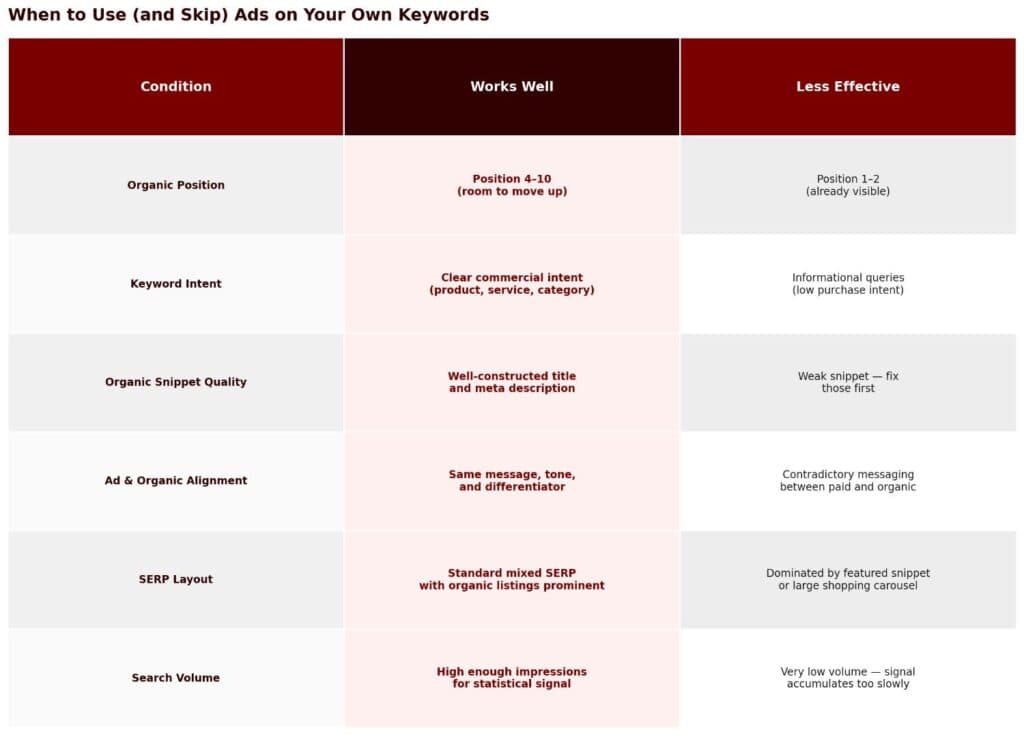
This is not a universal fix. Before allocating a budget, evaluate whether the conditions support the strategy.
| Condition | Works | Doesn't Work |
|---|---|---|
| Organic position | Between 4 and 10 - meaningful room to move | Position 1-3 - already visible; marginal lift only |
| Search intent | Commercial, transactional, product comparisons | Purely informational - clicks rarely convert |
| Organic snippet quality | Well-written title and meta in place | Weak snippet copy - fix those first |
| Ad and organic message alignment | Consistent brand voice and value proposition | Contradictory messaging - undermines trust signal |
| SERP type | Standard results with limited feature saturation | Shopping-heavy or featured-snippet-dominated SERPs |
| Keyword volume | Sufficient impressions for GSC data to be meaningful | Very low-volume - signal accumulates too slowly |
Your organic snippet must be already well-constructed. If the title tag and meta description are weak, fix those first. This strategy amplifies what's already on the SERP.
If your organic listing is dull, more exposure to a dull listing doesn't help.
How to Run This Without Wasting Budget
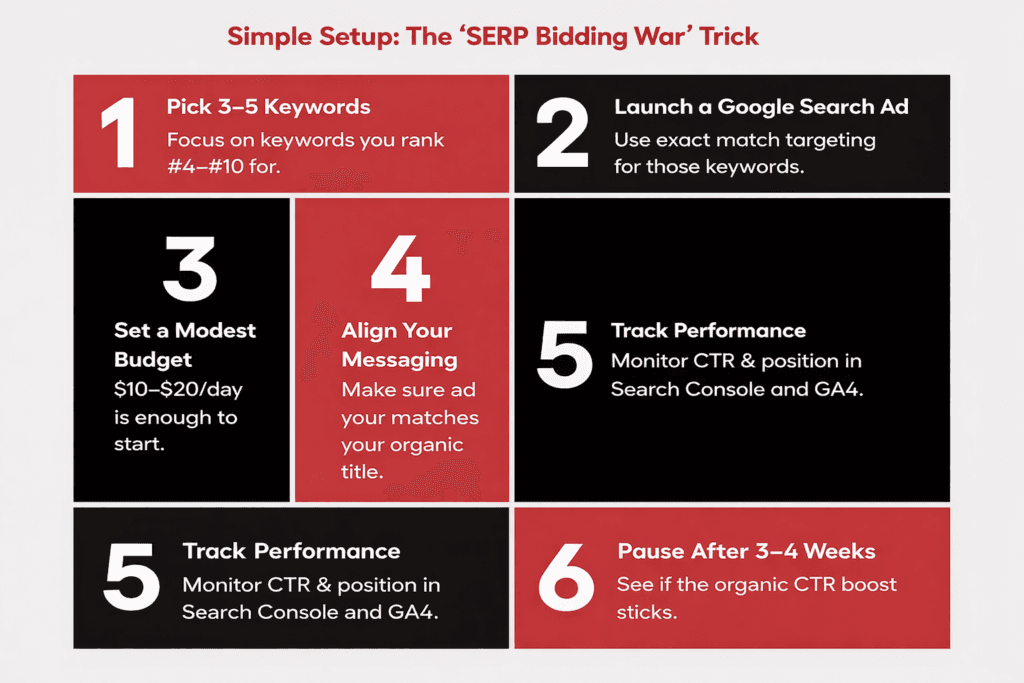
The setup is genuinely simple. The discipline is in being selective about which keywords you use it on.
Step one: Identify three to five candidates.
Pull your Search Console data and filter for keywords where the average position sits between 4.0 and 8.0 and where monthly impressions are high enough to generate meaningful CTR data. Cross-reference with your revenue analytics to confirm commercial value.
Step two: Build a tightly scoped campaign.
Use exact match targeting. You want impressions on precisely the keywords you rank for, not broad variations that dilute the signal. Keep ad groups small and organized by keyword clusters.
Step three: Set a modest daily budget.
$15 to $25 per day (approximately ₹1,250-₹2,000 per day) is sufficient to generate presence without overspending on a test. The objective is signal density, not paid click volume.
Step four: Write an ad copy that mirrors your organic listing's core value proposition.
Not identical copy, but the same message, the same differentiator, the same tone. Users should experience the two results as two expressions of the same brand, not two different pitches.
Step five: Run the campaign for four weeks, then pause.
Track organic CTR and average position weekly in Search Console throughout. Note any periods where position improves sharply, as these are the experimental windows. After pausing, monitor whether CTR holds, declines partially, or falls back to baseline.
Step six: Evaluate the organic lift as the return.
If organic CTR improved meaningfully and held after the pause, the strategy worked. If it returns to baseline, the keyword may not be a strong candidate, or the organic snippet needs improvement before retrying.
The Broader Point About SERP Strategy
Most SEO programs treat paid and organic as separate channels with separate teams, separate budgets, and separate reporting. A unified SEO and SEM strategy is far less common than it should be.
The logic is understandable: the incentives and measurement frameworks differ. But the user doesn't experience your brand through channel silos. They experience a single SERP, and what they see in aggregate shapes whether they click.
Brands that coordinate paid and organic visibility around the same high-value keywords create a compound effect that neither channel achieves independently. The paid placement builds exposure.
The organic placement earns trust. Together, they produce CTR performance that outpaces what the organic position alone would suggest.
This is less about a specific tactic and more about how you think about search investment. If your team is optimizing organic in isolation while your paid team runs branded and competitor campaigns without regard to organic overlap, you're leaving compounding gains on the table.
The $420 test described here didn't just lift CTR.
It demonstrated that a relatively small paid investment - the kind any experienced Google Ads agency India would structure as a signal test - can change the competitive dynamics of an organic position that had been stagnant for months. That's a different way of thinking about paid media as a lever within an organic SEO program, not as a substitute for it.
For a deeper look at how SERP features and paid inventory are restructuring organic visibility more broadly, see our breakdown of the SERP Squeeze problem affecting ecommerce rankings.
What to Watch Out For
A few operational notes before you run with this.
CTR improvements from this tactic can be temporary. The algorithmic test period appears to last a few days to a couple of weeks for most keywords. The organic CTR gain that persists after the ads pause is the more meaningful metric.
A 4.7% peak that settles to 3.8% is still a strong outcome. A 4.7% peak that drops back to 2.1% suggests the organic result didn't earn lasting signal during the test.
Don't conflate the paid clicks and the organic clicks in your reporting. They need to be tracked separately to understand which channel is producing the lift. If you're only looking at blended traffic, you'll misattribute the gain.
This tactic doesn't fix a weak page. If organic bounce rates are high or time-on-site is poor, more traffic to the page will amplify the problem, not solve it. Get the conversion fundamentals right before scaling exposure.
And finally, this is not a replacement for organic work.
Link building, content depth, technical health, and topical authority are what sustain rankings over the long term. What this tactic does is accelerate a CTR outcome for a page that's already done the foundational work and is stuck at a position where visibility is the binding constraint.
Frequently Asked Questions
What is a good organic CTR benchmark by search position?
Industry averages vary by vertical, but rough benchmarks are: position 1 captures approximately 25-30% CTR, position 2 gets 12-15%, position 3 earns 8-10%, positions 4-6 average 3-6%, and positions 7-10 typically see 1-3%. If your CTR falls significantly below the benchmark for your current position, SERP feature saturation or weak snippet copy is usually the cause - not the ranking itself.
How do I track organic CTR changes in Google Search Console?
Go to Google Search Console, click Search Results, then Queries. Filter by a specific keyword or URL and compare the CTR column across date ranges. Use the Compare feature to contrast periods when ads were running versus paused. A persistent CTR lift during active paid periods - one that doesn't fully revert after pausing - confirms the strategy is sending durable engagement signals to Google's systems.
Does this strategy work for informational keywords?
The effect is significantly weaker on informational queries. Users searching "how to care for leather" are not ready to purchase, and double SERP presence doesn't change that buying intent. The strategy works best when purchase intent is already present - the user is evaluating options, not gathering information - because the brand recognition effect nudges a primed buyer rather than educating a passive reader.
How is this different from just running retargeting ads?
Retargeting shows ads to users who have already visited your site. This strategy targets users who are searching the exact keyword for the first time - users who have never encountered your brand. The goal is to create the impression of market authority at the moment of first contact, not to re-engage an existing warm audience. The two tactics complement each other but serve different stages of the funnel.
Conclusion
Organic CTR is not purely a function of rank position. It is a function of SERP visibility - and in modern search results, visibility is shaped by what surrounds your listing as much as where your listing sits.
Running a modest paid campaign on keywords where you already hold an organic position between four and ten is one of the highest-leverage, lowest-cost experiments available to a search marketing team. The mechanism is behavioral - double presence increases perceived authority - and potentially algorithmic - Google's test systems may temporarily surface your organic result higher when they detect coordinated paid and organic presence.
The test costs less than a week's worth of a typical paid search budget. The downside is bounded. And the upside, a durable CTR improvement that persists after ads pause, is the kind of compounding gain that rank-centric reporting consistently undervalues.
If you want to pressure-test your current rankings against this framework, request a teardown → We'll look at where your organic positions are underperforming relative to their potential and identify which keywords are most likely to respond to SERP amplification.

Aditya Kathotia
Founder & CEO
CEO of Nico Digital and founder of Digital Polo, Aditya Kathotia is a trailblazer in digital marketing. He's powered 500+ brands through transformative strategies, enabling clients worldwide to grow revenue exponentially. Aditya's work has been featured on Entrepreneur, Economic Times, Hubspot, Business.com, Clutch, and more. Join Aditya Kathotia's orbit on LinkedIn to gain exclusive access to his treasure trove of niche-specific marketing secrets and insights.