

Most Google Ads accounts have quietly lost twenty to forty percent of their conversion signal in the last three years, and Smart Bidding has been making decisions on the corrupted half ever since. Enhanced Conversions, Consent Mode v2, and Customer Match are how you put the signal back. This is the first-party data activation playbook we run on every account, the silent failure modes that catch most implementations, and the validation routine that proves the signal you just rebuilt is actually being used.
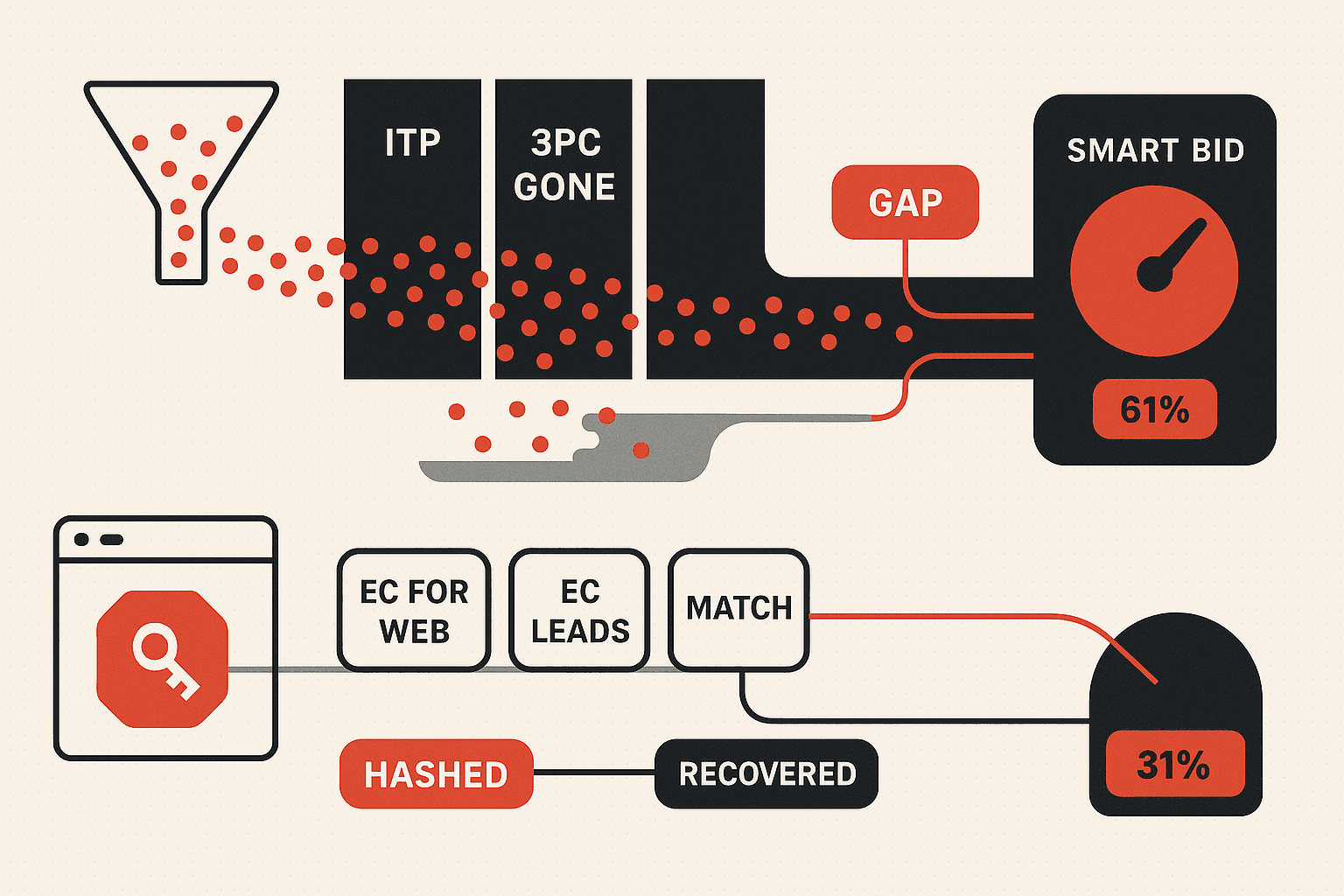
A few weeks ago, a brand we had just inherited showed us their Google Ads dashboard with a calm sort of confidence. ROAS was stable at 4.1. Conversion volume was flat. Cost per acquisition was within the band their last agency had committed to. By every visible number the account was healthy. By every invisible number, it was not.
When we ran the full conversion-signal audit, the picture changed. About thirty-one percent of their reported conversions in the previous quarter were modelled, not measured, meaning Google had estimated them in the absence of a verifiable click-to-conversion chain. Their match rate on the standard tag was thirty-nine percent against the orders table in their database, meaning roughly six out of every ten paid purchases were not being attributed to the click that drove them. And the Smart Bidding strategy, Target ROAS at 4.0, had been steering bids on the visible 39 percent of the funnel while the bigger half was effectively invisible to it.
That is the state of most Google Ads accounts in 2026, even well-managed ones. Cookie restrictions, cross-device journeys, and tightening consent norms have quietly broken the measurement layer that Smart Bidding relies on, and the platform has been compensating with modelling that hides the breakage. Enhanced Conversions is the fix that everyone has heard of and very few accounts have implemented correctly. Consent Mode v2 is the layer underneath it that most teams skipped. Customer Match is the audience layer that completes the first-party data stack. Run all three correctly, and the bidder gets the signal it needs to do its job. Skip them, and you keep paying smart-bidding prices for dumb-bidding signal.
What You Actually Lost in the Last Three Years
The conversion-signal degradation did not happen in one cliff. It happened in four steps, each one quietly eroding a different part of the measurement chain.
The first was Safari Intelligent Tracking Prevention, which from 2020 onward began capping first-party cookie lifetimes at seven days and then at twenty-four hours for cookies set via document.cookie. For any conversion path longer than a day, which is almost every considered purchase, the click cookie expired before the user came back to convert. The conversion still happened, but the cookie that would have credited the ad was gone.
The second was the iOS 14.5 release of App Tracking Transparency in 2021. The visible damage hit Meta Ads hardest, but Google Ads lost roughly fifteen to twenty percent of in-app and mobile-web conversion attribution as a knock-on effect, mostly in apps and Safari traffic where the IDFA had been doing implicit attribution work.
The third was the long-running third-party cookie deprecation cycle in Chrome, which went through multiple delays and reversals before settling on a privacy-sandbox approach in 2024-25 that still removed material amounts of cross-site identification. Cross-device journeys, the customer who clicks on phone and buys on desktop, became increasingly opaque.
The fourth was the rollout of Consent Mode v2 in early 2024, made mandatory for advertisers using EU traffic and increasingly relevant to India and other GDPR-aligned regions. Accounts that did not implement the new consent signals lost the ability to receive modelled conversions for the denied-consent slice of traffic and started seeing measurable underreporting.
Stacked together, these four shifts pulled the conversion signal Smart Bidding sees away from the conversion signal that actually happened. The gap is not constant, it varies by industry and traffic mix, but on the accounts we audit the typical range is twenty to forty percent of conversions either missing entirely from Google Ads or attributed to the wrong campaign. A bidder optimising on the visible half is, by definition, optimising on the wrong objective.
The chart is a generalised picture. Some accounts have lost more, others less, but the trajectory is the same on every account that has not actively rebuilt the signal layer. The fix is not one feature. It is a stack.
What This Does to Smart Bidding
If you have already moved to Target CPA, Target ROAS, or Maximize Conversions, the conversion-signal gap matters more than it did in the Manual CPC era. Smart Bidding is a prediction engine. It predicts the probability and value of a conversion for each impression based on hundreds of signals, and it bids accordingly. The training data for that prediction is the conversion events the account has recorded. If thirty percent of conversions are missing and the missing slice is not random, which it never is, the predictions are biased.
The bias usually runs in a specific direction. Conversions that involve longer consideration windows, cross-device journeys, or privacy-conscious user segments are the ones most likely to be missing. Those are also typically the higher-value conversions. So the bidder ends up underbidding on the audiences, keywords, and times of day that are actually producing the most revenue, and overbidding on the short-window, single-device, easily-tracked segments that look profitable but represent a shrinking share of real demand. Over time, the bidder gets very good at acquiring an increasingly narrow slice of the market, and the rest of the funnel quietly slips toward your competitors.
The fix is not to abandon Smart Bidding and go back to manual. The fix is to give the bidder the signal it needs to see the rest of the funnel.
The Three Layers of First-Party Data Activation
First-party data activation in Google Ads is not one feature. It is a three-layer stack, and most accounts implement one layer and miss the other two. The diagram below shows how the three layers fit together and what each one fixes.
The bottom layer is the foundation. Without Consent Mode v2 in place, the other three layers operate on incomplete consent data and the modelled-conversion fallback that fills the denied-consent gap never engages. The web and leads layers are the workhorses, recovering deterministic conversion signal from on-site purchases and offline lead progression respectively. Customer Match sits at the top, shaping who the bidder is even willing to pay for and excluding existing customers from prospecting budgets that should be acquiring new ones.
Enhanced Conversions for Web - The Setup
The web flavour is the entry point and the easiest to ship. The tag captures a first-party identifier, almost always the email entered at checkout or the phone number entered in a contact form, hashes it client-side using SHA-256, and sends the hash alongside the standard conversion event. Google then matches the hash against signed-in user identifiers on its own side and recovers conversions that the cookie would have lost.
Three implementation methods are available, and the choice has real consequences. The Google Tag implementation is fastest and lowest-effort but the least flexible. The Google Tag Manager implementation, using the Conversion Linker plus an enhanced-conversions variable, is the right default for most accounts because it lets you control exactly when the tag fires and what data layer fields it reads. The Google Ads API implementation, server-side, is the right choice for accounts with strict CSP policies or where the email is only available in the backend after a payment confirmation webhook.
Whatever method you choose, three things have to be true for the implementation to actually work. First, the identifier has to be present in the data layer or DOM at the moment the tag fires. The dominant failure mode here is the tag firing on a page load event that happens before the order-confirmation page has populated the customer email. Second, the identifier has to be normalised before it is hashed: emails lower-cased and whitespace-trimmed, phone numbers in E.164 format with country code. The platform's diagnostics will show match rates of ten to twenty percent on accounts that hash unnormalised data, and the fix is often a five-minute correction in the GTM variable. Third, the hash itself has to be SHA-256, not MD5 or any other algorithm. Double-hashing, where the GTM variable hashes an already-hashed input, produces a perfectly formed hash that matches nothing.
Validation runs in two places. The Enhanced Conversions diagnostic panel in Google Ads, under Tools and Settings then Conversions, will show match rate and a recorded-conversions count within twenty-four to forty-eight hours of correct firing. The browser-side tag-assistant trace will show whether the identifier field is populated and whether the hashing is happening locally before the network request leaves the browser. If both show green, the implementation is working. If diagnostic is green and tag-assistant is red, you are sending plaintext to Google, which is a compliance breach as well as a signal-quality issue.
Enhanced Conversions for Leads - The B2B Lever
The leads flavour is where most B2B accounts have the biggest opportunity and the smallest implementation. The premise is simple. A user clicks an ad, lands on the site, fills out a form, becomes a lead in your CRM, and then days or weeks later progresses to a sales-qualified opportunity or a closed-won deal. The actual business outcome happens long after the click and outside the website. Standard conversion tracking ends at the form fill, which means Smart Bidding optimises toward form fills, which means the bidder cannot tell the difference between a high-intent enterprise lead and a low-intent template-completer.
Enhanced Conversions for Leads fixes this by letting you upload the post-form-fill outcomes back to Google Ads, tied not to the gclid, which is fragile and often lost in the CRM-to-marketing-platform handoff, but to the hashed email captured at the form fill. Google matches the email back to the original click on its side and credits the right campaign, ad group, and keyword with the SQL or the closed-won.
The implementation has three pieces. First, the form-fill tag has to capture and hash the email at the point of submission, exactly the same as Enhanced Conversions for Web. Second, the CRM has to push lead-status changes back to Google Ads, either through a native connector for HubSpot, Salesforce, and Pipedrive, or through a Zapier or custom-built pipeline that fires the conversion adjustment API call when a lead progresses. Third, the conversion action setup in Google Ads has to be configured for offline import with a click-through window that matches your actual sales cycle, typically thirty to ninety days for B2B.
Done correctly, this is the single highest-leverage change you can make to a lead-gen Google Ads account. It moves the optimisation objective from "more form fills" to "more revenue," which is what the account was supposed to be optimising on in the first place. We have seen brands move from a CPA-of-form-fill of around fifty dollars and a closed-won rate of two percent, to a CPA-of-SQL of around four hundred dollars with the same total spend, simply because the bidder finally knew which form fills were worth bidding harder for.
For accounts already running Target CPA on lead value, this is also what unlocks the move from tCPA to tROAS, because once revenue data is flowing back, the bidder can optimise on value rather than count.
Customer Match - The Audience Layer
Customer Match is the third layer and the one most often used badly. Uploading a customer list with no segmentation logic is not a strategy. The point of Customer Match is to shape who the bidder is willing to pay for in three specific ways: exclusion, bid modification, and lookalike sourcing.
Exclusion is the simplest and highest-impact application. A list of existing customers, excluded from prospecting campaigns, prevents your acquisition budget from being spent on retention. On accounts running Performance Max, the share of budget being spent on existing customers is often the difference between a profitable PMax and a wasteful one, and a customer-exclusion audience is the simplest way to enforce that separation.
Bid modification is the next step. A list of high-LTV customers, applied as a positive bid modifier on retargeting and brand-defence campaigns, recognises that not all clicks are worth the same amount. A list of recent unconverted-cart abandoners, applied as a bid modifier on the prospecting campaigns those users typically engage with, lets the bidder pursue the warm-but-not-yet-converted segment more aggressively without inflating bids across the board.
Lookalike sourcing, called Similar Audiences in the Google Ads UI, used to be the third application, but Google has been gradually deprecating it in favour of audience signals fed into Performance Max. The current 2026 reality is that Customer Match feeds both the explicit audience layer in Standard Search and Shopping campaigns and the audience-signal layer in Performance Max, where it materially shapes the early-learning audience model.
List hygiene matters more than list size. A list of thirty thousand active customers refreshed monthly outperforms a list of one hundred and fifty thousand mixed-quality emails refreshed annually. The minimum list size for Customer Match to activate is one thousand matched users, but the practical threshold for meaningful signal is closer to five to ten thousand. Below that, treat Customer Match as an exclusion-only tool rather than a targeting one.
Consent Mode v2 - The Foundation Layer
Consent Mode v2 is the layer most accounts skipped because the rollout coincided with a quiet period in the consent-management news cycle, and most teams treated it as a checkbox compliance item rather than a measurement enabler. That was the wrong frame.
Consent Mode v2 added two new consent signals on top of the original Consent Mode framework, ad_user_data and ad_personalization, which together let advertisers communicate granular consent to Google Ads. When consent is granted, the tag fires normally and Enhanced Conversions data is sent. When consent is denied, the tag fires in a degraded mode that sends pings without identifiers, and Google's modelling engine uses those pings, combined with the granted-consent data from similar users, to estimate the missing conversions.
The practical effect on a real account is significant. For traffic from regions where consent friction is high, the EU is the obvious case but India, Brazil, and increasingly Indonesia are following similar trajectories, the difference between Consent Mode v2 implemented correctly and Consent Mode v2 missing or broken is typically ten to twenty percent of attributed conversions. That is not a rounding error. It is the difference between Smart Bidding seeing the campaign as profitable and Smart Bidding pulling spend out of it.
The implementation has two parts. The Consent Management Platform, whether OneTrust, Cookiebot, Iubenda, or a custom build, has to be configured to set the four Consent Mode signals correctly based on the user's actual consent choices. And the Google tag, whether deployed via Google Tag or GTM, has to be configured to read those signals and respond to them. Both parts have to be right. A CMP that sets the signals correctly but a tag that ignores them, or a tag that reads consent correctly but a CMP that defaults all signals to granted, produces a setup that looks compliant but is not.
The Seven-Point Validation Audit
The implementation work is the easy part. The validation work is what most teams skip and what determines whether the signal you just rebuilt is actually being used. The seven-point audit below is what we run on every account at week one, week four, and quarterly thereafter.
First, check the Enhanced Conversions diagnostic panel in Google Ads. Match rate above thirty percent and a recorded-conversions count consistent with overall conversion volume indicates the tag is firing and matching. Match rate below thirty or recorded count well below total conversions indicates a coverage or normalisation problem.
Second, check the customer-data field reporting in the conversion action setup. Each conversion action should show which first-party data field is being passed, email or phone or both, and the percentage of conversions for which that field was present. Fields present below seventy percent indicate the tag is firing on a page or event where the data is not yet available.
Third, run a tag-assistant trace on a real conversion event. Verify that the identifier is captured, hashed before the network request, and sent in the user_data parameter. A plaintext identifier in the request is a compliance breach. A missing user_data parameter means the implementation is not actually upgraded.
Fourth, verify Consent Mode v2 signal firing using the Google Tag Manager preview or the Tag Assistant Consent Mode panel. Each tag firing should show the current state of ad_user_data, ad_personalization, ad_storage, and analytics_storage. All-granted or all-denied across every user, regardless of their consent choice, indicates the CMP signal is not being read.
Fifth, check Smart Bidding strategy reporting for changes in conversion attribution. Within two to four weeks of correct implementation, the strategy reporting should show conversions distributed across a broader set of campaigns, keywords, and audiences than before. If the distribution looks identical to pre-implementation, the bidder is not yet using the new signal, and the data flow probably has a break.
Sixth, run the offline conversion diagnostic report for Enhanced Conversions for Leads. The report shows uploaded conversions, matched conversions, and the reasons for unmatched ones. Reason codes like "Conversion outside click-through window" usually indicate the conversion window is set too narrow for your actual sales cycle. Reason codes like "User identifier not matched" usually indicate normalisation issues at the upload step.
Seventh, cross-check Google Ads-reported conversions against your source of truth, the orders table for ecommerce or the CRM closed-won report for B2B, on a monthly basis. The gap should narrow over time, not widen. A widening gap indicates either an implementation regression, often caused by a website code change that broke the data-layer field the tag was reading from, or a CMP change that altered the consent-signal behaviour.
KPIs That Prove the Signal Is Recovered
Reported conversions go up. That is the visible outcome, and on a typical implementation the lift is between fifteen and forty percent within six weeks. But the more telling KPIs are the secondary ones.
Match rate is the leading indicator. Once it stabilises above sixty percent for ecommerce or above forty-five percent for lead-gen, the implementation is operating at full strength and the signal quality is no longer the limiting factor on Smart Bidding performance.
Modelled-conversion share is the lagging indicator. As deterministic matching improves, the share of Google's reported conversions that come from modelling rather than direct matching should fall. A pre-implementation account often has thirty to forty percent modelled-conversion share. A correctly-implemented account should see that fall to ten to fifteen percent within a quarter.
Cost-per-acquisition and return on ad spend, the headline metrics, should improve, but the improvement comes from a particular place: better distribution rather than across-the-board reduction. The campaigns and audiences that were previously underbid because their conversions were being credited elsewhere will see CPA fall and conversion volume rise. The campaigns and audiences that were previously overbid because their visible conversion rate was inflated by attribution errors will see spend fall and ROAS rise.
The new-customer share of conversions is the strategic KPI. With Customer Match exclusions in place and the conversion signal recovered, the share of conversions coming from new customers should rise, often substantially. On the brand we audited at the start of this piece, new-customer share went from forty-one percent to sixty-three percent of paid conversions within a quarter, with no change in total spend. The bidder finally had the signal it needed to pursue acquisition rather than retention.
Five Mistakes That Quietly Break Enhanced Conversions
The implementation traps are predictable, and the same five show up on most audits.
The first is firing the tag on a page where the first-party data field is not yet populated. The fix is to move the trigger to the order-confirmation page or the form-success event, and to verify the data layer field exists at that moment using the tag-assistant trace.
The second is hashing unnormalised data. Emails not lower-cased, whitespace not trimmed, phone numbers without country codes. The fix is a five-minute correction to the variable definition in GTM that normalises before hashing.
The third is double-hashing. A variable that hashes an input that was already hashed produces a hash of a hash, which matches nothing. The fix is to verify in tag-assistant that the input to the SHA-256 function is plaintext, not an already-hashed value.
The fourth is treating Consent Mode v2 as a CMP-only project. The CMP sets the signals, but the Google tag has to be configured to read them, and the conversion actions have to be configured to use the modelled-conversion fallback. Skipping any of those three legs produces a setup that looks live but does not actually recover the denied-consent slice.
The fifth is using offline conversion imports without status-change push-back. Uploading a one-off file of closed-won deals does not work. The bidder needs ongoing conversion updates as leads progress, and the CRM-to-Google connector has to push status changes on a daily or near-real-time cadence for the signal to compound into bidding decisions.
Where This Fits in Your Account
Enhanced Conversions sits next to conversion tracking accuracy as the foundation of every other paid-media improvement. Without clean conversion signal, Quality Score diagnostics cannot tell you what to fix, Smart Bidding strategy choice is constrained by the noise in the data, and landing page conversion optimisation reads the wrong signal because the success metric is wrong. It is also what makes customer acquisition cost reduction sustainable rather than seasonal.
For a brand running Performance Max as the dominant campaign type, Enhanced Conversions plus Customer Match exclusions changes the campaign from a retargeting amplifier into an acquisition engine. For a B2B account running search and demand-gen, Enhanced Conversions for Leads is the upgrade that makes account-based marketing budget allocation measurable rather than aspirational.
If you are evaluating where to start a quarterly audit of your paid media, this is the first layer to check, not because it is the most glamorous, but because every other optimisation is sitting on top of it. A bidding strategy can only be as good as the signal it sees. A landing page can only be tested honestly against a conversion event that is accurately tracked. An audience strategy can only allocate budget rationally between acquisition and retention if it knows who is already a customer.
Our PPC services and Google Ads management engagements treat conversion-signal recovery as week one. Not because it is a checkbox, but because everything else we change in week two through week twelve depends on the bidder seeing the funnel correctly. If you are running Smart Bidding on signal that is missing twenty to forty percent of the truth, you are paying a tax every day that compounds quietly.
The good news is that the recovery is mechanical. The features exist, the documentation exists, the validation tools exist. The work is in the discipline of implementing all four layers, verifying each one with the seven-point audit, and rerunning the validation quarterly to catch the silent breaks that website changes and CMP updates introduce. Brands that do this consistently end up with a measurement layer that the bidder can trust. Brands that skip it keep wondering why their Smart Bidding strategy never quite hits the target.
What to Do This Week
If you want to start the recovery this week, run the lightweight diagnostic first. Open Google Ads, go to Tools and Settings, then Conversions, then Diagnostics, and check the Enhanced Conversions status panel for each of your primary conversion actions. If the panel shows "not configured" or match rate below thirty percent, you have a real opportunity. If it shows match rate above sixty percent and recorded-conversions count consistent with total volume, you are operating at full strength on Layer 2 and the next opportunity is probably Layers 1, 3, or 4.
Then check Consent Mode in your tag manager. Verify that ad_user_data and ad_personalization are being set based on actual user consent and not defaulted to either value across all users. And pull your Customer Match audience list freshness in the audience manager: anything not refreshed in the last sixty days is likely too stale to be useful for either targeting or exclusion.
Those three checks take less than thirty minutes and tell you which layer of the stack to fix first. The full implementation, across all four layers and with the validation routine in place, is typically a four-to-six-week project on a single account. The performance lift starts showing up around week six and continues to compound for several months as Smart Bidding incorporates the cleaner signal into its model.
The competitors who have already done this work are not going to tell you. They will continue to outbid you on the keywords and audiences you cannot see clearly, while their account looks slightly better than yours on every metric for reasons that are not obvious from the outside. The signal recovery is the unglamorous infrastructure work that decides who wins the next three years of paid search, and it is the work most accounts are still deferring.
If you would like us to run the seven-point validation audit on your account and produce the prioritised remediation list, get in touch. We will not pretend the implementation is more complicated than it is. We will show you exactly which layer of the stack is leaking signal, what the recovery is worth at your current spend level, and the order to fix the breaks in.

Aditya Kathotia
Founder & CEO
CEO of Nico Digital and founder of Digital Polo, Aditya Kathotia is a trailblazer in digital marketing. He's powered 500+ brands through transformative strategies, enabling clients worldwide to grow revenue exponentially. Aditya's work has been featured on Entrepreneur, Economic Times, Hubspot, Business.com, Clutch, and more. Join Aditya Kathotia's orbit on LinkedIn to gain exclusive access to his treasure trove of niche-specific marketing secrets and insights.