

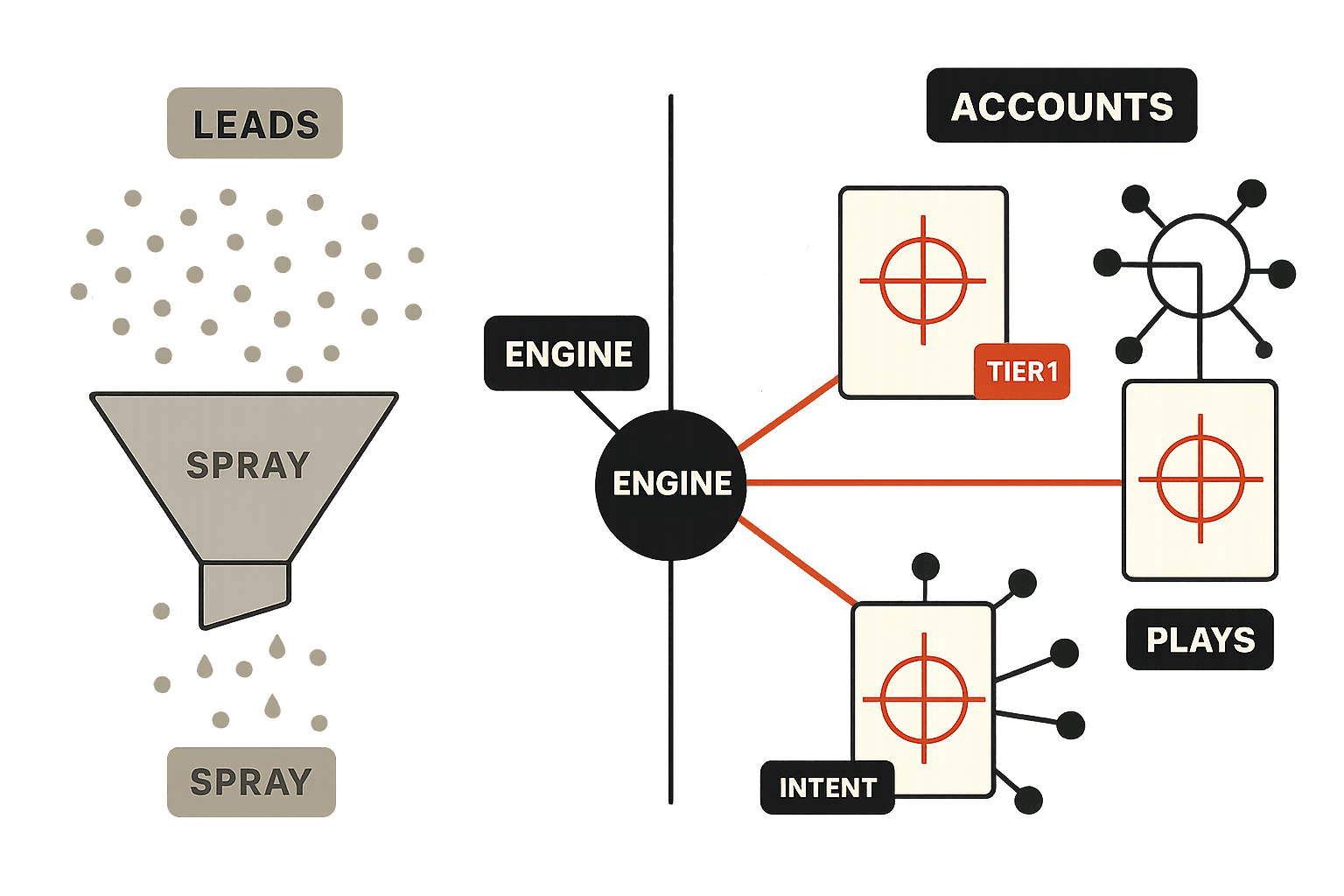
Most B2B funnels are optimised to manufacture leads, not revenue. The sales team ignores ninety percent of them, the MQL count looks healthy, and the pipeline stays thin. Account-based marketing flips that logic: pick the small set of accounts that can actually move your number, surround each one's buying committee, and measure pipeline instead of form fills. This is the operating system we run to build an ABM programme that produces deals rather than dashboards.
A B2B marketing team hits its lead target for the quarter and celebrates. Eleven hundred MQLs, up thirty percent. Then the quarterly business review arrives, the revenue number is missed again, and the head of sales says the thing every demand-gen marketer dreads to hear: "the leads are garbage."
Both sides are right, and that is the problem. Marketing did generate the leads. Sales did find them unworkable. The funnel did its job and the business still lost. This is the structural failure of volume-first B2B marketing: it optimises for the thing that is easy to count, the lead, and ignores the thing that actually pays the bills, the account.
Account-based marketing is the correction. It is not a campaign type or a software category, although vendors will try to sell it to you as both. It is a decision about where to point your effort. Instead of trying to attract everyone and filter down to the few who matter, you start with the few who matter and concentrate everything on them. You stop asking "how do we get more leads?" and start asking "how do we win these specific companies?"
That single shift changes the targeting, the content, the channels, the metrics, and the relationship between marketing and sales. This post is the system we run to make it work.
What Account-Based Marketing Actually Is
ABM treats the account as the atomic unit of marketing. Not the lead, not the contact, the account. A target list of named companies replaces a target audience of anonymous personas. Marketing and sales agree on that list together, and then everything is aimed at moving those companies, not at filling a database.
The clearest way to understand ABM is to see what it inverts. Traditional demand generation is a funnel: wide at the top, narrow at the bottom, designed to pour in as much volume as possible and filter relentlessly so that a small qualified fraction reaches sales. ABM flips the funnel. It starts narrow, with a deliberately chosen set of accounts, and then expands inside each one, engaging more of the buying committee, opening more conversations, and growing the relationship after the first deal closes.
This is why ABM and broad demand generation are not the same discipline wearing different names. They use different inputs, run on different timelines, and are judged on different metrics. Demand gen asks how cheaply it can produce a qualified lead. ABM asks whether the specific companies worth winning are engaging and entering pipeline. A team that runs ABM on demand-gen metrics will conclude, wrongly, that it is failing, because ABM deliberately produces fewer, more expensive, far more valuable opportunities.
When ABM Is Worth It, and When It Is Not
ABM is not a universal upgrade. It is a concentration strategy, and concentration only pays when the prize is big enough to justify pointing scarce resources at a small number of targets. Before committing, pressure-test the fit against four conditions.
High deal value. ABM costs more per account than broad marketing costs per lead, by design. That premium only makes sense when a single account is worth a great deal, whether that is a large one-time contract or an annual relationship that compounds. If your average deal is small and transactional, the maths does not work.
A buying committee, not a buyer. The modern B2B purchase involves multiple stakeholders, often six to ten people across functions, each with a different concern. ABM is built for exactly this: surrounding a committee with messages tuned to each role. If your product is bought by one person on impulse, you do not need the machinery.
A considered, multi-stage sales cycle. ABM shines when the decision takes months and passes through evaluation, consensus, and procurement. The longer and more complex the journey, the more value there is in coordinated, sustained, multi-threaded engagement.
A nameable market. You have to be able to write down the companies worth winning. If your total addressable market is a finite, identifiable set of organisations, you can target them. If it is hundreds of thousands of undifferentiated small buyers, broad demand generation will serve you better, and you should invest in lead generation systems built for volume instead.
When all four hold, and they usually do for enterprise, SaaS, fintech, and considered B2B purchases, ABM is the highest-leverage way to spend a marketing budget. When they do not, it is an expensive way to overcomplicate a volume problem.
The Three Tiers of ABM
"Account-based marketing" describes a spectrum, not a single tactic. In practice it runs in three tiers that trade depth of personalisation against breadth of coverage. Mature programmes run all three at once, matching the level of investment to the value of the account.
One-to-one, strategic ABM. Reserved for the handful of accounts that could individually transform the business. Each gets bespoke treatment: custom research, a tailored value proposition, executive-to-executive relationships, sometimes content built for that single company. The cost per account is high and the account count is low, often single digits. This is craft work, not campaign work.
One-to-few, ABM lite. A middle band of accounts grouped into small clusters that share an industry, a use case, or a specific pain point. Each cluster gets lightly personalised campaigns that speak to its shared context without the cost of fully bespoke work. This is where most of the disciplined volume lives, typically tens of accounts per cluster.
One-to-many, programmatic ABM. Technology-driven personalisation across hundreds of fit accounts, powered by intent data, account-targeted advertising, and dynamic website content that changes based on the visiting company. The personalisation is shallower but the coverage is wide, and it keeps the long tail of your fit list warm so that when an account heats up, you are already present.
The art is allocation. A small number of accounts deserve one-to-one effort, a larger band justifies one-to-few clustering, and the rest are covered programmatically. Spending one-to-one effort on a low-value account is waste; covering a transformational account with only programmatic ads is negligence.
Building the Target Account List
Everything in ABM depends on the list. Get the list wrong and the most beautifully orchestrated campaign in the world is aimed at the wrong companies. The list is built on two axes, and both matter.
The first axis is fit: how well an account matches your ideal customer profile. Build the profile from evidence, not ambition. Pull your best existing customers, the ones that close fastest, stay longest, expand the most, and complain the least, and extract the patterns. Firmographics first: industry, company size, revenue band, geography, business model. Then technographics: the tools and platforms they already run that your product complements or replaces. Then operational signals: the structures, roles, or situations that make a company a natural buyer. The output is a precise, evidence-based definition of the companies worth winning.
The second axis is intent: whether an account is showing in-market behaviour right now. Fit tells you who is worth pursuing; intent tells you who is worth pursuing this quarter. Intent signals include research activity on your category, engagement with your content, visits to high-commercial pages, hiring patterns, funding events, leadership changes, and third-party intent data that flags accounts researching your space across the web.
Plot every addressable account on those two axes and the priorities draw themselves.
The matrix turns a vague list into a sequenced plan. The top-right quadrant, high fit and high intent, is Tier 1: the right accounts buying right now, and they deserve one-to-one effort with sales fully engaged today. The bottom-right, high fit and low intent, is the nurture band: the right accounts that are not in-market yet, where one-to-few campaigns and programmatic air cover keep you present until intent appears. The top-left, low fit and high intent, is where discipline matters most: these accounts are raising their hands, but they are a poor fit, so qualify them quickly rather than letting their enthusiasm pull your team off-strategy. The bottom-left is simply off the list.
Build this list jointly with sales, write it down, and review it every quarter. Accounts heat up and cool down, fit definitions sharpen, and a stale list quietly drifts back into spray-and-pray.
Mapping the Buying Committee
Once the accounts are chosen, the real work is internal to each one. B2B deals are not won by convincing a person; they are won by building consensus across a committee. Research consistently puts the typical committee at six to ten people, and a single unconvinced stakeholder can stall a deal for a quarter or kill it outright.
So for each Tier 1 account, map the committee before you build the plays. Identify the economic buyer who controls the budget, the champion who wants the change and will sell it internally, the end users who will live with the product, the technical or security evaluators who can veto on risk, and the procurement and finance gatekeepers who manage the commercials. Each of these roles cares about something different. The economic buyer wants business outcomes and risk reduction; the end user wants their daily work to get easier; the technical evaluator wants to know it will not break or leak. A single generic message addressed to "the account" speaks to none of them.
Multi-threading, deliberately building relationships across several members of the committee rather than relying on one contact, is the single most reliable predictor of whether an ABM deal closes. A deal with one champion is a deal one job change away from dying. A deal with relationships across the committee survives turnover and builds its own internal momentum.
Orchestrating Plays Across Channels
ABM is won by orchestration, not by any one channel. The defining feature is that a target account experiences a coherent, personalised message across several channels at roughly the same time, so that marketing air cover and sales ground game reinforce each other instead of running on separate calendars.
The reliable components:
- Account-targeted advertising. Platforms that let you target by company and job role, LinkedIn foremost among them, put your message in front of the specific committee inside the specific account. This is the backbone of programmatic and one-to-few ABM, and it is where paid social and paid search earn their keep in a B2B context.
- Personalised content and landing experiences. Content tuned to the account's industry, use case, and role, with landing pages that reflect what the visiting company actually cares about. This is where a strong B2B content engine and a serious content production capability become the raw material of ABM rather than an afterthought.
- Coordinated sales outbound. Email, calls, and social outreach from sales, timed to land alongside the marketing touches rather than weeks apart. When a champion sees your ad on Monday, reads your content on Tuesday, and gets a relevant, personalised note from a rep on Wednesday, the effect compounds. Speed matters here too: when a target account does raise its hand, the speed of the follow-up materially changes whether the meeting happens.
- Retargeting tied to the account list. Keeping your brand present for known account visitors across the web, so engagement does not decay between deliberate touches.
- Brand and air cover. Earned coverage, thought leadership, and the credibility that comes from digital PR make every direct play land warmer. A committee that has seen your name in their industry press is easier to convince than one meeting you cold.
The orchestration only works if the plays are sequenced and shared. A spreadsheet or platform that shows, per account, what marketing has sent and what sales has done, prevents the most common failure mode: marketing and sales touching the same account with contradictory messages on uncoordinated timelines.
Sales and Marketing Alignment Is Not Optional
In broad demand generation, marketing and sales can survive a frosty relationship. Marketing throws leads over the wall and sales catches what it can. In ABM that arrangement is fatal, because the account is worked by both teams simultaneously and the buyer experiences any disconnect directly.
Alignment in ABM is concrete, not cultural. It means the target account list is agreed jointly and owned by both teams. It means a shared definition of what a qualified, engaged account looks like, so marketing and sales are working to the same bar. It means a service-level agreement on follow-up: when an account shows intent, sales acts within a defined window, and when sales flags an account as priority, marketing surrounds it. And it means a single shared view of each account's engagement, so both teams know what the other has done.
The clearest sign that alignment is real is a shared scoreboard. If marketing is measured on lead volume and sales on closed revenue, they will optimise against each other. If both are measured on pipeline and revenue from the target account list, they pull in the same direction. ABM works when marketing's success is defined as the accounts sales actually wants, won.
Measuring ABM: Pipeline, Not Leads
The fastest way to kill a good ABM programme is to measure it like a demand-gen programme. Lead volume and cost per lead are not just unhelpful in ABM, they are actively misleading, because the entire strategy trades volume for value. An ABM programme that produced fewer leads at a higher cost per lead but doubled the win rate inside your target accounts is a triumph that a lead-count dashboard would record as a failure.
Measure accounts and pipeline instead:
- Account engagement. How many of your target accounts are actively engaging, and how deeply. This is the earliest leading indicator and the one to watch in the first months.
- Pipeline coverage. How much qualified pipeline the target account list is generating against the revenue target. This connects the programme directly to the number the business cares about.
- Deal velocity. Whether targeted accounts move through the pipeline faster than non-targeted ones. Acceleration is one of ABM's most reliable returns, and it shows up before win-rate changes do.
- Average deal size and win rate within the list. Whether the accounts you targeted close at higher value and higher rates than your baseline. This is the ultimate proof that concentration paid.
Attribution in a multi-touch, multi-stakeholder, months-long ABM motion is genuinely hard, and pretending a single touch deserves the credit will mislead you. It is worth getting the measurement and attribution model right up front, and grounding the programme in the performance metrics that actually track to revenue rather than the ones that are merely easy to report.
The Mistakes That Sink ABM Programmes
Most ABM failures are not strategy failures. They are execution failures that repeat across teams. The ones we see most often:
- Calling list-based email blasting "ABM." Buying a list and emailing it is not account-based marketing. Without account selection discipline, committee mapping, orchestration, and sales alignment, it is just outbound with a fashionable label.
- A target list nobody agreed to. Marketing builds the list in isolation, sales never bought in, and the whole programme aims at accounts sales does not believe in. The list must be joint or it is dead on arrival.
- Single-threading. Betting the deal on one champion. When that person changes jobs, the deal evaporates. Multi-thread from the start.
- Measuring it like demand gen. Judging an account programme on lead volume and cost per lead, then killing it for "underperforming" when it was working exactly as designed.
- Impatience. Pulling the plug at month two because revenue has not appeared, when revenue follows the sales cycle and the early signals were engagement and meetings, both of which were present.
- Personalisation theatre. Inserting the company name into a template and calling it personalised. Real personalisation reflects the account's actual context and the role's actual concern, and committees can tell the difference instantly.
- Abandoning inbound. Treating ABM as a replacement for organic demand rather than a complement. The accounts you target still research you, and what they find when they do decides whether your outbound lands warm or cold.
Where ABM Fits in the Wider Engine
ABM is not a standalone machine bolted onto a marketing team. It is the precision layer that sits on top of a healthy demand engine. Inbound, content, and SEO build the authority and the inbound signal; ABM concentrates that authority on the accounts that move the number. The two feed each other. Inbound surfaces accounts you did not know were in-market, which enriches the target list. ABM tells your content team which industries and use cases to write for next. Strong B2B content gives the orchestration something worth sending. And a credible organic presence means that when a committee researches you mid-deal, they find a company that clearly knows its space.
The teams that get the most from ABM are the ones that stop treating it as a campaign and start treating it as an operating model: a joint marketing-and-sales motion, aimed at a deliberately chosen set of accounts, orchestrated across channels, and measured on pipeline. It is more disciplined and less glamorous than chasing a rising lead count, and it is exactly the discipline most competitors will not sustain. That gap is the opportunity.
Cross-Linked Resources for B2B Growth
ABM touches strategy, content, paid media, and measurement. The pieces below cover the surrounding work:
- B2B Marketing Services for the full-funnel B2B programme ABM plugs into
- B2B Lead Generation Services for the systems that feed and qualify the pipeline
- Lead Generation for the volume motion that complements account-based targeting
- Growth Marketing vs Demand Generation for where ABM sits in the broader demand picture
- The Five-Minute Lead Response Rule for the speed-to-lead discipline that makes intent signals count
- 7 B2B Content Building Blocks for the content that fuels account-based plays
- Marketing Attribution Explained for measuring a multi-touch account motion honestly
- Performance Marketing Metrics That Matter for the revenue-linked scoreboard ABM needs
- Content Marketing Services for producing the personalised assets at scale
- Digital PR Services for the brand air cover that warms target accounts
- Enterprise SEO Services and SaaS SEO Agency for the organic demand that feeds the target list
Running B2B marketing and tired of the lead-count theatre? We build account-based programmes that start from the accounts you actually want to win, map the buying committees, orchestrate the plays across channels, and report on pipeline instead of form fills. Talk to us about an ABM programme
The Bottom Line
Volume-first B2B marketing optimises for the lead, the thing that is easy to count, and then wonders why the revenue number keeps slipping. Account-based marketing optimises for the account, the thing that actually pays.
The shift is simple to state and demanding to run. Choose the accounts worth winning, on evidence rather than ambition. Score them on fit and intent and sequence the work accordingly. Map the buying committee inside each one and multi-thread across it. Orchestrate coherent plays across channels so marketing and sales reinforce each other. Align both teams on a single scoreboard. And measure pipeline, velocity, and win rate inside the list, never raw lead volume.
None of that requires a bigger budget than broad demand generation. It requires pointing the same effort at the accounts that can move the number, and having the discipline to keep doing it through a sales cycle that does not produce instant gratification. The companies that win their best accounts are not luckier. They picked those accounts on purpose, and then they surrounded them.

Aditya Kathotia
Founder & CEO
CEO of Nico Digital and founder of Digital Polo, Aditya Kathotia is a trailblazer in digital marketing. He's powered 500+ brands through transformative strategies, enabling clients worldwide to grow revenue exponentially. Aditya's work has been featured on Entrepreneur, Economic Times, Hubspot, Business.com, Clutch, and more. Join Aditya Kathotia's orbit on LinkedIn to gain exclusive access to his treasure trove of niche-specific marketing secrets and insights.