

The B2B funnel does not break at the click. It breaks 47 minutes later, when the lead that paid 380 dollars to acquire is still sitting in a CRM queue waiting for a human. Here is the routing, coverage, sequencing, and measurement system we install to compress lead response time below 5 minutes - and why doing so improves close rate more than any landing page change ever will.
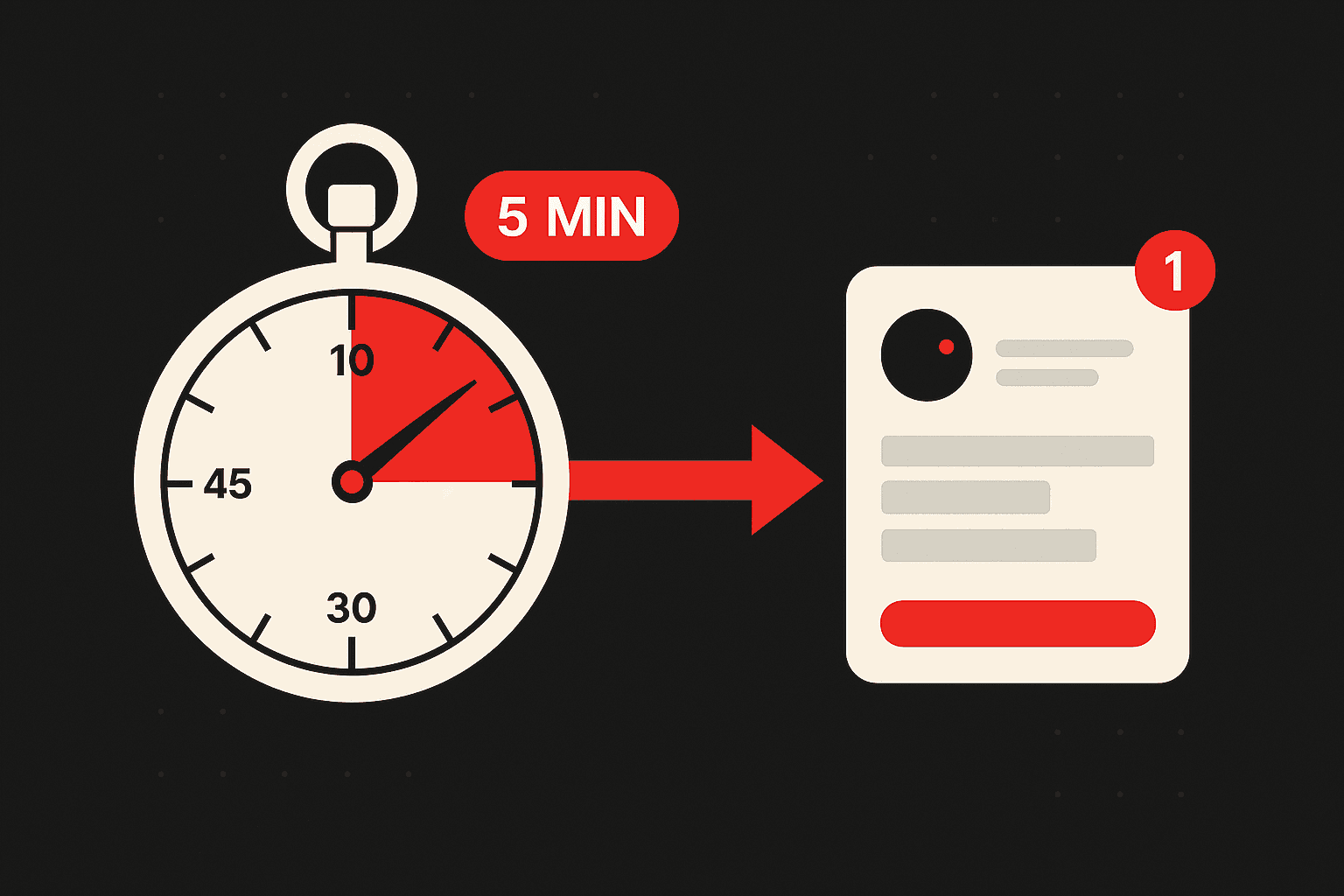
A SaaS founder messaged us in March with a familiar pattern. He was spending 64,000 USD a month on Google Ads and LinkedIn, generating roughly 380 demo requests per quarter, and converting 31 of them into closed-won deals. His CAC was high, his board was nervous, and his next instinct was to fire the demand-gen agency.
We ran the audit. The campaigns were fine. The targeting was tight. The landing page conversion rate was solid at 4.2 percent. The leads that came in were qualified at the form. The break was downstream of everything the marketing team owned.
Median time from form submit to first human contact was 51 minutes. The 95th percentile was 6 hours. The leads that landed on Friday afternoon got contacted Monday morning. By the time a rep called, the buyer had already booked demos with two competitors and partially evaluated a third. The marketing team was hitting their lead-volume target every quarter and the sales team was closing the leads they could reach in time. Both teams were performing. The system between them was bleeding 60 percent of the qualified pipeline before it could be worked.
We rebuilt the routing layer in three weeks. New median: 3 minutes. New P95: 11 minutes. Same campaigns, same spend, same product, same reps. Closed-won deals per quarter went from 31 to 74 over the next two quarters. The agency he was about to fire never changed a single ad.
This is the lead-response system we install. It is not an audit and it is not a checklist. It is the four-layer architecture that compresses speed-to-lead to under 5 minutes without 24/7 staffing, plus the measurement discipline that keeps it that way after the consultants leave.
Why 5 minutes is the only number in this entire piece that matters
The 5-minute benchmark traces back to a 2007 InsideSales.com study and has been replicated by Harvard Business Review, Drift, Chili Piper, and most credible RevOps research since. The headline result is consistent across all of them: a lead contacted within 5 minutes is roughly 9 times more likely to qualify than one contacted at 30 minutes, and 21 times more likely than one contacted at 60 minutes.
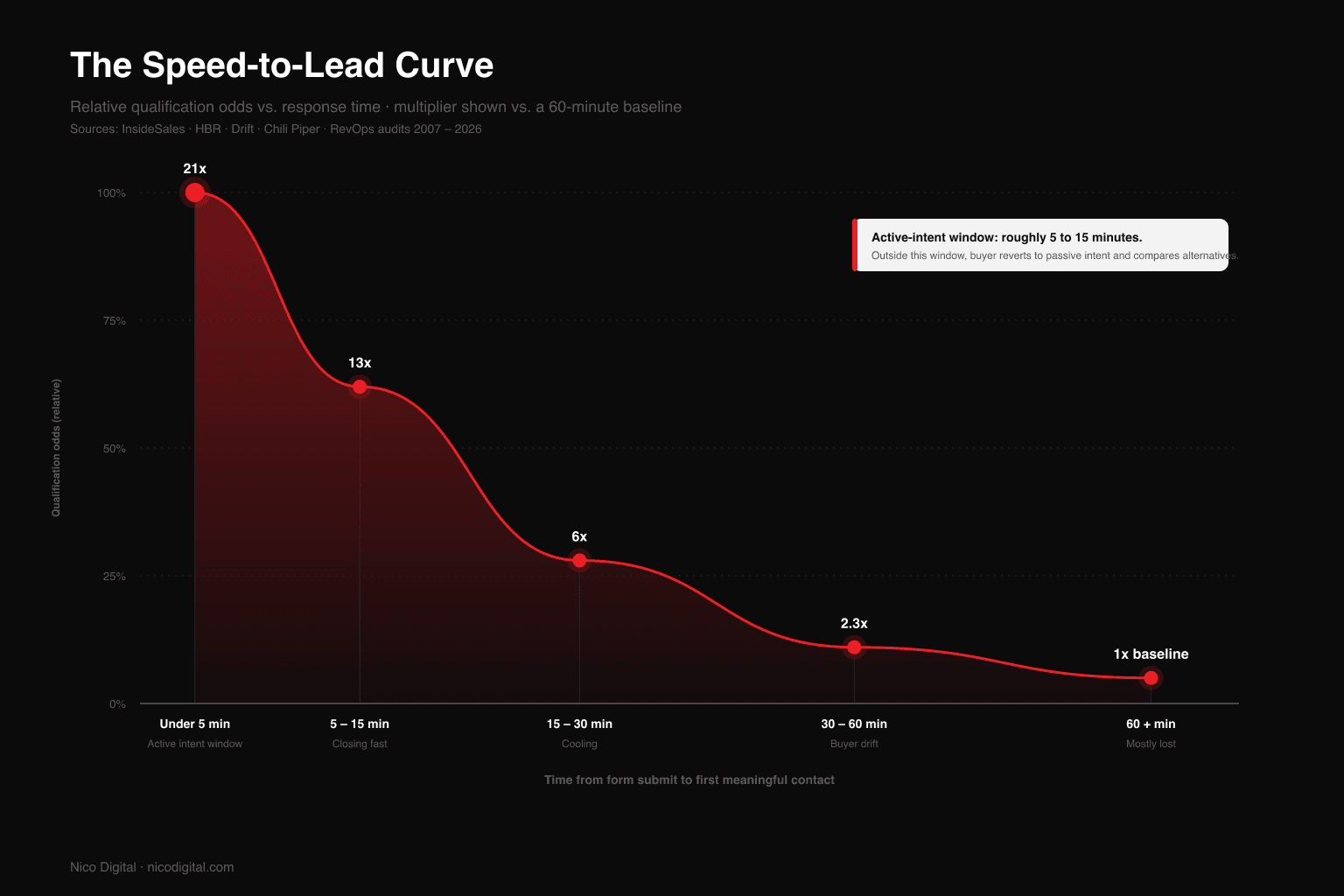
The mechanic is psychological. When a buyer fills a demo request form, they are in active intent state - browser open, topic mentally loaded, competitive options not yet explored, calendar relatively clear. That state lasts roughly 5 to 15 minutes for a B2B buyer at work and as little as 2 to 4 minutes for a consumer evaluating high-consideration purchases on mobile. Outside that window, the buyer reverts to passive intent. They close the tab, take the next meeting, eat lunch, get pulled into Slack. The momentum is gone, and reactivating it requires several follow-up touches that compound cost-to-contact and slip the deal into the next quarter.
The reason most teams underestimate this curve is that the median lead-response time on their dashboard looks reasonable. The median can sit at 18 minutes while the 95th percentile sits at 4 hours, and the 4-hour leads are where the lost revenue lives. We have audited accounts with 12-minute medians and 9-hour P95s where over half of the qualified pipeline was being lost in the long tail without anyone on either team noticing. The dashboard reported a healthy median; the spreadsheet of every individual lead told a different story.
The second reason teams underestimate it is that conversion attribution typically credits the channel that originated the lead, not the response speed that converted it. So a slow-response problem looks like a "Google Ads is not converting" problem, the team responds by tweaking bids and creative, and the underlying issue gets worse because the new creative drives more demos into the same broken response queue. We covered the broader trap of attribution distorting where teams invest effort in our piece on understanding marketing attribution properly, and lead response time is the most under-credited variable in the entire chain.
Why this is harder in 2026 than it has ever been
You would think that with smarter CRMs, AI assistants, and modern routing tools, lead response time should be a solved problem. It is in fact getting worse on most accounts we audit, for three structural reasons.
First, lead volume per rep has gone up. Performance Max, broad match with audience signals, and LinkedIn Audience Network have all expanded the top of the funnel without proportionally expanding sales-team capacity. Reps are running more meetings, processing more leads, and have less calendar slack to hit a 5-minute response window. The structural answer is not "work harder" - it is to either route differently or insert capacity.
Second, the share of leads arriving outside business hours has risen. Distributed buying teams, async work, and the shift toward research-on-mobile-evening have pushed a meaningful chunk of inbound to nights and weekends. A team that hits a 4-minute median Monday-to-Friday 9-to-6 can still have a 14-hour P95 because of the leads arriving at 10pm on Friday. Coverage design, not workflow design, is the answer to the long tail.
Third, smart bidding now optimises against the conversion signals you send it. If your conversion event is "form submit" and 60 percent of submits never get qualified because of slow response, you are training Google's and Meta's bidding algorithms on a polluted signal. The platform thinks it is optimising for valuable conversions; it is actually optimising for "conversions you will fail to convert." The bidding system gets worse at acquiring the leads that would have closed because the feedback loop is broken upstream of the algorithm. We get into the broader version of this problem in our 10 performance marketing metrics worth tracking piece - the upshot is that lead response time is no longer just a sales-ops metric, it is a paid-media efficiency metric, and treating it as one belongs in a different team's quarterly plan than where most companies have it filed.
The four-layer system
A working lead-response system has four layers. Each layer is owned by a specific team, has a specific failure mode, and has a specific tooling requirement. Most teams that struggle have invested in layer four (measurement) without fixing layers one and two, which is why their dashboards keep reporting the same problem they cannot solve.

Layer 1: Routing logic
The routing layer decides which lead goes to which rep, based on which attributes, in which order, with which fallback. It is not a tool - it is a set of business rules that the tool executes. Most teams have a tool but not a rules document, which means the routing logic lives in the head of whoever set up the tool and breaks the moment that person leaves.
The minimum viable routing logic for B2B inbound is:
-
Disqualifier check first. Block routing entirely for known competitor domains, free-email-address signups (when policy disallows them), and leads where required fields are obviously bogus (test@test.com, "asdf", phone number 0000000000). These should go to a marketing-owned bin for review, not into the SDR queue. This alone reclaims 8 to 14 percent of SDR capacity on most accounts.
-
Account match second. If the lead matches an existing account in the CRM, route to the account owner regardless of round-robin position. Sending an existing-customer expansion lead to a new SDR is the most common routing failure we see and the single most damaging - the customer reads it as "they don't know who I am" and the deal stalls.
-
Buyer-stage match third. If the lead is from a high-intent surface (demo request, pricing page, contact-sales) and the account size is enterprise, route to a senior AE, not to the bottom-of-funnel SDR rotation. Treating a 10,000-employee company demo request the same as a 12-employee company trial signup is a routing failure that costs you the larger deal even when the SDR is fast.
-
Geographic match fourth. Within rep tier, route by buyer time zone to a rep currently in working hours. Round-robin to the rep with the lowest workload is fine for tie-breaking but should not override geography for sub-5-minute response goals.
-
Round-robin within tier last. Genuinely random load balancing is the last decision, not the first.
The mistake we see most often is teams that start at step 5, never get to steps 1 to 4, and end up with "fast and fair" routing that misroutes high-value leads to junior reps and high-intent leads to busy AEs. Fast routing without intelligent routing is just a faster way to lose better leads.
Layer 2: Coverage design
Coverage design is the question of which humans are responsible for response in which hours, how that responsibility rotates, and what happens to leads outside the covered hours. Most teams answer this implicitly, badly, and never write it down.
A working coverage model has three explicit components:
The on-call responder rotation. One named person per shift whose primary job for that shift is responding to inbound, with no other meetings on the calendar during the shift. Rotating in 2-to-4 hour blocks works better than full days because the responder fatigue curve is steep - by hour 5, response quality drops noticeably. This person is not "the SDR with the lightest meeting load this week," it is a calendared rotation owned by sales ops.
The escalation path. If the on-call responder does not acknowledge a high-intent lead within 3 minutes, the system pings a secondary responder, then the manager, in defined time intervals. Without an escalation path, a single missed lead becomes a single lost deal. With an escalation path, the team can see in real-time when the on-call rotation is broken and fix it the same day.
The out-of-hours layer. This is where most teams fail. The two acceptable answers are: (a) an AI-mediated first-touch that confirms receipt, qualifies basic intent, and books a calendar slot for human follow-up at the responder's next available block; or (b) a transparent automated acknowledgement that names the next response window ("we will be in touch by 9am IST tomorrow") so the buyer does not perceive the silence as disinterest. The unacceptable answer is silence, which is what most teams have, and which makes the buyer mentally close the loop and move on.
The reason the out-of-hours layer is critical is that it disproportionately captures the highest-intent leads. Buyers who fill a form at 11pm are usually doing focused research with no work distractions and a clearer evaluation window. They are easier to close than the 2pm-Tuesday leads who filled the form between meetings. Losing them disproportionately because of coverage gaps is the most expensive single failure mode in the whole system.
Layer 3: Sequencing
Once first contact happens, the next 72 hours determine whether the lead converts to opportunity or goes cold. The sequencing layer is the multi-touch follow-up cadence after first contact, designed to maximise the probability of a meeting on the calendar within 5 business days.

A working B2B inbound sequence for a high-intent lead looks like:
-
T+0 to T+5 minutes: First touch - phone call attempt plus personalised email plus calendar link. All three at once, not in sequence. The personalised email contains a calendar booking link and references the specific page or asset the lead converted on (this requires the routing system to pass referrer data, which 60 percent of teams have not configured).
-
T+30 minutes to T+2 hours: Second touch if no meeting booked from the first - second phone call attempt plus a different-channel touch (LinkedIn message if the lead's LinkedIn was enriched, SMS if explicit consent was captured at form submit).
-
T+1 day: Third touch - value-additive content tied to the conversion topic, not a "just following up" email. If the lead converted on a pricing page, send a relevant case study with deal economics. If they converted on a demo request, send a 90-second product walkthrough video.
-
T+3 days: Fourth touch - personalised, references the original conversion, offers a different format (a 15-minute call instead of a 30-minute demo, an async Loom instead of a live call) to lower the commitment threshold.
-
T+7 days: Final touch - explicit "I'll close the loop unless I hear from you" message, which paradoxically generates 4 to 9 percent reply rate from leads who would otherwise have ghosted indefinitely.
The mistake we see most often is teams running a 14-touch sequence with no differentiation by intent level, converting fast leads into annoyed leads, and burning sender reputation on email infrastructure that then degrades the deliverability of the sequences for genuinely passive leads. Length is not virtue. Sequence design should match buyer intent, not the SDR team's activity quota.
Layer 4: Measurement
Measurement is the layer most teams over-invest in and under-act on. The dashboard exists, the median response time is reported, the team agrees the number is too high, nothing actually changes. The reason is that the wrong metric is being measured, the long tail is being hidden by averages, and the metric is not in anyone's compensation.
The minimum viable measurement stack is:
-
Time-to-first-meaningful-contact, distribution form. Median, P75, P90, P95 - reported separately, every week, with the P95 highlighted because that is where the leakage is. A single median number gives the team permission to ignore the long tail.
-
Share of leads contacted within 5 minutes, broken out by lead source, lead intent tier, and time of arrival. This breakdown is what surfaces structural problems - for example, "we hit 5-minute response on 84 percent of leads except the LinkedIn Lead Gen Form leads, where we hit 12 percent" tells you the LinkedIn integration is broken, which the median would have hidden.
-
MQL-to-SQL conversion rate, segmented by response time bucket. Sub-5-minute, 5-to-30 minute, 30-to-60 minute, 60-minute-plus. This is the single most persuasive chart in the entire RevOps function - it shows leadership in one image how much pipeline the slow-response cohort is leaking, and pays for the rebuild work in the first quarterly review.
-
Daily missed-SLA log. Every lead that breached the SLA, with the reason (coverage gap, routing failure, rep busy, tool failure), reviewed weekly by sales ops with the reps named. Not a public shaming exercise - a structured root-cause loop that catches the configuration drift that always creeps back in within 60 days of a system rebuild.
The metric in compensation matters because lead-response time is one of the few metrics where willpower will not move the number. Reps respond fast when their compensation depends on response time and slow when it does not. Marketing teams design routing for speed when their compensation includes response time and design it for fairness when it does not. Putting this in the comp plan, even at 5 percent weight, structurally aligns the system in a way that no amount of all-hands meetings will achieve.
Common failure modes when teams try to build this themselves
Across roughly 40 lead-response system builds we have led for B2B lead generation clients, the same handful of mistakes recur. Listing them here so you can avoid them.
Mistake 1: Buying tooling before defining rules. Teams buy Chili Piper or LeanData and assume the tool will solve routing. The tool requires routing rules as input. Without explicit rules, the tool replicates the chaos faster.
Mistake 2: Treating all leads with the same SLA. This either burns SDR capacity on low-intent traffic (newsletter signups should not be in the SLA cohort) or misses the speed window on high-intent traffic. Tier the SLA by intent.
Mistake 3: Hiding the P95 behind the median. A 10-minute median can coexist with a 6-hour P95. The 6-hour leads are where the revenue is. Always report distribution.
Mistake 4: Marketing owns lead volume, sales owns lead conversion, nobody owns lead response. This is the org-design version of the problem. The fix is a shared metric in both teams' compensation, owned operationally by RevOps or sales ops as a function.
Mistake 5: Counting drip emails as first touch. An automated "thanks for your interest" email is not a first touch. It is a confirmation of receipt. SLA timers should run until a personalised human or AI-mediated qualifying contact happens, not until the marketing automation fires its acknowledgement.
Mistake 6: Ignoring the conversion-event-quality feedback loop. Slow response degrades downstream conversion which degrades the signal sent back to ad platforms which degrades the quality of leads acquired which makes the response problem worse. Most teams break this loop without realising it. Fix response time and the campaign efficiency improves automatically over the following 30 to 60 days as the bidding algorithms recalibrate against cleaner conversion signals.
Mistake 7: Building the system once, then never auditing it. Routing logic drifts. New campaigns get launched without being added to the routing rules. New reps are added to round-robin pools without geography updates. Within 60 to 90 days of a clean rebuild, P95 response time will start creeping back unless someone owns weekly SLA review. This is not a project, it is an ongoing operations discipline.
Build vs buy: in-house, outsourced SDR, or AI-mediated
Once a team accepts the response-time problem is real, the next decision is who handles the response - and there are now three credible answers, where five years ago there were only two.
In-house SDR team. Best for accounts where buying motion is consultative, deal sizes are large enough to justify dedicated salaried headcount, and the product is technical enough that off-the-shelf SDRs would be slow to ramp. Worst for accounts with high lead volume in irregular bursts, because in-house teams are sized for steady-state and overflow during bursts is structurally hard.
Outsourced SDR team. Best for accounts that need geographic coverage, predictable response SLAs, and cost-per-contact discipline. Worst when the product requires deep technical knowledge or when the buyer expects to talk to a senior person on first contact. Insist on P95 reporting in the contract; without it, the vendor is hiding the long tail and you are paying for response coverage you are not actually getting.
AI-mediated first-touch. Best for the first 90 seconds of the response window, regardless of which model you use for human follow-up. A well-instrumented AI router can confirm receipt, qualify basic intent, ask one disqualifying question, and book a calendar slot in under 90 seconds, 24/7, at a cost per contact roughly two orders of magnitude below human SDRs. Worst when teams treat AI as a replacement for human SDRs rather than a layer in front of them - the AI is the first 90 seconds, not the entire qualification cycle.
The accounts that compound advantage in 2026 are the ones running a hybrid: AI for first-touch and acknowledgement at all hours, outsourced SDR for second-touch and qualification during covered hours, in-house AE for opportunity progression once a meeting is booked. Single-mode response operations are leaving money on the table because each mode has a structural strength the other two do not.
For accounts where this hybrid feels operationally complex to set up, we run the build as part of our lead generation engagements, with the routing rules, the coverage rotation, the sequencing playbooks, and the measurement instrumentation all installed before the first lead enters the new system.
Where this fits inside the broader marketing operation
Lead response time is the highest-leverage lever in the post-click chain, but it is not the only one. The full loop from impression to closed deal involves coordination across acquisition (paid and organic), the landing page experience that captures the form, the routing and response system this article covers, the qualification handoff between SDR and AE, the proposal and negotiation cycle, and the post-close onboarding that determines whether the deal expands or churns.
A leaking response system can be the dominant problem, and on most accounts it is, but it is rarely the only one. After the response-time fix lands, the next bottleneck typically appears at the SDR-to-AE handoff (deals get qualified but the discovery call gets scheduled 7 days out and the buyer cools), or at the proposal stage (the AE writes proposals from scratch instead of using a templated revenue model), or at the contract stage (legal review takes 14 days and the buyer signs with a faster competitor). Each of those is a separate operational fix with its own response-time-shaped problem inside it.
For accounts running both paid acquisition and content acquisition, the response-time system has to handle both intents in the same routing logic. We covered the broader question of how content and paid acquisition feed the same pipeline differently in our piece on growth marketing versus demand generation, and the routing rules differ meaningfully - content leads need longer nurture, paid leads need faster response, and the SDR team needs to know which is which the moment the lead lands.
For B2B teams investing in content as a long-term acquisition channel, the response system should also handle the moment that a long-time content reader finally raises their hand and books a call. Those leads are unusually high intent and unusually badly served by generic routing - they have already self-educated and want to talk to someone senior, fast. We get into the broader question of how B2B content earns this conversion in our seven content building blocks for B2B growth and ten tips for engaging B2B content pieces.
Where to start tomorrow
If you have a single hour and want to know whether this is your problem, do this:
-
Pull the last 200 inbound leads from your CRM. For each, calculate the time between lead-creation timestamp and first-meaningful-contact timestamp. Plot the distribution.
-
Calculate four numbers from the distribution: median, P75, P95, and the share contacted within 5 minutes.
-
Pull the MQL-to-SQL conversion rate of the leads contacted within 5 minutes versus the leads contacted at 60 minutes or later. Compute the ratio.
-
If the P95 is over 60 minutes and the conversion ratio is over 3x in favour of fast response, you have a 6-figure-or-higher annual leak in the response layer that no amount of Google Ads optimisation or PPC spend reallocation will fix.
If you have a week and want to make a structural change, build the routing rules document in layer one before touching any tool. The tool you have probably already supports the rules - the rules are what is missing. We have seen accounts cut median response time from 51 minutes to 8 minutes with a routing-rules rewrite alone, on the same Salesforce instance they already owned, before any new tooling was purchased.
The campaigns that win in the next 12 months will not be the ones with the cleverest creative or the cleanest attribution model. They will be the ones that stopped losing the leads they already paid for between the form submit and the first phone call.
If your team is closing fewer deals than the lead volume should support, the answer is almost certainly not "buy more leads." It is "respond faster to the leads you already have." The number you are looking for is 5 minutes. Most accounts are 10x slower than that and do not realise it because the median on their dashboard hides the cost.
Want a 30-minute review of your lead-response system, with the median, P95, and conversion-by-response-bucket breakdown computed live from your CRM data? Book a call. We will show you the leak, the dollar value of fixing it, and the routing changes that would close it inside a sprint. The audit is free; the only cost is finding out how much pipeline the response queue has been quietly losing.

Aditya Kathotia
Founder & CEO
CEO of Nico Digital and founder of Digital Polo, Aditya Kathotia is a trailblazer in digital marketing. He's powered 500+ brands through transformative strategies, enabling clients worldwide to grow revenue exponentially. Aditya's work has been featured on Entrepreneur, Economic Times, Hubspot, Business.com, Clutch, and more. Join Aditya Kathotia's orbit on LinkedIn to gain exclusive access to his treasure trove of niche-specific marketing secrets and insights.