


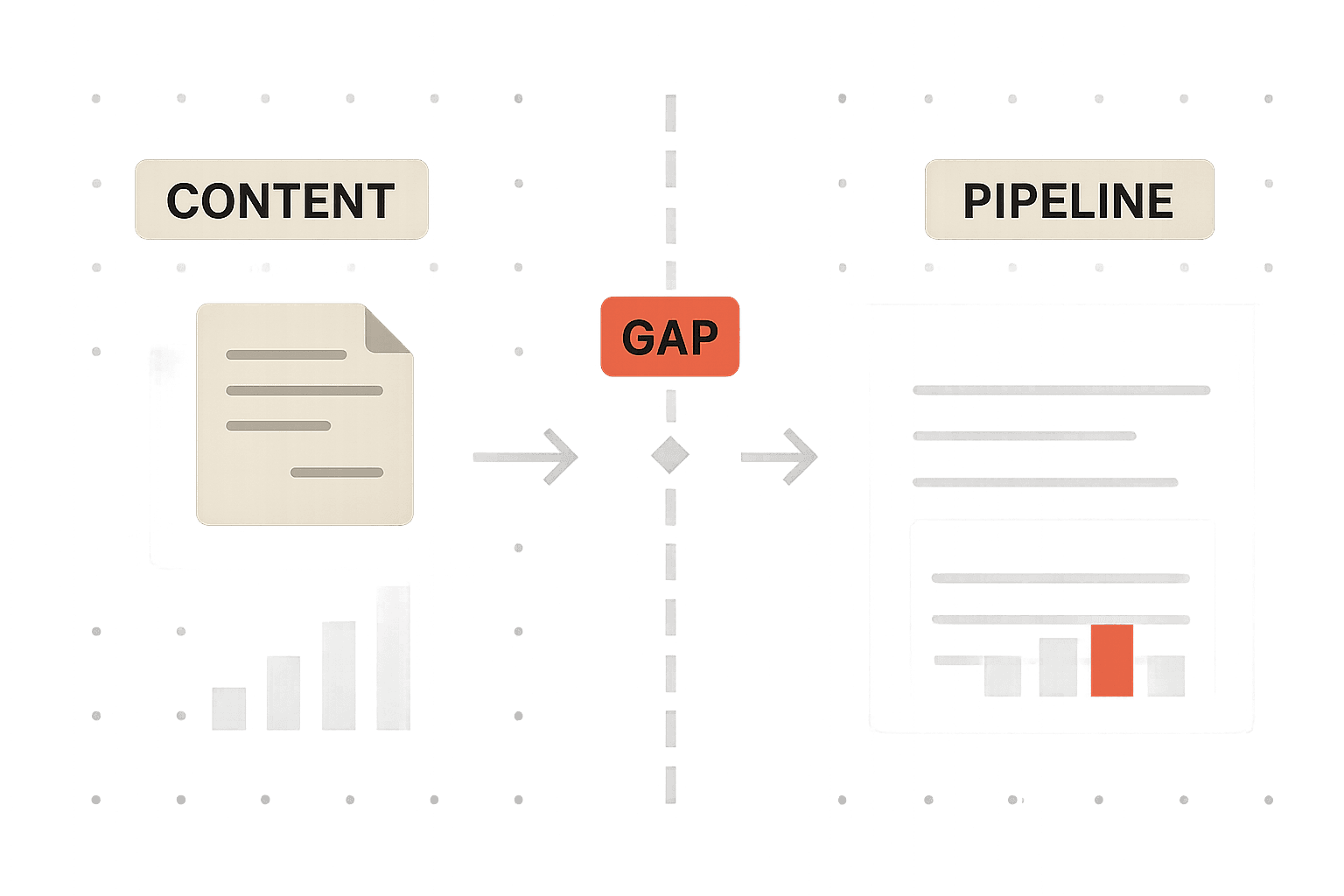
The gap between content production and revenue contribution is not a measurement problem. It is a structural one. Most B2B content programs are built to produce, not to convert, and the reporting infrastructure around them reflects that priority.
Traffic goes up, social shares accumulate, but the pipeline stays flat. Marketing leaders know something is wrong, but the audit rarely surfaces where.
The seven building blocks below are not a content strategy framework in the aspirational sense. They are operational prerequisites.
Organizations that have all seven functions consistently tend to be able to draw a direct line from content activity to revenue outcomes. Organizations missing even two or three of them tend to struggle to justify the budget, let alone scale it.
Is your B2B content program built to drive pipeline or just publish? We map content programs against these seven building blocks and give you a prioritized fix list. Request a B2B content audit →
Why the Content-Revenue Connection Breaks Down
Before getting into what to build, it is worth understanding where the disconnection typically lives.
The most common failure pattern: A content team that is producing well but operating in isolation from sales, demand generation, and product. They are generating assets against a content calendar rather than against buyer questions. The content is technically sound. It is not commercially aligned.
A second pattern: Organizations that have invested in content infrastructure but have not defined what success looks like beyond traffic metrics. Content ROI requires a measurement model that traces from asset consumption to pipeline influence to closed revenue. Most teams have the first metric and none of the others.
"The majority of B2B buyers who disengage with a vendor cite content quality as a factor." This represents a revenue problem disguised as a content issue.
The Seven Building Blocks
1. A Content Mission That Is Actually About the Buyer
Most content teams have a goal. Fewer have a mission. The difference is directional: a goal tells you what to produce, a mission tells you why it should exist for the audience consuming it.
The question to answer before any strategy document is written: what would your target buyers genuinely lose if your content stopped existing? If the answer is "not much," the content is not doing commercially meaningful work. For organizations that need to combine content output with pipeline acceleration, integrating B2B lead generation services into the content function ensures that mission-aligned content is being routed toward buyers who are ready to act, not just informed audiences who never convert.
A workable content mission for a B2B organization is specific about audience, problem, and outcome. It is not "we create educational content for marketers." It is something closer to: "we help revenue operations leaders at mid-market SaaS companies understand how to reduce attribution complexity without rebuilding their reporting infrastructure."
That specificity shapes every editorial decision downstream.
Where organizations go wrong: Confusing brand awareness goals with content missions. The two can coexist, but conflating them produces content that is neither distinctive enough to build brand association nor specific enough to generate demand.
The strategic test: Every piece of content should be evaluable against the mission statement. If it passes, publish. If it is a stretch, question whether it belongs in the program.
2. A Dedicated Content Function With Clear Ownership
Content produced by committees without clear ownership is almost always mediocre. The strategic, editorial, and operational functions of content require different skill sets and different accountability structures, and in most organizations, they are collapsed into one person or distributed without coordination.
Effective content organizations need distinct roles across content strategy, content creation, and content operations. These do not have to be separate headcounts, particularly in leaner organizations, but the responsibilities need to be explicitly owned.
The content operations layer is what most organizations underinvest in. Taxonomy, asset management, workflow tooling, content auditing, and performance reporting are not glamorous functions. They are what make everything else scale without descending into chaos.
Without this infrastructure, content organizations tend to duplicate effort, lose track of existing assets, and produce inconsistent work that undermines the brand signal they are trying to build.
The practical minimum: One person who owns the content calendar and publishing workflow, one person who owns editorial quality and strategy, and a documented process for how content moves from brief to published. In high-functioning programs, there is a content council that includes representation from sales, product, and marketing, meeting monthly to align on priorities.
3. Audience Research That Goes Beyond Persona Templates
Buyer personas are useful as starting structures. They become a constraint when they substitute for ongoing audience research.
B2B buyers are not static profiles. Their priorities shift with market conditions, organizational pressures, and personal career stakes. A persona documented in 2021 may no longer accurately reflect what your buyers care about or how they are framing their problems.
The most commercially useful audience intelligence comes from three sources that most content teams underuse:
- sales call recordings,
- customer success conversations, and
- direct buyer interviews.
These surfaces reveal the language buyers use, the objections they raise, the competing solutions they are evaluating, and the internal dynamics that influence purchasing decisions.
Content built from that intelligence will outperform content built from demographic assumptions, because it speaks to buyers' actual situation rather than a generalized version of it.
Advanced practice: Tag insights from sales and CS conversations by theme and feed them into a quarterly content planning process. The content ideas that emerge from real buyer language consistently outperform ideas generated from keyword tools alone.
Common mistake: Conducting audience research once during a brand refresh and treating it as permanent. Market positioning shifts, buyer priorities evolve, and the content that resonated two years ago may now feel misaligned to the audience it was written for.
4. Content Asset Management That Does Not Rely on Institutional Memory
Ask most B2B marketers where to find the case studies from two years ago, the product comparison pages, or the webinar recordings from last quarter. The answer typically involves several email chains and a Slack search.
Asset management is the foundational infrastructure that drives value across your entire content lifecycle. When assets are easy to find, clearly categorized, and tagged with the right metadata (audience, funnel stage, topic, and format), your team can move faster and work smarter.
You can repurpose content strategically, spot gaps in coverage, and avoid duplicating effort. Just as importantly, you create a reliable content library that sales teams will actually use.
"B2B organizations lose significant time and budget to poor asset management." The downstream effect is sales teams defaulting to informal, inconsistent content sharing that undermines both compliance and messaging coherence.
What effective asset management looks like in practice: A content library organized by buying stage, topic cluster, audience segment, and format. Updated on a defined cadence. Accessible to sales with search and filter functionality. Not a shared drive folder labeled "Marketing Assets 2024."
The tooling question: The right technology for asset management depends on organizational scale. For smaller programs, a well-structured Notion database or Airtable base is often sufficient. For organizations with large content volumes and complex sales motions, a dedicated DAM (digital asset management) system is worth the investment.
5. Metadata and Taxonomy as a Measurement Foundation
This is the building block that creates the most confusion and gets the least attention. It is also one of the most consequential.
Taxonomy is the labeling system your content team uses to categorize assets. Metadata is the descriptive layer attached to each asset - audience, topic, format, buyer stage, product line, campaign, and so on. Without consistent application of both, content performance data is almost impossible to interpret at the program level.
What effective metadata fields look like for a mid-market B2B content program:
| Field | Example Values |
|---|---|
| Audience | RevOps Leader / CMO / SDR / VP Sales |
| Funnel stage | Awareness / Consideration / Decision |
| Content format | Blog / Case study / Webinar / Guide |
| Topic cluster | Attribution / Pipeline reporting / Content ROI |
| Campaign | Q2 Launch / ABM Series / Evergreen |
The classic illustration: A content team produces an ebook that gets translated into three languages, distributed through four channels, and gated behind two different landing pages. Without consistent metadata tagging, the attribution data for that asset is fragmented across multiple reports that cannot be aggregated.
Building this correctly:
- Start by defining your taxonomy before publishing new content, not retroactively.
- Agree on the labeling conventions with the teams who will use the data - specifically demand generation, marketing operations, and sales leadership.
- Apply them consistently from day one.
6. Content Infrastructure That Matches Your Ambition
Content infrastructure is the technology stack that supports creation, management, publishing, distribution, and measurement. The gap between what organizations have and what they need is usually not about the sophistication of individual tools. It is about integration.
- A CMS that does not connect to the CRM means content engagement data cannot inform sales outreach.
- A marketing automation platform that is not properly tagged with content metadata means the nurture program performance is opaque.
- Analytics that track page views but not pipeline influence mean marketing cannot demonstrate commercial impact.
The audit question to ask: Can you currently trace a prospect's content consumption history from their first asset interaction to a closed opportunity? If not, identify where the data breaks down in that journey and start there.
On AI tooling: AI-assisted content production - from drafting to editing to distribution optimization - has compressed the production timeline significantly for organizations that have implemented it well. The leverage is real. The precondition is that the infrastructure around it - taxonomy, asset management, and distribution workflows - is already functional. AI amplifies what exists. It does not compensate for structural gaps.
Common mistake: Investing in new content technology before auditing whether existing tools are being used effectively. Most organizations are under-utilizing the platforms they already pay for, particularly marketing automation and CMS capabilities.
7. Measurement That Follows the Buyer, Not the Asset
Content ROI is not a single metric. It is a measurement model that accounts for content's role at multiple stages of the buyer journey and connects that role to pipeline and revenue outcomes.
Process metrics tell you whether the operational foundation is functioning - creation velocity, review cycle times, and asset coverage by stage.
Performance metrics tell you whether the content is doing commercially meaningful work - engagement rates, pipeline influence, and revenue attribution.
Neither set of metrics alone is sufficient. High-performance metrics with poor process metrics usually mean the content program is not scalable. Good process metrics with poor performance metrics usually mean the content is operationally efficient but strategically misaligned.
The measurement model to build toward:
- First-touch attribution for awareness content,
- Multi-touch attribution for consideration and decision-stage content, and
- Closed-loop reporting that connects content consumption to CRM opportunity data.
"Last-click attribution systematically undervalues the content that does the heaviest lifting early in the buyer journey."
The organizational prerequisite: Marketing operations and sales operations need to agree on the attribution model and the definitions of a qualified engagement before the measurement infrastructure is built. This conversation is often harder than the technical implementation, but it determines whether the resulting data will be believed and acted upon by leadership.
Where to Start If Your Program Is Missing Multiple Blocks
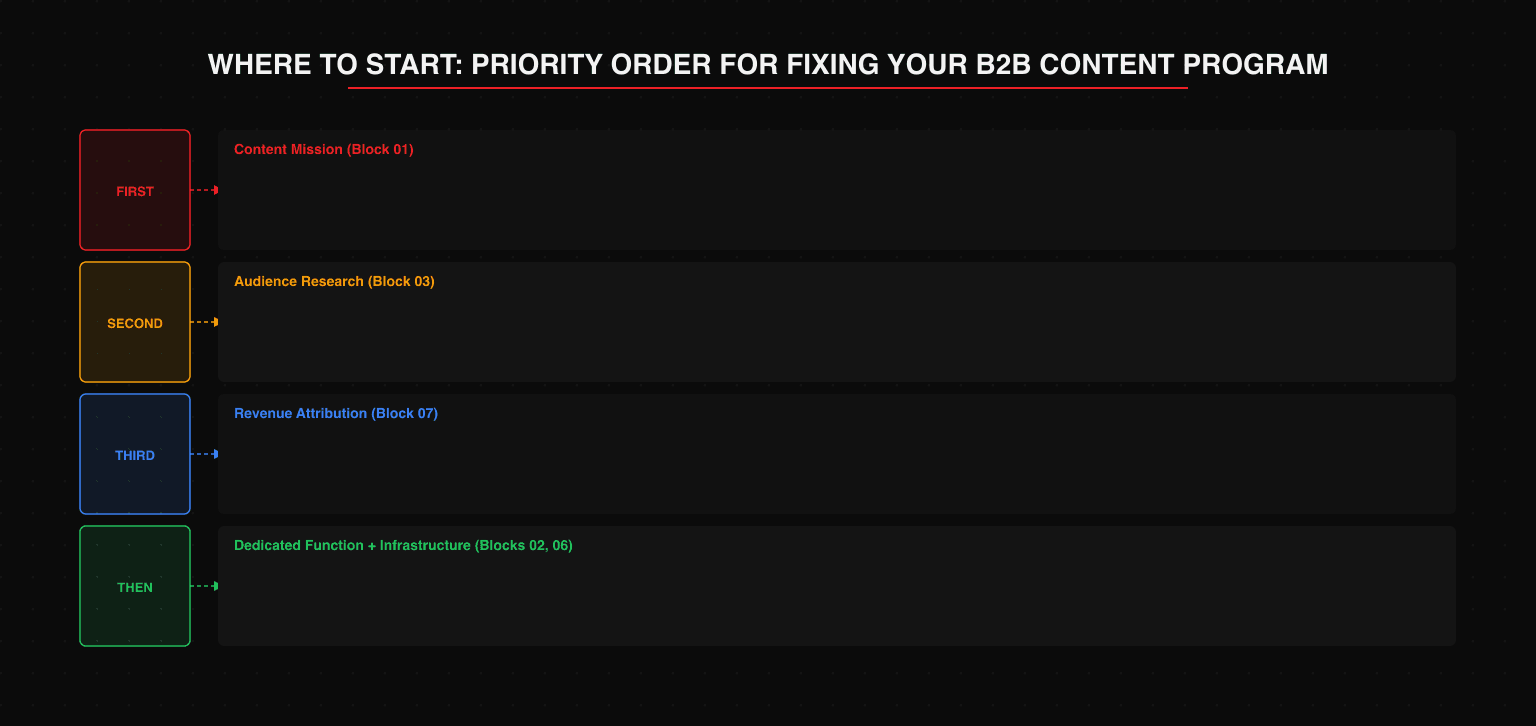
The instinct when auditing a content program with structural gaps is to try to fix everything simultaneously. That rarely works. The right sequence is to stabilize what is broken before building what is missing.
- If you are missing content mission alignment, start there. Everything else is predicated on knowing what the content is for and who it serves.
- If you have mission alignment but no measurement infrastructure, that is the next priority. You cannot make defensible investment decisions about content without data, and you cannot build data without the taxonomy and metadata foundation.
- If the foundation is in place but the connection to revenue remains unclear, the gap is usually in the integration between content data and pipeline data. That is a marketing operations problem, not a content strategy problem, and solving it requires a different set of conversations than editorial planning.
Organizations that get this right are not necessarily the ones with the largest content budgets. They are the ones who have built the operational infrastructure to know what is working, communicate it credibly to leadership, and make consistent incremental improvements based on data rather than intuition.
Organizations that have all seven building blocks in place are not just producing better content - they are compounding a competitive advantage that becomes harder to replicate the longer it runs. For teams that want to anchor their organic content strategy in search demand rather than editorial intuition, working with specialists in SEO for B2B companies ensures the content library is built around the queries your buyers are actually using.
Frequently Asked Questions
What is the most common reason B2B content fails to generate leads?
The most common failure is a structural misalignment - content teams producing against an editorial calendar rather than against buyer questions and pipeline needs. Content can be technically well-written and still generate no pipeline if it does not address the specific questions buyers ask at specific stages of their decision process. The fix is connecting content planning to sales intelligence: what objections are coming up, what topics buyers are researching before they engage, and what content appears in deals that close.
How do you create a B2B content mission statement?
A B2B content mission statement should specify who you serve, what problem you help them with, and what outcome your content helps them achieve. The template: "We help [specific audience] understand [specific problem domain] so they can [specific outcome]." Every piece of content should pass this test: would our target reader lose something of value if this content stopped existing? If the answer is no, the content is not doing commercially meaningful work.
What is a content taxonomy and why does it matter?
A content taxonomy is the labeling system that allows you to categorize, find, and measure your content assets systematically. It typically includes fields for audience segment, funnel stage, topic cluster, content format, and campaign. Without a consistent taxonomy, you cannot aggregate content performance data at the program level - you can only evaluate individual pieces in isolation. That makes it impossible to identify which topic clusters are generating pipeline, which funnel stages are underserved, or which formats are performing best for which audiences.
How much should a B2B company spend on content marketing?
A commonly cited benchmark is 25-30% of the overall marketing budget for content. For Indian B2B companies at early stages, a more practical starting point is enough budget to support two to three substantive pieces per month (₹30,000-₹80,000 per month for content production plus SEO tooling). The right number is less about a percentage and more about what it costs to consistently produce content that is better than what competitors are publishing on the same topics.
What is first-touch vs. multi-touch attribution for B2B content?
First-touch attribution assigns full credit for a lead or deal to the first piece of content a prospect interacted with. Multi-touch attribution distributes credit across all content interactions in the buyer journey. The most accurate picture comes from a multi-touch model that weights different stages based on their demonstrated contribution to close rates - which requires CRM integration and enough closed deals to be statistically meaningful.
Want to map your content program against all 7 building blocks? We'll identify which blocks are missing and give you a prioritized fix list with estimated impact on pipeline. Request a content program assessment →

Aditya Kathotia
Founder & CEO
CEO of Nico Digital and founder of Digital Polo, Aditya Kathotia is a trailblazer in digital marketing. He's powered 500+ brands through transformative strategies, enabling clients worldwide to grow revenue exponentially. Aditya's work has been featured on Entrepreneur, Economic Times, Hubspot, Business.com, Clutch, and more. Join Aditya Kathotia's orbit on LinkedIn to gain exclusive access to his treasure trove of niche-specific marketing secrets and insights.