

This is an independent analysis by Nico Digital. Zomato is not a client, and no non-public information was used. Every figure below comes from Eternal's quarterly results as reported in the business press, or from the FY25 annual report, with the publication and date noted inline.
Most explainers of how Zomato makes money were written when Zomato was a food delivery app. It is not that company any more. The listed parent is called Eternal, its largest business by revenue is a grocery company it bought in 2022, and food delivery is now the profit engine that pays for everything else. Understanding the model today means understanding four businesses, one app and a set of small fees that add up.
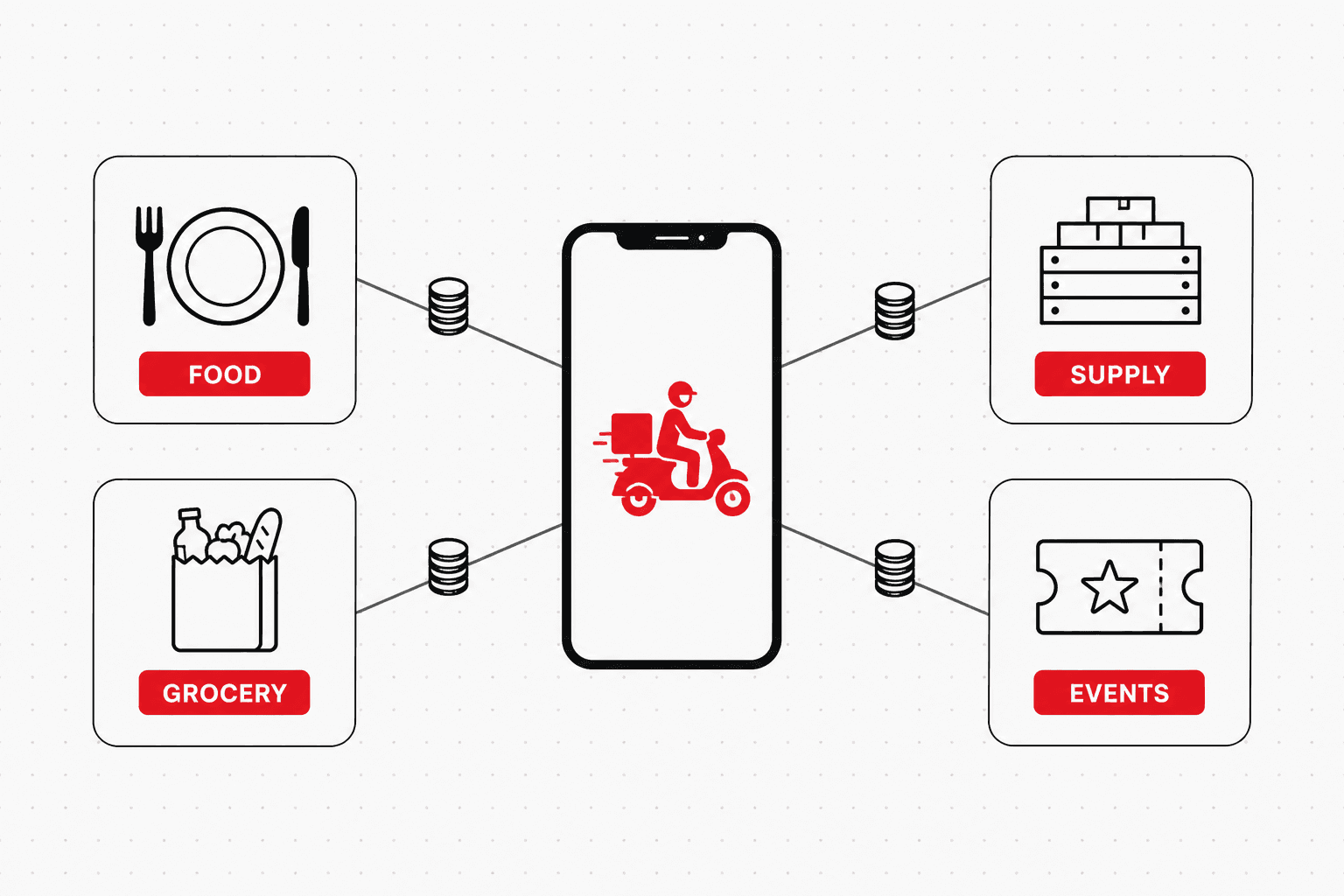
Short answer: Zomato earns from restaurants (commission and advertising) and from customers (platform fee, delivery charge and Gold membership). Its parent, Eternal, adds three more revenue engines: Blinkit quick commerce, Hyperpure B2B supplies and District going-out. In the quarter ended September 2026, Eternal reported ₹24,138 crore in revenue and ₹125 crore in net profit, with Blinkit contributing most of the revenue and food delivery most of the profit (Outlook Business, October 2026).
From Zomato to Eternal
Zomato started in 2008 as a restaurant discovery site, moved into food delivery in 2015, listed in 2021, and bought the quick commerce company Blinkit in an all-stock deal valued at ₹4,447 crore in June 2022 (Hindustan Times, June 2022). In 2025 the parent renamed itself Eternal Ltd, keeping Zomato as the food delivery brand.
The rename states the model: management describes Zomato as the mature business whose profits fund Blinkit, District and other bets. In FY25, the last full year before the group's accounting changed, Eternal reported revenue from operations of ₹20,243 crore and profit after tax of ₹527 crore (Eternal FY25 annual report, July 2025). By FY26, Blinkit's revenue alone was ₹37,779 crore (Outlook Business, July 2026), a jump that owes as much to an accounting shift as to growth.
The four revenue engines
Eternal's September 2026 quarter gives the cleanest snapshot of how revenue now splits across the group.
Food delivery: the take rate, broken into its parts
Zomato's food delivery business books ₹3,396 crore of revenue in the September 2026 quarter on net order value of about ₹11,445 crore (Analytics Insight, October 2026). That revenue comes from four lines.
Restaurant commission. The largest line. Zomato charges restaurants a service fee that varies with city, restaurant size and the services used; the company does not publish a single rate. Over 3.28 lakh restaurant partners were active in the June 2026 quarter (Inc42, July 2026).
Platform fee. A flat per-order charge to the customer that did not exist before August 2023. It launched at ₹2, was raised from ₹10 to ₹12 in September 2025 ahead of the festive season (Business Today, September 2025), and reached ₹14.9 per order in most major cities in March 2026 (Business Today, March 2026). Inc42 reported in July 2026 that the fee had brought in roughly ₹995 crore since launch, including about ₹154 crore in the June 2026 quarter, just under 5 percent of food delivery revenue for that period. There is almost no cost attached to it, so most of that money drops straight to the bottom line.
Delivery charges. Paid by the customer to compensate delivery partners. Gold members get free delivery above a threshold.
Advertising. Restaurants pay for sponsored listings at roughly ₹5 to ₹15 per click and for banner placements at ₹30 to ₹300 per thousand impressions (Inc42, July 2026). It is high-margin revenue from the supply side.
The result is a business whose adjusted EBITDA grew from ₹912 crore in FY24 to ₹2,079 crore in FY26, and which ran a 5.6 percent adjusted EBITDA margin on net order value in the June 2026 quarter, with 27.2 million monthly transacting customers (Inc42, July 2026).
Zomato Gold: a subscription that is really a retention tool
Gold costs about ₹30 for three months (Inc42, July 2026). At that price it is not a revenue line; it is a frequency device for the heaviest customers. Zomato said Gold had 38 lakh members by November 2023 (Inc42, November 2023). It has since trimmed benefits, adding a rain fee for Gold members on bad-weather orders from May 2025 (Angel One, May 2025), which tells you the programme is managed for margin, not for member counts.
Blinkit: the growth engine that overtook the parent
Blinkit is now larger than food delivery on every top-line measure. In the September 2026 quarter its net order value was ₹20,940 crore, up 79 percent year on year, and it turned an adjusted EBITDA profit of ₹184 crore against a ₹156 crore loss a year earlier (Angel One, October 2026). It ended the quarter with 2,751 dark stores after adding 308 in three months, and Eternal now guides to more than 3,500 stores by March 2027 (Kotak Neo, October 2026).
Blinkit's revenue line looks enormous because of a model change: from the June 2025 quarter it moved from a marketplace earning commissions to an inventory-led model that buys and sells the goods itself and books the full sale price as revenue. That is why its quarterly revenue jumped from ₹1,156 crore to ₹9,891 crore between the September 2024 and September 2025 quarters (Inc42, October 2025). We cover the dark store economics in detail in our Blinkit business model teardown.
Hyperpure: the B2B supply chain
Hyperpure sells ingredients and supplies to restaurants and, increasingly, other buyers. Its revenue grew 95 percent to ₹6,196 crore in FY25 (Eternal FY25 annual report, July 2025), then fell back to ₹1,023 crore in the September 2025 quarter because the volumes it used to sell to Blinkit were reclassified into the quick commerce segment once Blinkit went inventory-led (Inc42, October 2025). By the September 2026 quarter it was back to growth at ₹1,154 crore, up 13 percent (Analytics Insight, October 2026). It is low-margin, and its value is control of the supply chain the consumer businesses depend on.
District: going-out as a fourth engine
District bundles dining-out, movie and event ticketing into one app, built on Zomato's original restaurant discovery data and the ticketing business acquired from Paytm in 2024. In the September 2026 quarter it posted revenue of ₹304 crore, up 61 percent, on net order value of ₹3,259 crore, with an operating loss held flat at ₹55 crore; management says it is on track to break even by June 2027 (Inc42, October 2026).
The fee ladder: how a ₹2 line became a ₹1,000 crore line
The platform fee is the most instructive piece of the model: it shows how a habituated customer base lets a company add pure-margin revenue in small, almost unnoticed steps.
The fee only works because the product is habitual, the increments are small, and each one is timed to peak demand (the festive season) or a cost story (fuel prices in March 2026). Swiggy moved in step, which removed the competitive penalty.
Zomato's marketing strategy
Zomato spends heavily, but the spending is not where the strategy lives. Eternal's advertising expense was ₹945 crore in the June 2026 quarter, up from ₹671 crore a year earlier (exchange4media, July 2026), most of it going to Blinkit's expansion rather than food delivery. Four things do the marketing work for the food business.
A voice people quote. Zomato's social accounts and push notifications are written like a sharp friend rather than a brand. The notifications get screenshotted and shared, which is distribution the company does not pay for, and the style has been imitated by half the D2C brands in India.
Moments, not always-on. Spend concentrates into festivals, cricket and cultural events when ordering intent peaks. The September 2025 fee hike timed "ahead of the festive season" is marketing and finance working off the same calendar.
Gold as the retention layer. A ₹30 membership that unlocks free delivery turns the heaviest customers into a cohort the company can steer with thresholds, rain fees and partner offers. Membership is a pricing tool wearing a loyalty programme's clothes.
The app as a distribution channel. With 27.2 million monthly transacting customers (Inc42, July 2026), the Zomato app is the cheapest acquisition channel Blinkit and District will ever have. This is the part of the model most analyses miss: the food business is not just the profit engine, it is the audience.
What a D2C or marketplace brand can copy
You cannot copy Eternal's scale. You can copy the structure of its decisions.
-
Add fee lines after habit, not before. The platform fee launched at ₹2 in year eight of food delivery, when the behaviour was fixed. Brands that add convenience fees before they have repeat customers are taxing a relationship that does not exist yet.
-
Treat your best customers as a cohort. A membership with a low entry price and a free-shipping threshold does for a D2C brand what Gold does for Zomato: it raises frequency and gives you a lever that discounts never give you.
-
Sell visibility to your supply side. If you run a marketplace, or a brand with resellers, the demand you aggregate is a product. Sponsored placement and co-op advertising are the highest-margin revenue most marketplaces never build.
-
Use the mature business to launch the new one. Blinkit and District were cross-sold to an existing audience. A brand with an owned list and strong organic search visibility can launch a second category to its own customers before spending on paid acquisition; our Groww teardown shows the same pattern in fintech.
-
Report on net, not gross. Eternal reports net order value, which is gross value minus discounts. Most D2C dashboards still celebrate gross revenue while discounting quietly erodes the margin.
Next: how the grocery side makes a ₹525 order profitable, in the Blinkit business model, and how a rival built a brand on the same promise, in the Zepto marketing strategy.
Frequently Asked Questions
How does Zomato make money?
Zomato's food delivery business earns from four lines: a commission charged to restaurants on each order, a platform fee charged to customers (₹14.9 per order in most major cities as of March 2026), delivery charges, and advertising sold to restaurants as sponsored listings and banners. The parent company, Eternal, also earns from Blinkit quick commerce, Hyperpure restaurant supplies and District, its going-out and ticketing business. Zomato Gold membership adds a small subscription line.
What is Zomato's biggest business now?
By revenue and by order value, Blinkit. In the quarter ended September 2026, Blinkit's net order value was ₹20,940 crore against roughly ₹11,445 crore for food delivery, and Blinkit's revenue of ₹19,152 crore made up most of Eternal's ₹24,138 crore in consolidated revenue. Food delivery is still the group's main source of profit, with an adjusted EBITDA margin of 5.6 percent of net order value in the June 2026 quarter.
Why did Zomato change its name to Eternal?
The listed parent renamed itself Eternal Ltd in 2025 to reflect that it runs several businesses rather than one: Zomato (food delivery), Blinkit (quick commerce), Hyperpure (B2B supplies) and District (going-out). The Zomato consumer brand and app did not change. The rename signalled that Zomato is the mature cash generator funding the growth of the other three.
What is the Zomato platform fee and how much does it earn?
The platform fee is a flat charge added to every food order, separate from delivery charges. It launched in August 2023 at ₹2 per order, rose from ₹10 to ₹12 in September 2025, and reached ₹14.9 per order in most major cities in March 2026. Inc42 reported in July 2026 that the fee had earned roughly ₹995 crore since launch, and about ₹154 crore in the June 2026 quarter alone, just under 5 percent of quarterly food delivery revenue.
What is Zomato's marketing strategy?
Zomato's marketing rests on a distinctive social-media voice, witty push notifications, festival and event campaigns, and a membership programme (Gold) that locks in frequent users. Since 2022 the app has also become a distribution channel for the group's newer businesses, cross-promoting Blinkit and District to a base of around 27 million monthly transacting food customers. Eternal's consolidated advertising spend was ₹945 crore in the June 2026 quarter, up from ₹671 crore a year earlier, according to exchange4media.
What can a D2C or marketplace brand learn from Zomato?
Five things stand out: add small, defensible fee lines once customers are habituated; treat the best customers as a membership cohort; sell advertising to your own supply side once you have demand; use your mature business as the distribution channel for new ones; and report on net order value rather than gross so discounts are visible. The business model is only copyable at a smaller scale if the brand owns its customer relationship, which is why search and retention matter more than paid reach.

Aditya Kathotia
Founder & CEO
CEO of Nico Digital and founder of Digital Polo, Aditya Kathotia is a trailblazer in digital marketing. He's powered 500+ brands through transformative strategies, enabling clients worldwide to grow revenue exponentially. Aditya's work has been featured on Entrepreneur, Economic Times, Hubspot, Business.com, Clutch, and more. Join Aditya Kathotia's orbit on LinkedIn to gain exclusive access to his treasure trove of niche-specific marketing secrets and insights.