
This is an independent analysis by Nico Digital. Rapido is not a client, and no non-public information was used. Rapido is unlisted, so the figures below come from its filings with the Registrar of Companies as reported by Entrackr and Inc42, from company statements and court rulings as reported in the business press, with the publication and date noted inline.
Every ride-hailing app in India used to make money the same way: take a slice of the fare. Rapido stopped. Since February 2024 it has charged many of its drivers a flat daily fee instead, and in FY25 its subscription revenue grew nearly 14 times to ₹275 crore while its ride commissions fell 23.5 percent (Entrackr, January 2026). A bike taxi startup that began in Bengaluru in 2015 now claims more than 5 million rides a day across more than 400 cities (Inc42, September 2026), and in May 2026 investors valued it at $3 billion (Business Today, May 2026).
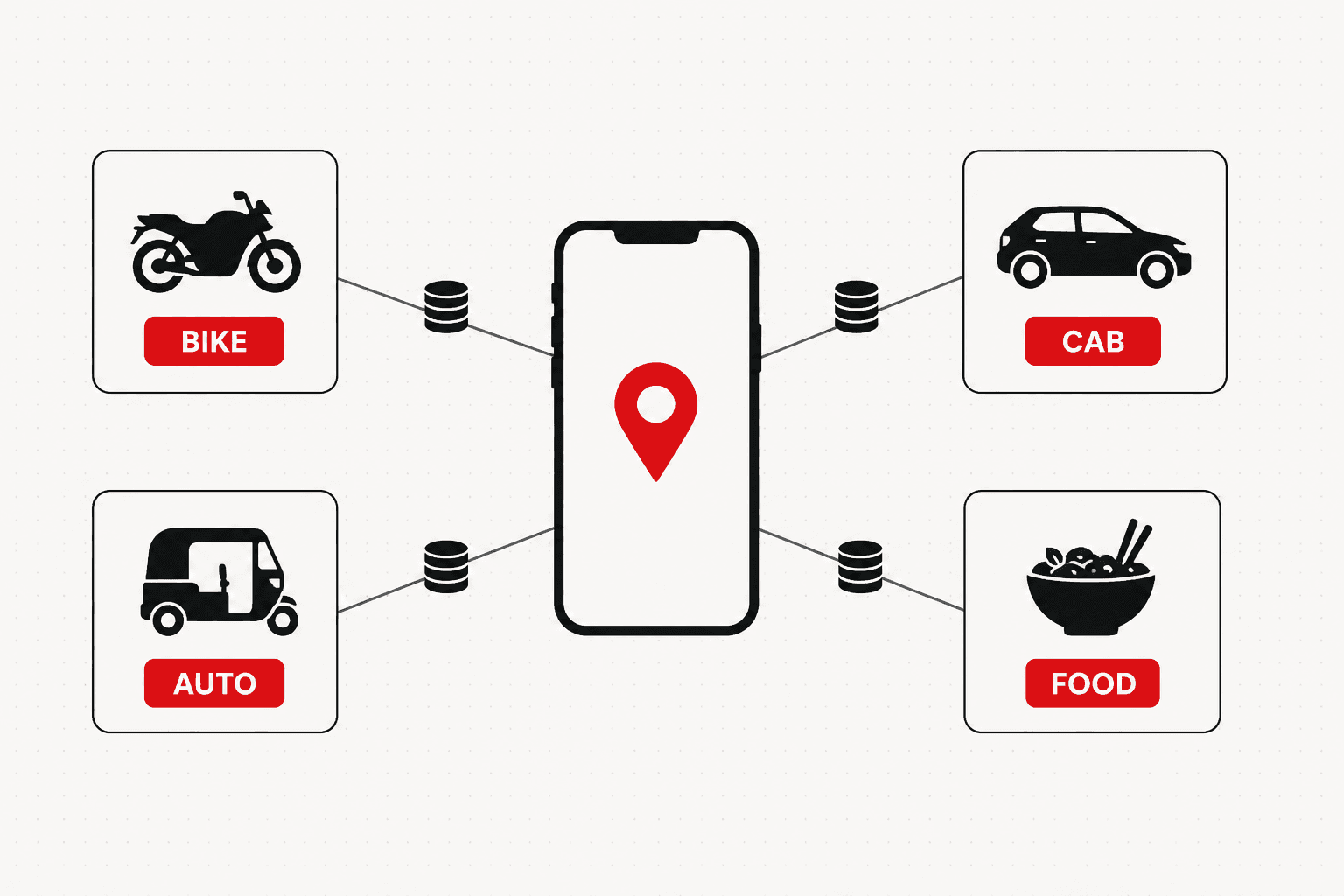
Short answer: Rapido makes money from delivery, ride commissions and subscriptions, in roughly equal parts. In FY25 delivery earned ₹340 crore, platform commissions ₹277 crore and subscriptions ₹275 crore, out of revenue from operations of ₹934 crore (Entrackr, January 2026). The subscription line is the model: many captains pay a flat daily or monthly fee rather than a commission, which made Rapido the cheapest platform for drivers and pulled supply away from Ola and Uber. It still lost ₹258 crore in FY25, 30.5 percent less than in FY24.
From bike taxis to a three-vehicle network
Rapido began as a bike taxi aggregator in 2015, founded by Aravind Sanka, Pavan Guntupalli and Rishikesh SR after their logistics startup shut down. For its first three years it ran bike taxis only in Bengaluru, Gurugram and Mysuru, then launched in 60 cities in 2018 (Inc42, April 2025). Auto-rickshaws and hyperlocal delivery came during the Covid-19 pandemic, and cabs in December 2023 (Inc42, April 2025).
The bike was the wedge. A motorcycle ride is the cheapest form of paid transport in an Indian city, and it beats traffic. By April 2025 Rapido said it had about 70 percent of India's bike taxi market, nearly 40 percent of auto rides and 22 percent of cab hailing, with 20 million transacting users and 2 million transacting bike taxi partners a month (Inc42, April 2025). These are company estimates, not audited figures. Rapido owns no vehicles; every captain brings their own.
The zero-commission subscription
Until 2024 Rapido charged a 15 to 30 percent commission per ride, like Ola and Uber (Inc42, April 2025). Cabs launched on zero commission in 2023 and autos moved in 2024 (Inc42, September 2026). By April 2025 bike and auto captains paid about ₹20 to ₹30 a day to use the platform, and cab drivers paid ₹40 a day or ₹500 a month, while bike captains in some cities were still moving off commission (Inc42, April 2025).
The arithmetic explains the appeal. A captain completing ten ₹100 rides a day at a 20 percent commission hands over ₹200; on a ₹30 daily pass, the same captain pays ₹30, by our arithmetic. The drivers who drive most have the strongest reason to log in to Rapido first.
For Rapido, the fee works like software pricing. Revenue tracks the number of captains who log in, not the fare, so it is predictable and does not rise when Rapido cuts prices to win riders. Competitors followed. Uber moved its autos to a subscription model in February 2025 (Inc42, September 2026).
How Rapido makes money
Delivery: the quiet largest line
Delivery earned ₹340 crore in FY25, up 28.3 percent, and overtook ride income as Rapido's biggest line (Entrackr, January 2026). The same captains who carry passengers carry parcels, and Sanka has said the network handles deliveries for Swiggy, Zomato and ecommerce and quick commerce platforms (Inc42, September 2026). Idle time between rides becomes paid time, without a separate fleet.
Subscriptions and commissions
Subscription revenue of ₹275 crore includes captain platform fees and passes that users buy for ride benefits; Entrackr does not split the two (Entrackr, January 2026). Commission income fell 23.5 percent to ₹277 crore as more captains moved to passes; if the shift continues, subscriptions become the larger line. Passenger transport services added ₹21 crore and advertising ₹16 crore, and interest on investments brought ₹69 crore of other income, for total income of ₹1,003 crore (Entrackr, January 2026).
Revenue and loss, as filed
Rapido's revenue from operations roughly tripled to ₹443 crore in FY23, from ₹145 crore in FY22, while its loss widened to ₹675 crore from about ₹439 crore; it spent ₹2.65 to earn each rupee (Entrackr, January 2024). In FY24 revenue rose to ₹648 crore and the loss narrowed to ₹371 crore (Inc42, April 2025). In FY25 revenue grew 44 percent to ₹934 crore, the loss fell 30.5 percent to ₹258 crore, and Rapido spent ₹1.35 for each rupee of revenue (Entrackr, January 2026).
The biggest cost is still the supply side. Delivery charges and incentives to captains were ₹500 crore in FY25, about 40 percent of total expenses of ₹1,261 crore (Entrackr, January 2026). In April 2025 the company said it expected to be fully profitable in FY26 (Inc42, April 2025), and Prosus's investor presentation showed gross merchandise value up 111 percent year on year in the first half of FY26 (Inc42, September 2026). The FY26 filing will show whether it did.
The funding history tracks the model. Swiggy led a $180 million round in 2022, and in September 2025 Swiggy agreed to sell its stake to Prosus and WestBridge for about ₹2,400 crore (Inc42, September 2026), a month after Rapido moved into food delivery. In May 2026 Rapido raised $240 million in fresh money led by Prosus, as part of a $730 million primary and secondary round, at a $3 billion valuation (Business Today, May 2026).
Ownly: zero commission comes to food delivery
Ownly is the subscription idea applied to restaurants. It began as a pilot in parts of Bengaluru in August 2025, charging restaurants ₹25 per order plus GST and waiving delivery fees for customers in the areas it served (Inc42, September 2026). In July 2026 it moved to zero restaurant commission and became a tab inside the main Rapido app, with close to 20,000 restaurants listed and deliveries run through Rapido's existing rider network (Business Today, July 2026).
The pitch targets the take rate described in our Swiggy and Zomato teardowns. Rapido needs no separate fleet, and India's ride-hailing user base is nearly twice its online food ordering base (Business Today, July 2026). No Ownly order volumes or revenue have been disclosed, so this is still a bet.
The regulatory fight over bike taxis
The core product sits in a legal grey zone. Under the Motor Vehicles Act, private vehicles cannot be used commercially without permits, which is why bike taxis have faced temporary bans in Mumbai, Bengaluru and Delhi (Inc42, April 2025).
Karnataka. The state government imposed a bike taxi ban in March 2024, a single judge of the High Court ordered services suspended in April 2025 until the state framed a policy, and the halt took effect on 16 June 2025 (Entrackr, January 2026). On 23 January 2026 a Division Bench led by Chief Justice Vibhu Bakhru set the order aside. It held that motorcycles fall within transport vehicles under the Motor Vehicles Act, that the trade is protected under Article 19(1)(g), and that permits cannot be refused only because a vehicle is a motorcycle, while allowing the state to impose conditions (Entrackr, January 2026). Bike taxis were off the road in Rapido's home state for about seven months.
Maharashtra. The state notified bike taxi rules in July 2025 that allow only electric bikes, granted Ola, Uber and Rapido provisional licences in September 2025, and revoked them in March 2026, citing petrol bikes, complaints over women riders' safety and missing documents (Angel One, March 2026).
The central government's Motor Vehicle Aggregator Guidelines of 2025 allow bike taxis subject to state approval (Entrackr, January 2026), so the fight is now over which conditions each state sets.
Rapido's marketing strategy
Rapido spends heavily to buy demand. Its advertising and promotion expense was ₹252 crore in FY25 (Entrackr, January 2026), about 27 percent of revenue from operations by our arithmetic. Compare that with the half a percent Zerodha spends, a business that grew on referrals instead.
IPL as the launch window. Rapido has used the IPL season as its national stage. In 2022 its "Smart Ho, Toh Rapido" campaign starred Ranveer Singh and Allu Arjun, with separate films for Hindi-speaking and non-Hindi-speaking markets, a 12-week run across TV, radio and OTT, and a budget reported at close to $20 million (MediaNews4u, March 2022).
Regional by design. The IPL 2025 campaign promised a ride in five minutes, was made by Lowe Lintas Bangalore and ran in Hindi, Telugu, Marathi, Tamil and Bengali (MediaNews4u, March 2025). A bike taxi is a local habit, so the message speaks the city's language.
Supply-side marketing. The zero-commission pitch is aimed at drivers as much as riders. In March 2025, Similarweb data showed Rapido's captain app averaging over 820,000 monthly downloads, against under 500,000 for each of Ola's and Uber's India driver apps (Inc42, April 2025). In a marketplace, the side that is harder to recruit gets the best offer.
What a marketplace or services brand can copy
-
Price for the side you are short of. Rapido gave drivers the better deal and let rider growth follow supply. Ask which side actually limits your growth before you discount.
-
Turn a cut into a subscription where the heavy user pays the least per job. A flat fee rewards your most active providers, which is exactly the behaviour you want, and it makes your revenue predictable.
-
Reuse the network for new jobs. Parcels, food and travel all ride on the same captains and the same app. A service business with a field team can sell an adjacent job to the same customer before it builds a new team.
-
Treat regulation as a line in the plan. One court order switched off Rapido's home-state bikes for seven months. If your model sits in a grey zone, budget for it.
For another marketplace built on independent professionals, see the Urban Company business model; for another brand that bought national fame through the IPL, the CRED business model.
Frequently Asked Questions
How does Rapido make money?
Rapido earns from four main lines. In FY25, delivery brought in ₹340 crore, commissions on rides ₹277 crore and subscriptions ₹275 crore, while passenger transport, advertising and other income added ₹42 crore, for revenue from operations of ₹934 crore. Subscriptions are the distinctive line: instead of taking a cut of every fare, Rapido charges many captains a flat daily or monthly fee to use the platform, and also sells ride passes to users.
What is Rapido's zero-commission model?
Rapido used to take a 15 to 30 percent commission on each ride. It moved to a subscription model in February 2024, and by April 2025 bike and auto captains paid about ₹20 to ₹30 a day, while cab drivers paid ₹40 a day or ₹500 a month. Captains keep the whole fare, and Rapido's income no longer depends on how much each ride costs, only on how many captains log in.
Is Rapido profitable?
Not on its filed accounts so far. Rapido's revenue from operations rose 44 percent to ₹934 crore in FY25 and its net loss narrowed 30.5 percent to ₹258 crore, from ₹371 crore in FY24. It spent ₹1.35 to earn each rupee of operating revenue in FY25, against ₹2.65 in FY23. The company had said it expected to be fully profitable in FY26, but FY26 accounts had not been reported as of September 2026.
What is Rapido Ownly?
Ownly is Rapido's food delivery service. It began as a pilot in parts of Bengaluru in August 2025, charging restaurants ₹25 per order plus GST and waiving customer delivery fees in the areas it served. In July 2026 it moved to zero restaurant commission and was folded into the main Rapido app, with close to 20,000 restaurants listed.
Why were bike taxis banned in Karnataka?
The state argued there was no approved policy for using private motorcycles as taxis. A single judge of the Karnataka High Court suspended bike taxi services in April 2025 until the state framed a policy, and the halt took effect on 16 June 2025. On 23 January 2026 a Division Bench set the order aside, holding that motorcycles can be transport vehicles and that a blanket ban was unreasonable, while allowing the state to impose permit conditions.
What can a marketplace or services brand learn from Rapido?
Price for the supply side you need most; a flat fee that lets drivers keep the whole fare made Rapido the cheapest platform for full-time captains. Reuse the same network for new jobs, as Rapido did with parcels and food. And plan for regulation as a business risk: one court order shut its home-state bike taxis for seven months.

Aditya Kathotia
Founder & CEO
CEO of Nico Digital and founder of Digital Polo, Aditya Kathotia is a trailblazer in digital marketing. He's powered 500+ brands through transformative strategies, enabling clients worldwide to grow revenue exponentially. Aditya's work has been featured on Entrepreneur, Economic Times, Hubspot, Business.com, Clutch, and more. Join Aditya Kathotia's orbit on LinkedIn to gain exclusive access to his treasure trove of niche-specific marketing secrets and insights.
More in Marketing Strategy
- Paytm Business Model: Payments, Devices and Lending After the RBI Ban
- PhonePe Business Model: How a Free UPI App Makes Money
- Physics Wallah Business Model: How Low-Fee Edtech Makes Money
- boAt Business Model: How an Audio Brand Built a D2C Empire
- Nykaa Business Model: Content-Led Beauty Commerce Explained
- Swiggy Business Model: Food Delivery, Instamart and the Margin Gap