
This is an independent analysis by Nico Digital. Zerodha is not a client, and no non-public information was used. Zerodha is unlisted, so the figures below come from its filings with the Registrar of Companies as reported by Entrackr and Inc42, from Zerodha's own published charges and business updates, and from SEBI circulars, with the publication and date noted inline.
Zerodha charges nothing to buy and hold shares. It has never raised outside money (Business Today, January 2023), says it does not advertise, and gives away its trading education for free. In FY25 it still reported ₹8,847 crore of revenue from operations and ₹4,237 crore of profit (Entrackr, November 2025). The free product is the funnel; the money comes from the minority of clients who trade often, and from the cash everyone else leaves in their accounts.
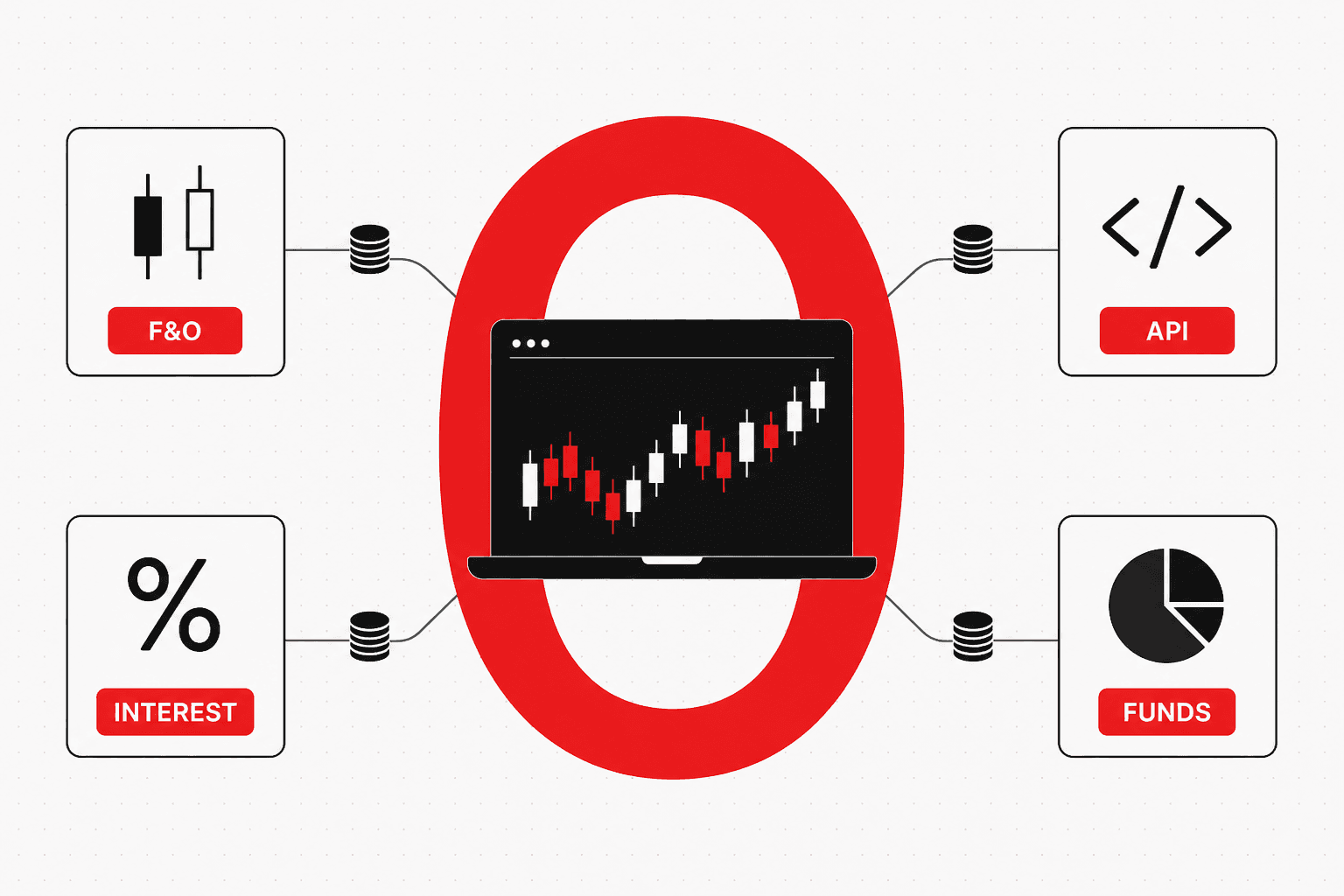
Short answer: Zerodha makes money from active traders, not long-term investors. Equity delivery is free, but intraday, futures and options orders cost up to ₹20 each, and futures and options trading has been its main revenue driver. It also earns interest on client funds and margin loans, an annual maintenance charge on demat accounts and smaller depository fees. In FY26 it disclosed a net profit of ₹4,283 crore, flat on FY25, after SEBI's 2024 rules cut into F&O volumes (Inc42, August 2026).
Zero brokerage, flat ₹20: the price that built a giant
Nithin Kamath bootstrapped Zerodha in 2010 with his brother Nikhil as co-founder (Zerodha, About page, November 2026). The pitch was a price list rather than a slogan. Today it reads: ₹0 for equity delivery; 0.03 percent or ₹20, whichever is lower, for intraday and futures; a flat ₹20 for options; and free account opening for resident individuals (Zerodha charges page, November 2026). Account opening became free on 29 June 2024 (Zerodha Z-Connect, July 2024), and new accounts opened from 1 June 2026 pay no maintenance charge in their first year (Zerodha Z-Connect, June 2026).
The logic is a two-sided price. Long-term investors, who would leave over a percentage fee, pay almost nothing and become the base. Active traders, who place many orders and care more about a cap than a percentage, pay ₹20 a time and generate the revenue. The model scaled: in December 2024 Zerodha had 8.12 million active NSE clients and a 16.41 percent share, behind only Groww (Entrackr, January 2025).
The lead has since slipped. Active clients fell from 78.88 lakh to 68.93 lakh between FY25 and FY26 (Business Today, citing Kotak Institutional Equities, April 2026), and by October 2026 Zerodha, at 67.6 lakh, had fallen to third behind Groww and Angel One (Free Press Journal, November 2026).
How Zerodha makes money
Zerodha publishes no segment report, but filings and its own posts give the main lines. In FY23, fees and commissions were ₹5,727 crore, about 84 percent of operating revenue (Inc42, December 2023), and Kamath has written that F&O is the primary revenue driver (Zerodha Z-Connect, September 2023).
F&O brokerage: the engine
Every intraday, futures or options order earns up to ₹20. In FY26 brokerage income was ₹2,738 crore, down 10.7 percent (Inc42, August 2026). Each order costs the same whatever its size, so this line tracks order counts, which is why rules that cut trade counts hit it directly.
Exchange charges and the lost rebate
About a quarter of Zerodha's revenue was exchange transaction charges collected from clients and passed on (Zerodha Z-Connect, September 2023). Exchanges used to charge brokers less per trade at higher volumes, while brokers charged clients the standard rate and kept the difference. Kamath put those rebates at about 10 percent of revenue (Zerodha Z-Connect, July 2024). In FY26, net transaction charges were zero, against about ₹400 crore the year before (Inc42, August 2026).
Interest: the quiet second engine
Clients keep cash with a broker between trades, and Zerodha held cash and bank balances of ₹22,679 crore at the end of FY25 (Entrackr, November 2025). Interest income was ₹2,269 crore in FY26, down about 4 percent (Inc42, August 2026). Margin trading, launched in December 2024 and now charged at 0.04 percent a day (Zerodha charges page, November 2026), had a book of ₹9,000 crore and contributed about 10 percent of revenue by August 2026 (Zerodha Z-Connect, August 2026).
AMC, APIs and mutual funds
The annual maintenance charge is ₹300 a year plus GST for regular demat accounts (Zerodha charges page, November 2026) and brought in about ₹180 crore in FY26 (Inc42, August 2026). Kite Connect, the API for algorithmic traders, has moved the other way: order APIs became free in 2025 (Zerodha Z-Connect, April 2025) and the data plan was cut from ₹2,000 to ₹500 a month (Kite Connect forum, May 2025). It is a retention tool for heavy traders, not a revenue line.
Mutual funds work the same way. Direct funds on Coin cost nothing (Zerodha charges page, November 2026), while Zerodha Fund House, a joint venture with smallcase's parent, launched its first fund in October 2023 and earned ₹16.8 crore of revenue at a ₹5.1 crore loss in FY26, on quarterly average assets of ₹14,448 crore in March 2026 (Inc42, August 2026).
Revenue and profit, as filed
Revenue from operations rose from ₹2,729 crore in FY21 to ₹4,964 crore in FY22, and profit from ₹1,122 crore to ₹2,094 crore (Indian Startup News, citing Entrackr, January 2023). FY23 revenue was ₹6,833 crore and profit ₹2,909 crore (Inc42, December 2023). For FY24 the company announced ₹8,320 crore of revenue and ₹4,700 crore of profit (Inc42, September 2024), a figure that excluded about ₹1,000 crore of unrealised gains (Entrackr, September 2024); the filing showed revenue from operations of ₹9,372 crore and profit of ₹5,496 crore (Inc42, December 2024).
FY25 revenue fell to ₹8,847 crore and profit to ₹4,237 crore, down 22.9 percent; Entrackr measured the revenue fall at 11.5 percent against an FY24 base of ₹9,993 crore, and put the EBITDA margin at 63.78 percent (Entrackr, November 2025). For FY26, Zerodha disclosed net profit of ₹4,283 crore, up about 1 percent, with revenue similar to FY25 (Inc42, August 2026). A business with roughly 1,200 employees (Inc42, September 2024) earning a 60 percent-plus margin is the clearest proof the model works.
What SEBI's 2024 rules did to the model
Two 2024 circulars hit exactly the lines Zerodha depended on.
True to label. SEBI's circular of 1 July 2024 required exchanges to charge every member the same fee from 1 October 2024, ending volume rebates (Zerodha Z-Connect, July 2024). Kamath warned that Zerodha might have to drop free delivery, then confirmed in October that delivery would stay free and the hit would be about 10 percent of revenue (Inc42, October 2024).
The F&O framework. SEBI's circular of 1 October 2024 raised the minimum index derivative contract size to ₹15 lakh, limited each exchange to one weekly expiry index and added an extra 2 percent margin on short options on expiry day from 20 November 2024, with upfront premium collection from February 2025 (TaxGuru, October 2024). Kamath estimated that about 60 percent of Zerodha's F&O trades and about 30 percent of all orders would be affected (Inc42, October 2024).
The effect was immediate. Brokerage revenue fell about 40 percent year on year in the June 2025 quarter, and Zerodha said it would be forced to charge for delivery if weekly options were stopped altogether (Zerodha Z-Connect, September 2025). Kamath described FY26 revenue as not having grown in real terms (Zerodha Z-Connect, August 2026). The response has been diversification: margin trading, the fund house, a first-year AMC waiver and refunds of up to ₹500 of transfer charges for clients moving from other brokers (Zerodha Z-Connect, June 2026).
Zerodha's marketing strategy: growth without advertising
Zerodha says it does not spend on advertising, and that referrals and partners bring about 10 percent of new business (Zerodha Z-Connect, September 2023). Its FY25 filings show ₹47 crore of advertising expense (Entrackr, November 2025), about half a percent of revenue. Compare that with CRED's IPL years or Swiggy's ₹4,207 crore of FY26 advertising and promotion spend (Bajaj Broking, May 2026). Three things replaced the ad budget.
Education that does not sell. Varsity, Zerodha's free course library, needs no login, does not pitch Zerodha and has more than two million users (Zerodha Z-Connect, November 2024); a free Varsity Live course drew over 2 lakh registrations (Zerodha Z-Connect, September 2025). It meets new investors before they choose a broker, without asking for the account.
Transparency as content. Kamath's anniversary posts publish revenue drivers, regulatory risks and failures in detail, and the trade press reports them. The disclosure is the marketing: it makes a low-cost broker look like the safe choice.
Referrals and community. Clients earn 10 percent of the brokerage of accounts they refer (Zerodha Z-Connect, August 2026), and TradingQnA gives users a forum run by the company (Zerodha, About page, November 2026).
Rainmatter: where the profits go
Zerodha sets aside about 10 percent of its earnings for startups and another 10 percent for the social sector, and Rainmatter has invested more than ₹1,500 crore in over 160 startups since 2016 (Business Today, April 2026), most of them in climate, health and fitness, and fintech (Entrepreneur India, April 2026). Rainmatter Foundation, created in 2020, backs a ₹100 crore rewilding fund (Zerodha Z-Connect, September 2025). It is not a revenue line; it is reputation.
What a fintech brand can copy
-
Make the entry product free and charge the heavy user. Free delivery won investors; flat fees on frequent trades paid for them. A fintech brand can price its first product at zero if a clear segment will pay for the second.
-
Educate without a pitch. Varsity works because it never asks for the sale. Search-led education compounds long after a campaign ends, and our Groww teardown shows the same pattern.
-
Let the product and referrals carry acquisition. At half a percent of revenue on ads, Zerodha's marketing is its product, pricing and disclosure.
-
Do not let one line carry the company. When SEBI curbed F&O trading, the engine slowed and profit fell 22.9 percent in a year. Build the second and third lines before the regulator forces you to.
Next: a fintech that bought fame instead, in the CRED business model; and fees layered on habit, in the Zomato and Meesho teardowns. For what a single regulator's order can do to a payments company, see the Paytm business model. For a payments app that monetises merchants instead of users, see the PhonePe business model.
Frequently Asked Questions
How does Zerodha make money if delivery trades are free?
Zerodha charges nothing to buy and hold shares, but it charges a flat ₹20 or 0.03 percent, whichever is lower, on intraday and futures trades and a flat ₹20 on every options order. Futures and options trading has been its main revenue driver. It also earns interest on client funds and on margin trading loans, an annual maintenance charge on demat accounts, and smaller fees such as depository charges on shares sold. In FY26 it reported brokerage income of ₹2,738 crore and interest income of ₹2,269 crore.
What is Zerodha's revenue and profit?
According to its filings as reported by Entrackr and Inc42, Zerodha's revenue from operations was ₹4,964 crore in FY22, ₹6,833 crore in FY23 and ₹8,847 crore in FY25, and its profit was ₹2,094 crore, ₹2,909 crore, ₹5,496 crore and ₹4,237 crore from FY22 to FY25. For FY26 the company disclosed a net profit of ₹4,283 crore, up about 1 percent, and said revenue was similar to FY25.
How did SEBI's 2024 rules affect Zerodha?
Two SEBI circulars hit the model. The July 2024 true-to-label circular ended volume-based exchange rebates from October 2024; Nithin Kamath said those rebates were about 10 percent of Zerodha's revenue. The October 2024 F&O framework raised contract sizes, cut weekly expiries to one index per exchange and tightened margins from November 2024. Zerodha's brokerage revenue fell about 40 percent year on year in the June 2025 quarter, and FY25 profit fell 22.9 percent.
Does Zerodha spend on advertising?
Very little. Zerodha says it does not advertise, and its FY25 filings show ₹47 crore of advertising expense against ₹8,847 crore of revenue, about half a percent. Growth came from low prices, word of mouth, a referral programme that pays 10 percent and brings about a tenth of new business, and free education through Varsity, which Zerodha says has more than two million users.
What is Rainmatter?
Rainmatter is Zerodha's investment and philanthropy arm. Zerodha sets aside about 10 percent of its earnings for startups and another 10 percent for the social sector. Rainmatter has invested more than ₹1,500 crore in over 160 startups since 2016, mostly in climate, health and fintech, and Rainmatter Foundation, created in 2020, backs climate work, including a ₹100 crore rewilding fund.
What can a fintech brand learn from Zerodha?
Price the entry product at zero and charge the heavy users who value it most; earn trust with education that does not sell; let product quality and referrals do the acquisition work; and never let one revenue line carry the business. Zerodha's own weakness is the last one: when SEBI curbed F&O trading, the line that paid for everything else shrank, and the company had to build interest, margin lending and mutual fund income quickly.

Aditya Kathotia
Founder & CEO
CEO of Nico Digital and founder of Digital Polo, Aditya Kathotia is a trailblazer in digital marketing. He's powered 500+ brands through transformative strategies, enabling clients worldwide to grow revenue exponentially. Aditya's work has been featured on Entrepreneur, Economic Times, Hubspot, Business.com, Clutch, and more. Join Aditya Kathotia's orbit on LinkedIn to gain exclusive access to his treasure trove of niche-specific marketing secrets and insights.
More in Marketing Strategy
- Paytm Business Model: Payments, Devices and Lending After the RBI Ban
- PhonePe Business Model: How a Free UPI App Makes Money
- Physics Wallah Business Model: How Low-Fee Edtech Makes Money
- Rapido Business Model: How a Bike Taxi App Makes Money
- boAt Business Model: How an Audio Brand Built a D2C Empire
- Nykaa Business Model: Content-Led Beauty Commerce Explained