

This is an independent analysis by Nico Digital. boAt is not a client, and no non-public information was used. Every figure below comes from boAt's filings as reported in the business press (Entrackr, Inc42 and others), from its updated draft prospectus as covered at filing, or from contemporaneous news coverage, with the publication and date noted inline.
boAt is usually filed under "D2C brand". The numbers say something more interesting: it is a brand that sells almost entirely through other people's stores, owns no factory of its own, and still became India's largest audio brand. What boAt owns is the design, the brand and the demand. Everything else is rented.
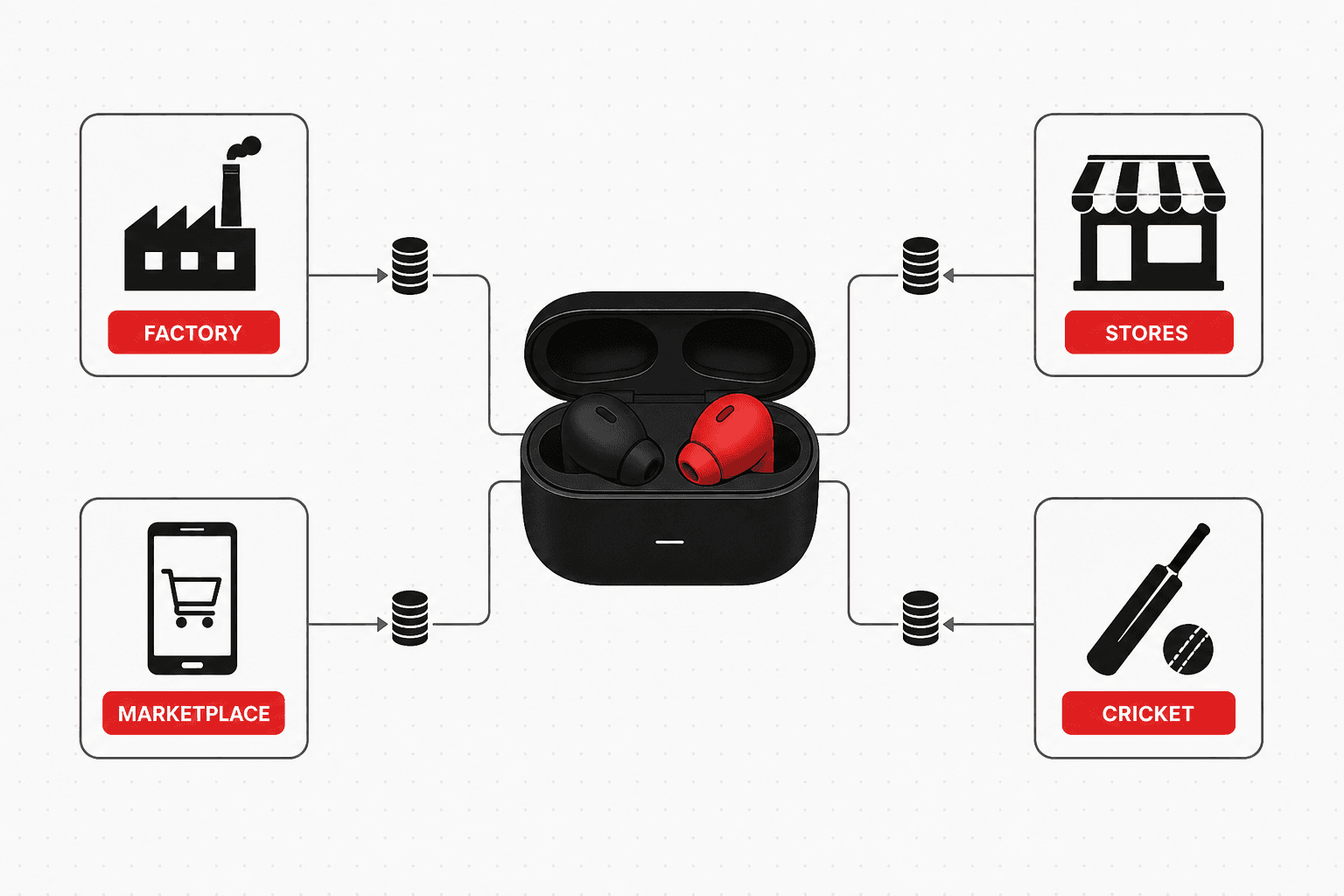
Short answer: boAt designs earbuds, headphones, speakers, smartwatches and chargers, has them built by contract manufacturers (now mostly in India, through a joint venture with Dixon Technologies), and sells them mainly on Amazon and Flipkart. In FY26 it reported operating revenue of ₹2,931 crore and a net profit of ₹84.5 crore, up 38 percent, with no bank debt (Inc42, August 2026). Audio was about 84 percent of FY25 revenue (Indian Startup News, October 2025).
From cable importer to India's biggest audio brand
Sameer Mehta and Aman Gupta set up Imagine Marketing with ₹15 lakh each, and it first imported and distributed foreign brands such as House of Marley while the founders studied the Indian market (Business Today, January 2024). The boAt brand followed in 2016, starting with smartphone charging cables (Business Today, January 2024).
That first cable set the template. It was a braided cable rated for 10,000 bends, priced at ₹1,500, the same as Apple's, and marketed to people tired of cables that broke (Outlook Business, May 2019). From there the range moved into neckbands, speakers, wireless headphones, true wireless earbuds and smartwatches (Business Today, January 2024). The only outside money in the early years was ₹6 crore from Fireside Ventures in May 2018 (Outlook Business, May 2019).
By FY25 boAt held about 26 percent of India's audio accessories market by value and 34 percent by volume (Inc42, November 2025). In October 2025 it filed an updated draft prospectus for a ₹1,500 crore IPO: ₹500 crore of fresh shares and a ₹1,000 crore offer for sale, with South Lake Investment, a Warburg Pincus fund, as the largest shareholder at 39.35 percent (Indian Startup News, October 2025).
The asset-light model: design here, build elsewhere
boAt is a brand company. It designs products in-house and pays someone else to make them. In the early years that meant contract manufacturers in China who first had to be persuaded to run small batches, with only minimum inventory held in India (Outlook Business, May 2019).
The cost structure shows it. In FY25 boAt spent ₹2,070 crore buying finished stock (Entrackr, September 2025), about 67 percent of its ₹3,073 crore operating revenue by our arithmetic. There is no line for running factories, because boAt does not run any. What it does carry is the brand-owner's risk: warranty claims, unsold stock and the marketing needed to make a contract-made product feel like a lifestyle purchase.
From Chinese factories to Califonix
The shift to India happened through partners, not plants. Dixon Technologies was already making wearables for boAt when the two announced a 50:50 joint venture in January 2022 to design and manufacture Bluetooth audio devices in India (Outlook Business, January 2022). That JV is Califonix Tech and Manufacturing.
The change is visible in the share of units made in India: 39.65 percent in FY23 and 75.83 percent in the quarter ended June 2025, when Califonix alone produced 37.46 percent of boAt's units (SMEStreet, November 2025). Califonix has 30 million units of annual capacity and made 13.44 million units in FY25, a 44.8 percent utilisation rate (SMEStreet, November 2025). Co-founder Sameer Mehta summed it up in early 2024: two years earlier nothing was made in India, and by then 70 percent was (Business Today, January 2024).
Warranty costs are falling too: warranty expenses fell from ₹82.6 crore in FY25 to ₹57.5 crore in FY26 (Inc42, August 2026). For the opposite strategy, a brand that owns its factories outright, see the Lenskart business model.
Channel mix: a D2C brand that sells through marketplaces
The irony in boAt's "D2C" label is in its own filings.
In FY21, third-party marketplaces brought in ₹1,128 crore of boAt's ₹1,314 crore of sales, offline retail ₹162 crore and its own website ₹24 crore (Inc42, March 2022). By our arithmetic that is about 86, 12 and 2 percent. E-commerce channels made up 84 to 86 percent of sales in every year from FY19 to FY21 (Inc42, March 2022).
Offline has grown since: from 27.7 percent of revenue in FY23 to 28.4 percent in FY25, with quick commerce emerging as a new online channel (Inc42, November 2025). boAt now sells through more than 12,000 offline retail stores across 25 states and five union territories, backed by 115+ service centres (Indian Startup News, October 2025). International sales are still small: about ₹45 crore in FY26, roughly 1.5 percent of revenue (Inc42, August 2026).
Marketplace dependence is a trade-off, not a mistake. Amazon and Flipkart supplied traffic, logistics and payment trust that a new brand could not have built. The cost is that boAt rents its customer relationship and competes for the same search results as every rival. Quick commerce adds a second rented shelf; the Blinkit business model explains why those platforms increasingly charge brands for visibility.
Pricing: affordable, never the cheapest
boAt is remembered as the affordable option, but it never set out to win on price. Mehta's line in 2019 was that "a price race is a race to the bottom", and he compared boAt's position to Zara's: not luxury, not cheap (Outlook Business, May 2019). The ₹1,500 cable priced at Apple's level was the proof.
The market did not stay that kind. In India's true wireless earbud market, boAt kept the top spot in the first quarter of 2025, but its shipments fell 11 percent year on year as rivalry intensified at the low end of the price range (Counterpoint Research, May 2025). Smartwatches were worse: wearables revenue fell from ₹901.5 crore in FY23 (Inc42, December 2023) to ₹550.3 crore in FY24 (Inc42, November 2024) and ₹330 crore in FY25 (Indian Startup News, October 2025).
boAt's response was to give up volume rather than margin. Gross margin rose from 22.6 percent in FY23 to 29.23 percent in FY25 (Inc42, November 2025), and the wearables segment turned a profit of about ₹7 crore in FY26 after a ₹54 crore loss in FY25 (Inc42, August 2026).
Revenue and profit, as filed and reported
boAt grew fast, stalled, and then chose profit.
Operating revenue grew from ₹1,314 crore in FY21 (Inc42, March 2022) to ₹2,873 crore in FY22 and ₹3,376.7 crore in FY23, when boAt swung from a ₹68.7 crore profit to a ₹129.4 crore loss, its first, as advertising spend reached ₹427.6 crore (Inc42, December 2023). FY24 revenue fell to ₹3,117.7 crore and the net loss narrowed to ₹79.7 crore (Inc42, November 2024).
FY25 was the turn: operating revenue of ₹3,073 crore and a net profit of about ₹60 crore (Entrackr, September 2025), shown as ₹61.1 crore in the FY26 comparison (Inc42, August 2026). Operating cash flow went from negative ₹18.1 crore in FY23 to positive ₹441.5 crore in FY25 (Inc42, November 2025). In FY26 revenue slipped to ₹2,931 crore, but profit rose 38 percent to ₹84.5 crore, finance costs fell about 72 percent to ₹7.9 crore, and boAt ended the year with about ₹397 crore of cash and no bank debt (Inc42, August 2026).
boAt's marketing strategy: cricket, celebrities and boAtheads
boAt sells audio gear as a lifestyle accessory, and its marketing rests on three choices.
Celebrities who carry youth credibility. boAt signed Kartik Aaryan as an ambassador in October 2018, when it already counted more than 800,000 "boAtheads" among its buyers (MediaNews4U, October 2018). Its early approach skipped TV and print entirely in favour of social media and influencers (Outlook Business, May 2019).
Cricket as the main stage. boAt's IPL work began in 2018 with two teams; by 2020 it was the official audio partner of six, with Hardik Pandya, Shikhar Dhawan, Shreyas Iyer, Rishabh Pant, Prithvi Shaw and KL Rahul among its ambassadors, and about 90 percent of its marketing budget went to digital (Social Samosa, October 2020). For IPL 2024 it narrowed to Royal Challengers Bangalore and Gujarat Titans as official audio and wearable partner, built around a "Be a boAthead" fan campaign (afaqs, March 2024).
A named community. "boAtheads" turns buyers into members. In its early years boAt used product reviews from that community to shape new designs (Outlook Business, May 2019).
The spend is large and steady as a share of sales. Advertising and promotion was ₹427.6 crore in FY23 (Inc42, December 2023), ₹365.7 crore in FY24 (Inc42, November 2024) and ₹389.7 crore in FY25 (Indian Startup News, October 2025), which by our arithmetic is 12.7, 11.7 and 12.7 percent of revenue in those three years. The IPO plan earmarks ₹150 crore of fresh-issue proceeds for branding and marketing over FY26 to FY28 (Indian Startup News, October 2025).
What a D2C brand can copy
You do not need boAt's cricket budget to use its logic.
-
Own the brand, rent the rest. boAt never built a factory or a delivery network. It put its capital into design, inventory and demand, and let contract manufacturers and marketplaces carry the fixed costs until scale justified a partner like Dixon.
-
Launch with one product that proves the promise. A cable that survives 10,000 bends, priced like Apple's, told buyers what the brand stood for before it sold a single earbud.
-
Use marketplaces for reach, not for identity. A D2C brand can win early on Amazon and Flipkart, as boAt did, but should invest in a name, a community and search demand it owns, so that customers ask for the brand rather than the cheapest result.
-
Name your community. "boAtheads" made loyal buyers feel like insiders and gave the brand a ready audience for every launch and campaign.
-
Choose margin when a category turns into a price war. boAt let wearables revenue fall by almost two thirds rather than chase the bottom, and the segment came back to profit.
Next: how a marketplace makes money from brands like boAt, in the Meesho business model; how a platform adds fee lines once habit forms, in the Zomato business model; and how a beauty retailer combines inventory, owned brands and content, in the Nykaa business model.
Frequently Asked Questions
How does boAt make money?
boAt, owned by Imagine Marketing, makes money by selling its own audio, wearable and accessory products, which it designs in-house and has built by contract manufacturers. Product sales were ₹3,070.4 crore of its ₹3,073 crore FY25 operating revenue, and audio alone was ₹2,586 crore, about 84 percent. Most of it is sold through Amazon and Flipkart, with 12,000+ offline stores and its own website adding the rest.
Does boAt manufacture its own products?
Not in its own factories. boAt designs products and uses contract manufacturers, first in China and now mostly in India. Its 50:50 joint venture with Dixon Technologies, Califonix, was announced in January 2022. Domestic production rose from 39.65 percent of units in FY23 to 75.83 percent in the June 2025 quarter, when Califonix alone made 37.46 percent of boAt's units.
Is boAt profitable?
Yes, since FY25. boAt reported a net loss of ₹129.4 crore in FY23 and ₹79.7 crore in FY24, then a profit of ₹61.1 crore in FY25 and ₹84.5 crore in FY26. FY26 operating revenue was ₹2,931 crore, down nearly 5 percent, and the company ended the year with about ₹397 crore of cash and no bank debt.
Where does boAt sell its products?
Mostly on marketplaces. In FY21 third-party marketplaces brought in ₹1,128 crore of boAt's ₹1,314 crore of sales, offline retail ₹162 crore and its own website just ₹24 crore. Offline has since grown to 28.4 percent of revenue in FY25, through more than 12,000 retail stores, but online marketplaces remain the core channel.
What is boAt's marketing strategy?
boAt markets itself as a lifestyle brand through cricket, celebrities and community. It signed Kartik Aaryan in 2018, was the official audio partner of six IPL teams in 2020, and has used cricketers such as Hardik Pandya and KL Rahul as ambassadors. Around 90 percent of its budget went to digital in 2020, and loyal buyers are cast as boAtheads. It spent ₹389.7 crore on advertising and promotion in FY25.
Why did boAt's revenue stop growing?
Mainly because smartwatches collapsed. Wearables revenue fell from ₹901.5 crore in FY23 to ₹550.3 crore in FY24 and ₹330 crore in FY25, while audio grew from ₹2,350.8 crore to ₹2,586 crore. boAt chose margin over volume: wearables turned a segment profit of about ₹7 crore in FY26 after a ₹54 crore loss a year earlier.

Aditya Kathotia
Founder & CEO
CEO of Nico Digital and founder of Digital Polo, Aditya Kathotia is a trailblazer in digital marketing. He's powered 500+ brands through transformative strategies, enabling clients worldwide to grow revenue exponentially. Aditya's work has been featured on Entrepreneur, Economic Times, Hubspot, Business.com, Clutch, and more. Join Aditya Kathotia's orbit on LinkedIn to gain exclusive access to his treasure trove of niche-specific marketing secrets and insights.
More in Marketing Strategy
- Paytm Business Model: Payments, Devices and Lending After the RBI Ban
- PhonePe Business Model: How a Free UPI App Makes Money
- Physics Wallah Business Model: How Low-Fee Edtech Makes Money
- Rapido Business Model: How a Bike Taxi App Makes Money
- Nykaa Business Model: Content-Led Beauty Commerce Explained
- Swiggy Business Model: Food Delivery, Instamart and the Margin Gap