

This is an independent analysis by Nico Digital. PhonePe is not a client, and no non-public information was used. PhonePe is unlisted, so the figures below come from its draft IPO filings and Registrar of Companies filings as reported by Entrackr, Inc42 and other business press, and from NPCI data as reported by MediaNama, with the publication and date noted inline.
PhonePe runs India's largest payments app, and for most of its life the main thing it processed earned it nothing. UPI payments to merchants carried no merchant discount rate from January 2020 (ThePrint, September 2026), and person-to-person transfers have never been charged. PhonePe still built ₹7,920.5 crore of operating revenue in FY26 (Inc42, July 2026). The free payment is the habit; the money comes from merchants, lenders, insurers and advertisers who want access to that habit.
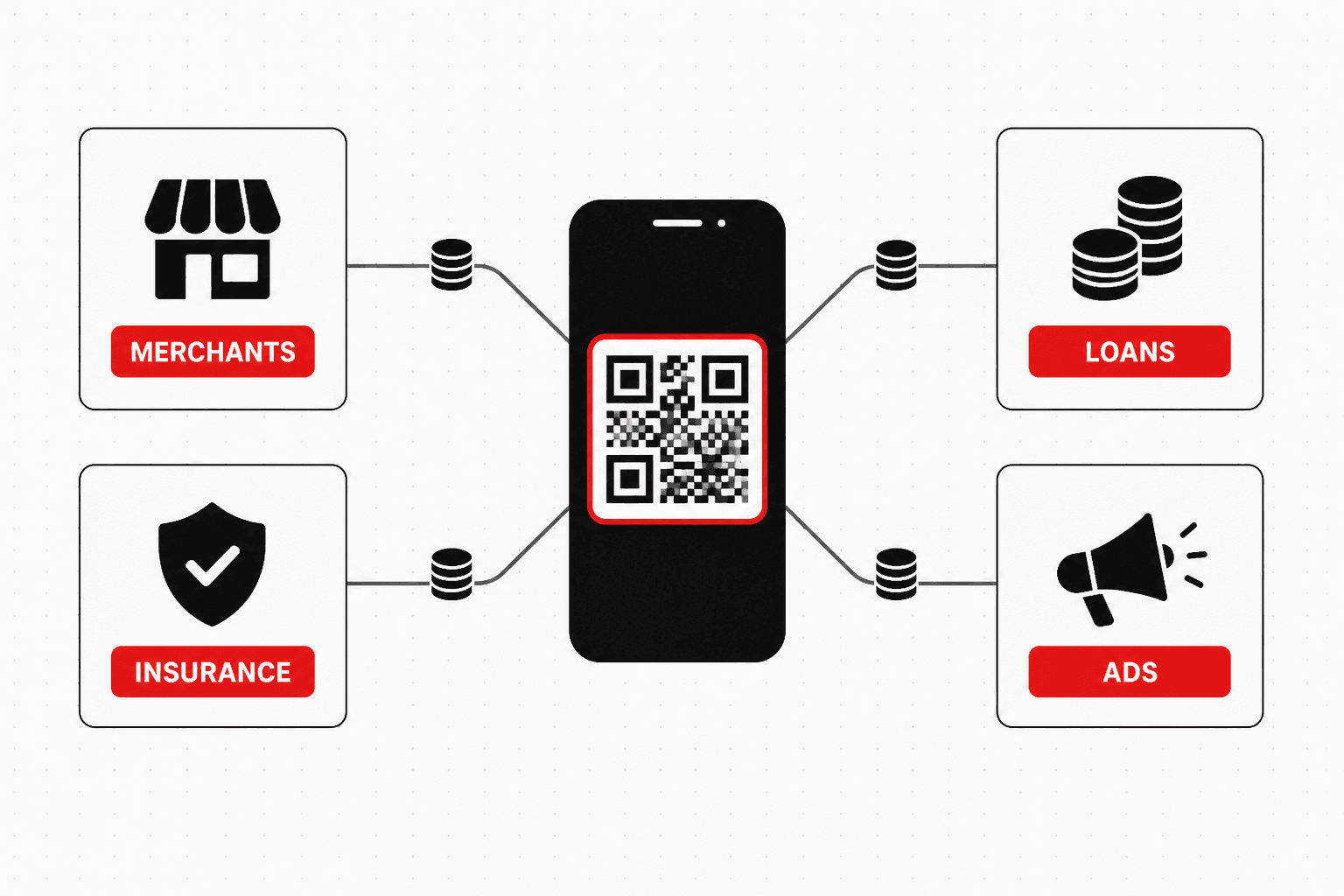
Short answer: PhonePe makes money around UPI, not from it. Merchants pay for card and online payment gateway services and for devices such as SmartSpeakers; partner lenders and insurers pay commissions for loans and policies sold in the app; and advertisers and NPCI incentives add the rest. Merchant payments and financial services rose from about 16 percent of revenue in FY23 to about 42 percent by September 2025 (Outlook Business, February 2026). In FY26 it reported a net loss of ₹2,792 crore on operating revenue of ₹7,920.5 crore, up 11.5 percent (Inc42, July 2026).
From a Flipkart buy to a Walmart-owned fintech
PhonePe was conceived in 2015 by three former Flipkart employees, Sameer Nigam, Rahul Chari and Burzin Engineer, and Flipkart confirmed it had acquired the startup on 1 April 2016 (Inc42, April 2016). Walmart bought a controlling stake in Flipkart in 2018, which brought PhonePe with it (ThePrint, citing Reuters, January 2023).
In December 2022 PhonePe separated from Flipkart and moved its domicile from Singapore to India. The move was treated as a capital gains event: Nigam said investors paid about ₹8,000 crore in tax to make it (Business Today, January 2023), and Walmart confirmed it paid most of a bill of nearly $1 billion (ThePrint, citing Reuters, January 2023). The updated IPO draft shows the result: Walmart's WM Digital Commerce Holdings owns 71.77 percent, General Atlantic 8.89 percent, Headstand 5.73 percent, and Nigam and Chari 2.55 percent each (Entrackr, January 2026).
UPI market share: the habit PhonePe owns
PhonePe processed 10.91 billion UPI transactions in September 2026, a 45.57 percent share of volume through NPCI-listed apps, against 7.71 billion and 32.23 percent for Google Pay (MediaNama, October 2026). The two together handled 77.8 percent, down from 81.9 percent a year earlier, and PhonePe's own share slipped 0.9 points (MediaNama, October 2026).
The share is also a risk. NPCI's circular capping any app at 30 percent of UPI volume, measured over a rolling three months, has a compliance deadline of 31 December 2026 for existing providers (MediaNama, October 2026). For context on the rest of the sector, see our list of fintech companies in India.
The zero-MDR problem, and what changed in October 2026
A merchant discount rate is the fee a shop pays on each digital payment. On UPI it was zero, so the app with almost half the market earned nothing on most of its volume. That changed partly in September 2026, when the government set a 0.4 percent charge on UPI payments to merchants above ₹2,000, capped at ₹300 for payments of ₹75,000 and above. Small merchants receiving up to ₹1 lakh a month through UPI QR codes stay exempt, which the government says shields 96 percent of merchant transactions (ThePrint, September 2026).
Charges began on 15 October 2026. In Inc42's worked example, the app provider's cut is 0.08 percent of the payment, and Bernstein estimates the fee pool could reach about ₹22,000 crore a year by FY28, with about ₹7,000 crore going to third-party apps such as PhonePe (Inc42, September 2026).
How PhonePe makes money
PhonePe's draft filings split revenue into consumer payments, merchant payments and financial services, and the mix has moved steadily away from the consumer side.
Merchant payments were 14.75 percent of revenue in FY23 and 30.78 percent by the six months to September 2025, while financial services rose from 0.96 percent to 11.55 percent (Outlook Business, February 2026). Consumer payments and other lines made up the remaining 84.29 percent and 57.67 percent.
Consumer payments: what still earns on a free app
Some consumer flows do pay. In the six months to September 2025, Entrackr counted ₹518.5 crore of revenue from rent and related payment categories, ₹70.9 crore from real-money gaming and ₹167 crore of government-linked incentives, and classed them as discontinued or policy-led; excluding them cut reported revenue of ₹3,918 crore to ₹3,162 crore, which Entrackr put at about 19 percent of operating income (Entrackr, February 2026). For FY26, PhonePe booked ₹286 crore of NPCI incentives for enabling credit cards on UPI and deploying payment devices (Inc42, July 2026). CRED leaned on the same card-funded rent payments.
Merchant payments: cards, gateway and devices
Merchant payments brought in ₹1,991 crore in FY25, about 28 percent of revenue (DT Next, citing IANS, March 2026). PhonePe earns here through payment gateway fees on online transactions, merchant devices, settlement and reconciliation tools, and paid promotion inside the app (Finshots, January 2026). The base is wide: 47.19 million registered merchants covering 98.61 percent of India's pin codes, 11.31 million monthly active merchants in March 2025, and 9.19 million devices deployed, including the SmartSpeaker that reads payments aloud (DT Next, citing IANS, March 2026).
Lending and insurance: distribution, not a balance sheet
PhonePe acts as a lending service provider, matching users and merchants with banks and NBFCs and earning a commission without carrying the loans (Finshots, January 2026); it surrendered its NBFC licence to the RBI in February 2025 (Inc42, December 2025). Merchant loan disbursals grew from ₹11 crore in FY23 to ₹4,507 crore in FY25, and lending revenue reached ₹288 crore in the first half of FY26, nearly 88 percent of the previous full year (DT Next, citing IANS, March 2026). PhonePe has issued about 4 million insurance policies a year since 2023 (Inc42, December 2025). Lending and insurance distribution together earned ₹513 crore in the half (Entrackr, February 2026).
The appstore
PhonePe bought Indus OS for $90 million in May 2022 and launched Indus Appstore on 21 February 2024 with no commission on in-app purchases (MediaNama, October 2026). In October 2026 it renamed it PhonePe Appstore, said the store is available on 200 million devices largely through phone-maker pre-installs, and added gift cards, top-ups and ads (MediaNama, October 2026). It also recorded a ₹684.7 crore goodwill impairment on the unit in FY26 (Inc42, July 2026).
Pincode: the bet that did not work
Pincode launched in April 2023 on the government-backed ONDC network, moved to quick commerce through local kirana stores, and had its consumer app shut in December 2025, with Nigam calling it a distraction from small retailers (TechCrunch, December 2025). The discontinued operation cost ₹364.7 crore in FY26 (Inc42, July 2026).
Revenue and loss, as filed
Operating revenue grew from ₹2,914 crore in FY23 (Outlook Business, February 2026) to ₹5,064 crore in FY24 and ₹7,115 crore in FY25, up 40 percent, while the net loss narrowed from ₹1,996 crore to ₹1,727 crore (Entrackr, January 2026); the FY23 loss was ₹2,796 crore (Finshots, January 2026). Adjusted EBITDA margin reached 20.76 percent in FY25 (Outlook Business, January 2026).
FY26 broke the trend. Operating revenue rose 11.5 percent to ₹7,920.5 crore, but the net loss widened 62 percent to ₹2,792 crore (Inc42, July 2026). ESOP costs were ₹2,390.5 crore, employee costs ₹4,386.1 crore, payment processing ₹1,907.1 crore, and marketing and sales promotion nearly doubled from ₹496 crore to ₹956 crore; a ₹434.5 crore gain from selling a stake in MapmyIndia softened the result (Inc42, July 2026).
The IPO: what the filings say
PhonePe filed confidentially in September 2025 (Inc42, September 2026). SEBI cleared the papers on 20 January 2026, and the updated draft prospectus filed on 21 January proposed an offer for sale of up to 5.06 crore shares, with no fresh issue, so PhonePe receives none of the money (Entrackr, January 2026). Walmart's unit would sell about 4.59 crore shares, roughly 9 percent, while Tiger Global and Microsoft would exit (Entrackr, January 2026).
The listing has slipped. In March 2026 PhonePe shelved the IPO, citing geopolitical tension and market volatility, and Nigam said it remained committed to listing in India (MediaNama, March 2026). In September 2026, with the MDR decision made, Inc42 reported a target of February to March 2027 at about a $10 billion valuation, with updated papers expected by the end of 2026 (Inc42, September 2026).
PhonePe's marketing strategy: the counter, not the billboard
The SmartSpeaker is the ad. A speaker that announces every payment sits on millions of shop counters, so each sale repeats the brand to the customer standing there. PhonePe added Amitabh Bachchan's voice in Hindi and English, then Mammootty, Kichcha Sudeep and Mahesh Babu in Malayalam, Kannada and Telugu in February 2024 (afaqs, February 2024).
Feet on the street. The draft filing counts 25,657 field staff and more than 31,000 commissioned agents focused on rural areas (DT Next, citing IANS, March 2026). About 65 percent of users come from Tier-2 and Tier-3 cities (Finshots, January 2026), and registered users passed 65 crore (Outlook Business, February 2026).
Spend when share is contested. Marketing and sales promotion nearly doubled to ₹956 crore in FY26 (Inc42, July 2026). Unlike Zerodha's half-a-percent ad budget, PhonePe is paying to hold a habit that costs users nothing to switch.
What a fintech brand can copy
-
Monetise the relationship, not the transaction. PhonePe's payment is free; the merchant, the loan and the policy pay. A fintech brand can give away its high-frequency product if it knows which lower-frequency product the trust will sell.
-
Give the small merchant hardware that markets you. The SmartSpeaker confirms payment in a noisy shop and advertises the brand at the point of sale.
-
Distribute before you lend. Acting as a lending service provider let PhonePe earn on credit without holding it. Balance-sheet risk can come later, if at all.
-
Cut the distractions early. Pincode cost ₹364.7 crore in its final year and the appstore needed a ₹684.7 crore write-down. Adjacent bets need a kill date.
-
Do not build on a price someone else sets. Rent payments, gaming and incentives all moved with policy. Diversify the revenue a regulator can switch off.
Next: a marketplace that earns without commission, in the Meesho business model, and a retailer that monetises content and creators, in the Nykaa business model.
Frequently Asked Questions
How does PhonePe make money if UPI payments are free?
Most UPI payments earn PhonePe nothing, so it earns around them. Merchants pay for card and online payment gateway services and rent devices such as SmartSpeakers. PhonePe earns commissions for distributing loans and insurance from partner lenders and insurers, sells ads, and collects incentives from NPCI. Merchant payments brought in ₹1,991 crore in FY25, about 28 percent of revenue.
What is PhonePe's revenue and profit?
PhonePe is not yet profitable. Its operating revenue rose from ₹2,914 crore in FY23 to ₹5,064 crore in FY24, ₹7,115 crore in FY25 and ₹7,920.5 crore in FY26. The net loss was ₹1,996 crore in FY24 and ₹1,727 crore in FY25, then widened to ₹2,792 crore in FY26 on ₹2,390.5 crore of ESOP costs, a ₹684.7 crore Indus Appstore impairment and the Pincode shutdown.
Who owns PhonePe?
Walmart, through WM Digital Commerce Holdings, owned 71.77 percent of PhonePe according to its January 2026 updated draft prospectus. General Atlantic held 8.89 percent, Headstand 5.73 percent, and co-founders Sameer Nigam and Rahul Chari 2.55 percent each. Walmart's stake came with its 2018 Flipkart deal; PhonePe separated from Flipkart and moved its domicile from Singapore to India in December 2022.
Is PhonePe listed, and when is the PhonePe IPO?
Not yet. SEBI cleared PhonePe's confidential draft papers on 20 January 2026 and it filed an updated draft prospectus the next day for an IPO that is entirely an offer for sale, so the company receives no proceeds. It shelved the listing in March 2026 amid market volatility. In September 2026 Inc42 reported it was targeting a listing between February and March 2027.
What is PhonePe's UPI market share?
PhonePe processed 10.91 billion UPI transactions in September 2026, a 45.57 percent share of volume through NPCI-listed apps, against 32.23 percent for Google Pay. Its share is down 0.9 points in a year. NPCI's rule capping any app at 30 percent of UPI volume has a compliance deadline of 31 December 2026 for existing providers.
What can a fintech brand learn from PhonePe?
Win the habit first and monetise the relationship it creates, not the transaction; put a physical product in front of small merchants that does a job and advertises the brand; distribute other companies' financial products before taking balance-sheet risk; and cut bets that distract from the core. PhonePe's warning is the other side: a free product leaves you exposed to every change in regulation and incentives.

Aditya Kathotia
Founder & CEO
CEO of Nico Digital and founder of Digital Polo, Aditya Kathotia is a trailblazer in digital marketing. He's powered 500+ brands through transformative strategies, enabling clients worldwide to grow revenue exponentially. Aditya's work has been featured on Entrepreneur, Economic Times, Hubspot, Business.com, Clutch, and more. Join Aditya Kathotia's orbit on LinkedIn to gain exclusive access to his treasure trove of niche-specific marketing secrets and insights.
More in Marketing Strategy
- Paytm Business Model: Payments, Devices and Lending After the RBI Ban
- Physics Wallah Business Model: How Low-Fee Edtech Makes Money
- Rapido Business Model: How a Bike Taxi App Makes Money
- boAt Business Model: How an Audio Brand Built a D2C Empire
- Nykaa Business Model: Content-Led Beauty Commerce Explained
- Swiggy Business Model: Food Delivery, Instamart and the Margin Gap