

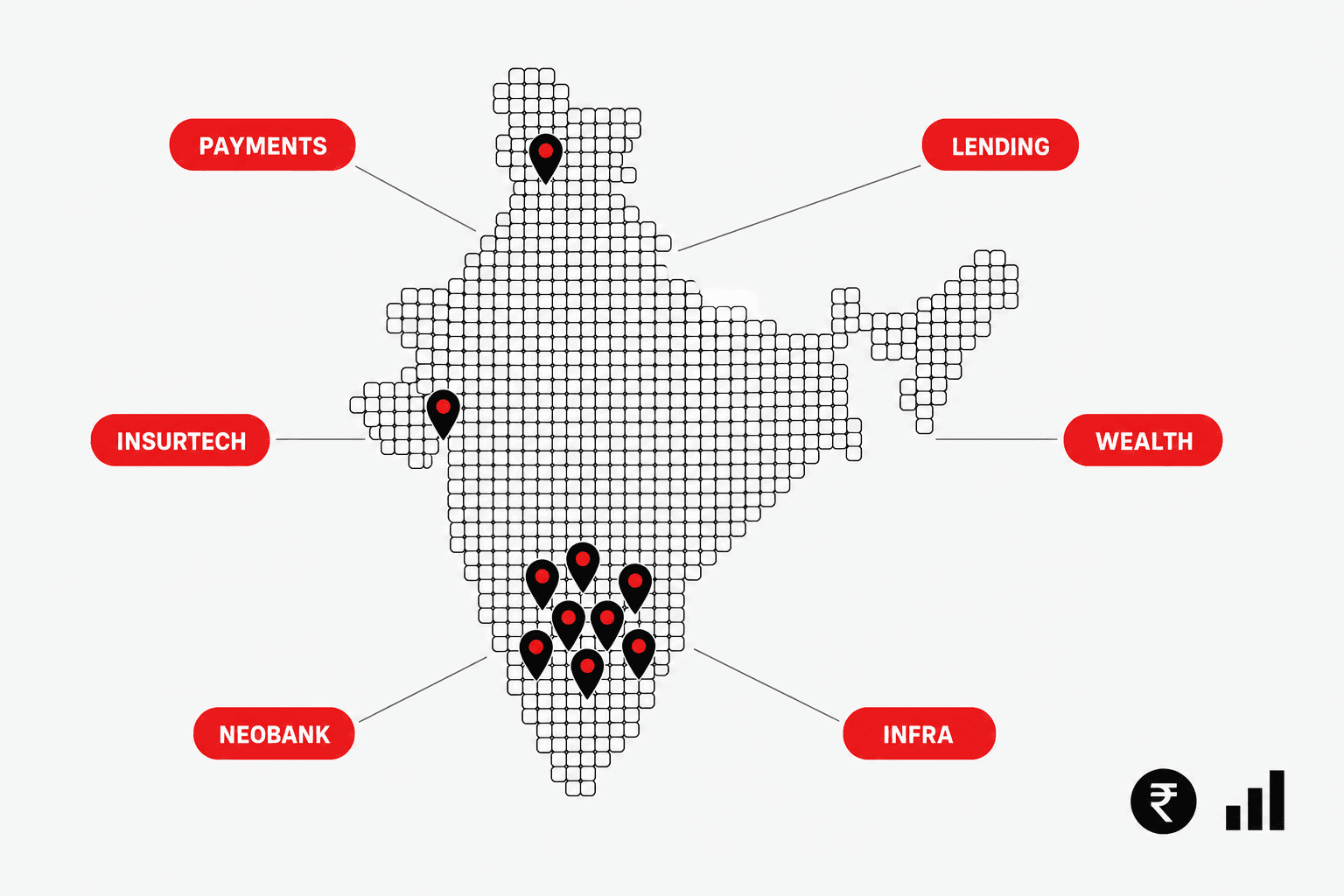
UPI processed 20.70 billion transactions worth ₹27.28 lakh crore in October 2025, its highest monthly volume at the time, according to NPCI data reported by Business Today. In the same year India ranked third in the world for fintech funding behind the United States and the United Kingdom, with Bengaluru companies taking 52 percent of the money raised in the first nine months, per Tracxn figures reported by Outlook Business. Those two numbers explain why "fintech companies in India" is a question asked by job seekers, investors, partners and marketers alike.
This is a reference list, not a ranking. It covers 30 notable Indian fintech companies grouped into six segments, each with a founding year and headquarters city verified against the company's own site or a reliable press or exchange source, cited beside the entry. Where sources disagree, the note says so. The final section covers what marketing looks like in this sector, because it is unlike any other.
The 30 Companies by Segment
Payments
| Company | Founded | HQ | What it does | Source |
|---|---|---|---|---|
| Paytm (One97 Communications) | 2009 | Noida | Full-stack payments and financial services app; NSE-listed | Inc42 profile |
| PhonePe | 2015 | Bengaluru | UPI-led payments and financial services super app | Inc42 profile |
| Razorpay | 2014 | Bengaluru | Payment gateway and business banking for merchants | Inc42 profile |
| BharatPe | 2018 | Gurugram | QR payments and credit for small merchants (some sources list Delhi) | Inc42 profile |
| Pine Labs | 1998 | Noida | Point-of-sale terminals and merchant payment platform | Inc42 profile |
| Cashfree Payments | 2015 | Bengaluru | Payment gateway, payouts and API banking | Cashfree about page |
| MobiKwik | 2009 | Gurugram | Mobile wallet and pay-later; listed in December 2024 | Inc42 profile |
Lending and Credit
| Company | Founded | HQ | What it does | Source |
|---|---|---|---|---|
| CRED | 2018 | Bengaluru | Credit card bill payments, rewards and credit products | Inc42 profile |
| Slice | 2016 | Bengaluru | Consumer credit; merged with North East Small Finance Bank to become a small finance bank | Inc42 report |
| KreditBee | 2018 | Bengaluru | Digital personal and business loans | Inc42 profile |
| MoneyView | 2014 | Bengaluru | Lending platform for personal credit | Inc42 profile |
| Lendingkart | 2014 | Ahmedabad | Working-capital loans for SMEs | Inc42 profile |
| axio (formerly Capital Float) | 2013 | Bengaluru | Consumer credit and pay-later; acquisition by Amazon completed September 2025 | Inc42 report |
| Simpl | 2015 | Bengaluru | Pay-later checkout for online merchants; RBI directed a halt to payment operations in September 2025 | Inc42 profile |
A note on churn: pay-later has been the most volatile segment. ZestMoney, founded in 2015 in Bengaluru, announced its wind-down in December 2023 (Inc42) and is not on the list for that reason.
Wealth and Investing
| Company | Founded | HQ | What it does | Source |
|---|---|---|---|---|
| Zerodha | 2010 | Bengaluru | Discount stockbroker; began operations 15 August 2010 | Zerodha about page |
| Groww | 2016 | Bengaluru | Retail investing app for stocks and mutual funds; listed November 2025 | Inc42 profile |
| Upstox | 2009 | Mumbai | Stockbroker (RKSV Securities); reports more than 2 crore customers | Upstox press release |
| INDmoney | 2019 | Gurugram | Investing and money management app (some sources give 2018 or 2020) | Inc42 profile |
| Smallcase | 2015 | Bengaluru | Curated stock and ETF portfolio platform | Smallcase about page |
Insurtech
| Company | Founded | HQ | What it does | Source |
|---|---|---|---|---|
| PB Fintech (Policybazaar) | 2008 | Gurugram | Insurance and credit marketplace; NSE-listed | StockAnalysis company page |
| Acko | 2016 | Bengaluru | Digital-first general insurer | Acko about page |
| Go Digit General Insurance | 2016 | Bengaluru (registered office Pune) | Digital general insurer; listed | Go Digit filing |
| Turtlemint | 2015 | Mumbai | Advisor-led insurance distribution platform; BSE-listed | StockAnalysis company page |
Neobanking
| Company | Founded | HQ | What it does | Source |
|---|---|---|---|---|
| Jupiter | 2019 | Mumbai | Consumer neobank (Amica Financial Technologies); registered office Khar West | Jupiter terms page |
| Fi Money (epiFi) | 2019 | Bengaluru | Neobank app; wound down consumer banking in March 2026 and pivoted to enterprise AI | Inc42 profile, TechCrunch, Mar 2026 |
| Niyo | 2015 | Bengaluru | Travel and salary-account neobanking (Finnew Solutions) | Entrepreneur India |
| Open | 2017 | Bengaluru | SME business banking platform | Open about page |
Infrastructure
| Company | Founded | HQ | What it does | Source |
|---|---|---|---|---|
| Perfios | 2008 | Bengaluru | Financial data aggregation and decisioning for lenders | Business Today |
| M2P Fintech | 2014 | Chennai | Banking-as-a-service and card issuing APIs | M2P contact page |
| Signzy | 2015 | Bengaluru | AI-driven KYC, KYB and onboarding | Inc42 report |
Sources: company websites and the press or exchange pages linked in each row, checked November 2026. Founding year is the year the company or brand began operating as reported by that source; legal incorporation dates can differ by a year. HQ is the operating headquarters; registered offices are noted where they differ.
What the List Shows
Three patterns stand out. Bengaluru dominates: 19 of 30 headquarters, which matches the funding concentration Tracxn reports. The founding wave was 2014 to 2016: 15 of the 30 were founded in those three years, the period when UPI launched (2016), smartphone data costs collapsed and Aadhaar-based KYC made remote onboarding practical. Consolidation and regulation are reshaping the list in real time: Slice became a bank, axio was bought by Amazon, Kuvera and Setu were absorbed by CRED and Pine Labs respectively (and are left off this list for that reason), ZestMoney closed, and Simpl's payments operations were halted by the RBI. Any list of Indian fintechs has a shelf life of about a year.
What Fintech Marketing Looks Like in India
Fintech is unusual among consumer categories because almost every product is researched before it is bought, the research happens in search and increasingly in AI assistants, and every claim is regulated by the RBI, SEBI or IRDAI. That shapes the marketing in three ways.
Search and content carry a disproportionate share of acquisition. Insurance and lending keywords are the most expensive clicks in India, with average CPCs of ₹250 to ₹460 by our benchmarks, so the companies that scale efficiently build enormous organic libraries: calculators, eligibility explainers, comparison pages and glossaries, structured so that Google and AI answer engines can cite them. Groww's content-led growth to a 50-million-user platform, Acko's 1.1 million monthly organic visits and Bajaj Finserv's 24-million-visitor organic engine are the clearest public examples, and we have written up each one: Groww, Acko and Bajaj Finserv. Razorpay's developer-first content engine is another, covered in our Razorpay teardown.
Trust is the conversion variable. Claim settlement ratios, regulator registration numbers, security explanations and transparent fee pages do more for conversion than offers do. Ditto Insurance's trust-first approach, documented in our Ditto case study, is the template many smaller brands now copy.
Compliance sits inside the content process, not after it. Every rate, return and comparison needs a source and a disclaimer, which is slower than D2C marketing but also a moat: thin affiliate content cannot keep up with regulated, well-sourced pages, and AI engines increasingly prefer the latter. Our fintech and BFSI SEO page sets out how we build programmes inside those constraints.
Frequently Asked Questions
How many fintech companies are there in India?
There is no single official count, and published figures vary with the definition used. Tracxn's 2025 reporting placed India third globally in fintech funding behind the United States and the United Kingdom, with Bengaluru-based companies taking just over half of the funding raised in the first nine months of 2025. Older industry reports have counted anywhere from 2,000 to over 6,000 fintech companies depending on whether they include infrastructure providers, lenders and insurance distributors. This list covers 30 notable names across six segments rather than attempting a census.
Which city has the most fintech companies in India?
Bengaluru, by a wide margin. Of the 30 companies on this list, 19 are headquartered there, including PhonePe, Razorpay, Zerodha, Groww, CRED and Acko. Gurugram and Mumbai form the second tier (Policybazaar, BharatPe, MobiKwik and INDmoney in Gurugram; Upstox, Turtlemint and Jupiter in Mumbai), followed by Noida (Paytm, Pine Labs), Chennai (M2P Fintech) and Ahmedabad (Lendingkart). Tracxn's 2025 funding data shows the same pattern, with Bengaluru taking 52 percent of fintech funding and Mumbai 22 percent.
What are the main segments of fintech in India?
Six segments cover most of the market: payments (wallets, UPI apps, gateways and merchant terminals), lending and credit (personal loans, SME loans, credit cards, pay-later), wealth and investing (brokers, mutual fund platforms, portfolio tools), insurtech (digital insurers and distribution marketplaces), neobanking (app-first banking layered on partner banks) and infrastructure (APIs, KYC, core banking and data platforms sold to other financial companies). Many large companies now span two or more segments.
Which Indian fintech companies are publicly listed?
Several on this list are listed on Indian exchanges: Paytm (One97 Communications), PB Fintech (Policybazaar), Go Digit General Insurance, MobiKwik, Groww and Turtlemint. Listing dates and status are drawn from the exchange and press sources cited in the table; always check the current exchange record before relying on this, as the set changes every year.
What does fintech marketing look like in India?
It is compliance-aware search and content marketing at scale. Because financial products are researched before they are bought, the companies that win organic search build large libraries of calculators, explainers and comparison pages, structured so that both Google and AI answer engines can cite them. Paid search is expensive (insurance and lending keywords are the costliest clicks in India), so SEO and content carry a larger share of acquisition than in most industries, and every claim has to pass RBI, SEBI or IRDAI advertising rules.
Is this list a ranking of the best fintech companies in India?
No. The companies are grouped by segment and listed in no particular order within each group. Inclusion reflects public prominence and verifiable facts, not quality, size or any commercial relationship. Founding years and headquarters cities are taken from company websites or the press sources cited beside each entry, and where sources disagree the note says so.
Marketing a fintech product inside RBI, SEBI or IRDAI constraints? We build compliance-aware SEO and content programmes for lenders, insurers, brokers and payments companies, and we publish the playbooks behind the biggest organic engines in the sector. See our fintech and BFSI SEO approach or read the Groww case study.

Aditya Kathotia
Founder & CEO
CEO of Nico Digital and founder of Digital Polo, Aditya Kathotia is a trailblazer in digital marketing. He's powered 500+ brands through transformative strategies, enabling clients worldwide to grow revenue exponentially. Aditya's work has been featured on Entrepreneur, Economic Times, Hubspot, Business.com, Clutch, and more.
More in Digital Marketing
- 10 Types of Digital Marketing: India Costs and When Each Fits
- Why Not to Hire a Full-Service Marketing Agency
- Email Marketing Agency in India: What to Ask Before You Sign
- Best Digital Marketing Agencies in Hyderabad: 2026 Hiring Guide
- Best Digital Marketing Agencies in Ahmedabad: 2026 Field Guide
- Best Digital Marketing Agencies in Surat: A 2026 Buyer's Map