

Email is the only channel your brand actually owns. Your search visibility can be redrawn by an algorithm update or absorbed into an AI Overview. Your social reach is rented from platforms that quietly change distribution whenever it suits their revenue. Your paid media stops the moment the card declines. An email list is different: it is a first-party asset that survives every one of those events and travels with you.
Which makes it strange how badly most Indian brands hire for it. Email is routinely handed to whoever already runs social, or bundled as a throwaway line item into a digital retainer, or outsourced to a vendor whose actual product is sending capacity rather than strategy. The result is a monthly newsletter nobody asked for, an open rate reported as though it still means something, and a sending domain that quietly loses the ability to reach the inbox at all.
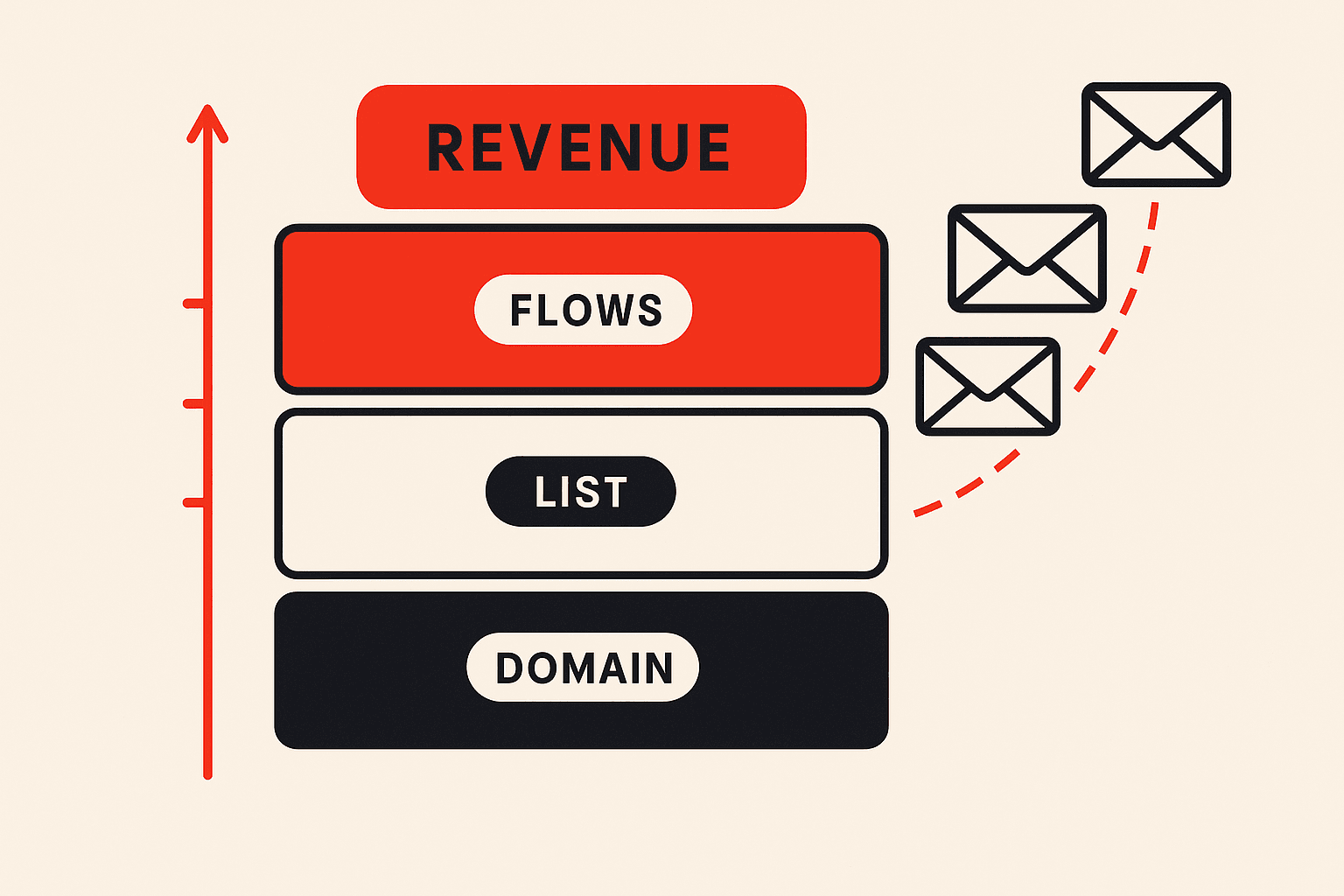
The gap between an email programme that compounds and one that decays is almost never the writing. It is the infrastructure underneath it, the consent behind the list, the automated flows that run while nobody is watching, and whether anyone is measuring revenue rather than vanity. That system is what a genuine email marketing agency in India sells, and it is the thing you have to test for before you sign anything.
This guide covers what these agencies actually do, why deliverability decides your ceiling before creative ever gets a chance, what the DPDP Act changed about consent, what the work costs in India, and the specific questions that separate a lifecycle team from a bulk-mail shop.
What an email marketing agency in India actually does
The word "agency" covers an enormous range here, from two people with a Mailchimp login to lifecycle teams running segmented programmes across millions of contacts. The useful way to tell them apart is to ask which of four layers they own.
Infrastructure. Authenticating your sending domain with SPF, DKIM and DMARC. Choosing between a dedicated and a shared sending IP, and warming it properly. Separating marketing mail from transactional mail so a promotional complaint spike never stops a password reset from arriving. Monitoring blocklists and inbox placement rather than assuming a send equals a delivery. This layer is invisible when it works and catastrophic when it does not.
List. Growing consented subscribers through on-site capture that is designed rather than bolted on, and then, less glamorously, removing the people who never engage. Most Indian lists are far larger than they are valuable. Suppressing dead contacts feels like going backwards and is usually the single fastest way to improve results.
Lifecycle. Building the automated flows that run without anyone touching them: welcome and onboarding, abandoned cart, browse abandonment, post-purchase, replenishment, winback, and for B2B the nurture sequences tied to pipeline stage. This is where the money is. In most well-run ecommerce programmes a minority of sends, the automated ones, produce the majority of the revenue.
Measurement. Tying revenue back to individual flows and individual campaigns, holding out control groups where it matters, and reporting on numbers that survived the last five years of privacy changes.
An agency that only designs templates and schedules sends is doing perhaps a fifth of the job, and it is the fifth that matters least. If the pitch is about creative and calendar, ask who owns the other three layers. Frequently the answer is nobody.
Deliverability is the ceiling, and it is set before you write a word
Everything in an email programme sits on top of whether mailbox providers are willing to accept your mail. This is the part almost no agency in India leads with, and it is the part that most often explains a programme that "stopped working" for no visible reason.
In February 2024, Google and Yahoo introduced enforced requirements for bulk senders, and Microsoft followed with its own version for Outlook. The substance is now the baseline everywhere. If you send at meaningful volume, you must authenticate with SPF and DKIM, publish a DMARC record for your sending domain, offer one-click unsubscribe in the message headers rather than only a link buried in the footer, and keep your spam complaint rate below roughly 0.3%. Cross the complaint threshold consistently and your mail stops reaching the inbox regardless of how good it is.
That last number deserves emphasis because of how small it is. Three complaints in a thousand sends is not a rounding error you can absorb. It is the difference between a functioning channel and a dead one, and it is reached surprisingly quickly by a brand that mails a stale list aggressively during a festive push.
There is a specific Indian version of this problem worth naming. A lot of domestic vendors sell "bulk email" from shared IP pools, where your reputation is pooled with every other sender on that infrastructure. You can write impeccable email and still land in spam because somebody else on the same pool is mailing a scraped database. Ask any prospective agency, plainly, whether you will be on a dedicated sending IP, who else shares it if not, and who owns the sending domain. If they cannot answer clearly, that is your answer.
Not sure whether your domain is even authenticated? A deliverability check is the cheapest diagnostic in marketing and takes under a week. Talk to our team about an audit
What the DPDP Act changed, and what most brands still get wrong
India's Digital Personal Data Protection Act, 2023 reframed the ground rules, and a striking number of email programmes here are still running on pre-DPDP assumptions.
The core shift is that consent has to be real. The notice at the point of collection must be clear and specific about what the data will be used for. Consent must be freely given for that stated purpose, which is difficult to argue when the opt-in is a pre-ticked box or is bundled invisibly into terms and conditions. And the individual must be able to withdraw consent as easily as they gave it, which means a working, honoured unsubscribe rather than a preference page that quietly does nothing.
Three consequences follow that matter commercially:
- Purchased and scraped lists are indefensible. They were always bad practice because they destroy sender reputation. They are now also a compliance exposure, because you cannot produce evidence of consent you never obtained.
- You need to store proof, not just the address. Timestamp, source, IP, and the exact wording of the notice shown at capture. Most Indian brands store the email address and nothing else, which means they cannot demonstrate lawful basis if asked.
- Withdrawal has to be genuinely honoured across systems. An unsubscribe that clears one platform but leaves the contact live in the CRM is not a withdrawal.
One clarification worth making because it causes real confusion: TRAI's DLT registration regime, the one that governs sender IDs and template approval, applies to SMS and voice. It does not govern email. If an agency answers your compliance question by citing DLT, they are quoting the wrong rulebook, and that tells you something about the depth of the advice you are buying.
Agency or in-house: an honest decision framework
Email is more automatable than most channels, which makes the in-house case stronger here than it is for, say, paid social. The right answer depends less on company size than on three specific conditions.
| Condition | Points to in-house | Points to an agency |
|---|---|---|
| Send frequency | Constant, multiple campaigns weekly, always-on calendar | Sporadic, seasonal, or campaign-led |
| Existing skill | Someone already owns deliverability and knows the platform properly | Nobody on the team can explain DMARC without searching for it |
| Flow maturity | Core flows already built and performing, work is now iteration | Starting from nothing, or inherited a setup nobody understands |
| Platform | Stable, well understood, not being migrated | Migrating, consolidating, or choosing for the first time |
| Data complexity | Clean, single source of truth, integrations already working | Fragmented across store, CRM and spreadsheets |
| Speed needed | Comfortable building capability over two to three quarters | Need flows live and earning this quarter |
The same trade-off shows up when brands evaluate a social media marketing agency or an influencer marketing agency, but email tilts further toward in-house than either, because the work is more systematised and less dependent on constant external relationships.
The pattern that works best in practice is not a binary. It is an agency doing the build, the infrastructure and the flow architecture, then handing operations to an in-house owner once the system is stable, with the agency retained for strategy and testing. Programmes that stay fully outsourced for years tend to stagnate, because nobody internally develops enough context to challenge the calendar. Programmes taken fully in-house too early tend to break at the infrastructure layer, because the person running them has never had to diagnose an inbox placement problem.
The flows that actually earn the money
If you take one operational point from this guide, take this one: in a mature ecommerce email programme, the automated flows generate a disproportionate share of the revenue relative to how many sends they represent. Campaigns get all the attention in agency reporting because they are visible and they feel like work. Flows are what pay.
This matters when you evaluate an agency, because a proposal weighted toward "four campaigns a month" and light on flow architecture is a proposal weighted toward the wrong half of the channel.
For B2B the map is different but the principle holds. The flows are lead nurture by pipeline stage, content-download follow-up, demo-request routing, dormant-opportunity revival and post-onboarding expansion. The trigger is stage change rather than cart abandonment, and speed of response is the variable that moves conversion most, which is the same finding behind our analysis of the five-minute lead response rule. If your nurture waits until the Tuesday send, you have already lost the enquiry. The same logic drives the sequencing in our LinkedIn Ads playbook for B2B SaaS, where the email follow-up does more work than the ad itself.
What email marketing costs in India
Two costs get blurred in almost every proposal, deliberately. Insist on seeing them separately.
The agency retainer. For campaign management on an existing, functioning setup, expect roughly ₹25,000 to ₹60,000 per month. For a full lifecycle programme including flow building, segmentation work, ongoing testing and proper reporting, roughly ₹60,000 to ₹1,50,000. Enterprise programmes with large databases, multiple markets or regional-language variants start around ₹2,00,000 and go well beyond. One-off builds and platform migrations usually land between ₹75,000 and ₹3,00,000 depending on how many flows are in scope.
The platform licence. This is paid to the software vendor, not the agency. Indian platforms and entry-level global tools start in the low thousands per month. Klaviyo, Braze and the enterprise suites price on contact count and send volume, and a large list can push this into lakhs annually. A retainer that looks cheap because the licence is quietly excluded is not cheap.
Metro tier affects the retainer more than most buyers expect. Mumbai and Delhi NCR sit at the top of every band. Bangalore, Pune and Hyderabad run somewhat below. Kolkata, Ahmedabad, Indore and Jaipur run meaningfully below again for equivalent scope, which is one reason a Kolkata-based digital marketing team can often deliver the same programme at a different cost base. What should not vary by city is whether the agency understands deliverability.
Two pricing structures to be wary of. Per-email pricing rewards volume, and volume is precisely the behaviour that destroys sender reputation. Percentage-of-revenue pricing sounds aligned but usually is not, because email claims credit for a great deal of purchase intent it did not create, so the attribution model quietly becomes the agency's own commission calculation.
How to vet an email marketing agency: the questions that work
Most vetting conversations are useless because the questions invite a rehearsed answer. These do not.
- "Walk me through how you would authenticate our sending domain." Should produce SPF, DKIM and DMARC without hesitation, plus a view on a dedicated versus shared IP. Vagueness here disqualifies.
- "What is our current spam complaint rate, and what would you do if it crossed 0.3%?" Tests whether they monitor the number that actually governs inbox access.
- "Which of our contacts would you stop mailing in month one?" A good agency will want to suppress a chunk of the list. An agency that promises to mail everyone is optimising for the appearance of scale.
- "How do you capture and store proof of consent?" Should cover timestamp, source and the notice wording. See the DPDP section above.
- "Show me a flow architecture you have built, not a campaign you have designed." Flow diagrams reveal system thinking. Template screenshots reveal a design service.
- "What do you report on, and why is open rate not on the list?" Anyone still leading with open rate has not updated their practice since 2021.
- "Which platform would you put us on and why not the other three?" A specific comparative answer indicates fit assessment. A single default recommendation across all clients usually indicates a reseller relationship.
- "What happened the last time a client's deliverability collapsed?" Every agency with real tenure has one of these stories. An agency that claims it has never happened has either not been doing this long or is not being straight with you.
The red flags are equally specific. Any offer to supply a database, any mention of a guaranteed inbox placement rate, any "bulk email" pricing quoted per lakh of sends, any proposal that skips the audit entirely and opens with a campaign calendar, and any answer to a compliance question that cites DLT registration.
Measuring it properly
Apple's Mail Privacy Protection broke open rate in 2021 by pre-fetching tracking pixels regardless of whether a message was read. Any report still anchored to opens is anchored to an instrument that no longer measures anything. What survived:
- Revenue per recipient, segmented by flow and by campaign. The single most useful number in the channel.
- Click-to-conversion rate, which isolates whether the landing experience is holding up its end. If email clicks convert far below other sources, the problem is usually the page, a theme we picked apart in our landing page audit of common conversion killers.
- List growth net of unsubscribes and suppressions. Gross additions flatter; net is the truth.
- Spam complaint rate, watched continuously rather than reviewed monthly.
- Flow-level holdouts on the highest-value automations, so you can distinguish revenue email caused from revenue it merely witnessed. This is the discipline most agencies skip and the one that answers the only question your finance team actually cares about.
Where email fits alongside everything else
Email underperforms in isolation and compounds when it is wired into the rest of the stack. A few of the connections that matter most.
Your list is first-party data, which makes it the highest-quality input available to your paid media. Uploading consented customer segments improves match rates and targeting quality, and it is the same first-party foundation that makes enhanced conversions in Google Ads work properly. Brands that treat email and paid as separate departments leave this on the table.
Content and email feed each other directly. The research, guides and analysis produced by a content marketing programme are what give a newsletter a reason to exist, and email is the fastest distribution any new piece gets, which is part of why content marketing compounds rather than spiking.
For Indian D2C in particular, email sits beside WhatsApp rather than competing with it. WhatsApp wins on immediacy and open behaviour but is expensive per message and easy to overuse. Email wins on cost, depth and archive value. The brands getting this right run them as one lifecycle with different jobs, which is the argument underneath our look at WhatsApp as a shopping channel in India and at WhatsApp Channels for business.
And on the acquisition side, email cannot fix a list that is not growing. The subscribers come from organic search, from paid campaigns, from social, and from on-site capture. If your ecommerce SEO is not bringing qualified traffic in, your email programme is optimising a shrinking asset. This is also why the CRM and funnel plumbing matters more than it looks, a lesson we wrote up honestly after rebuilding our own in-house CRM and sales funnel.
How Nico Digital approaches email marketing
We treat email as owned infrastructure rather than as a content calendar. Engagements start with a deliverability and consent audit, because there is no point designing anything until we know whether your mail arrives and whether your list is defensible. From there we build the flow architecture before the campaign calendar, on the platform that fits the motion rather than the one we resell, and we report on revenue per recipient with holdouts on the flows that matter.
We also say no to work that would damage a client. We do not supply lists, we do not mail purchased data, and we will recommend suppressing a large share of an inherited database if that is what the numbers say, even when it makes the first month's report look worse. That is usually the conversation that tells a prospective client whether we are the right fit.
Email works best as part of a connected programme, which is why it sits alongside our lead generation, B2B demand generation and D2C growth work rather than as an isolated line item.
Want to know whether your email programme is actually reaching the inbox? We will audit deliverability, consent and flow coverage, and show you what is recoverable. Get a proposal
Key takeaways
- Email is the only channel you own. Search and social distribution can be changed without your consent. A consented list cannot.
- Deliverability sets the ceiling. SPF, DKIM, DMARC, one-click unsubscribe and a complaint rate under roughly 0.3% are the price of entry, not optional hygiene.
- The DPDP Act made consent evidential. Store timestamp, source and notice wording, not just the address. And DLT registration governs SMS, not email.
- Flows earn, campaigns get noticed. Judge a proposal by its flow architecture, not its campaign volume.
- Separate the retainer from the licence. Expect roughly ₹25,000 to ₹1,50,000 per month in agency fees depending on scope, with the platform cost quoted separately.
- Open rate is dead as a KPI. Revenue per recipient, click-to-conversion, net list growth, complaint rate and flow-level holdouts are what remain.
- Vet on infrastructure questions. How they answer the DMARC question and the suppression question tells you more than any case study deck.
Frequently Asked Questions
What does an email marketing agency in India actually do?
A real email marketing agency owns four things: infrastructure, list, lifecycle, and measurement. Infrastructure means authenticating your sending domain with SPF, DKIM and DMARC, warming the sending IP, and monitoring reputation. List means growing consented subscribers through on-site capture and cleaning the ones who never engage. Lifecycle means building the automated flows that run without a human, such as welcome, abandoned cart, browse abandonment, post-purchase, replenishment and winback, plus the campaign calendar on top. Measurement means tying revenue back to individual flows and campaigns. Agencies that only design templates and hit send are not doing the job, because the money in email sits in the automated flows, not the newsletter.
How much does an email marketing agency cost in India?
There are two separate costs and agencies often blur them. The agency retainer for managed email typically runs ₹25,000 to ₹60,000 per month for campaign management on an existing setup, ₹60,000 to ₹1,50,000 for a full lifecycle programme with flow building and ongoing testing, and ₹2,00,000 upwards for enterprise programmes with segmentation across large databases and multiple markets. One-off setup or migration projects usually sit between ₹75,000 and ₹3,00,000 depending on how many flows are being built. The platform licence is separate and paid to the vendor: Indian platforms and entry-level global tools start in the low thousands per month, while Klaviyo, Braze and similar scale with contact count and can run into lakhs. Always ask for the retainer and the licence quoted separately.
Is email marketing still worth it in India in 2026?
Yes, for a specific reason: it is the only major channel where you own the audience outright. Search visibility can be reshaped by an algorithm update or an AI Overview, and social reach is rented from platforms that change distribution without notice. An email list is a first-party asset that moves with you. The widely quoted ROI figures of thirty-something rupees returned per rupee spent come from platform vendors and carry obvious selection bias, so treat them as directional rather than as a forecast. The honest case for email is not the multiple. It is that email is the cheapest channel for repeat revenue from people who already know you, and it is the asset that makes every other channel more efficient.
What is the difference between an email marketing agency and a bulk email service provider?
A bulk email service provider sells you sending capacity: an interface, a contact limit, and a volume of sends per month. Everything else is your problem. An agency sells outcomes and owns the strategy, the segmentation, the creative, the flow architecture and the measurement. The distinction matters because most of the failure modes in email are strategic rather than technical. A provider will happily let you mail a purchased list into a reputation collapse. A competent agency will refuse. If a vendor's pitch leads with how many emails you can send per month rather than what those emails will be, you are talking to a provider, not an agency.
Does the DPDP Act affect how Indian brands can run email marketing?
It does, and most brands have not adjusted. India's Digital Personal Data Protection Act, 2023 puts consent at the centre of processing personal data, requires that the notice given at the point of collection is clear and specific about the purpose, and gives individuals the right to withdraw consent as easily as they gave it. In practice that means pre-ticked opt-in boxes, consent bundled into terms and conditions, and lists bought from a data broker all sit on very weak ground. Note that TRAI's DLT registration regime applies to SMS and voice, not email, so an agency that quotes DLT as its email compliance answer has not read the right rulebook. Ask any agency how they capture, timestamp and store proof of consent.
Which email marketing platform should an Indian brand use?
Match the platform to the motion rather than to the brand name. For D2C and ecommerce where revenue attribution per flow matters most, Klaviyo remains the strongest fit and integrates cleanly with Shopify and WooCommerce. For app-led businesses that need email sitting alongside push and in-app messaging, the Indian-origin platforms MoEngage, WebEngage, CleverTap and Netcore are genuinely competitive and often cheaper at Indian contact volumes. For B2B where email must reflect pipeline stage, HubSpot or Zoho Campaigns tied to the CRM is usually right. For transactional mail, Amazon SES, Postmark or a dedicated relay should be separated from marketing mail so a promotional complaint spike never blocks a password reset. Beware any agency that recommends the same platform to every client, because that usually signals a reseller commission rather than a fit assessment.
Why did my open rates stop being reliable?
Apple's Mail Privacy Protection, introduced in 2021, pre-fetches tracking pixels for Apple Mail users whether or not the message was actually read, which inflates opens and makes open rate unusable as a performance metric or as a segmentation input. Any agency still reporting open rate as a headline KPI, or still building "engaged subscriber" segments on opens alone, is working with a broken instrument. The metrics that survived are click-through rate, click-to-conversion rate, revenue per recipient, list growth net of unsubscribes, and spam complaint rate. Opens are still useful as a rough deliverability tripwire, because a sudden collapse suggests inbox placement trouble, but they should never anchor a report.
How long before an email programme starts producing revenue?
Faster than SEO and slower than paid media. If you already have a list with genuine consent, the core automated flows can be live within three to five weeks and usually start contributing within the first month, because they capture demand that already exists rather than creating it. If you are starting from a cold or damaged domain, add four to eight weeks of warming and list hygiene before volume can safely rise, and expect the first quarter to look like infrastructure work rather than growth. The compounding shows up around month four to six, when flow coverage is complete, segmentation is real and the campaign calendar has enough test history to stop guessing.

Aditya Kathotia
Founder & CEO
CEO of Nico Digital and founder of Digital Polo, Aditya Kathotia is a trailblazer in digital marketing. He's powered 500+ brands through transformative strategies, enabling clients worldwide to grow revenue exponentially. Aditya's work has been featured on Entrepreneur, Economic Times, Hubspot, Business.com, Clutch, and more. Join Aditya Kathotia's orbit on LinkedIn to gain exclusive access to his treasure trove of niche-specific marketing secrets and insights.