

Most brands treating WhatsApp as a customer service channel are leaving significant revenue on the table. The ones treating it as a full-stack commerce layer are quietly building one of the most defensible acquisition and retention moats in Indian e-commerce right now.
That distinction matters more than it sounds.
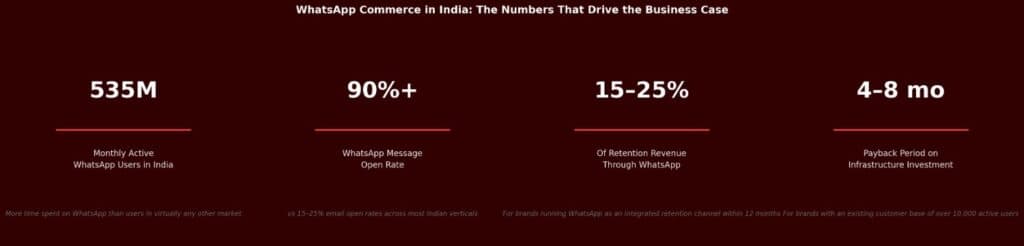
India has roughly 535 million monthly active WhatsApp users. That number is cited often. What gets cited less is the behavioral reality underneath it: Indian consumers spend more time on WhatsApp than users in virtually any other market, and they have normalized purchasing decisions happening inside chat threads. This is not a future behavior you are waiting for. It is already the operating environment.
If you are a growth leader at a D2C brand or a mid-market retailer targeting Indian consumers, the question is not whether WhatsApp commerce is relevant.
It is whether your current setup is capturing that intent or ceding it to competitors who have already built the infrastructure.
The Platform Shift That Most Brands Missed
WhatsApp was not built for commerce. It was built for private, encrypted communication between individuals. That origin story is actually the source of its commercial power.
When Meta launched WhatsApp Business in 2018, it did not simply create a business messaging app. It embedded commercial activity inside a medium that Indian consumers already trusted for their most personal conversations. The gap between "message from a friend" and "message from a brand" is meaningfully smaller on WhatsApp than on any other channel.
That trust asymmetry is a structural advantage. Email open rates in India hover in the 15-25% range for most verticals. WhatsApp message open rates consistently reach 90% or above. That is not a marginal improvement. It is a different category of attention.
But attention alone does not generate revenue. The brands converting that attention efficiently have made deliberate architectural choices about how they deploy WhatsApp across the purchase funnel.
Understanding the Two Tiers of WhatsApp Commerce
Before building any strategy, you need clarity on which WhatsApp product you are actually working with. They are not interchangeable, and choosing the wrong one at the wrong stage of business growth is a common and costly mistake.
WhatsApp Business App
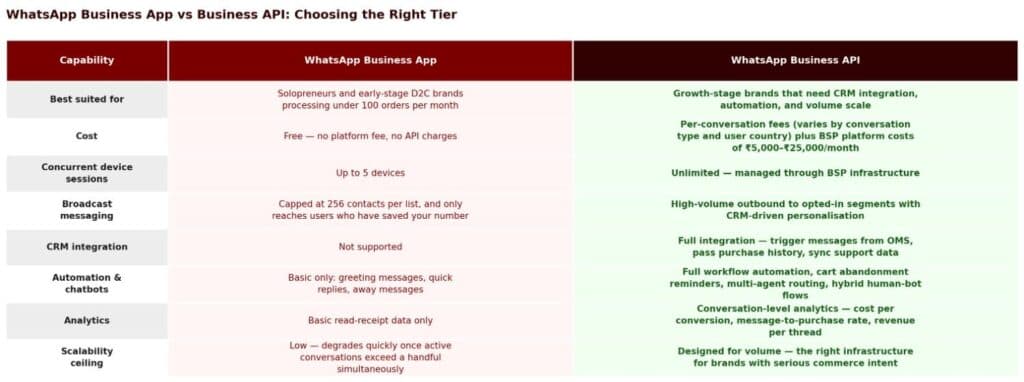
The standard WhatsApp Business app is free, supports up to five concurrent device sessions, and gives you basic automation through greeting messages, quick replies, and away messages. You get product catalogues, contact labels, and basic read-receipt analytics.
For solopreneurs and early-stage D2C brands processing under 100 orders a month, this is a reasonable starting point. It requires no technical integration and gets you to market quickly.
The ceiling, however, is low.
- You cannot integrate it with your CRM.
- Broadcast messaging is capped at 256 contacts per list and only reaches users who have saved your number.
- There is no API access, no workflow automation, and no way to scale personalization.
If you are managing more than a handful of active conversations simultaneously, the experience degrades fast.
WhatsApp Business API (Cloud API)
The API tier is where commerce infrastructure lives. Accessed through Meta's Cloud API or via a WhatsApp Business Solution Provider (BSP), this layer removes the volume constraints and opens integration with your existing tech stack.
What this means practically:
- Make WhatsApp work like a real commerce channel.
- Trigger automated order confirmations from your OMS.
- Send cart abandonment reminders at the right moment.
- Use CRM data to send messages tailored to purchase history.
- And manage support with multi-agent routing.
The API is not free. You are charged per conversation, with rates varying based on conversation type (marketing, utility, authentication, or service) and the user's country.
For India-focused businesses, the economics are generally favorable, but you need to model your conversation volume before committing to a BSP relationship.
One common mistake here is over-automating. Brands that replace all human touchpoints with chatbot flows often see a drop in the point of purchase intent.
Indian consumers, particularly in categories like fashion, jewelry, and electronics, want a human available. The architecture should enable hybrid routing, not remove the human element entirely.
Choosing a BSP: How the Leading Platforms Compare
The BSP you choose determines your integration depth, template approval speed, analytics quality, and practical cost per conversation. The Indian market has several strong options, each suited to different brand stages and tech stacks.
| BSP | Best For | Shopify Integration | Starting Price (approx.) | Strengths |
|---|---|---|---|---|
| Interakt | SMB D2C brands | Native, strong | ₹2,500/month | INR pricing, Shopify-native, good UX |
| Wati | Growing D2C, teams | Good | ₹2,500/month | Team inbox, CRM features, competitive pricing |
| DoubleTick | High-volume broadcast | Moderate | ₹4,000/month | Fast broadcasts, good for sales teams |
| AiSensy | Early-stage brands | Moderate | ₹999/month | Affordable, simple flows |
| Gupshup | Enterprise, custom | Custom | Custom | Deep API customization, multi-channel |
| Yellow.ai | Enterprise AI | Custom | Custom | AI-powered, omnichannel support |
Regardless of which BSP you choose, evaluate on: API uptime and reliability, Meta template approval speed (some BSPs have faster relationships with Meta), CRM and OMS integration capabilities, quality of conversation analytics, and customer support SLA.
WhatsApp Message Templates: What Gets Approved and What Doesn't
Business-initiated WhatsApp conversations (messages you send first, outside a customer-opened conversation window) require pre-approved templates. Understanding the template categories and approval criteria prevents delays and campaign failures.
Template Categories
Marketing templates are used for promotions, new product announcements, and re-engagement campaigns. These require explicit opt-in from recipients and are the most scrutinized category for approval. In India, marketing conversation rates apply.
Utility templates cover transactional communications: order confirmations, shipping notifications, payment receipts, appointment reminders, and delivery updates. These are easier to approve and cost less per conversation.
Authentication templates are used for OTPs and verification codes. They have the most standardized format requirements.
Service templates apply when a customer messages you first - you have a 24-hour window to respond with any message type without template approval.
What Gets Approved
Approved templates are:
- Clear about their purpose in the first line
- Not deceptive about the sender or offer
- Compliant with WhatsApp's commerce policy for your product category
- Not purely promotional without value to the recipient (a "check out our sale" template without a specific offer is typically rejected)
Example Template Structure
Order Shipped - Your [Brand Name] order is on its way!

Hi {{1}}, your order #{{2}} has been shipped and is expected by {{3}}.

Track here: {{4}}

Reply STOP to unsubscribe.
Submit templates through your BSP dashboard. Approval typically takes 24-72 hours. Build a template library of approved utility messages before launching campaigns so operational communications are never delayed waiting for approval.
Where WhatsApp Fits in Your Growth Stack
WhatsApp commerce does not exist in isolation. Its ROI depends heavily on how it integrates with your broader funnel architecture.
Acquisition
WhatsApp is not a discovery channel. Nobody opens WhatsApp to browse unknown brands.
Acquisition entry points come from elsewhere:
- Click-to-WhatsApp ads on Facebook and Instagram,
- QR codes on packaging,
- website widgets, and
- SMS or email opt-in flows that migrate users to WhatsApp for ongoing communication.
Click-to-WhatsApp (CTWA) ads deserve specific attention. They function like standard Meta Ads for ecommerce but route users directly into a WhatsApp conversation rather than a landing page.
For brands where the purchase decision requires consultation, such as custom products, high-consideration SKUs, or subscription services, CTWA can significantly compress the sales cycle.
The tradeoff: CTWA campaigns require a fast response infrastructure. A user who messages you through an ad and waits 20 minutes for a reply has already made a negative brand impression. If you are running CTWA at scale without automated intake flows, you are spending media budget to create frustration.
Retention and LTV
This is where WhatsApp commerce generates its highest returns. The cost of reactivating an existing customer through WhatsApp is a fraction of the cost of acquiring a new one, and the conversion rate on well-timed retention messages is substantially higher than any email equivalent.
Practical retention plays that compound over time:
- post-purchase check-ins timed to product usage cycles,
- loyalty program updates and exclusive access windows,
- replenishment reminders for consumables, and
- win-back sequences for lapsed customers with personalized incentive logic.
The brands doing this well are not blasting the same message to everyone. They are using purchase history, browsing behavior, and lifecycle stages to send fewer messages with higher relevance.
The distinction matters because WhatsApp allows users to block businesses easily. A high unsubscribe rate is not just a list hygiene problem; it signals poor segmentation and damages your sender reputation with Meta.
The Catalogue and Payments Infrastructure
WhatsApp Catalogues allow businesses to list products with pricing, descriptions, and SKU-level detail directly inside the chat interface. Collections enable category grouping.
Together, they create a browsable product layer without requiring the user to leave the app.
The integration is not a replacement for your e-commerce storefront. Treat it as a discovery and consideration layer, particularly effective for new customer conversations and repeat browse behavior from existing customers.
WhatsApp Pay, available in India, Brazil, and the United States, enables in-thread transactions through UPI. For Indian consumers, UPI is already the default payment behavior.
Removing the redirect to a browser-based checkout eliminates a friction point that disproportionately affects mobile conversion rates. Cart abandonment often happens at exactly this redirect.
The practical caveat:
WhatsApp Pay has transaction limits and is not suited for high-value purchases or complex checkout logic like multi-item discount stacks.
- For most D2C brands, it works well for repeat purchases, top-ups, and low-consideration categories.
- For first-time high-value purchases, you still want the full checkout environment with trust signals, return policy visibility, and secure payment options beyond UPI.
Ready to build WhatsApp commerce that actually converts? - Book a free WhatsApp strategy session → We'll audit your current setup, map the highest-revenue automation opportunities, and recommend the right BSP for your stack.
What the Competitive Landscape Actually Looks Like
The brands winning on WhatsApp commerce in India are not the ones with the most sophisticated technology. They are the ones with the clearest intent mapping. They:
- Know which conversations lead to revenue and which are cost centers.
- Instrument their WhatsApp interactions with the same analytical rigor they apply to paid channels.
- Can tell you their cost per WhatsApp-attributed conversion, their message-to-purchase conversion rate, and their average revenue per conversation thread.
Most brands cannot tell you any of that. They have WhatsApp Business running, they respond to incoming messages, maybe they send occasional broadcast updates, and they count it as a channel.
That is not a channel strategy. It is reactive customer service with a broadcast function bolted on.
The gap between those two operating postures is where competitive advantage is currently being built. Brands that get the instrumentation right in the next 12 to 18 months will have attribution data and optimization leverage that latecomers cannot easily replicate.
Regulatory and Platform Risks to Watch For
WhatsApp operates under Meta's commerce policies, and those policies have evolved significantly since 2021. Categories including financial services, pharmaceutical products, and certain digital goods face restrictions on what can be transacted through the platform.
Meta also enforces quality ratings for business accounts. High opt-out rates, spam reports, or policy violations can result in message sending limits or account suspension. If your business depends on WhatsApp as a primary retention channel, that platform dependency is a risk that should be actively managed with backup channels and list portability practices.
The other regulatory dimension is India's data localization and privacy framework under the Digital Personal Data Protection Act.
WhatsApp data flows through Meta's infrastructure. If your business operates in a sector with strict data residency requirements, this has compliance implications that your legal team should evaluate before deep WhatsApp integration.
None of this is a reason to avoid the channel. It is a reason to build with clear eyes about the risk surface.
Building the Infrastructure: A Practical Sequence
For growth teams evaluating how to get this right, the sequence matters as much as the individual decisions.
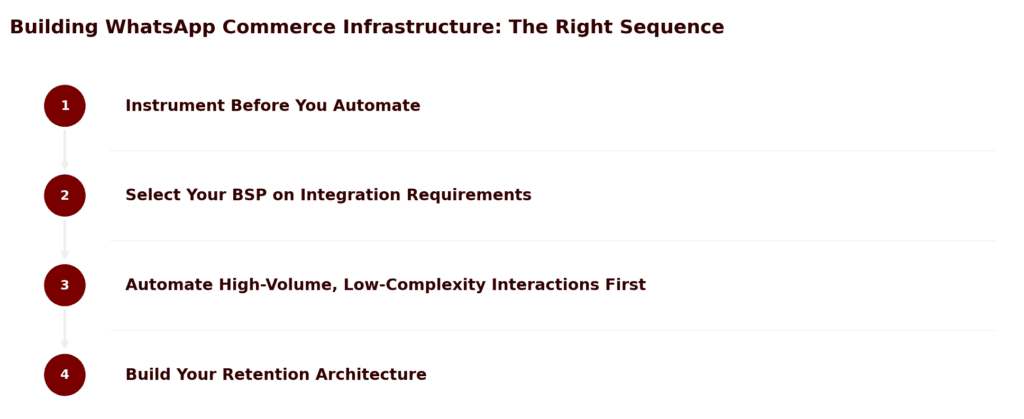
Start with instrumentation before automation. Before you build elaborate chatbot flows, make sure you can measure what is happening in the conversations you already have.
- What intent signals are present?
- Which conversation paths correlate with purchase?
- What are your actual response time distributions?
- How much does your response time affect conversion?
Then select your BSP based on your integration requirements, not their marketing materials. The BSP landscape in India includes players like Interakt, Wati, DoubleTick, and others.
Evaluation criteria should include:
- CRM compatibility,
- API reliability,
- conversation routing capabilities, and
- the quality of their analytics layer.
Template approval timelines with Meta also vary by BSP relationship quality.
Automate the highest-volume, lowest-complexity interactions first, like order confirmations, shipping updates, return initiation. These are utility conversations with clear scripts. Getting them right builds the operational confidence to tackle more complex automation progressively.
Then build your retention architecture. This is where the compounding returns come from. A well-built WhatsApp retention flow for a consumable brand can generate meaningful revenue at near-zero incremental CAC once the infrastructure is in place.
The Business Case, Framed Honestly
WhatsApp commerce is not zero-cost. The API infrastructure has per-conversation fees, BSP platform costs typically run between 5,000 and 25,000 rupees per month, depending on volume and features, and there is real engineering time involved in proper CRM integration.
The return profile, when the channel is built correctly, is favorable. Brands running WhatsApp as an integrated retention channel typically see 15-25% of their total retention-attributed revenue come through WhatsApp within 12 months of a proper build.
For high-frequency purchase categories, that number climbs.
The payback period on the infrastructure investment is usually four to eight months for brands with an existing customer base of over 10,000 active users. Below that threshold, the economics are thinner, but the capability building still has value if you are growing toward that scale.
What does not work:
- Treating WhatsApp as a broadcast channel for promotional messages,
- building automation without human fallback,
- ignoring opt-out rates until Meta throttles your account, or
- running WhatsApp independently from your CRM and email systems.
Frequently Asked Questions
How do I collect WhatsApp opt-ins legally in India?
Under the Digital Personal Data Protection Act (DPDP) and WhatsApp's own opt-in requirements, you must obtain explicit, informed consent from users before sending them marketing messages. Compliant opt-in methods include: website checkout opt-in checkbox (clearly labeled, not pre-ticked), WhatsApp click-to-message ads (the user initiates the conversation), physical store QR codes with opt-in language, and post-purchase email opt-in flows. Store opt-in consent records - timestamp, channel, and consent language - for compliance purposes. Never import contacts into WhatsApp broadcast lists without explicit opt-in confirmation.
Can I integrate WhatsApp with Shopify without a BSP?
Meta's Cloud API allows direct integration without a BSP, but it requires developer resources and ongoing API management. For most Shopify brands, BSPs like Interakt or Wati offer pre-built Shopify integrations that handle order sync, abandoned cart triggers, and customer data automatically without custom development. The BSP cost is typically lower than the engineering cost of a DIY integration, and BSPs maintain the Meta integration as the API evolves. DIY Cloud API integration makes sense for brands with in-house engineering teams and complex, non-standard workflow requirements.
What is a good message-to-purchase conversion rate on WhatsApp for Indian D2C brands?
Benchmark conversion rates vary significantly by message type and audience segment. Cart abandonment recovery messages typically convert at 8-15%, significantly higher than email equivalents (2-5%). Re-engagement campaigns for lapsed customers typically convert at 3-8%. Loyalty and replenishment reminders to active customers typically convert at 5-12%. New customer acquisition via Click-to-WhatsApp ads converts at 2-6% depending on category and ad quality. Brands below these benchmarks should audit message timing, personalization depth, and offer relevance before scaling spend.
How is this different from the WhatsApp marketing guide on the Nico Digital blog?
This guide focuses on the technical infrastructure and commercial architecture of WhatsApp commerce - BSP selection, template strategy, conversation economics, and conversion optimization. For the broader strategic context of why WhatsApp is becoming a primary commerce channel in India - macro behavioural trends, D2C use cases beyond the infrastructure layer - see our companion post on WhatsApp Channels for business.
Conclusion
WhatsApp commerce in India is past the early-adopter phase. The channel infrastructure is mature, the consumer behavior is established, and the brands that have built proper API integrations with CRM connectivity and retention automation are seeing compounding returns that make the channel increasingly hard to justify not investing in.
The brands that will lose competitive ground are those still treating WhatsApp as a reactive customer service inbox. The ones that will compound advantage are building the instrumentation, the template library, the retention architecture, and the BSP integration now - before the channel becomes as contested as email marketing became a decade ago.
The practical starting point is simpler than most teams expect: audit your current conversation volume, identify the three highest-frequency interaction types, build approved utility templates for each, and implement a cart abandonment flow. That foundation generates measurable return and builds the operational confidence to layer retention automation on top.
If you want a clear-eyed assessment of where your current WhatsApp setup has gaps and what the revenue opportunity looks like for your specific business, book a free WhatsApp audit → - no pitch, just a diagnostic that tells you what is worth building and what is not.

Aditya Kathotia
Founder & CEO
CEO of Nico Digital and founder of Digital Polo, Aditya Kathotia is a trailblazer in digital marketing. He's powered 500+ brands through transformative strategies, enabling clients worldwide to grow revenue exponentially. Aditya's work has been featured on Entrepreneur, Economic Times, Hubspot, Business.com, Clutch, and more. Join Aditya Kathotia's orbit on LinkedIn to gain exclusive access to his treasure trove of niche-specific marketing secrets and insights.