

Executive Summary
Acko General Insurance is one of India's most successful D2C InsurTech companies. Unlike traditional insurers that rely on agent networks, Acko sells exclusively online - which makes organic search not just a marketing channel, but the primary customer acquisition engine. Every organic visitor is a potential direct sale with zero intermediary costs.
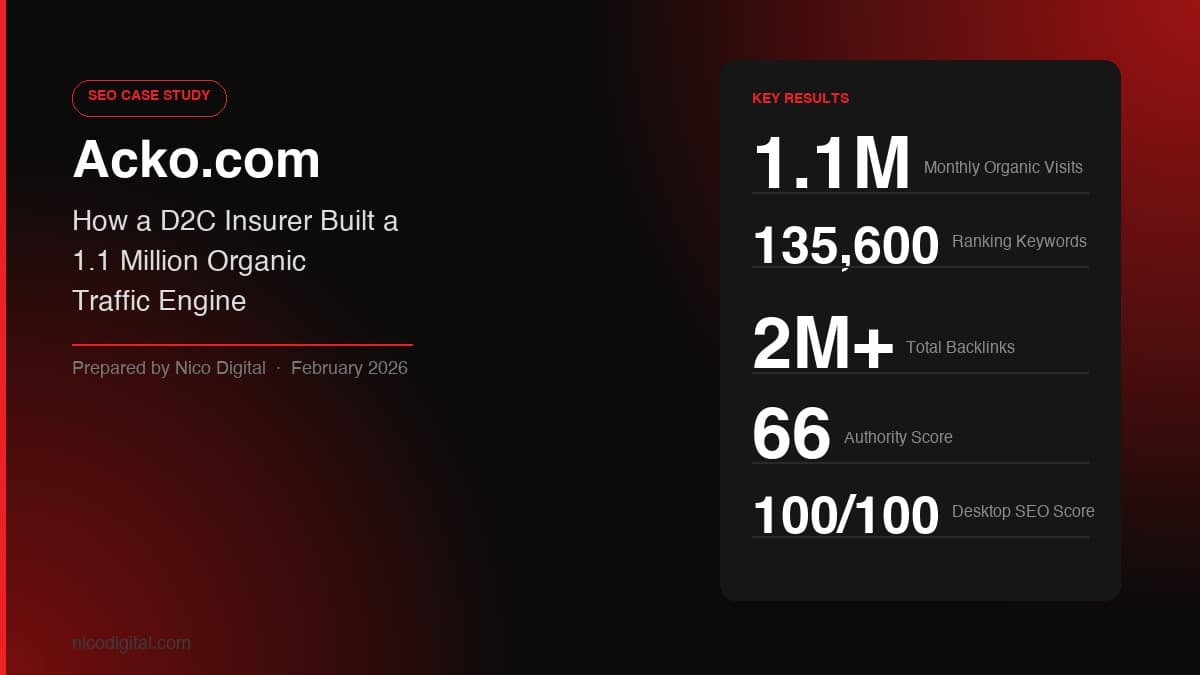
This case study documents how Acko built and executed the SEO strategy that took it from near-zero organic visibility to 1.1 million monthly organic visits, 135,600 ranking keywords, and a domain authority score of 66 (Industry Leader classification).
The approach was built on a simple thesis: own every question an Indian vehicle owner or insurance buyer could ask, then convert that attention into policy sales through aggressive internal linking and on-page conversion optimisation.
Organic Keywords Growth - acko.com
| KPI | Value | What This Means |
|---|---|---|
| Organic Keywords | 135,600 | Ranking for more keywords than 95% of Indian insurance sites |
| Monthly Organic Traffic | 1.1 Million | Equivalent to $699,300/month in Google Ads spend |
| Branded Traffic | 397,600/mo (+2.22%) | Nearly 400K people search for Acko by name every month |
| Total Backlinks | 2 Million+ | From 8,000 unique referring domains globally |
| Authority Score | 66 (Industry Leader) | Places Acko in the top tier of Indian insurance domains |
| Core Web Vitals | All Green | Passing all 3 CWV metrics on both mobile and desktop |
| Indexed Pages | 8,864 | Each page targeting a specific keyword cluster |
The Content Strategy: How Acko Built 8,864 Pages That Rank
The Decision: Manual Content Over Programmatic
The first and most critical strategic decision was choosing manual content creation over programmatic SEO. Many insurance competitors - particularly aggregators like PolicyBazaar - use template-driven programmatic pages to scale quickly. Acko took the opposite approach.
95% of Acko's top-performing pages were manually created by dedicated content teams.
Why? Because in YMYL (Your Money, Your Life) categories like insurance, Google demands E-E-A-T: Experience, Expertise, Authoritativeness, and Trustworthiness. Template-generated pages with swapped-out keywords simply cannot demonstrate the depth of expertise that a 6,800-word manual guide can.
The insight: In YMYL verticals, manual content at scale beats programmatic content at scale. The per-page investment is higher, but the ranking probability and longevity are dramatically better. Google's Helpful Content system actively devalues thin, template-driven pages - and in insurance, the penalty is severe.
The Architecture: Pillar-Cluster Model
Every insurance vertical was structured as a pillar-cluster architecture. Here's exactly how it works:
- One pillar page serves as the comprehensive hub for the entire topic (e.g.,
/car-insurance/). This page is 6,000-7,000 words, covers every sub-topic, and targets the highest-volume head keyword. - 6-10 cluster pages each target a specific long-tail keyword within that topic (e.g.,
/car-insurance/idv-calculator,/car-insurance/third-party-car-insurance,/car-insurance/zero-depreciation). - Every cluster page links back to the pillar, and the pillar links out to every cluster. Clusters also cross-link to each other where topically relevant.
- The result: a tightly interlinked topic hub that signals to Google - "This domain has comprehensive expertise on car insurance, covering every angle."
This isn't just theoretical. The car insurance pillar page contains 152 internal links - an extraordinarily dense linking structure that distributes PageRank across the entire cluster while keeping users within the Acko ecosystem. Only 3 external links appear on the entire page, ensuring minimal link equity leakage.
The Exact Content Template Acko Used
Every pillar page follows the same proven template:
| Element | Specification | Why It Works |
|---|---|---|
| Word count | 6,000-7,000 words | Outranks thin competitor pages; covers every possible query |
| H1 tag | Exact-match primary keyword | "Car Insurance" - no cleverness, just the keyword |
| H2 subheadings | 10+ per page | Each H2 targets a related question or sub-topic |
| Internal links | 100-150 per page | Distributes authority; keeps users in the ecosystem |
| External links | 2-3 maximum | Links only to regulatory/government sources for trust |
| Images | 200-300 per page | Custom graphics, comparison tables, process diagrams |
| Alt text coverage | 80%+ of images | Drives image search traffic + accessibility compliance |
| Schema markup | 5 types per page | Organization, BreadcrumbList, Product, ImageObject, HowTo |
The H2 strategy is particularly important. Each H2 subheading on the car insurance page maps to a specific question people ask: What is Car Insurance, Key Features, Types of Policies, Electric Vehicle Coverage, Third-Party vs Comprehensive, What's Covered, What's Not Covered, Add-ons, Factors Affecting Premium, How to Calculate Premium. This means a single page can rank for dozens of question-based long-tail keywords through H2 optimisation.
The Traffic Magnet Play: RTO & Vehicle Utility Content
This was one of the most impactful and counterintuitive decisions in the strategy. Instead of only creating insurance content, Acko built an entire section of vehicle utility tools and informational pages - content about checking vehicle owner details, PUC certificates, e-challans, FASTag recharges, and RTO information.
None of this is insurance content. But here's the logic:
- Every person searching "vehicle owner details" owns a vehicle. Vehicle owners legally require insurance.
- These utility queries have massive search volume - "e challan" alone has 6.1 million monthly searches, "vehicle owner details" has 90,500.
- Competition for utility queries is lower than for commercial insurance keywords, making it faster to rank.
- The conversion path is clear: Free utility tool → User sees Acko brand → Internal links to insurance products → Quote request → Policy sale.
Top 10 Pages by Organic Traffic
The insight: Four of the top 10 traffic-driving pages are RTO/utility pages, not insurance pages. The /rto/vehicle-owner-details page drives 71,000 monthly visits alone. This single tactic accounts for over 15% of total organic traffic and creates a top-of-funnel channel that pure insurance competitors simply don't have.
The utility pages also have an unexpected SEO benefit: they signal to Google that acko.com is a comprehensive automotive resource, not just an insurance seller. This topical breadth strengthens the domain's authority across all vehicle-related queries - including commercial insurance keywords.
The Content Satellite Strategy: AckoDrive.com
Acko launched a separate domain - ackodrive.com - as a standalone automotive content hub. This was a deliberate strategic decision with two goals:
- Capture informational automotive queries (car reviews, bike comparisons, driving tips) without diluting acko.com's transactional insurance intent.
- Build a separate domain authority in the automotive niche, creating a second organic acquisition channel.
The result: AckoDrive now pulls approximately 1 million visits per month, with 58.83% from organic search. It feeds brand awareness back to acko.com without competing with it in search results.
The Keyword Strategy: Owning the Full Funnel
The Intent-Based Targeting Framework
Rather than chasing the highest-volume keywords indiscriminately, the keyword strategy was built on an intent-based funnel model. Every keyword was categorised by search intent, and content was created to match:
Keyword Intent Distribution
| Intent | Share | Example Keywords | Content Type | Conversion Role |
|---|---|---|---|---|
| Informational | 62.4% | what is car insurance, puc certificate, vehicle owner details | Guides, utility tools, explainers | Top-of-funnel awareness |
| Commercial | 18.3% | best car insurance, two wheeler insurance online, compare health plans | Comparison pages, calculator tools | Mid-funnel consideration |
| Transactional | 11.1% | buy car insurance, renew bike insurance online, acko premium calculator | Product pages with CTAs | Bottom-funnel conversion |
| Navigational | 8.3% | acko, acko insurance, acko login, acko claim status | Homepage, login, support pages | Brand demand capture |
Why 62.4% informational? This is the key insight most competitors miss. They focus their resources on commercial and transactional keywords - where competition is fiercest and CPC is highest. Acko deliberately over-indexed on informational content because:
- Informational pages are easier to rank for. Lower keyword difficulty means faster results.
- They build topical authority. Google sees a domain covering every angle of a topic and rewards it with better rankings on commercial keywords too.
- They create internal linking opportunities. Each informational page links to 3-5 commercial pages, passing authority and guiding users down the funnel.
- They compound over time. An informational page answering "what is third-party car insurance" continues driving traffic for years.
How Acko Sequenced Keyword Targeting
The keyword rollout followed a deliberate sequence:
Phase 1 (Months 1-6): Foundation. Acko targeted branded keywords first (acko, acko insurance, acko car insurance) to ensure the brand owned its own search results. These are low-competition, high-intent keywords that convert well.
Phase 2 (Months 3-12): Informational land grab. While competitors fought over "car insurance" (KD 67), Acko published 50+ informational pages targeting lower-difficulty questions. These pages ranked quickly, built authority, and started passing link equity to commercial pages.
Phase 3 (Months 9-18): Commercial assault. With topical authority established through informational content, Acko went after the money keywords: "two wheeler insurance," "car insurance," "health insurance." The pillar pages, backed by clusters and internal links, climbed to top-3 positions.
Phase 4 (Ongoing): Utility expansion. The RTO/vehicle utility play opened an entirely new traffic channel, bringing in 150K+ monthly visits from non-insurance queries.
SERP Feature Domination
SERP Feature Ownership - acko.com
Beyond standard organic rankings, the content strategy captures significant SERP real estate:
- 5,200 People Also Ask appearances - Acko's content appears in the expandable question boxes that sit at the top of search results. This was achieved by structuring H2s as questions and providing concise, direct answers in the first paragraph under each H2.
- 4,700 Image Pack appearances - Custom infographics and comparison tables trigger image results. Every image has descriptive alt text and is contextually embedded within relevant content.
- 782 AI Overview citations - Google's AI is actively citing Acko content as authoritative. This is achieved through clear definitions, structured data, and authoritative formatting that AI systems prefer to reference.
The Backlink Strategy: Building Authority Through Three Tiers
Backlink Profile - acko.com
The backlink profile totals 2 million+ links from 8,000 referring domains with a 66 authority score. But the raw numbers aren't what matters - it's the structure. The backlink acquisition strategy was built in three deliberate tiers, each serving a different purpose.
Tier 1: Embedded Partnership Links (Volume Play)
The most powerful link source comes from embedded insurance integrations with major platform partners. When Acko serves as the insurance provider within another company's checkout flow (e.g., adding travel insurance during a flight booking), the partner site links back to Acko with every transaction page.
| Anchor Text | Backlinks | Domains | What This Tells Us |
|---|---|---|---|
| insurance partner | 698,996 | 4 | Deep embedded integrations with 4 major platforms |
| acko term insurance | 405,009 | 6 | Product-level integrations on 6 partner properties |
| acko health insurance | 404,014 | 21 | Health insurance embedded across 21 partner touchpoints |
| acko life insurance | 403,508 | 8 | Life insurance integrations across 8 platforms |
The insight: 698,996 backlinks from just 4 domains means these are sitewide embedded widgets or checkout integrations. Every product page, every transaction page on the partner site links back to Acko. This is not a link-building tactic most companies can simply replicate - it requires building a product that other platforms want to embed. But the SEO payoff is massive: millions of contextually relevant backlinks from high-authority domains.
Tier 2: Brand Authority Links (Trust Play)
The second tier focuses on building brand authority through sports sponsorships, startup ecosystem links, and earned media coverage.
IPL Cricket Sponsorships
Acko sponsored two IPL teams - Delhi Capitals and Gujarat Titans. The SEO benefit is significant: both team websites (delhicapitals.in at DR 61, gujarattitansipl.com at DR 55) link to acko.com from their sponsor pages, news articles, and match day content. These are high-authority, editorially placed links that Google considers strong trust signals.
Startup & Tech Ecosystem Links
Acko's positioning as a tech-first insurer earned placements on high-authority startup platforms:
- CareCredit.com (DR 91) - Linked to Acko's health insurance content from a health/wellness editorial article. This is the highest-DR link in the profile.
- Failory.com (DR 74) - Featured Acko in "Top 100 Indian Startups 2026" with an editorial backlink.
- KFintech (DR 79) - Corporate registry listing with a branded link.
- Team-BHP (DR 69) - India's largest automotive enthusiast forum, where genuine user reviews of Acko's car insurance link to specific product pages.
Fintech Partnership Links
Strategic partnerships with complementary fintech companies - Rupeek (gold loans), Progcap (supply chain finance), Bajaj Finserv - created a fintech ecosystem link network. Each partner links to Acko from their partner pages, insurance comparison tools, or co-marketing content.
Tier 3: Organic & Tool-Earned Links (Compounding Play)
The third tier is the long-term compounding engine - links earned naturally through useful content and tools:
- Naked URL links (www.acko.com) from 1,860 domains - editorial mentions, blog citations, news articles.
- Branded anchor links (acko, acko.com) from 1,400+ domains - natural brand mentions across the web.
- Utility tool links - the IDV calculator earned links from 31 domains, the bike insurance check from 12 domains, the EMI calculator from 24 domains. These tools are useful enough that other sites link to them as resources.
This is the most sustainable part of the backlink strategy. While partnership links require business deals and sponsorship links require budget, tool-earned links grow passively as more people discover and reference the tools.
The Anchor Text Profile: Intentionally Clean
Across 7,387 unique anchor texts, the profile is overwhelmingly branded and natural. There is no evidence of aggressive anchor text manipulation - no exact-match keyword anchors in suspicious volumes. This is critical for YMYL sites where Google's link spam detection is particularly aggressive.
The distribution: ~80% branded/URL anchors, ~15% product-branded anchors (acko + product name), and ~5% generic keyword anchors. This is exactly the ratio Google expects from a legitimate brand with strong organic visibility.
Technical SEO: The Foundation Everything Else Rests On
Technical SEO in the insurance vertical is a hygiene factor: it won't win you rankings on its own, but failing it will prevent everything else from working.
Core Web Vitals: How Acko Passed on Both Mobile & Desktop
| Metric | Mobile | Desktop | How Acko Achieved It |
|---|---|---|---|
| LCP | 2.0s | 2.0s | Preloaded hero images, lazy-loaded below-fold, CDN delivery |
| INP | 112ms | 59ms | Debounced event handlers, code-split heavy JS bundles |
| CLS | 0 | 0 | Explicit width/height on all images, font-display: swap |
| FCP | 1.7s | 1.4s | Server-side rendering for critical above-fold content |
| TTFB | 0.9s | 0.8s | Edge caching, optimised server response pipeline |
With 90.26% of Acko's traffic coming from mobile devices, CWV performance directly impacts rankings. Google uses CWV as a ranking signal, and in competitive SERP positions (#2 vs #3 for "car insurance"), it can be the tiebreaker.
On-Page SEO Audit Score: 100/100 Desktop
The desktop SEO audit returned a perfect 100/100 score. This required meticulous attention to:
- Title tags on every page following the [Action] + [Keyword] + [Value Prop] formula
- Meta descriptions containing the primary keyword within the first 120 characters
- Canonical URLs correctly self-referencing on every page to prevent duplicate content
- Heading hierarchy - exactly one H1 per page, logically nested H2s and H3s
- Image alt text on 81% of all images (231 out of 286 on the car insurance page alone)
- Mobile viewport properly configured across all templates
- No broken links detected in regular crawl audits
Schema Markup: Five Types Per Page
Acko implemented five distinct schema types on product pages, each serving a specific purpose:
| Schema Type | What It Does | SEO Impact |
|---|---|---|
| Organization | Declares Acko as a recognised entity with logo and social profiles | Knowledge Panel eligibility, brand SERP control |
| BreadcrumbList | Shows navigation path (Home > Car Insurance > IDV Calculator) | Breadcrumb rich results in SERPs, better CTR |
| Product | Marks insurance products with pricing, availability, reviews | Product rich results with price/rating snippets |
| ImageObject | Provides metadata for featured images and infographics | Image search visibility, Google Discover eligibility |
| HowTo | Structures step-by-step guides (how to buy insurance, how to claim) | How-to rich results with expandable steps |
A deliberate gap Acko identified but chose not to fill yet: FAQPage schema. While many competitors use FAQPage to trigger FAQ rich results, Acko found that Google has been increasingly suppressing FAQ rich results since 2023. The risk of implementing it and having it ignored - or worse, triggering a manual review for SERP manipulation - outweighed the potential benefit.
Competitive Landscape: Where Acko Sits
Competitive Landscape - Estimated Organic Traffic (thousands/month)
Acko operates in a market with 26,068 organic competitors, spanning three distinct competitive categories.
Category 1: Insurance Aggregators - Companies like PolicyBazaar (10.7M organic traffic, 621K keywords) and InsuranceDekho (258K traffic) are comparison platforms that rank for every insurance keyword imaginable. PolicyBazaar has 3.4x more keywords than Acko. However, the keyword overlap is only 23% - because Acko deliberately avoided competing head-to-head on aggregator-style comparison queries and instead carved out a D2C niche with utility content.
Category 2: Traditional Insurers - Legacy players like Tata AIG (2.9M traffic), ICICI Lombard (1.7M), and HDFC Ergo (1.4M) have been aggressively scaling content. These companies have deeper pockets, established brand trust, and regulatory relationships. But they entered SEO late and their content strategies are less sophisticated - most lack pillar-cluster architectures, utility content plays, or embedded partnership links.
Category 3: Government & Automotive Portals - The most interesting competitive finding: Acko's #1 organic competitor by keyword overlap is parivahan.gov.in (India's government vehicle registration portal, 30% overlap). This validates the RTO utility content strategy completely - Acko is successfully competing with the government itself for vehicle-related queries and winning on several terms including "vehicle owner details" (#1), "HSRP number plate" (#8), and "PUC certificate" (top 5).
| Competitor | Overlap | Their Traffic | Their Keywords | Acko's Advantage |
|---|---|---|---|---|
| parivahan.gov.in | 30% | 33.8M | 234.9K | Better UX, faster pages, insurance upsell path |
| policybazaar.com | 23% | 10.7M | 621.5K | D2C model = higher margins per visitor |
| tataaig.com | 23% | 2.9M | 232.7K | Deeper content, utility tools, mobile-first |
| icicilombard.com | 20% | 1.7M | 192.6K | RTO utility traffic they don't compete for |
| hdfcergo.com | 16% | 1.4M | 171.3K | Stronger CWV, better internal linking |
Key Takeaways: What Made This Work
1. Manual Content Beats Programmatic in YMYL
Manually creating 95% of top-performing pages required significantly more investment than programmatic alternatives. But in insurance - a category where Google applies the strictest quality standards - the depth, accuracy, and expertise of manual content consistently outranked template-driven competitors. The car insurance pillar page at 6,832 words outranks pages from companies with 10x the domain authority because it genuinely answers every question a buyer has.
2. Utility Content Is a Competitive Moat
The decision to build RTO utility pages created a traffic channel that direct competitors (other insurers) cannot easily replicate because it requires building genuine utility tools, not just content. This single play contributes 15%+ of total organic traffic and feeds the insurance conversion funnel with pre-qualified vehicle owners.
3. Internal Linking Density Is the Multiplier
152 internal links on a single page sounds aggressive. It is. But each link serves a purpose: passing authority to cluster pages, guiding users to conversion points, and creating clear topical signals for search engines. The pillar-cluster model only works when the internal linking is this dense and this deliberate.
4. Partnership Links Are an Unfair Advantage
698,996 backlinks from embedded platform integrations created a link velocity that cannot be matched through traditional link building. The lesson isn't "get partnership links" - it's "build a product other platforms want to embed." Acko's insurance-as-a-service model naturally generates links as a byproduct of product distribution.
5. Branded Search Is the Ultimate Safety Net
With 397,600 monthly branded searches growing at +2.22% MoM, Acko has built something that pure SEO cannot replicate and algorithm updates cannot take away: brand demand. Even if every non-branded ranking disappeared tomorrow, 400K people would still search for Acko by name every month.
6. Technical Perfection Enables Content Performance
Passing all Core Web Vitals, scoring 100/100 on desktop SEO, and implementing 5 schema types per page created the technical foundation that allows the content and link strategies to perform at full capacity. In a market where competitors still fail CWV, technical excellence is a measurable ranking advantage.
Results at a Glance
| Metric | Result |
|---|---|
| Total Organic Keywords | 135,600 positions across India, US, and Australia |
| Monthly Organic Traffic | 1.1 Million visits/month |
| Traffic Value | $699,300/month in equivalent Google Ads spend |
| Branded Search Demand | 397,600/month and growing at +2.22% MoM |
| #1 Rankings | "two wheeler insurance" (90.5K vol), "vehicle owner details" (90.5K vol), "acko" (201K vol) |
| Backlink Profile | 2M+ links from 8,000 referring domains, Authority Score 66 |
| Core Web Vitals | All 3 metrics green on mobile and desktop |
| Desktop SEO Score | 100 out of 100 |
| Total Pages Indexed | 8,864 across all verticals |
| SERP Features | 5,200 PAA + 4,700 Image + 2,300 Sitelinks + 782 AI Overview |
| Content Satellite | AckoDrive.com: 1M+ visits/month additional |
Traffic, keyword, and backlink data referenced in this case study are estimates derived from industry-standard SEO analytics methodologies. Actual performance metrics may vary.
Want to build an organic traffic engine like Acko's for your D2C or financial services brand? Nico Digital helps InsurTech, Fintech, and D2C brands build SEO authority, own their category, and convert organic traffic into direct revenue. Book a free strategy consultation.

Aditya Kathotia
Founder & CEO
CEO of Nico Digital and founder of Digital Polo, Aditya Kathotia is a trailblazer in digital marketing. He's powered 500+ brands through transformative strategies, enabling clients worldwide to grow revenue exponentially. Aditya's work has been featured on Entrepreneur, Economic Times, Hubspot, Business.com, Clutch, and more. Join Aditya Kathotia's orbit on LinkedIn to gain exclusive access to his treasure trove of niche-specific marketing secrets and insights.