

This is an independent analysis by Nico Digital. PhysicsWallah is not a client, and no non-public information was used. PhysicsWallah Limited has been listed since November 2025, so the figures below come from its quarterly results, its offer documents and its pre-listing filings with the Registrar of Companies as reported by Inc42, Entrackr, Storyboard18, Outlook Business and other business press, with the publication and date noted inline.
PhysicsWallah, or PW, began as a teacher in Prayagraj uploading physics lectures to YouTube in 2016 (Outlook Business, April 2025). It now sells courses to millions of exam aspirants, runs 370 coaching centres (Inc42, November 2026) and is a listed company. Its online courses collect an average of ₹4,312 per student (Inc42, August 2026), a fraction of what classroom coaching costs. The free lectures are the funnel; the money comes from structured paid batches and, increasingly, from offline centres.
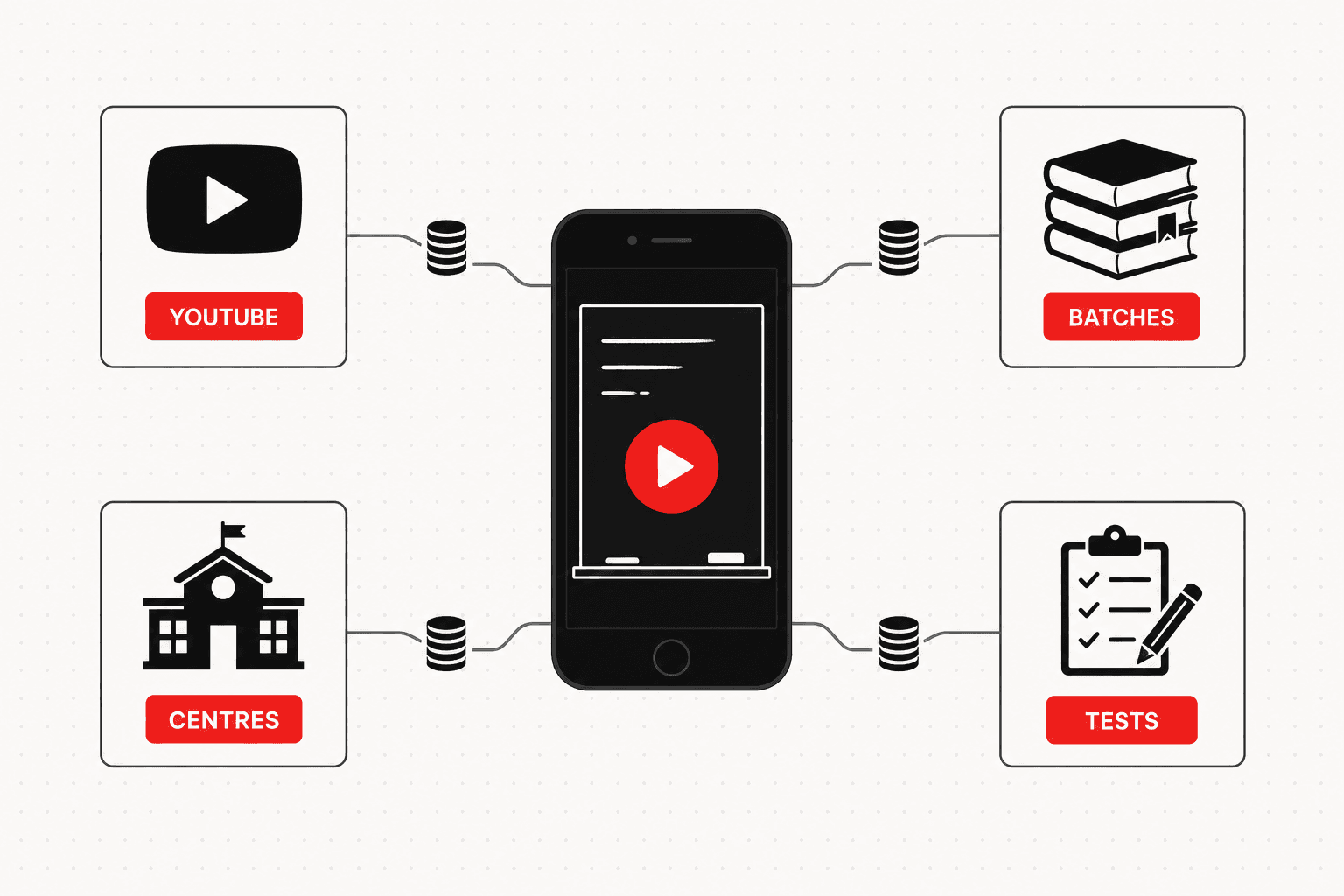
Short answer: PhysicsWallah makes money from paid test-prep courses. Most learners buy low-priced online batches; a smaller number pay several times more for classroom teaching at Vidyapeeth and Pathshala centres. Free YouTube teaching keeps acquisition cheap. In FY26 operating revenue rose 35 percent to ₹3,899.5 crore and the net loss narrowed 90 percent to ₹24.2 crore (Inc42, May 2026). In the September 2026 quarter it earned ₹143.6 crore on revenue of ₹1,242.3 crore, up 18.2 percent (Inc42, November 2026).
From a YouTube channel to a listed company
Alakh Pandey started the PhysicsWallah channel in 2016, registered the company in 2020 and launched an app for live classes that year; it reached more than 35,000 users within a few days, and Prateek Maheshwari is his co-founder (Outlook Business, April 2025). A maiden $100 million round in 2022 made PW a unicorn (Inc42, August 2026), and a $210 million round led by Hornbill Capital in September 2024 valued it at $2.8 billion (Outlook Business, April 2025).
The ₹3,480 crore IPO combined a ₹3,100 crore fresh issue with a ₹380 crore offer for sale, was priced at ₹109 within a ₹103 to ₹109 band, and was subscribed 1.8 times; the shares opened at ₹145 on the NSE on 18 November 2025, a 33 percent premium (Entrackr, November 2025). The draft papers earmarked ₹710 crore of proceeds for marketing (Storyboard18, September 2025), and ₹1,008.9 crore went to offline and hybrid centres, of which ₹134.9 crore had been spent by June 2026 (Inc42, August 2026).
The low-fee online batch model
When the app launched, packages started at ₹1,000 and went up to ₹4,000 per student (Outlook Business, April 2025). Prices have risen slowly since: average collection per online user was ₹3,682.79 in FY25 (Storyboard18, October 2025) and ₹4,312 in the June 2026 quarter, up 10 percent (Inc42, August 2026).
Low prices only work at volume, and PW has it. Total paid users reached 5.34 million in FY26, up 20 percent, of whom 4.87 million studied online and 0.47 million offline (Outlook Business, May 2026). Daily active users rose from 0.93 million in FY23 to 2.70 million in FY25, and average engagement from 93 to 111 minutes (Storyboard18, October 2025). The online segment earned an operating profit of ₹75.9 crore in the June 2026 quarter (Inc42, August 2026).
The product is a batch: a structured course for one exam cycle rather than a library of videos. That gives each student a reason to pay even when much of the teaching style is free on YouTube, and every year brings a new cohort of aspirants to sell to.
YouTube-led acquisition
PhysicsWallah's real distribution asset is free teaching. By June 2025 it had 98.8 million subscribers across 207 YouTube channels, growing at 41.8 percent a year from FY23 to FY25, plus 888 channels and handles across platforms with 119.27 million followers and 22.85 billion cumulative YouTube views (Storyboard18, October 2025). The flagship "Physics Wallah - Alakh Pandey" channel had 13.7 million subscribers in July 2025 (Storyboard18, October 2025), roughly a seventh of the YouTube total.
That spread matters. A brand built on one teacher is fragile; PW now runs hundreds of channels led by many teachers, in many languages and exam categories, so the founder is the origin story rather than the only face.
Paid media sits on top of that base rather than replacing it. Advertising and publicity cost ₹276.2 crore in FY25, about 10 percent of revenue (Storyboard18, September 2025), and marketing was ₹128 crore in the June 2026 quarter, up from ₹117 crore a year earlier (Inc42, August 2026).
Offline: Vidyapeeth and Pathshala
PW launched Pathshala, a hybrid format, in 2021 and Vidyapeeth, full classroom coaching, in 2022 (Inc42, August 2026). The network went from 198 centres across 109 cities in March 2025 (Storyboard18, October 2025) to 353 in India and the UAE by March 2026 (Inc42, May 2026) and 370 by September 2026 (Inc42, November 2026).
Offline revenue was ₹1,774 crore in FY26, up 31 percent and 45 percent of operating revenue (Inc42, May 2026), against ₹1,954 crore online, up 39 percent (Outlook Business, May 2026). The gap per student explains it: offline revenue per user was ₹12,633 in the June 2026 quarter, against ₹4,312 collected per online user (Inc42, August 2026).
Offline is still the costlier engine. It made an operating loss of ₹27 crore in the June 2026 quarter, or ₹54 crore after corporate costs, while the company says mature Vidyapeeth centres earn steady-state margins of 13 to 15 percent (Inc42, August 2026). Growth slowed in the September quarter, when offline revenue rose 9 percent to ₹540.9 crore against 26.4 percent online growth (Inc42, November 2026). Like Lenskart, PW uses physical locations to reach customers an app alone does not convert.
Test-prep categories beyond JEE and NEET
PW started with engineering and medical entrance exams, and it has deliberately grown past them. JEE and NEET fell from 54 percent of online enrolments in FY23 to 29 percent in FY26, and a state board and vernacular vertical drew 393,000 enrolments in its first year (Inc42, May 2026). The online catalogue now spans JEE, NEET, K-12, government exams, CA, CS, ACCA, CFA and skills courses, helped by acquisitions including Saarthi IAS for UPSC, Xylem Learning and Utkarsh Classes (Inc42, August 2026).
The company describes JEE, NEET, CA, MBA and commerce as mature and profitable categories, while NEET PG, skills, Curious Junior and vernacular education are still in investment mode (Inc42, August 2026). K-12 and early learning brought in ₹105 crore in the June 2026 quarter, up 88 percent, across 14 state boards (Inc42, August 2026). NEET now makes up about 15 percent of online revenue (Inc42, November 2026).
Revenue and profit, as filed
Before listing, PW's filings showed fast growth and uneven profit. Operating revenue rose from ₹744.3 crore in FY23, restated from ₹779.28 crore, to ₹1,940.4 crore in FY24, while the restated FY23 result became an ₹84 crore loss and FY24 showed a ₹1,131 crore loss that included ₹756 crore of non-cash fair-value losses on preference shares (Entrackr, November 2024). FY25 revenue was ₹2,886.6 crore (Storyboard18, September 2025) and the loss ₹243.3 crore (Inc42, May 2026). FY26 revenue rose 35 percent to ₹3,899.5 crore and the loss shrank to ₹24.2 crore, with EBITDA of ₹549 crore at a 14.1 percent margin (Outlook Business, May 2026).
The quarterly pattern is the honest answer to whether PW is profitable. It earned ₹69.7 crore in the September 2025 quarter and ₹102.3 crore in the December quarter, then lost ₹69.1 crore in the March 2026 quarter (Inc42, May 2026) and ₹88.3 crore in the June quarter, before earning ₹143.6 crore in the September 2026 quarter, when EBITDA rose 52.6 percent to ₹348 crore at a 28 percent margin (Inc42, November 2026). Across the first half of FY27 the two quarters add up to a profit of about ₹55 crore. In its December 2025 shareholder letter the company said it expects FY27 to be a PAT-positive year as cost efficiencies strengthen (Free Press Journal, December 2025), a claim the March 2027 results will test.
Founder-led brand marketing
The greeting is the logo. Pandey's "Hello bacchon" opening became recognisable to a generation of aspirants (Inc42, August 2026). The brand is a teacher who sounds like an older brother, which no ad agency could have written.
The story as content. Amazon miniTV released Physics Wallah, a web series based on Pandey's life, in December 2022 (Outlook India, December 2022). Few companies get their founding myth turned into free entertainment that doubles as recruitment for students.
Price as a promise. Low fees are part of the founder narrative, from the ₹1,000 starting packages of 2020 to online collections still near ₹4,300 per student. A message that matches the price list carries further than a discount banner.
Then institutionalise it. In May 2026 Pandey and Maheshwari said PW is moving to an AI-first model across teaching, counselling, operations and product (Outlook Business, May 2026). The same pattern shows up in Zerodha, where free education built trust that paid products monetised, and in Nykaa, where creator content does the selling.
What an education or creator-led brand can copy
-
Teach in public before you sell. PW's free lectures built a 98.8 million subscriber base before most students paid anything. For a coaching institute, that means ranking for the questions aspirants search, which is the core of SEO for coaching and test prep institutes.
-
Price for no salesperson. A batch at a few thousand rupees can be bought from a phone without a counsellor call. Keep the entry product cheap enough that content alone closes the sale.
-
Outgrow the founder. The flagship channel is about a seventh of PW's YouTube base. Build a bench of teachers and channels so the brand survives any one face.
-
Add a premium physical tier. Classroom students pay roughly three times as much. Offline earns its place when the online base already trusts the name.
-
Plan for the admission calendar. PW's profit arrives in two quarters and leaves in two. Budget marketing and cash for the lean months, not the average.
Frequently Asked Questions
How does Physics Wallah make money?
PhysicsWallah sells paid courses. Most students buy low-priced online batches for exams such as JEE, NEET, CA and government jobs, at an average collection of ₹4,312 per online user in the June 2026 quarter. A smaller number attend Vidyapeeth and Pathshala centres, where revenue per student was ₹12,633. In FY26 online revenue was ₹1,954 crore and offline ₹1,774 crore.
Is Physics Wallah profitable?
Not yet on a full-year basis. PhysicsWallah reported a net loss of ₹24.2 crore in FY26, down 90 percent from ₹243.3 crore in FY25, on revenue of ₹3,899.5 crore. Quarterly results swing with the admission cycle: it earned ₹143.6 crore in the September 2026 quarter after a ₹88.3 crore loss in the June quarter, and the company has said it expects FY27 to be a profitable year.
What is PW Vidyapeeth?
Vidyapeeth is PhysicsWallah's offline coaching format, launched in 2022, with full classroom teaching; Pathshala, launched in 2021, is the hybrid format. The network grew from 198 centres in March 2025 to 353 in March 2026 and 370 by September 2026. Offline revenue was ₹1,774 crore in FY26, 45 percent of operating revenue, and mature centres earn 13 to 15 percent margins, according to the company.
When did Physics Wallah list, and at what price?
PhysicsWallah listed on 18 November 2025. Its ₹3,480 crore IPO, a ₹3,100 crore fresh issue plus a ₹380 crore offer for sale, was priced at ₹109, the top of a ₹103 to ₹109 band, and subscribed 1.8 times. The shares opened at ₹145 on the NSE, a 33 percent premium. The draft papers earmarked ₹710 crore of proceeds for marketing.
What is Physics Wallah's marketing strategy?
PhysicsWallah's marketing starts with free teaching. Alakh Pandey's YouTube lectures built the brand, and by June 2025 PW had 98.8 million subscribers across 207 YouTube channels and 22.85 billion cumulative views. Those viewers become low-cost buyers of paid batches. Paid advertising came to ₹276.2 crore in FY25, about 10 percent of revenue, and the founder's story was turned into an Amazon miniTV series in 2022.
What can an education brand learn from Physics Wallah?
Teach for free in public until the audience trusts you, then sell a structured paid version at a price that does not need a sales team; spread the brand across many teachers and channels so it outgrows one face; add offline centres where students will pay more for accountability; and diversify beyond one exam. PW's own lesson is that profit follows the admission calendar, so plan cash for the lean quarters.

Aditya Kathotia
Founder & CEO
CEO of Nico Digital and founder of Digital Polo, Aditya Kathotia is a trailblazer in digital marketing. He's powered 500+ brands through transformative strategies, enabling clients worldwide to grow revenue exponentially. Aditya's work has been featured on Entrepreneur, Economic Times, Hubspot, Business.com, Clutch, and more. Join Aditya Kathotia's orbit on LinkedIn to gain exclusive access to his treasure trove of niche-specific marketing secrets and insights.
More in Marketing Strategy
- Paytm Business Model: Payments, Devices and Lending After the RBI Ban
- PhonePe Business Model: How a Free UPI App Makes Money
- Rapido Business Model: How a Bike Taxi App Makes Money
- boAt Business Model: How an Audio Brand Built a D2C Empire
- Nykaa Business Model: Content-Led Beauty Commerce Explained
- Swiggy Business Model: Food Delivery, Instamart and the Margin Gap