

Search "SEO vs PPC cost" from an office in Pune and Google will hand you a first page of American pricing. SEO.com will tell you SEO runs $1,500 to $5,000 a month. Improvado will quote a $2.5K monthly investment. Google's own resource page will tell you there is no cost to appear in organic results, which is the single most expensive sentence in digital marketing. Somewhere on page one, an Indian agency will assure you that "SEO is free but time-intensive."
None of that is a lie exactly. It is just priced in the wrong currency for the wrong market, and the businesses that act on it make a predictable mistake: they import a dollar-denominated sequencing decision into a rupee-denominated P&L, where the ratios are completely different.
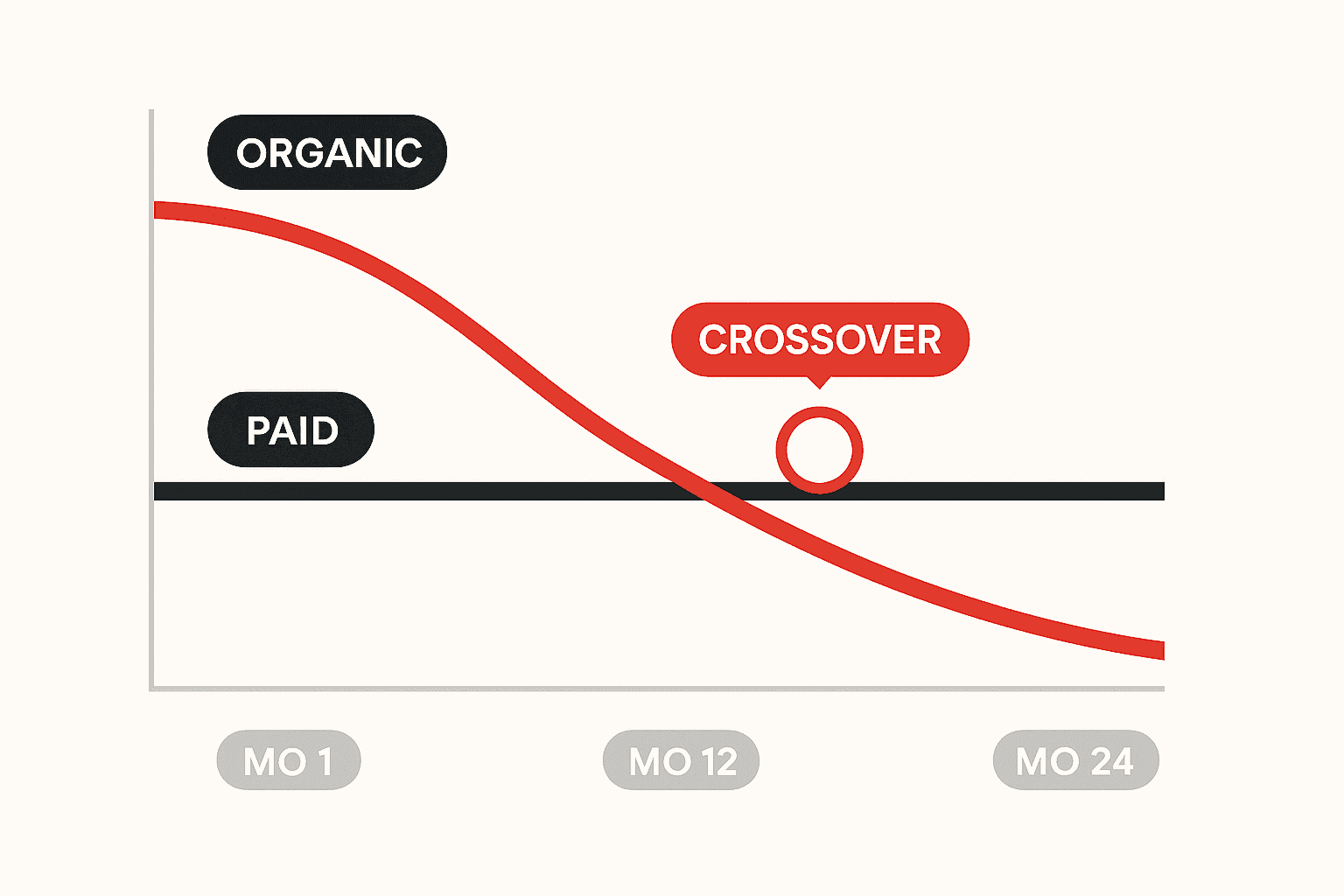
So this article does the thing the first page does not. It prices both channels in rupees, includes the invoice lines that comparisons usually omit, and runs a twenty-four month model that names the specific month organic overtakes paid - along with the honest admission that there are two such months, five apart, and most agencies quote the flattering one.
The Short Answer
In India in 2026, paid search costs somewhere between ₹230 and ₹12,800 per lead depending almost entirely on your industry's auction price, and that number does not improve with time. Organic search costs a retainer of roughly ₹10,000 to ₹2,00,000 per month depending on tier, produces almost nothing for the first three to four months, and then falls in cost per lead every single month thereafter.
In the worked model below - an Indian healthcare brand at a ₹150 average CPC, spending ₹2,40,000 a month all-in on paid and ₹80,000 a month on organic - the two channels deliver almost identical lead volume across two years. Paid delivers 1,280 leads for ₹57.6 lakh. Organic delivers 1,248 leads for ₹20.7 lakh. The marginal cost per lead crosses over in month seven. The cumulative, all-in cost per lead crosses over in month twelve.
That gap between month seven and month twelve is the most important number in this article, and almost nobody publishes it.
Why Every Comparison You Have Read Is in Dollars
This is not a complaint about American content. It is a warning about a specific arithmetic trap.
Indian CPCs are far below US CPCs in most verticals. Indian SEO retainers are also far below US retainers. If both scaled down by the same factor, you could simply divide the American advice by four and carry on. They do not scale down by the same factor.
Media pricing is set by auction, and auctions are local. An Indian insurance click is genuinely cheap relative to a US insurance click because the bidders, the policy values and the disposable incomes behind them are different. Retainer pricing, though, is set by labour - and skilled Indian SEO labour has been repricing upward for a decade while Indian click prices in several verticals have stayed comparatively flat.
The practical consequence is that in India the ratio between "what a month of organic costs" and "what a month of paid costs" is different from the ratio an American article assumes. In low-CPC Indian verticals - ecommerce, travel, automotive, where clicks run ₹3 to ₹30 - paid is startlingly cheap and the crossover arrives late or never. In high-CPC Indian verticals - insurance, education, B2B SaaS, where clicks run ₹205 to ₹460 - the crossover arrives fast and the case for organic is overwhelming.
An imported comparison cannot tell you which of those two businesses you are. That is the gap this article fills.
What PPC Actually Costs in India: The Full Invoice
Ad spend is not your PPC cost. Ad spend is the largest line on your PPC cost. Businesses that compare channels on media spend alone routinely understate their true paid cost by 20 to 35 percent, which is more than enough to invert the conclusion.
Here is the complete invoice.
| Line item | Typical India range | Notes |
|---|---|---|
| Media spend | Set by auction | ₹3 to ₹460 per click depending on vertical - see the table below |
| Management fee | 10-20% of spend, or ₹25,000-₹75,000 flat | Percentage models get expensive as you scale; flat models get expensive when you cut back |
| Landing pages and creative | ₹15,000-₹50,000 upfront, then ongoing | The most under-budgeted line; a campaign is only as good as the page it lands on |
| Tracking, tooling, call attribution | ₹5,000-₹15,000 per month | Conversion tracking, call tracking, reporting infrastructure |
| Internal time | Rarely costed | Approvals, creative review, sales follow-up on the leads generated |
The critical property of this invoice is not its size. It is its shape. Every line on it recurs, and none of it gets cheaper because you have been doing it for a while. Your month-thirty-six cost per click is set by the same auction that set your month-one cost per click, and if anything the auction has more bidders in it now.
For the vertical-by-vertical auction prices behind this, we maintain a separate breakdown of Google Ads CPC benchmarks across Indian industries, including the city multiplier that makes Mumbai clicks cost more than the national average.
What SEO Actually Costs in India: The Full Invoice
Organic has an invoice too, and the "SEO is free" framing survives mainly because a large part of that invoice never reaches the marketing budget - it lands on the engineering team instead.
| Line item | Typical India range | Notes |
|---|---|---|
| Retainer | ₹10,000-₹2,00,000 per month | Freelancer ₹5,000-₹25,000 · small agency ₹15,000-₹60,000 · mid-tier ₹50,000-₹1,50,000 · enterprise ₹1,00,000-₹5,00,000 |
| Content production | Often billed separately | Verify whether writing is inside or outside the retainer before comparing quotes |
| Tooling | ₹8,000-₹20,000 per month | Rank tracking, crawling, backlink data |
| Technical implementation | Internal engineering time | The most commonly omitted cost in the entire comparison |
| Digital PR and links | Highly variable | Discretionary, and the line most often padded in proposals |
The full retainer picture, tier by tier and with the red flags that distinguish a real proposal from a padded one, sits in our guide to what SEO services cost in India. If you are trying to price a one-off diagnostic rather than an ongoing programme, SEO audit cost in India covers that separately, and link building cost in India covers the line item most likely to be inflated.
The technical implementation line deserves emphasis, because it is where organic programmes quietly die. An agency delivers a prioritised list of fixes. The fixes require developer time. The developer queue is full. Three months later the retainer has been paid three times and the crawl budget problem is still there. Nothing about that failure appears on the invoice, but it moves the crossover month to the right by however long the queue is - and in the model below, every month of delay costs roughly ₹80,000 in retainer that bought nothing.
Cost Per Lead by Industry: The Table Nobody Runs
Cost per click is a vanity metric. You cannot deposit a click. The number that decides the comparison is cost per lead, and to get there you need one more variable that almost every CPC benchmark article omits: your landing page conversion rate.
The table below takes the midpoint of each Indian industry's CPC band and converts it into a paid cost per lead at two conversion rates - 3 percent, which is a mediocre-to-average landing page, and 5 percent, which is a good one.
| Industry | Avg CPC (₹) | Paid CPL @ 3% | Paid CPL @ 5% |
|---|---|---|---|
| Insurance | ₹310-460 | ₹12,833 | ₹7,700 |
| Education | ₹295-385 | ₹11,333 | ₹6,800 |
| B2B SaaS / Tech | ₹205-255 | ₹7,667 | ₹4,600 |
| Real Estate | ₹50-330 | ₹6,333 | ₹3,800 |
| Finance / Lending | ₹65-270 | ₹5,583 | ₹3,350 |
| Healthcare | ₹95-210 | ₹5,083 | ₹3,050 |
| Legal | ₹50-130 | ₹3,000 | ₹1,800 |
| Home Services | ₹25-75 | ₹1,667 | ₹1,000 |
| Travel | ₹14-30 | ₹733 | ₹440 |
| Automotive | ₹8-25 | ₹550 | ₹330 |
| Ecommerce / Retail | ₹3-20 | ₹383 | ₹230 |
Two things jump out.
First, the spread is enormous - a factor of about fifty-six between ecommerce and insurance. Any generic claim that "PPC costs more than SEO" is meaningless without naming the vertical. An insurance brand paying ₹12,833 per paid lead has an overwhelming financial case for building organic. An ecommerce brand paying ₹383 per paid lead may never see a crossover worth chasing.
Second, look at what the conversion rate column does. Moving from a 3 percent page to a 5 percent page cuts cost per lead by 40 percent in every single row. That is a larger, faster and cheaper win than switching channels, and it costs a fraction of either retainer. Before you re-plan your channel mix, it is almost always correct to fix the page first - our PPC landing page audit covers the specific conversion killers we find most often, and a Google Ads audit will usually surface wasted spend that changes the maths before you have added a rupee of budget.
The 24-Month Model
Now the part the first page of Google does not have.
Below is a full two-year model for a single hypothetical business: an Indian healthcare brand - dental implants, hair transplant, that kind of high-ticket local intent - operating at a ₹150 average CPC.
The assumptions, stated plainly:
- Paid track: ₹2,00,000 monthly media spend plus a ₹40,000 monthly management fee, so ₹2,40,000 all-in. At ₹150 per click that buys 1,333 clicks. At a 4 percent landing page conversion rate that produces 53 leads per month, at a cost per lead of ₹4,500. This holds flat for all twenty-four months.
- Organic track: ₹80,000 monthly retainer, plus a one-time ₹1,50,000 in month one for technical remediation and the initial content batch. Organic leads ramp on an S-curve: nothing in months one and two, single digits through month five, accelerating through the middle of year one, and flattening around 95 leads per month late in year two.
| Month | Organic leads | Organic cost per lead | Organic blended CAC | Paid CAC (flat) |
|---|---|---|---|---|
| 1 | 0 | n/a | n/a | ₹4,500 |
| 3 | 2 | ₹40,000 | ₹1,95,000 | ₹4,500 |
| 6 | 14 | ₹5,714 | ₹21,000 | ₹4,500 |
| 7 | 20 | ₹4,000 | ₹14,000 | ₹4,500 |
| 9 | 33 | ₹2,424 | ₹7,982 | ₹4,500 |
| 12 | 54 | ₹1,481 | ₹4,440 | ₹4,500 |
| 15 | 72 | ₹1,111 | ₹3,000 | ₹4,500 |
| 18 | 85 | ₹941 | ₹2,294 | ₹4,500 |
| 21 | 92 | ₹870 | ₹1,900 | ₹4,500 |
| 24 | 96 | ₹833 | ₹1,659 | ₹4,500 |
The two-year totals:
| Paid | Organic | |
|---|---|---|
| Total invested | ₹57,60,000 | ₹20,70,000 |
| Total leads | 1,280 | 1,248 |
| Blended cost per lead | ₹4,500 | ₹1,659 |
| Cost per lead, month 24 | ₹4,500 | ₹833 |
Near-identical lead volume. Roughly 2.8 times the cost. And the two channels are travelling in opposite directions - paid exits month twenty-four at exactly the price it entered month one, while organic exits at ₹833 and still falling.
A necessary caveat before anyone screenshots that chart: this is a model, not a case study. The paid side is built from published Indian CPC benchmarks and a conventional management fee. The organic side uses a lead ramp consistent with what a well-run programme in a mid-competition Indian vertical tends to look like, but it is a curve we have drawn, not a client's GA4 export. Change the CPC, the conversion rate, the retainer or the content velocity and both crossover months move. The value here is the shape and the method, not the specific digits.
The Two Crossovers, and Which One Your Agency Quoted You
This is the single most useful distinction in the article, so it gets its own section.
Crossover one is marginal. It is the month when one more organic lead costs less than one more paid lead. In the model, month seven: organic's cost per lead that month is ₹4,000 against paid's ₹4,500. It is a real milestone - from here, at the margin, organic is the cheaper place to put the next rupee.
Crossover two is blended. It is the month when everything you have ever spent on organic, divided by every lead organic has ever produced, finally falls below the paid equivalent. In the model, month twelve, and it is close - ₹4,440 against ₹4,500. This number carries the dead weight of months one through four, when you paid the retainer and got almost nothing.
Both are legitimate. They answer different questions. Marginal answers "where should the next rupee go?" Blended answers "has this investment paid for itself yet?"
The problem is that agencies quote the marginal crossover and clients hear the blended one. A founder told "you will beat your paid cost per lead by month seven" reasonably concludes the programme is in profit by month seven. It is not. On a cumulative basis it is still five months and roughly ₹4 lakh underwater. When month eight arrives and the finance team runs the real numbers, trust collapses - not because the SEO underperformed, but because two different metrics were allowed to wear the same name.
Ask which one you are being quoted. If the answer is vague, that is the answer.
Five Hidden Costs That Wreck the Comparison
The developer queue. Covered above, and worth repeating because it is the most common failure. Retainer paid, fixes unshipped, crossover pushed right. Budget the engineering time explicitly or the model is fiction.
Attribution asymmetry. Paid gets a clean click-to-conversion path inside the ads platform. Organic gets whatever your analytics setup can reconstruct, usually last-click, which systematically credits paid and branded search with conversions that organic content originated. If you compare a generously-attributed channel against a stingily-attributed one, you will reach the wrong conclusion with total confidence.
The branded search leak. A meaningful share of "paid conversions" in most accounts are people searching your brand name who would have arrived anyway. They are the cheapest clicks in the account, which flatters your blended paid cost per lead. Segment branded and non-branded before you compare anything, or you are partly measuring paid against itself.
Content that stops working. Organic's falling cost per lead assumes the content base is maintained. It is not a bond that pays forever. Abandon it and rankings decay - which is why a maintenance allocation belongs in the model rather than being treated as optional. That decay is slow enough to be invisible for two quarters and expensive enough to matter by the fourth.
Lead quality drift. Cost per lead is not cost per customer. If paid leads close at 8 percent and organic leads close at 14 percent - a gap we see more often than not, because organic visitors have usually done more reading before they arrive - then a channel comparison run on cost per lead understates organic's advantage substantially. Run the comparison on cost per closed customer if your CRM can support it. Our guide to reducing customer acquisition cost works through that end of the funnel.
When Paid Is Genuinely Cheaper Forever
An honest cost comparison has to include the cases where the expensive-looking channel wins, and there are four.
Your search demand is too small to compound. If your entire addressable market is a few hundred searches a month across a dozen keywords, organic has nothing to build into. You will rank for everything available within a year and the curve flattens at a low ceiling. Buy the clicks.
Your offer has a deadline. A single event, a product launch window, a seasonal push. There is no twenty-four month horizon over which content pays back, so the entire model above is irrelevant. Paid is not just cheaper here, it is the only channel that fits.
Your unit economics are strong enough to buy everything. If your margin comfortably absorbs the auction price and you would happily take every available click, paid gets you to the ceiling in weeks rather than quarters. Organic is then an efficiency play, not a growth play - still worth doing eventually, but not urgent.
Marketplaces own your first page. In several Indian retail and travel categories, the organic results are almost entirely aggregators, marketplaces and directories with domain authority you will not match this decade. Your realistic organic ceiling may sit below what paid can deliver, and the honest recommendation is to compete on the platforms where you can actually win.
Notice that three of those four are visible before you spend anything, from a SERP and a keyword export. Which is the argument for running the diagnostic before choosing the channel rather than after.
What AI Search Does to Both Sides of the Model
Both cost curves are being repriced in 2026, in opposite directions.
On the organic side, the traffic curve flattens. AI Overviews and answer engines absorb a share of informational clicks. Ranking first is worth measurably less than it was three years ago, because a portion of the people who would have clicked now get their answer in the results. But the queries most affected are the top-of-funnel ones, which were always the least commercially valuable. What is rising in value is being the cited source in an AI answer, which correlates with the same signals that produce good rankings and produces visitors who arrive far better informed. Practically: organic investment buys somewhat fewer sessions and somewhat better ones, so measure it on qualified leads rather than traffic. Our work on answer engine optimisation and AI SEO services covers the mechanics.
On the paid side, the price floor rises. As zero-click answers swallow informational queries, advertiser competition concentrates on the transactional terms buyers still click - exactly the terms that were already the most expensive. Expect upward pressure on CPCs at the bottom of the funnel, which pushes both crossovers earlier rather than later.
The net effect on the model is that organic's lead ramp is slightly slower to build but the paid line it has to beat is slightly higher. For most high-CPC Indian verticals, those two roughly cancel, or tilt marginally in organic's favour.
How to Build This Model for Your Own Business
Six steps, an afternoon's work, and it will beat any generic recommendation including this one.
1. Get your real CPC, not the benchmark. Pull the last ninety days from your Google Ads account, segmented into branded and non-branded. Use the non-branded figure. If you are not running paid yet, use the Keyword Planner forecast for your ten highest-intent terms and add 20 percent, because forecasts are optimistic.
2. Get your real landing page conversion rate. Not your site-wide rate - the rate on the specific page paid traffic lands on. If you have never measured it, assume 3 percent and treat improving it as the highest-priority project in this entire exercise.
3. Calculate your true paid cost per lead. Divide media spend plus management fee plus amortised creative and tooling by leads. Compare that against the number you have been quoting internally. The gap is usually 20 to 35 percent and it is usually a surprise.
4. Price the organic side honestly, including engineering. Retainer, plus content if billed separately, plus tools, plus a realistic estimate of internal developer days at your loaded cost. If you cannot get developer time committed in writing, add three months of delay to the model before you start.
5. Draw your own ramp, then halve your optimism. Sketch expected organic leads per month for twenty-four months. Whatever you drew for months one through six, cut it. Nearly every organic forecast is too aggressive early and too conservative late, because people model a straight line where reality is an S-curve.
6. Find both crossovers and tell your CFO which is which. Compute month-by-month marginal cost per lead and cumulative blended CAC. Name both months out loud when you present the plan. Being the person who volunteered the less flattering number is worth more than being the person whose forecast was slightly better.
If working through step four makes it clear you do not actually know what is broken on the site or how much engineering the fixes need, that is a diagnostic problem rather than a budgeting problem - our SEO audit service is built to produce exactly that scoped, costed input.
Frequently Asked Questions
Is PPC cheaper than SEO? For about the first year, yes. After that, no, and the gap widens indefinitely. In the model here, paid costs ₹4,500 per lead in month one and ₹4,500 per lead in month twenty-four. Organic costs far more per lead early and ₹833 per lead by month twenty-four. Over two years the same lead volume runs ₹57.6 lakh through paid and ₹20.7 lakh through organic.
What does PPC actually cost in India? Four lines, not one: media spend set by auction at ₹3 to ₹460 per click depending on vertical, a management fee of 10 to 20 percent of spend or ₹25,000 to ₹75,000 flat, landing page and creative production of ₹15,000 to ₹50,000 upfront plus iteration, and tracking and tooling at ₹5,000 to ₹15,000 monthly. Media spend alone understates the true cost by 20 to 35 percent.
What does SEO actually cost in India? Retainers run ₹10,000 to ₹2,00,000 monthly by tier - freelancer ₹5,000 to ₹25,000, small agency ₹15,000 to ₹60,000, mid-tier ₹50,000 to ₹1,50,000, enterprise ₹1,00,000 to ₹5,00,000. Add ₹8,000 to ₹20,000 monthly in tooling, content if it is billed outside the retainer, and internal engineering time to ship the technical fixes, which is the cost most often left out entirely.
When exactly does SEO become cheaper than PPC? There are two answers and they are five months apart. The marginal crossover - when the next organic lead costs less than the next paid lead - lands at month seven in this model. The blended crossover - when cumulative organic spend per cumulative organic lead drops below paid - lands at month twelve, because it carries the dead weight of the ramp-up months. Always ask which one a proposal is quoting.
Why is every other SEO vs PPC cost article priced in dollars? Because the pages ranking for these queries are published by US and European companies quoting their own markets. Indian CPCs and Indian retainers are both far below US levels, but they do not scale down by the same factor, so importing a dollar comparison produces the wrong sequencing decision for an Indian business.
Can I just do the cheaper one? If your budget genuinely supports only one channel, sequence rather than split - an underfunded paid campaign buys too little data to learn from, and an underfunded organic programme never accumulates enough content to reach either crossover, so you pay for two ramps and complete neither. Which one to fund first is a separate decision from which one costs less, and we work through it in detail in SEO vs PPC: which to invest in first.
Does a higher conversion rate matter more than the channel choice? Frequently, yes. Moving a landing page from 3 percent to 5 percent cuts cost per lead by 40 percent in every row of the industry table above. That is a bigger swing than most channel switches, it arrives in weeks rather than quarters, and it costs a fraction of either retainer. Fix the page before you re-plan the mix.
How do AI Overviews change these numbers? They flatten organic's traffic curve, because some informational clicks never happen now, and they raise paid's price floor, because competition concentrates on the transactional queries buyers still click. Those two effects largely offset, with a slight tilt toward organic in high-CPC verticals - the crossovers move a little earlier, not later.
Is organic lead quality actually different? In most accounts we look at, organic leads close at a meaningfully higher rate than paid leads, because organic visitors have typically consumed more content before converting. If that holds for you, a comparison run on cost per lead understates organic's advantage, and you should rerun it on cost per closed customer.
What if I have no historical data at all? Use the industry CPC band from the table above, assume a 3 percent conversion rate, price the organic side at a mid-tier retainer, and run the model anyway. A model built on benchmarks and stated assumptions is far more useful than an argument built on instinct, and it gives you something specific to correct once ninety days of real data arrives.
Where to Go From Here
If you want this modelled against your actual numbers rather than a healthcare brand's - your CPCs, your conversion rate, your competitive set, your realistic organic ceiling - that is a scoping conversation, not a proposal. Tell us what you are spending now and we will build the two-crossover model for your vertical, including the cases where the honest answer is that you should keep buying clicks and leave organic alone for another year.
If you already know which side you are funding, our SEO services and PPC management pages set out what each programme actually involves, and Google Ads management covers the paid side in platform-specific detail.
Related Reading on Channel Cost and ROI
- SEO vs PPC: Which to Invest In First - the sequencing decision, once you know the costs
- Google Ads Cost in India: 2026 CPC Benchmarks - the auction prices behind every paid figure above
- SEO Services Cost in India - the retainer tiers behind every organic figure above
- SEO Pricing in India - the pricing pillar, with band-by-band scope
- SEO Audit Cost in India - pricing the diagnostic that scopes the work
- Link Building Cost in India - the most frequently padded line in an SEO proposal
- Reduce Customer Acquisition Cost - the funnel end of the same problem
- PPC Landing Page Audit - the 40 percent conversion-rate win
- Google Ads Audit: Cut Wasted Spend - before you increase paid budget
- Google Ads Quality Score - how to pay below your industry's CPC band
- How Long Does SEO Take? - the ramp curve behind the organic model
- SEO Agency vs Freelancer - which retainer tier fits your situation
- Answer Engine Optimisation - what changes as AI search absorbs clicks
- SEO Statistics India 2026 - the market data behind these benchmarks
- Digital Marketing Glossary - if any term above was unfamiliar

Aditya Kathotia
Founder & CEO
CEO of Nico Digital and founder of Digital Polo, Aditya Kathotia is a trailblazer in digital marketing. He's powered 500+ brands through transformative strategies, enabling clients worldwide to grow revenue exponentially. Aditya's work has been featured on Entrepreneur, Economic Times, Hubspot, Business.com, Clutch, and more. Join Aditya Kathotia's orbit on LinkedIn to gain exclusive access to his treasure trove of niche-specific marketing secrets and insights.