

Ask ten agencies "SEO or PPC?" and you will get the same answer ten times: it depends, and you should really do both. It is technically correct and completely useless. It is the marketing equivalent of a doctor telling you to "eat well and exercise" when you asked which of two treatments to start on Monday.
The honest version is more specific, and it starts by fixing the question. "Which is better" is the wrong frame, because SEO and PPC are not competitors selling the same thing. One rents you traffic instantly and stops the moment you stop paying. The other builds an asset that takes months to produce results and then keeps producing them for years. Comparing them head-to-head is like comparing a taxi to buying a car. The right question is almost always which one do I fund first, and that has a real, decidable answer based on your numbers.
This piece gives you that answer. Not a philosophy of search marketing, but a decision framework: fund PPC first when these conditions are true, fund SEO first when those are true, and run both when you can. We will look at what each channel actually is, the money math that makes SEO cheaper eventually but not immediately, five common business situations with a clear verdict for each, and how AI search in 2026 quietly changes the calculation on both sides.
The Short Answer
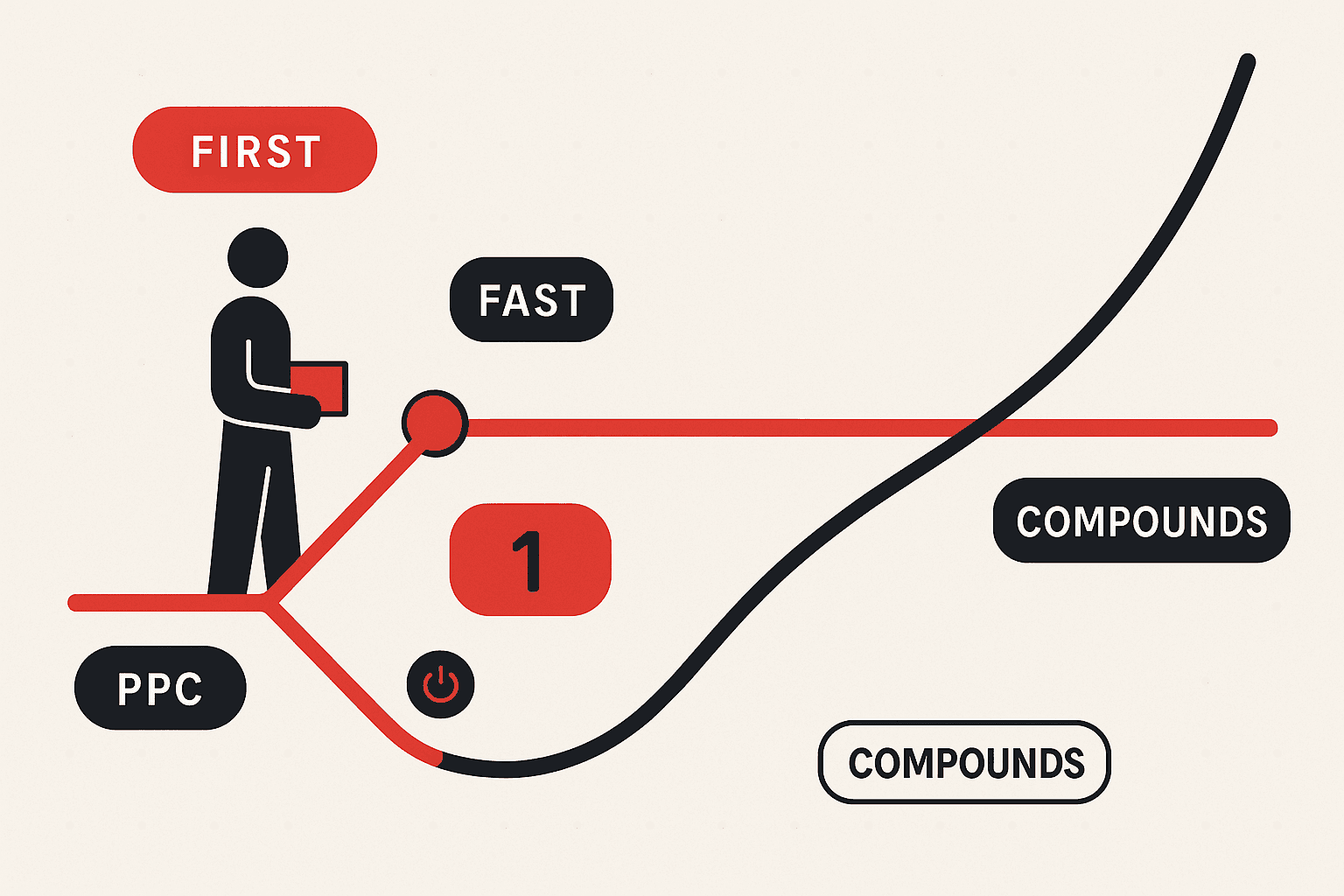
SEO and PPC are not rivals, they are different instruments for different jobs, so the useful decision is sequencing, not selection. PPC (pay-per-click) buys immediate, switch-on traffic at a roughly fixed cost per click - it is media you rent. SEO (search engine optimisation) earns organic traffic that takes three to six months to build but compounds and lowers your cost per lead over time - it is an asset you own.
The verdict: fund PPC first if you need revenue and demand proof inside 90 days and have the margin to absorb paid costs. Fund SEO first if you have a 6 to 12 month runway, thin margins that cannot sustain CPCs, and content that can compound. If you can afford both, run a lean PPC campaign to generate immediate cash and keyword data, then reinvest part of that revenue into SEO so the cheaper channel takes over within a year. The question was never "which one" - it is "which one first, and when does the second one join."
What Each One Actually Is
Before you can sequence them, you have to be precise about what you are buying with each.
PPC answers: "Can I get in front of buyers today, at a price I control?" You bid on keywords, your ad appears at the top of the results, and you pay each time someone clicks. Traffic starts within hours and stops within hours of pausing the campaign. You control targeting, budget, and messaging down to the keyword - and you pay for every single visit, forever.
SEO answers: "Can I become the answer buyers find without me paying per click?" You make your site the most crawlable, relevant, trustworthy answer to a query, and Google ranks it organically. There is no per-click charge, but there is real upfront and ongoing investment in content, technical health, and authority. Results take months to appear, and then they compound.
Here is how the two split in practice.
| Dimension | SEO | PPC |
|---|---|---|
| What you are buying | An owned asset that keeps working | Rented media that stops when you stop |
| Time to first results | 3 to 6 months | Hours to days |
| Cost model | Upfront and ongoing investment, free per click | Pay per click, roughly fixed per visit |
| Cost per lead over time | Falls as content compounds | Stays roughly flat |
| Control and speed | Slow to change, indirect | Instant on, off, and adjustable |
| Traffic when you stop | Declines slowly over months | Drops to near zero immediately |
| Best at | Long-term, lower-cost, trusted acquisition | Immediate demand capture and testing |
| Trust signal | Organic rank reads as earned credibility | Ads read as paid placement |
Notice that almost every row is a mirror image. That is the whole point: their strengths and weaknesses are inverted, which is exactly why they belong together over time rather than in opposition. PPC's biggest weakness (it never gets cheaper) is SEO's biggest strength (it gets cheaper every month). SEO's biggest weakness (it is slow) is PPC's biggest strength (it is instant). A business that understands this stops asking which is better and starts asking how to use each for what it is good at. Our SEO services and PPC services are run as one connected motion for precisely this reason.
The Real Question Is Sequencing, Not Selection
The reason "which is better" produces a useless answer is that it assumes a permanent choice. Real businesses do not make a permanent choice. They make a first choice under a budget constraint, then add the second channel as revenue and runway allow.
So reframe it. You are not picking a religion. You are deciding which channel to fund with the next available rupee or dollar, given where your business is right now. That decision turns on four variables, and once you know yours, the answer is usually obvious.
The four inputs are worth stating plainly, because most "SEO vs PPC" advice ignores them entirely:
- Cash runway. How many months can you fund marketing before it must pay for itself? A short runway pushes you toward PPC, because SEO will not have produced meaningful traffic before the money runs out.
- Profit margin. PPC only works if the margin on a sale comfortably exceeds the cost to acquire it. Thin-margin businesses often cannot make paid math work and are structurally better suited to organic.
- Sales cycle. A long, considered purchase (B2B software, high-ticket services) rewards SEO's trust and content depth. An impulse or urgent purchase (emergency plumber, last-minute gift) rewards PPC's ability to capture demand at the moment of need.
- Existing demand. If people already search for what you sell, both channels can capture it. If you are creating a new category, PPC has little to bid on and SEO content becomes the tool that generates the demand in the first place.
The Money Math: Why SEO Is Cheaper Eventually, Not Immediately
The single most misunderstood point in this debate is cost. "SEO is free" is wrong, and "SEO is cheaper" is only true if you specify when.
PPC has a near-zero lead time and a roughly flat cost per lead. You switch it on, leads arrive, and each one costs about the same next year as it does today - because you are always paying the auction price. It is predictable, controllable, and it never gets cheaper on its own.
SEO is the opposite shape. It has real upfront cost and a lead time of months before it produces much, so early on its cost per lead looks terrible - you have spent money and have little traffic to show. But every piece of content you publish and every ranking you earn keeps working without additional per-click cost, so as the base grows, your cost per lead falls month after month. Eventually the lines cross, and organic becomes the cheaper channel - then keeps getting cheaper.
This shape is why the sequencing logic works. PPC is how you survive the months before the crossover. SEO is what makes life after the crossover cheap. A business that only ever runs PPC is renting its entire pipeline in perpetuity at a cost that never improves. A business that only ever runs SEO gambles that it can survive the lead-time gap with no paid safety net. Most healthy companies want to live on the far right of that chart - where organic carries the bulk of demand cheaply - but they need PPC to get them there without starving in the meantime.
Two honest caveats. First, the crossover month is not fixed: in a low-competition niche with fast content velocity it can arrive by month 9, while in a brutally competitive space it may take 18 months or never fully cross if you stop investing. Second, SEO's cost per lead only keeps falling if you keep maintaining the content - abandon it and rankings decay. For a realistic picture of what organic actually costs and when it pays back, see our breakdowns of how long SEO takes and what SEO services cost in India, alongside real Google Ads CPC benchmarks on the paid side.
If you want this chart with actual rupees on the axes rather than an illustrative shape, we have modelled it out in full: PPC vs SEO cost, the real numbers for India prices both invoices line by line, converts CPC into cost per lead across eleven Indian industries, and runs a 24-month model that names both crossover months - the marginal one your agency probably quoted, and the blended one your CFO actually cares about.
Five Situations and the Verdict for Each
Frameworks are abstract until you map them to real businesses. Here are five common situations, each with the variables that decide it and a clear call.
1. A brand-new business that needs revenue this quarter
Short runway, demand exists, you need to prove the model works before the money runs out. Verdict: PPC first. You do not have the six months SEO needs, and you need conversion data now to know whether your offer even sells. Run a tight paid campaign on your highest-intent keywords, learn what converts, and only add SEO once you have revenue to reinvest. Starting with SEO here is a bet against the clock you will usually lose.
2. A thin-margin ecommerce store in a crowded category
Margins too thin to sustain the CPCs, high competition, but genuine long-tail search demand. Verdict: SEO first (with surgical PPC). If a paid click costs more than your product margin can bear, PPC as a primary channel is structurally unprofitable. Organic is your path to sustainable acquisition - product and category pages, buying guides, and comparison content that compounds. Reserve a small paid budget for your few highest-margin, highest-intent products only. Our ecommerce SEO work is built for exactly this margin problem.
3. A B2B SaaS company with a long sales cycle
Considered purchase, patient buyers, a market that needs educating. Verdict: SEO-led, PPC for capture. Long sales cycles reward the trust and depth that organic content builds - buyers research for weeks and you want to be present across that journey, not just at the click. Lead with SEO and content marketing, and use PPC narrowly to capture the small share of buyers who are ready to demo now. This is the classic case where content is the actual product of the funnel.
4. A local service business (plumber, dentist, law firm)
Urgent, high-intent, local demand where the buyer wants an answer now. Verdict: PPC first, local SEO close behind. When someone searches "emergency plumber near me", they click fast and buy fast - PPC and Google Ads put you at the top at the exact moment of need. But local SEO and a strong Google Business Profile are unusually cheap and durable for local firms, so build them in parallel. Local is one of the few cases where both channels pay back quickly.
5. An established business with steady cash flow and no organic presence
Healthy margins, runway, existing demand, but the site ranks for nothing. Verdict: run both, deliberately. This is the textbook "do both" case people invoke without earning it. Fund PPC to capture demand you are currently missing, and simultaneously invest in SEO to stop renting your entire pipeline. Use the paid keyword and conversion data to prioritise which organic pages to build first. Within a year, organic should be carrying a growing share of demand at a falling cost while paid holds the high-intent slots. If you are unsure where you sit, a structured SEO audit will tell you how much organic upside is actually on the table.
When PPC Wins First
Pulling the situations together, PPC should get the first rupee when:
- You need results now. Revenue this quarter, a product launch, a seasonal window, or an investor milestone that will not wait six months.
- You are testing. New offer, new market, new landing page - paid buys you statistically useful conversion data in weeks that SEO would take months to reveal. This alone justifies PPC even for SEO-led businesses.
- The margin supports it. Your profit per sale comfortably exceeds your cost to acquire one, so every paid lead is accretive.
- You want to own a specific moment. A competitor conquesting campaign, a high-intent bottom-of-funnel term, or a promotion where timing is everything.
- Organic is genuinely hard. In some SERPs the top spots are locked up by entrenched authorities and realistic organic wins are 18 months out - paid is how you compete in the meantime.
The discipline that separates profitable PPC from expensive PPC is relentless waste control. Most accounts we inherit are burning a meaningful share of spend on the wrong queries, weak match types, and untracked conversions. Before scaling any paid budget, run a proper Google Ads audit to cut wasted spend and get first-party conversion tracking right, or you will scale a leak.
When SEO Wins First
SEO should get the first rupee when:
- You have runway. Six to twelve months where marketing does not have to fully pay for itself yet - that patience is the entry ticket to compounding.
- Margins are thin. If paid CPCs would eat your profit, organic is not a preference, it is the only structurally sound path to affordable acquisition.
- You are building a category or brand. Content that educates a market creates demand PPC has nothing to bid on yet, and positions you as the authority when that demand matures.
- Your buyers research. Long, considered purchases reward depth, trust, and being present across a multi-week journey - all organic strengths.
- You want an asset, not a bill. SEO builds equity you own; every month of PPC is a bill you rent. Businesses thinking in years, not quarters, weight toward the asset.
The catch is that SEO only compounds if it is built on solid ground. Content on a site Google cannot crawl, render, or trust will not rank no matter how good it is. That is why serious SEO starts with technical fundamentals and honest keyword-to-intent mapping - and why a business with no organic presence should not simply "start blogging" but should follow a real strategy. The upside, when it works, is the ability to beat competitors with far deeper pockets precisely because you are not paying per click.
How AI Search Changes the Calculation in 2026
Here is the part almost no "SEO vs PPC" article has caught up to. The rise of AI Overviews and answer engines like ChatGPT, Perplexity, and Gemini is quietly rewriting both sides of this decision, and pretending otherwise is malpractice in 2026.
On the SEO side, the goal is shifting from ranking to being cited. When a Google AI Overview or an AI assistant answers a query directly, the classic blue link matters less than whether your page is the source the answer pulls from. This does not make SEO less valuable - it makes it different. The discipline tilts toward extractable, evidence-backed content, clear answers stated up front, strong entity coverage, and structured data, which is the domain of answer engine optimisation and AI SEO. Ranking number one for an informational term you get no click from is a hollow win; being the cited source across Google, ChatGPT, and Perplexity is the new prize. And no, SEO is not dead in 2026 - it is consolidating around trust and citation.
On the PPC side, zero-click AI answers are absorbing top-of-funnel informational queries, which concentrates paid value at the bottom of the funnel. As AI handles "what is" and "how to" searches without a click, the queries where people still click and buy are the high-intent, transactional ones - "buy", "near me", "pricing", "book a demo". Paid budget rationally migrates toward those. The upside is that PPC on genuine buying-intent terms is often more efficient in an AI-search world, because you are no longer paying for informational tyre-kickers who now get their answer from an overview.
The net effect on sequencing: SEO investment increasingly means investing to be cited by AI, and PPC investment increasingly means owning the transactional queries AI has not swallowed. The channels are diverging in role even as the underlying "own the answer, capture the intent" logic stays the same.
Common Mistakes Teams Make
- Treating it as a permanent either/or. It is a sequencing decision under a budget constraint, not an identity. The right answer changes as your business grows.
- Expecting SEO to perform on a PPC timeline. Judging a five-month-old SEO programme by whether it beats last week's paid campaign guarantees you kill the asset right before it compounds.
- Running PPC with no waste control. Unmanaged paid accounts leak spend on the wrong queries and broken tracking. Scaling that is scaling a loss.
- "Just start blogging" as an SEO strategy. Content with no keyword-to-intent mapping, no technical foundation, and no internal linking is not SEO - it is journaling. Depth and architecture are what compound.
- Ignoring that the two feed each other. Not using PPC conversion data to prioritise SEO, or not defending organically won terms with paid, leaves the biggest efficiency of running both on the table.
- Optimising only for Google's blue links while AI eats the clicks. In 2026, an SEO plan that does not account for AI citation and a PPC plan that does not account for zero-click compression are both fighting the last war.
How to Sequence the Work
Putting it together, here is the order of operations that consistently produces the best return:
- Diagnose your four variables honestly - runway, margin, sales cycle, and existing demand. They, not your preference, decide the first move.
- If you need cash or proof now, start with a lean, tightly managed PPC campaign on your highest-intent keywords. Get tracking right first, then let it generate revenue and, just as importantly, conversion data.
- Feed the paid data into an SEO roadmap. The keywords and angles that convert in PPC are exactly the ones worth building organic authority around. This is the single highest-leverage handoff between the channels.
- Build SEO on a sound technical and content foundation so it can actually compound - not scattered blog posts, but a real cluster architecture that earns rankings and AI citations.
- As organic ramps, rebalance. Let the cheaper channel take a growing share of demand while PPC concentrates on the high-intent, bottom-of-funnel and transactional queries where it stays efficient - increasingly the queries AI has not absorbed.
The businesses that win at search are not the ones who picked the "right" side of an imaginary war. They are the ones who understood that PPC funds the present and SEO builds the future, and sequenced the two so that the expensive channel buys them the time to build the cheap one.
If you are not sure which move is right for where your business is today, that is exactly the question a real strategy conversation answers. We are happy to look at your numbers - a conversation with our team will tell you which channel your next rupee should fund, and when the second one should join, instead of leaving you with another "it depends."

Aditya Kathotia
Founder & CEO
CEO of Nico Digital and founder of Digital Polo, Aditya Kathotia is a trailblazer in digital marketing. He's powered 500+ brands through transformative strategies, enabling clients worldwide to grow revenue exponentially. Aditya's work has been featured on Entrepreneur, Economic Times, Hubspot, Business.com, Clutch, and more. Join Aditya Kathotia's orbit on LinkedIn to gain exclusive access to his treasure trove of niche-specific marketing secrets and insights.