

Verdict: No. SEO is not dead in 2026. What is dead is the 2018-style version of it that relied on keyword volume, exact-match anchors, and ranking single URLs for single queries. The discipline now spans AI search citations, AEO, AI Overview defence, topical authority, and entity signals - and the brands compounding traffic in 2026 are the ones who treat all of it as one program.
Every year, a wave of hot takes announces that SEO is over. In 2026, with Google's AI Overviews dominating SERPs and ChatGPT handling millions of queries that would have gone to Google a year ago, the case sounds more credible than ever. Here is what is actually happening.
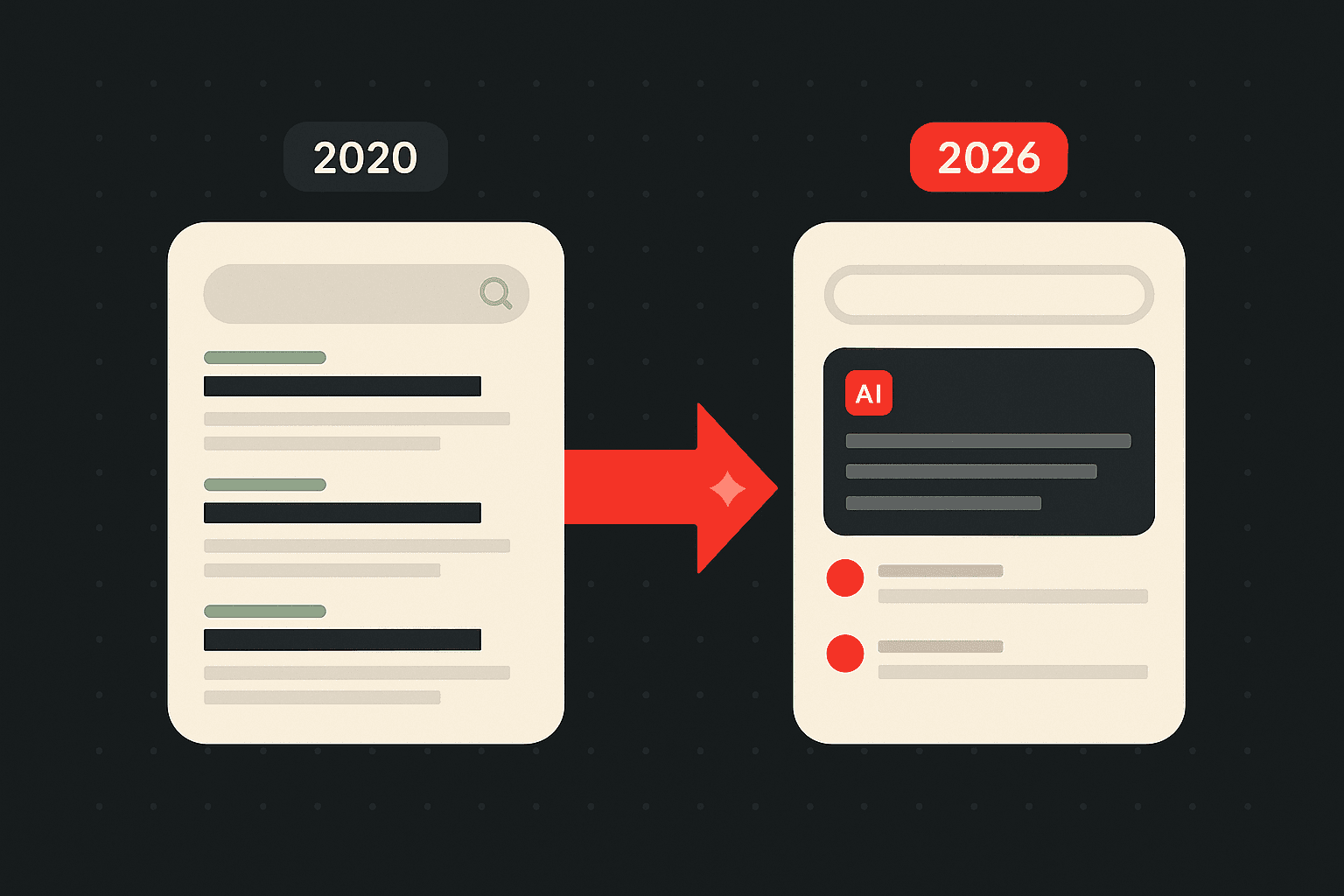
The "SEO is dead" narrative has been running for at least a decade. It peaked when Google launched Panda in 2011, again when Knowledge Graph launched in 2012, again with the rise of featured snippets, and again with voice search. Each time, the people declaring death were wrong - but they were pointing at something real: SEO was changing, and the strategies of the previous cycle were losing value.
2026 is another version of that same moment. The change this time is bigger and faster than before. But the conclusion is still wrong.
The Short Answer: No. But SEO Has Fundamentally Changed
Search is not dying. Discovery intent - people wanting to find information, products, services, and answers - has not disappeared. What has changed is the surface where that discovery happens and the form of the answer they receive.
If your current SEO strategy is optimising for what worked in 2022, it is in serious trouble. If you are adapting to how search actually works in 2026, you are playing a larger and more interesting game than before.
What AI Has Actually Changed About Search
AI Overviews Summarise Before You Click
Google's AI Overviews (formerly Search Generative Experience) now appear on a significant percentage of informational queries. Instead of a list of ten blue links, the user sees a synthesised paragraph - and then the links below it.
The practical effect: click-through rates on position-one organic results for informational queries have declined. Users who only wanted a quick factual answer may never scroll to the links. Traffic to content that existed solely to answer basic questions has dropped materially.
ChatGPT, Perplexity, and Gemini Are New Discovery Surfaces
A growing share of queries that used to go to Google now go to conversational AI tools. This is real and measurable. Research tasks, product comparisons, and recommendation searches are particularly likely to move to these surfaces.
The implication is that "ranking on Google" is no longer the only way to be discovered, and possibly not always the highest-priority one for certain audiences.
Zero-Click Searches Have Increased
Between AI Overviews, featured snippets, Knowledge Panels, and local packs, Google increasingly answers the query without requiring the user to click through. Total zero-click searches have grown year over year. This is not new - it began with featured snippets - but AI has accelerated it significantly.
What Has Not Changed
People Still Click Organic Results
Zero-click is growing, but it is not universal and it is not total. Commercial intent searches - the ones with actual revenue attached - still produce high click-through rates because users want to evaluate options, not just receive a summary. The queries that drive business still send traffic.
AI Answers Cite Sources - Being Cited Matters More Now
Google's AI Overviews cite the pages they draw from. Perplexity explicitly links its sources. When an AI tool recommends a product, service, or agency, it is pulling from indexed web content that it considers authoritative.
This means the race is no longer just to rank number one - it is to be the source that AI systems cite. And the criteria for being cited are almost identical to the criteria for ranking well: depth, accuracy, authority, trust signals. The game has a new output, but the inputs are the same.
E-E-A-T Signals Are More Important, Not Less
Google's E-E-A-T framework - Experience, Expertise, Authoritativeness, and Trustworthiness - has become more central, not less, as AI-generated content floods the web. Demonstrating genuine human expertise, first-person experience, and institutional credibility is what differentiates content that AI systems trust and surfaces from content they ignore.
The brands that invested in real authority are doing well. The brands that chased volume with thin, templated content are in trouble.
The New SEO Playbook for 2026
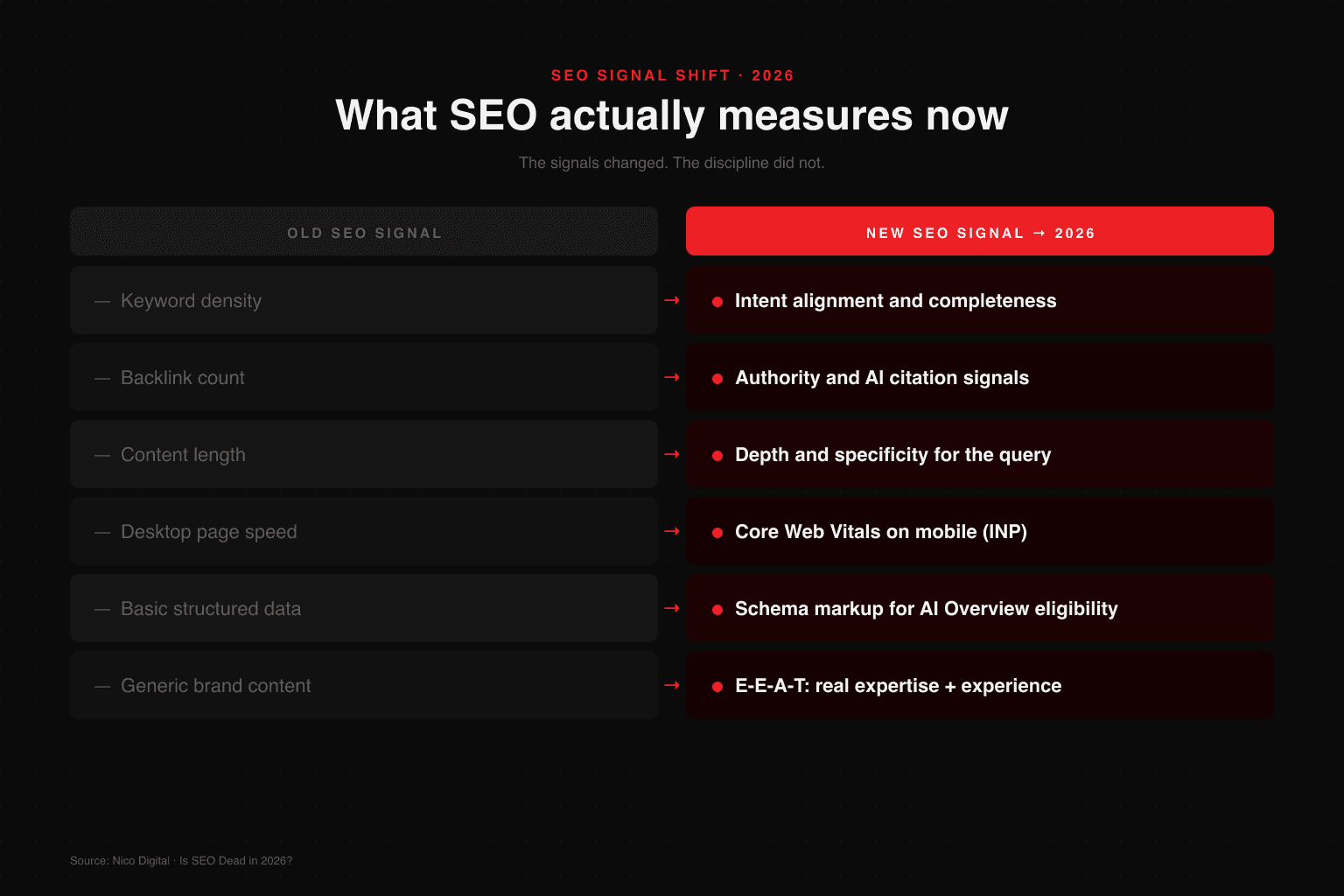
| Old SEO Signal | New SEO Signal |
|---|---|
| Keyword density | Intent alignment and completeness |
| Backlink count | Authority and citation by trusted sources |
| Content length | Depth and specificity relevant to the query |
| Desktop page speed | Core Web Vitals on mobile, INP performance |
| Basic structured data | Schema markup for AI Overview eligibility |
| Generic brand content | E-E-A-T: demonstrable expertise and real experience |
AEO Alongside Traditional SEO
Answer Engine Optimisation is the practice of structuring content to be cited and surfaced by AI tools, not just ranked on traditional SERPs. This means writing clear, definitive answers to specific questions, using structured data, and building content that demonstrates genuine expertise rather than just topical breadth.
Traditional SEO and AEO are not competing strategies. They are complementary - the signals that earn AI citations largely overlap with the signals that earn strong organic rankings. A practical way to build both simultaneously is the intent-first SEO approach, which structures content around what searchers are actually trying to accomplish rather than the keywords they typed.
FAQ Schema and Structured Data
Structured data has always helped with rich results. In 2026, it also helps AI systems parse and attribute your content accurately. FAQ schema, HowTo schema, and proper article markup are not optional extras - they are infrastructure. For a complete guide to implementation, see our schema markup guide.
Building Genuine Authority, Not Gaming Algorithms
The brands succeeding in 2026 SEO are the ones that were building real expertise, earning real links, and producing genuinely useful content before AI changed the landscape. The algorithmic shortcuts - link schemes, thin content at scale, exact-match keyword stuffing - are not just ineffective now. They are actively penalised.
Authority built slowly through real expertise and genuine helpfulness is more durable than it has ever been, because it is harder for AI-generated content to replicate.
What "SEO Dying" Actually Means
When people say SEO is dying, they are usually right about one thing: a specific version of SEO is losing value. But that specific version was already bad practice.
Generic, thin content is dying. The blog post that existed to rank for a keyword without genuinely helping anyone was always a liability. Google has been trying to kill it for fifteen years. AI completion tools have flooded the web with more of it, which makes genuinely differentiated content even more valuable by comparison.
Keyword stuffing is dead. This one has been dead for years. If you are still doing it, your traffic problems predate AI Overviews.
Expertise-based content is thriving. Original research, specific case studies, content that demonstrates genuine experience, first-person insights, and genuine opinions - all of this is performing better than it was three years ago, because it is scarce and hard to fake.
The brands winning organic search in 2026 are not the ones who found a workaround. They are the ones who took the long view seriously.
Frequently Asked Questions
What is Answer Engine Optimization and how is it different from SEO?
Answer Engine Optimization (AEO) is the practice of structuring content to be cited and surfaced by AI tools - ChatGPT, Perplexity, Google AI Overviews - not just ranked in traditional blue-link results. Where SEO focuses on ranking position, AEO focuses on being the source that AI answers draw from. The signals that earn AI citations largely overlap with strong organic ranking signals, so the two approaches reinforce each other.
How do I make my content appear in Google AI Overviews?
Structured data (FAQ schema, HowTo schema, Article schema) significantly improves AI Overview eligibility. Beyond markup, AI Overviews strongly favor content that provides clear, direct answers to specific questions, demonstrates genuine expertise, and comes from domains with strong E-E-A-T signals. Short, direct answers embedded in well-structured content are disproportionately represented in AI Overview citations.
Are Google rankings still important in 2026?
Yes, particularly for commercial-intent queries. Zero-click is growing on informational searches, but queries with purchase intent still generate high click-through rates because users want to evaluate options rather than receive a single summarized answer. Rankings for commercial and transactional queries remain one of the highest-return SEO investments.
What does E-E-A-T mean and how do I demonstrate it?
E-E-A-T stands for Experience, Expertise, Authoritativeness, and Trustworthiness. The most practical way to demonstrate it: publish content only genuine practitioners would produce, include real case data and first-person observations, earn citations from credible third parties, and maintain technical trust signals (HTTPS, clear policies, accurate information). AI systems use these signals to determine which sources to recommend.
Will SEO exist in 5 years?
The discipline will exist, but the job description will evolve. SEOs who understand entity authority, structured data, AI Overview optimization, and how to connect organic performance to revenue will be more valuable. Those who only track blue-link rankings and write keyword-targeted blog posts will face pressure. The underlying human need - to find reliable, relevant information - will not disappear. The mechanisms for satisfying it will continue to change.
Conclusion
SEO in 2026 is harder to game and more rewarding to do right. The programs succeeding now are the ones that invested in genuine authority before AI changed what authority means. The gap between building real expertise and manufacturing the appearance of it has never been more commercially consequential.
For brands navigating this shift, the relevant question is not "is SEO dead?" It is "are we doing the version of SEO that AI systems trust, or the version they ignore?"
Adapting your SEO strategy to the current environment takes more than updating keywords - it requires rethinking how you demonstrate authority across traditional and AI search surfaces. If you are looking for an SEO agency in India that works across both traditional rankings and AI search surfaces, our services are built for exactly this landscape.
If you want the deeper layer underneath this argument, three companion guides go further: SEO vs AEO vs GEO is the definitional pillar that separates the three disciplines, how to rank on ChatGPT is the tactical playbook for citations inside OpenAI's surfaces, and how to rank on Perplexity covers the recency- and Reddit-weighted retrieval engine. For a buyer's-side view of how to choose an agency to run all three, see our best SEO agency in India guide.
Still ranking on Google but missing from ChatGPT and AI Overviews? We audit your content for AI visibility gaps and fix the signals that AI search systems use to decide who to recommend. Book an SEO Strategy Call →

Aditya Kathotia
Founder & CEO
CEO of Nico Digital and founder of Digital Polo, Aditya Kathotia is a trailblazer in digital marketing. He's powered 500+ brands through transformative strategies, enabling clients worldwide to grow revenue exponentially. Aditya's work has been featured on Entrepreneur, Economic Times, Hubspot, Business.com, Clutch, and more. Join Aditya Kathotia's orbit on LinkedIn to gain exclusive access to his treasure trove of niche-specific marketing secrets and insights.