


Two pages can rank in adjacent positions for the same query and generate vastly different click-through rates. The content quality might be comparable. The authority gap might be minimal.
The difference is often structural: one result is visually differentiated by review stars, FAQ dropdowns, or product pricing, and the other is a standard blue link competing on the same plain-text playing field as every other listing on the page.
Schema markup is the implementation that drives that difference. It is a standardized vocabulary of code, maintained at Schema.org and supported by all major search engines, that communicates the meaning and structure of your content to search engine systems rather than leaving them to infer it. When implemented correctly, it unlocks the rich snippet formats that make certain listings visually and informationally dominant in search results.
The commercial case is straightforward.
Click-through rate directly affects organic traffic without requiring any change in ranking position. A page that moves from a 2.4 percent CTR to a 6 percent CTR from the same impression volume generates 2.5 times the traffic from the same keyword investment.
That is the return profile that makes schema markup a priority item rather than a nice-to-have.
This piece explains how schema markup works, which types have the highest practical return, how to implement them without a full development cycle, and where teams most commonly waste the effort.
What Schema Markup Does and What Makes It Important
Schema markup is JSON-LD code added to a page that tells search engines, in precise, machine-readable language, what the content represents. Without it, Google must infer the meaning and structure of your content from natural language processing alone.
With it, you are explicitly stating: this is a product, here is its price, here is its aggregate rating, here is who manufactured it.
The visible benefit is rich snippets: the visual enhancements that appear in search results when Google decides to display structured data alongside your listing. But the less-discussed benefit is entity recognition. Schema markup helps Google understand your brand, your content, and your offerings as distinct entities in its Knowledge Graph, which feeds into how your site is evaluated for AI Overview eligibility and how accurately your brand appears in knowledge panels and voice search results.
A site that consistently implements an accurate, complete schema across its key page types is giving Google explicit confirmation of what it would otherwise spend computational resources inferring. That clarity correlates with more consistent indexing, better rich result eligibility, and stronger entity-level signals. Schema is not just a CTR play. It is a foundational trust signal.
The mechanism behind the CTR impact is psychological and practical.
Rich results take up more vertical space in SERPs, which increases the visual footprint of a listing. They include additional information, review scores, FAQ previews, and product pricing that answer pre-click questions and reduce uncertainty.
Plus, they break the visual monotony of a page full of identical text links, which draws the eye disproportionately even from higher-ranked results.
Research consistently shows that review stars alone can lift CTR by 30 percent or more.
The FAQ schema can nearly double the click surface area of a listing.
For e-commerce product pages with accurate pricing and availability markup, the rich result often pre-qualifies the visitor before they click, which tends to reduce bounce rate alongside increasing traffic volume.
The Schema Types with the Highest Practical Return
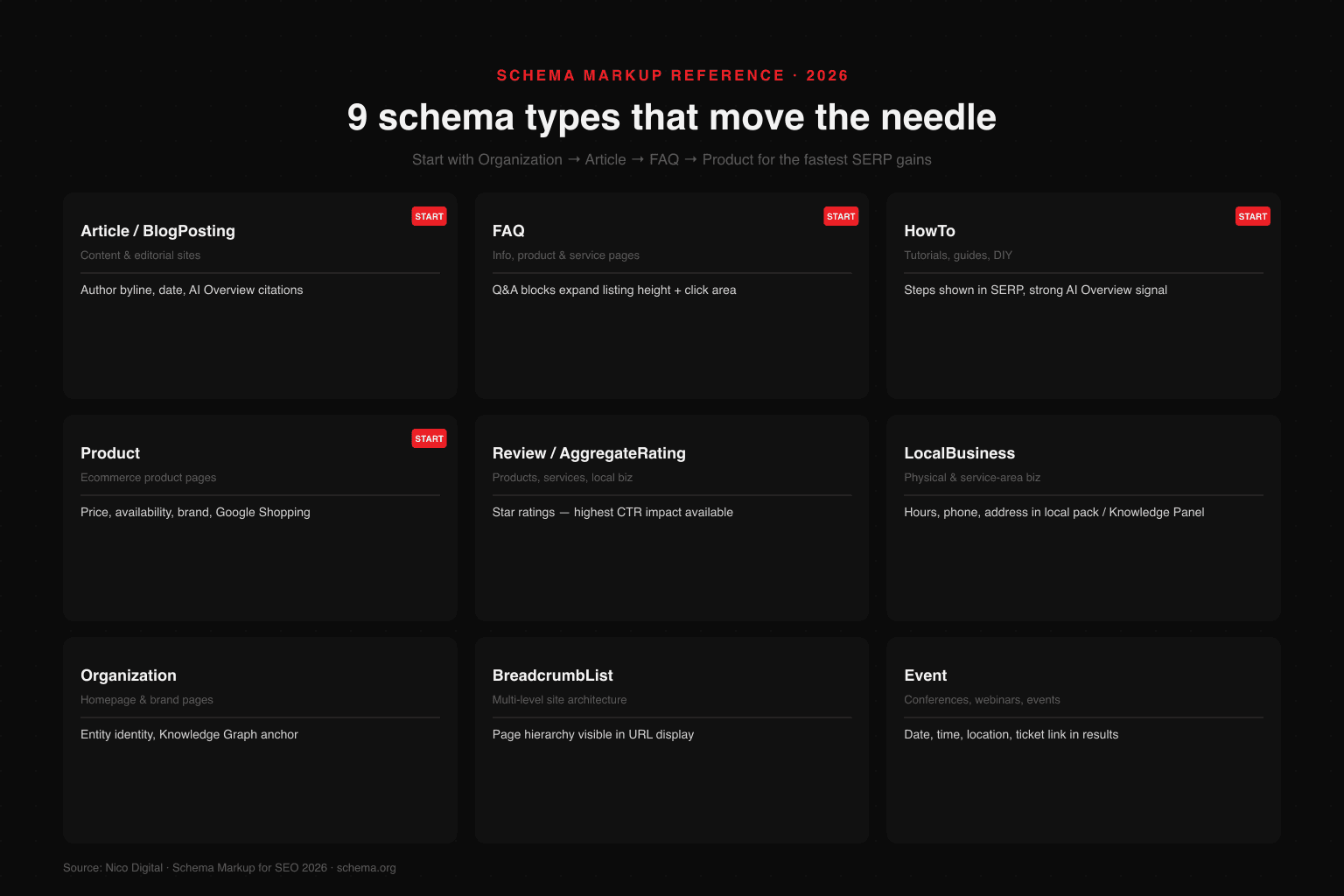
Schema.org documents hundreds of schema types. Most of them have minimal impact on search visibility.
The types that consistently produce measurable CTR and visibility gains are a much smaller set, and the right starting point depends on your site type and content mix.
| Schema Type | Best For | What It Unlocks in SERPs |
|---|---|---|
| Article / BlogPosting | Content-publishing sites | Author byline, publish date, headline; eligibility for Google News rich results and AI Overview citations |
| FAQ | Informational, product, and service pages | Question-and-answer blocks displayed directly under your listing; increases result height and click surface area |
| HowTo | Tutorials, guides, DIY, recipes | Step-by-step instructions, time required, and materials shown in SERP without a click; strong AI Overview signal |
| Product | E-commerce product pages | Price, availability, brand, and aggregate rating displayed as a rich result; required for Google Shopping integration |
| Review / AggregateRating | Products, services, local businesses | Star rating display is one of the highest-impact CTR signals available through structured data |
| LocalBusiness | Physical locations, service-area businesses | Strengthens Knowledge Panel; surfaces hours, phone, address, and directions directly in local results |
| Organization | Homepage and brand-level pages | Establishes official brand identity for Google; anchors entity recognition and improves Knowledge Graph accuracy |
| BreadcrumbList | Multi-level site architectures | Displays page hierarchy in the URL section of the listing; improves scannability and category clarity |
| Event | Conferences, webinars, live events | Date, time, location, and ticket link shown directly in results; captures intent at the research stage |
For most sites, the sequencing that produces results fastest is:
- Organization schema on the homepage (establishes entity identity),
- Article or BlogPosting schema across the content library (improves indexing clarity and AI Overview eligibility),
- FAQ schema on the pages most likely to appear for informational queries (directly increases listing size and click surface), and
- Product or AggregateRating schema on commercial pages (the highest-impact CTR driver for e-commerce and review-heavy sites).
LocalBusiness schema deserves particular attention for any brand with a physical presence or a defined service area. It is the infrastructure that powers Knowledge Panel accuracy and local pack visibility.
Incomplete or inaccurate LocalBusiness markup is one of the most common causes of local search underperformance, and it is almost always correctable without significant development effort.
How Schema Markup Influences AI Overview Eligibility
The connection between schema markup and AI Overview selection is less direct than the connection to rich snippets, but it is functionally significant. Google's AI systems extract information for Overview summaries from pages that are clearly structured, factually reliable, and easy for automated systems to parse. Schema markup contributes to all three of those criteria.
FAQ schema is the most direct connection. When FAQ content is marked up with Question and Answer entity types, the AI system can extract discrete question-answer pairs with high confidence about what the question is and what the answer is. Pages with FAQ schema that answer queries matching user intent are consistently over-represented in AI Overview citations relative to their ranking position.
Article schema with accurate datePublished and dateModified attributes signals content freshness, which matters for AI Overviews on topics where recency is a quality signal.
HowTo schema makes step-by-step content extractable in a format an AI system can summarize cleanly.
Organization schema anchors entity recognition that feeds into how Google evaluates whether your brand is a trusted source for a given topic.
The practical implication is that schema markup is no longer just a SERP aesthetics investment.
It is part of the infrastructure that determines whether your content is accessible to AI-mediated search surfaces, including AI Overviews, voice search, and AI assistant responses that pull from web sources.
Implementation: The Three Routes and When to Use Each
Schema implementation has a reputation for being technically demanding, which is not entirely warranted. The method that makes sense depends on your CMS, your development resources, and the precision you need.
Plugin-Based Implementation (WordPress and Similar CMS Environments)
For sites running on WordPress, plugins like Rank Math and Yoast SEO include built-in schema generation for the most common types: Article, FAQ, HowTo, and Organization. They handle the JSON-LD formatting automatically and reduce the risk of syntax errors. For straightforward use cases, this is a reasonable starting point that does not require developer involvement.
The limitation is precision.
Plugin-generated schema covers the standard fields but often misses custom attributes that improve rich result eligibility:
- specific product identifiers,
- multiple FAQ sections on a single page,
- service-specific schema with areaServed attributes, or
- custom author schema with credential information.
If your site is competitive and you need the full benefit of structured data, plugin implementations often need supplementation with manually written JSON-LD for the pages that matter most.
Manual JSON-LD (The Method That Gives Full Control)
JSON-LD, which stands for JavaScript Object Notation for Linked Data, is Google's recommended implementation format for schema. It lives in a script tag in the document head and does not require any modification to the visible HTML of the page. This makes it the cleanest implementation method and the most flexible.
Google's Structured Data Markup Helper is a visual tool that allows you to tag page elements and generate the JSON-LD code from that tagging. It is a reasonable starting point for teams new to manual implementation.
For more complex schemas, Schema.org's documentation is comprehensive, and Google's developer documentation specifies which properties are required versus recommended for rich result eligibility.
Manual JSON-LD is the right method for high-value pages where precision matters, and it is the standard approach in enterprise SEO programs where schema errors at scale have outsized consequences. This includes:
- product pages that need complete Offer and AggregateRating markup,
- service pages with specific areaServed and serviceType attributes, and
- any page where you want complete control over what is communicated to search engines.
Google Tag Manager (Useful for Non-CMS Environments)
GTM can inject JSON-LD schema into pages without touching the codebase directly.
This is particularly useful for sites where development cycles are slow or where schema needs to be applied to pages managed by a CMS that does not support custom code injection.
The risk is that the GTM-injected schema is rendered via JavaScript, which introduces a dependency on crawler JavaScript execution.
Verify that Google Search Console confirms the schema is being recognized before relying on this method at scale.
Validation Is Not Optional
Regardless of implementation method, every schema deployment should be validated using Google's Rich Results Test before going live and reviewed in Search Console's Enhancements report after indexing. An unvalidated schema can contain syntax errors that prevent rich result eligibility entirely, or semantic errors that result in a Search Console warning rather than a rich result.
Search Console's Enhancements section shows which:
- schema types have been detected across your site,
- pages are eligible for rich results, and
- have errors or warnings requiring attention.
Checking this monthly is the minimum viable monitoring process for a site with active schema markup.
The CTR Impact in Practice
A mid-sized e-commerce brand selling home products held consistent rankings for its target keywords but was consistently losing clicks to a competitor in an adjacent position. The competitor's listings displayed review stars, FAQ dropdowns, and product pricing. The brand's listings were standard text results.
The implementation covered four schema types across the site:
- Product and AggregateRating on product pages,
- FAQ on informational and product support pages,
- Article on the blog, and
- Organization on the homepage.
No content was rewritten. No ranking changes were made. The work was entirely structural data.
Within 21 days, the brand's CTR moved from 2.4 percent to 6.1 percent on the product pages where schema was implemented. Impressions increased 19 percent, partly attributable to improved AI Overview eligibility for FAQ-enriched pages. Organic traffic to those pages grew 41 percent.
The bounce rate on product pages also declined, because visitors who clicked through after seeing price and availability in the rich result arrived with more accurate expectations.
Pre-qualification at the SERP level improved the quality of the traffic, not just the volume.
The Mistakes That Neutralize Schema Investment
Schema implementation errors are common and often silent: they do not generate obvious errors; they simply prevent the rich result from appearing. Understanding the failure modes helps avoid wasted effort.
Markup That Does Not Match Page Content
This is Google's most frequently cited schema violation. If a page has FAQ schema markup but no actual FAQ content visible to users, or Review schema with a rating but no actual reviews on the page, Google will either ignore the markup or issue a manual action for misleading structured data. The schema must describe what is actually on the page, visible to users, not what you wish were there.
This rule has an important practical implication for review markup: you can only use the AggregateRating schema on a page that displays the underlying reviews.
You cannot apply it to a homepage that simply asserts a star rating without the supporting review content. Getting this wrong is a quality guideline violation, not just a missed opportunity.
Applying Too Many Schema Types to a Single Page
There is a category of over-implementation that creates confusion rather than clarity.
A single product page should have a Product schema. It should not also have Article schema, HowTo schema, and Organization schema all competing for the primary schema type.
Google's guidance is that each page should communicate a primary entity type.
Secondary schema, like BreadcrumbList, is fine alongside the primary, but stacking multiple primary types creates ambiguity about what the page actually is.
Ignoring Schema After Initial Implementation
Schema markup breaks over time.
Template updates alter the HTML structure that the schema references. Content changes make previously accurate markup inaccurate. New page types are added without schema consideration.
A schema implementation that is not actively monitored through Search Console will gradually accumulate errors and warnings that degrade rich result eligibility.
Building a schema maintenance step into your quarterly SEO review process takes minimal time and prevents the silent degradation that affects most sites six to twelve months after initial implementation.
2026 Schema Implementation Checklist
The checklist below covers the schema types and validation steps relevant to most site types. Use it as an audit tool against your current implementation and as a deployment checklist for new schema work.
Site-Wide (Homepage)
- Organization schema with name, URL, logo, and sameAs links to official social profiles
- Structured data is reviewed after any significant CMS or template update
- LocalBusiness schema if the physical or service-area location applies
- BreadcrumbList schema on all interior pages
Blog and Article Pages
- Article or BlogPosting schema with datePublished, dateModified, author, and headline
- FAQ schema on pages with question-and-answer sections
- BreadcrumbList schema reflecting category hierarchy
Product Pages
- Product schema with name, description, brand, SKU, and image
- AggregateRating schema with reviewCount and ratingValue
- Offer schema with price, priceCurrency, and availability
- No markup for products that are out of stock or discontinued
Service Pages
- Service schema with serviceType, provider, and areaServed
- FAQ schema for common service questions
- Review or AggregateRating schema where applicable
Specialized Pages
- HowTo schema on step-by-step guides and tutorials
- Event schema on event listing pages with accurate dates and location
- Recipe schema for food or nutrition content
Validation and Monitoring
- All schema tested in Google Rich Results Test before deployment
- Search Console Enhancements report monitored monthly
- No schema types applied to pages where that content does not actually exist
- Structured data reviewed after any significant CMS or template update
Want to know specifically which schema types your highest-value pages are missing? A structured data audit identifies missing markup, validation errors, and the realistic CTR improvement for your specific keyword set. Request a Schema Markup Audit →
Frequently Asked Questions
What is the fastest schema markup to implement for immediate CTR gains?
FAQ schema delivers the most immediate and visually impactful CTR improvement for most site types. It requires adding a FAQ section to existing pages (if not already present), marking it up with Question and Answer entity types, and validating with Google's Rich Results Test. The expanded listing footprint from FAQ dropdowns is often visible in search results within a few weeks of implementation and indexing.
Does schema markup directly improve rankings?
Schema markup does not directly improve ranking position in the way that backlinks or content quality do. Its primary value is CTR improvement from the same ranking position - more clicks without requiring a ranking change. The indirect ranking benefit comes through improved behavioral signals (lower bounce rate, higher time-on-page from better-qualified traffic) and stronger AI Overview eligibility, which can generate additional branded search volume.
Can I implement schema without a developer?
Yes, for most common schema types. WordPress users can implement FAQ, Article, and Organization schema through Rank Math or Yoast SEO without touching code. Google's Structured Data Markup Helper generates JSON-LD from a visual tagging interface for any page type. Google Tag Manager can inject schema without CMS access for sites without plugin support. Developer involvement becomes necessary for complex Product schema with variant pricing, or custom schema types not supported by standard plugins.
How often should I audit my schema markup?
Quarterly at minimum. More frequently if your site template or CMS is regularly updated, since template changes frequently break schema references. Add schema validation to your monthly Search Console review by checking the Enhancements report for new errors or warnings. A schema implementation that was working in January may have broken by March if a plugin update changed how FAQ sections render.
What is the difference between schema markup and Open Graph tags?
Schema markup (JSON-LD) is structured data that search engines read to understand and enhance your search results. Open Graph tags are meta tags that social platforms (Facebook, LinkedIn, X) read to control how your content appears when shared on those platforms. They serve different purposes and both should be implemented - schema for search visibility and rich snippets, Open Graph for social sharing appearance. They do not overlap or conflict with each other.
Conclusion
Schema markup is not a new concept, but its strategic importance has increased substantially as AI-mediated search surfaces have expanded.
The sites that implement structured data thoroughly are building infrastructure that serves them across multiple channels simultaneously: traditional organic rich results, AI Overviews, voice search, Google Shopping, and Knowledge Graph entity representation.
The investment is lower than most teams expect. A focused schema audit, prioritized implementation across key page types, and a monitoring process built into an existing SEO workflow are achievable without significant development cycles - or handled end-to-end through technical SEO services if in-house bandwidth is limited. The return, measured in CTR improvement from existing impressions, is one of the most predictable and fastest-acting outcomes available in an SEO program.
Most sites with consistent organic rankings are generating fewer clicks than their impression volume warrants. A schema audit identifies which page types are missing eligible markup, which implementations have validation errors, and what the realistic CTR improvement looks like for your specific keyword set. Request a Structured Data Audit →

Aditya Kathotia
Founder & CEO
CEO of Nico Digital and founder of Digital Polo, Aditya Kathotia is a trailblazer in digital marketing. He's powered 500+ brands through transformative strategies, enabling clients worldwide to grow revenue exponentially. Aditya's work has been featured on Entrepreneur, Economic Times, Hubspot, Business.com, Clutch, and more. Join Aditya Kathotia's orbit on LinkedIn to gain exclusive access to his treasure trove of niche-specific marketing secrets and insights.