

"How long does SEO take?" is the first question almost every business owner asks, and it is usually answered with the least useful phrase in marketing: "it depends."
It does depend. But "it depends" is a cop-out unless someone tells you what it depends on, what a realistic timeline actually looks like, and how to know your investment is working long before the rankings you care about finally move. That is what this guide does.
Here is the honest, experience-based answer up front, before any caveats: for most businesses, SEO shows early movement in three to six months and produces meaningful organic traffic and leads in six to twelve months. Established sites with existing authority can see results faster, in two to four months. Brand-new domains in competitive niches often take twelve months or more before SEO becomes a dependable channel.
If you only read one paragraph, read that one. The rest of this article explains why those numbers are what they are, the five variables that decide where you land inside that range, the leading indicators that prove SEO is working before money keywords move, and how the timeline differs for local, ecommerce, and national businesses in India. The cost of getting this wrong is real: most companies that quit SEO do so at month four or five - right before the curve they paid to build finally starts to pay them back.
The Honest Short Answer
If a business asks me for a single timeline, this is the one I give:
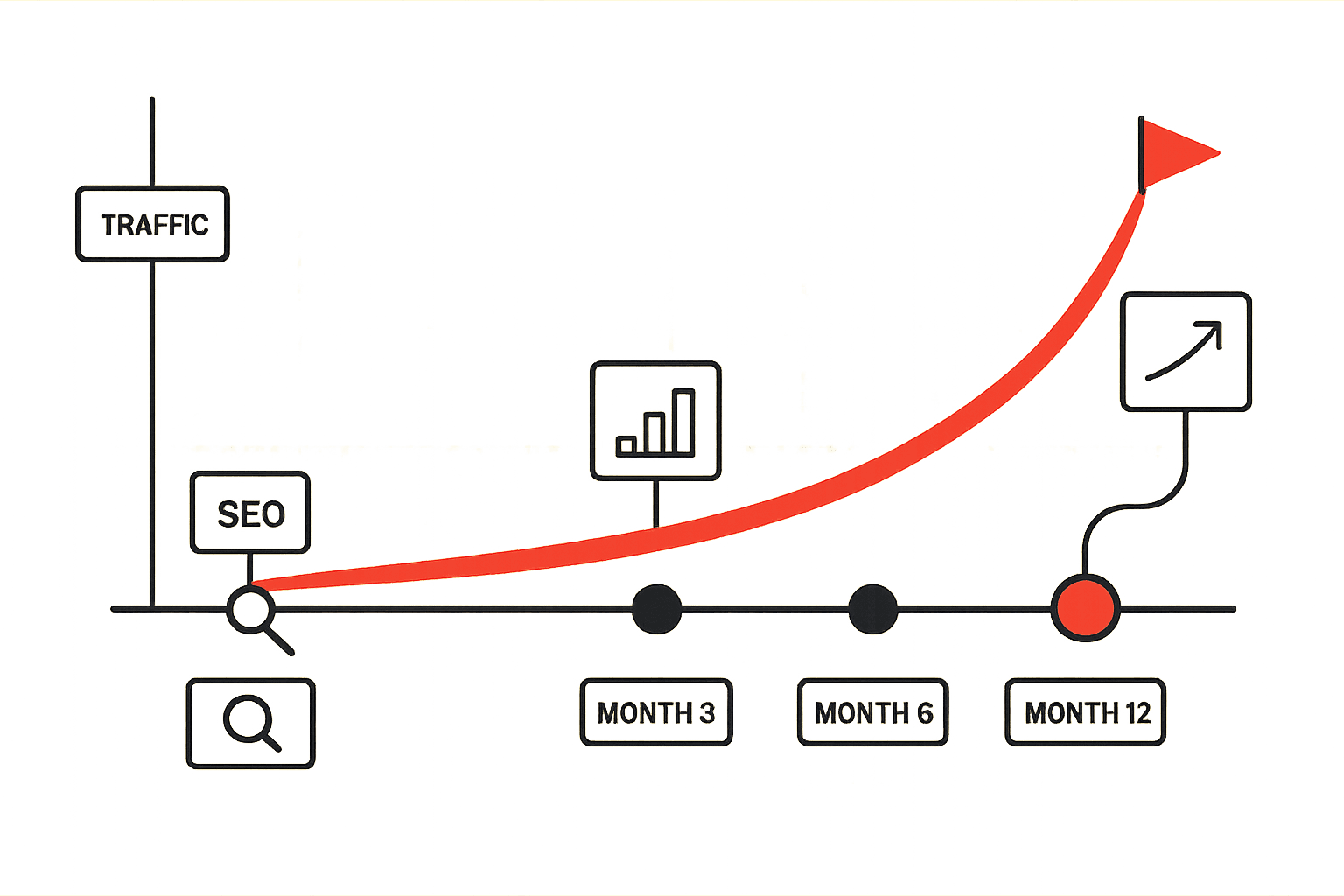
- Months 0-3 (Foundation): Indexing, technical fixes, content foundation, and keyword targeting. You will see almost nothing in traffic. This is normal and necessary.
- Months 3-6 (Early movement): Impressions rise across a widening set of queries. Long-tail and low-competition keywords start ranking. First measurable organic clicks arrive.
- Months 6-12 (Traction): Commercial keywords climb into the top 10. Organic traffic becomes a real lead source. The asset starts to feel like a channel, not an experiment.
- Months 12+ (Compounding): Authority compounds. New content ranks faster than old content did. Cost per lead falls. This is where SEO becomes the cheapest acquisition channel you own.
Now the important part: where you land inside those bands is not random. It is decided by five variables, and once you understand them, you can predict your own timeline far more accurately than any generic chart can.
Why SEO Takes Time at All
Before the timeline makes sense, you need the mechanism. SEO is slow for a structural reason, not because agencies are slow.
Google does not rank a page the moment it is published. It has to discover it, crawl it, index it, and then decide how much to trust it relative to everything else competing for the same query. Trust is the slow part. A brand-new page has no performance history, so Google tests it - it shows the page at modest positions, watches how searchers respond, and promotes or demotes it based on that real-world feedback. That testing loop takes weeks to months per query, and it repeats as your content matures.
Competitive keywords are even slower because the pages already ranking have accumulated years of authority, links, and engagement. Overtaking them requires content that is demonstrably better and enough domain authority for Google to consider you a credible alternative. Link equity compounds slowly too - a backlink earned today might take weeks to be crawled and months to fully pass value.
This is also exactly why SEO is worth the wait. The same trust that takes months to build is what makes the asset durable. A page that took six months to rank can keep delivering leads for three to five years. That durability is the entire argument for SEO as a channel over channels that stop the instant you stop paying.
The Five Variables That Decide Your Timeline
Two businesses can start SEO on the same day and see results months apart. The gap is always explained by these five factors. Diagnose where you sit on each and you can predict your own curve.
1. Your site's existing authority
A domain that has been live for years, with existing backlinks and a history of indexed content, starts with trust in the bank. It can rank new pages in weeks. A domain registered last month starts from zero and has to earn every bit of that trust. This single variable explains most of the difference between a two-month result and a twelve-month one. If you are launching a brand-new site, the early strategy has to be different - win small keywords first, build authority, then chase the head terms.
2. Keyword competitiveness
Ranking for "best running shoes" and ranking for "vegan trail running shoes for flat feet in Pune" are not the same job. The first is a battle against billion-dollar brands; the second has a handful of weak competitors. Competitive head terms take nine to eighteen months. Long-tail and local terms can take two to four. The fastest-growing SEO programmes deliberately sequence keywords from easy to hard rather than fighting the hardest one on day one. A proper SEO audit maps this competitiveness before a single word is written.
3. Content velocity and quality
SEO is a publishing business. Sites that ship genuinely useful, in-depth content on a consistent cadence build topical authority - Google's sense that you are a credible source on a subject - far faster than sites that publish thin posts occasionally. One excellent 2,500-word resource that fully answers a query will outperform ten 400-word posts. Velocity matters, but never at the cost of depth. This is why content marketing and SEO are inseparable, and why content depth is the single biggest lever most businesses are underusing.
4. Technical SEO health
If Google cannot crawl, render, and index your pages efficiently, none of the content or links matter. Slow load times, broken canonicals, orphaned pages, render-blocking JavaScript, and messy site architecture all cap your ceiling and slow the whole timeline. On a technically healthy site, the timeline compresses; on a broken one, it stretches indefinitely. Fixing technical SEO early is the highest-leverage thing you can do to make every later month count.
5. Link-building and authority velocity
Backlinks remain one of the strongest ranking signals, and how fast you earn quality, relevant links directly affects how fast your authority - and your rankings - climb. This is also the slowest-compounding variable, because links take time to be crawled and to pass value. Note the word quality: buying bulk links accelerates penalties, not rankings. Sustainable link building is a slow, compounding input, which is exactly why it should start early rather than be bolted on at month nine.
How the Timeline Changes by SEO Type
The "six to twelve months" rule is an average. Your actual timeline depends heavily on what kind of SEO you are doing.
Local SEO: the fastest
Local SEO is usually the quickest to pay off - often two to four months - because the competitive set is small and the signals are concentrated. A fully completed Google Business Profile, consistent name-address-phone citations, genuine recent reviews, and a few location-relevant pages can move you into the local pack for less-contested terms within a quarter. Competitive local categories in big metros take longer, four to eight months, but local is where most service businesses see their first wins.
Ecommerce SEO: moderate, then compounding
Ecommerce sits in the middle. Category and product pages compete in crowded markets, so commercial terms take six to twelve months. But ecommerce has a hidden accelerator: hundreds of product and category pages mean hundreds of long-tail entry points, and a technically sound store with good internal linking can start capturing long-tail product searches within a few months while the head terms mature.
National and competitive B2B SEO: the longest
If you are competing nationally for high-value commercial keywords - SaaS, finance, B2B services - expect the full nine to eighteen months for the most competitive terms. These categories have entrenched, well-funded competitors and long buyer research cycles. The payoff is proportional: a single page ranking for a high-intent national term can be worth lakhs in pipeline. This is where the easy-keywords-first sequencing matters most, and where working with an experienced SEO consultant or agency to prioritise correctly saves you months.
AI search and AEO: a faster early surface
Here is the genuinely new development. Getting cited inside AI Overviews, ChatGPT, and Perplexity can happen faster than ranking on page one of traditional Google for a competitive term. AI engines weight clear, well-structured, authoritative answers and lean less on accumulated backlink history for many queries. Well-structured content with strong entity coverage and schema can start earning AI citations within weeks to a few months. This does not replace traditional SEO - the underlying signals are the same - but answer engine optimisation and AI SEO give you an earlier surface to win while page-one rankings mature. If a meaningful share of your buyers now start their research in an AI engine, this is no longer optional.
How to Tell SEO Is Working Before Rankings Move
This is the single most important section for anyone worried about the wait. Rankings for your money keywords are a lagging indicator - they move last. Businesses that judge SEO only on those positions panic and quit at month four, right before the curve turns. The professionals watch leading indicators instead, and these move long before rankings do:
- Rising impressions in Google Search Console across a widening set of queries. This is the earliest signal that Google is surfacing your content more often.
- More pages indexed and crawled. A growing indexed-page count means your foundation is being recognised.
- Improving average position - even if you are still on page two or three. Climbing from position 45 to position 18 is real progress that has not yet produced clicks.
- Long-tail keywords starting to rank. The easy terms always move first; they are the early warning that the hard terms are coming.
- Clicks from queries you never targeted. When Google starts ranking you for related terms you did not write for, your topical authority is growing.
- Citations appearing in AI engines. Search your key topics inside ChatGPT and Perplexity periodically; early AI citations are a strong forward signal.
If impressions and indexed pages are climbing month over month, the engine is working - the rankings and traffic are downstream of those signals. The right way to read an SEO programme at month four is not "where are my rankings" but "are the leading indicators trending up." If they are, stay the course.
Worried your SEO has stalled - or unsure whether it is on track? A diagnostic audit reads your leading indicators, technical health, and competitive position, and tells you honestly where you are in the timeline and what is slowing it down.
Get an SEO auditMistakes That Reset the SEO Clock
Some decisions do not just slow SEO down - they restart the timer. Avoid these:
- Quitting at month four or five. The most expensive SEO mistake there is. You pay for the foundation and then walk away right before it pays you back.
- Constantly changing strategy. Ripping up the keyword plan every quarter means nothing ever accumulates authority. SEO rewards consistency.
- Chasing the hardest keyword first. Spending nine months losing to billion-dollar brands instead of winning ten easy keywords that build the authority you need to eventually win the hard one.
- Buying cheap bulk backlinks. This does not accelerate the timeline; it risks a penalty that erases it entirely. Real link building is slow on purpose.
- Ignoring technical debt. Launching a content programme on a slow, poorly architected site is pouring water into a leaking bucket.
- Site migrations done carelessly. A botched replatform or URL change can wipe out years of accumulated authority overnight and send you back to month zero.
Should You Use Paid Ads While SEO Matures?
Often, yes. The honest weakness of SEO is the wait, and the honest strength of paid search is immediacy - traffic the day you launch. The smartest play for a business that needs leads now and wants a durable channel later is to run both in parallel: PPC delivers immediate pipeline and live keyword data while your SEO foundation matures, then you taper paid spend on the keywords where organic has taken over. This way the six-to-twelve-month wait does not mean six-to-twelve months of silence. For a clear-eyed view of whether organic search is still worth the wait at all, see our analysis of whether SEO is dead in 2026.
Is SEO Worth It If It Takes This Long?
For most businesses, yes - and the delay is precisely what makes it worth it. The slowness that frustrates you in month three is the same property that makes the asset durable in year three. Paid traffic stops the instant you stop paying. Organic rankings keep delivering for months or years after the work is done, and the cost per lead falls as the asset compounds. A page that took six months to rank can generate leads for three to five years at a marginal cost approaching zero.
The honest caveat: SEO is a poor fit if you need leads this week, cannot sustain at least six to twelve months of consistent investment, or operate in a market with no organic search demand. In those situations, lead with paid and treat SEO as a longer-horizon bet, or skip it. But if you can commit to the timeline, SEO becomes the cheapest and most defensible acquisition channel you will ever own. For the full economics, including what the investment actually costs in the Indian market, see our breakdowns of SEO pricing in India and how much SEO services cost.
A note for Indian businesses specifically: the timeline bands above hold, but two local factors shift them. First, many Indian niches are still less saturated than their US or UK equivalents, which means well-executed SEO can reach page one faster here than the global averages suggest. Second, bilingual and voice search - English plus regional-language queries - opens long-tail opportunities that English-only competitors ignore, and those long-tail terms are exactly the ones that rank fastest. If you are evaluating partners, our guide to the best SEO agencies in India covers what to look for, including the AI-search capability that increasingly separates good agencies from dated ones.
The Bottom Line
How long does SEO take? Three to six months for early movement, six to twelve months for meaningful traffic and leads, and twelve months onward for the compounding growth that makes it the best-value channel you own. Where you land inside that range is decided by your site's authority, your keyword competitiveness, your content velocity, your technical health, and your link-building pace.
The businesses that win at SEO are not the ones with the biggest budgets. They are the ones who understand the timeline, watch the leading indicators instead of panicking over rankings, and refuse to quit at month four. Build the foundation, stay consistent, measure the right signals, and the curve will turn - usually right around the point where most of your competitors gave up.
Want a realistic timeline for your specific site, keywords, and market? We will map where you sit on all five timeline variables and show you the fastest credible path to organic traffic and AI-search visibility - no 30-day-ranking promises, just an honest plan.
Talk to our SEO teamFrequently Asked Questions
How long does SEO take to work?
For most businesses, SEO takes three to six months to show early movement and six to twelve months to produce meaningful organic traffic and leads. Established sites with authority can see results in two to four months; brand-new domains in competitive niches often take twelve months or more. The timeline is set by five variables: existing authority, keyword competitiveness, content velocity, technical health, and link-building pace.
Why does SEO take so long?
Because Google must discover, crawl, index, and then trust your content before ranking it, and trust is earned slowly. New pages have no track record, so Google tests them at lower positions and watches user response before promoting them. Competitive keywords are held by pages with years of accumulated authority, and overtaking them requires both better content and enough authority to be a credible alternative.
How long does SEO take for a new website?
A brand-new site with no authority typically takes six to twelve months to rank for anything competitive, and longer in crowded niches. It can rank for low-competition long-tail and local terms in two to four months, which is why the smart early strategy is to win small keywords first and build authority before chasing head terms.
How long does local SEO take to show results?
Local SEO often shows results in two to four months because the competitive set is smaller. A fully optimised Google Business Profile, consistent citations, recent reviews, and location-relevant content can reach the local pack for less-contested terms within a quarter. Competitive local categories in large metros take four to eight months.
How can I tell if my SEO is working before rankings move?
Watch leading indicators: rising impressions in Search Console, more pages indexed, improving average position, long-tail keywords starting to rank, clicks from queries you did not target, and citations appearing in AI engines. If impressions and indexed pages climb month over month, the engine is working and rankings are coming.
Is SEO worth it if it takes so long?
Yes for most businesses, because the delay is what makes the asset durable - organic rankings keep delivering long after the work is done, and cost per lead falls as it compounds. It is a poor fit only if you need leads this week or cannot sustain six to twelve months of investment; in that case, run paid ads alongside SEO.
How long does it take to rank on the first page of Google?
It depends on competitiveness. Low-competition and local keywords can reach page one in two to four months; medium-competition commercial terms in six to nine months; high-competition head terms in nine to eighteen months. Win the easy keywords first, then use that momentum to climb toward the hard ones.
Does SEO work faster because of AI search?
AI search has not made traditional SEO faster, but getting cited in AI Overviews, ChatGPT, and Perplexity can happen faster than ranking page one for a competitive term, because AI engines weight clear, authoritative, well-structured answers. Strong content with good entity coverage and schema can earn AI citations within weeks to a few months - an earlier surface to win while page-one rankings mature.

Aditya Kathotia
Founder & CEO
CEO of Nico Digital and founder of Digital Polo, Aditya Kathotia is a trailblazer in digital marketing. He's powered 500+ brands through transformative strategies, enabling clients worldwide to grow revenue exponentially. Aditya's work has been featured on Entrepreneur, Economic Times, Hubspot, Business.com, Clutch, and more.