

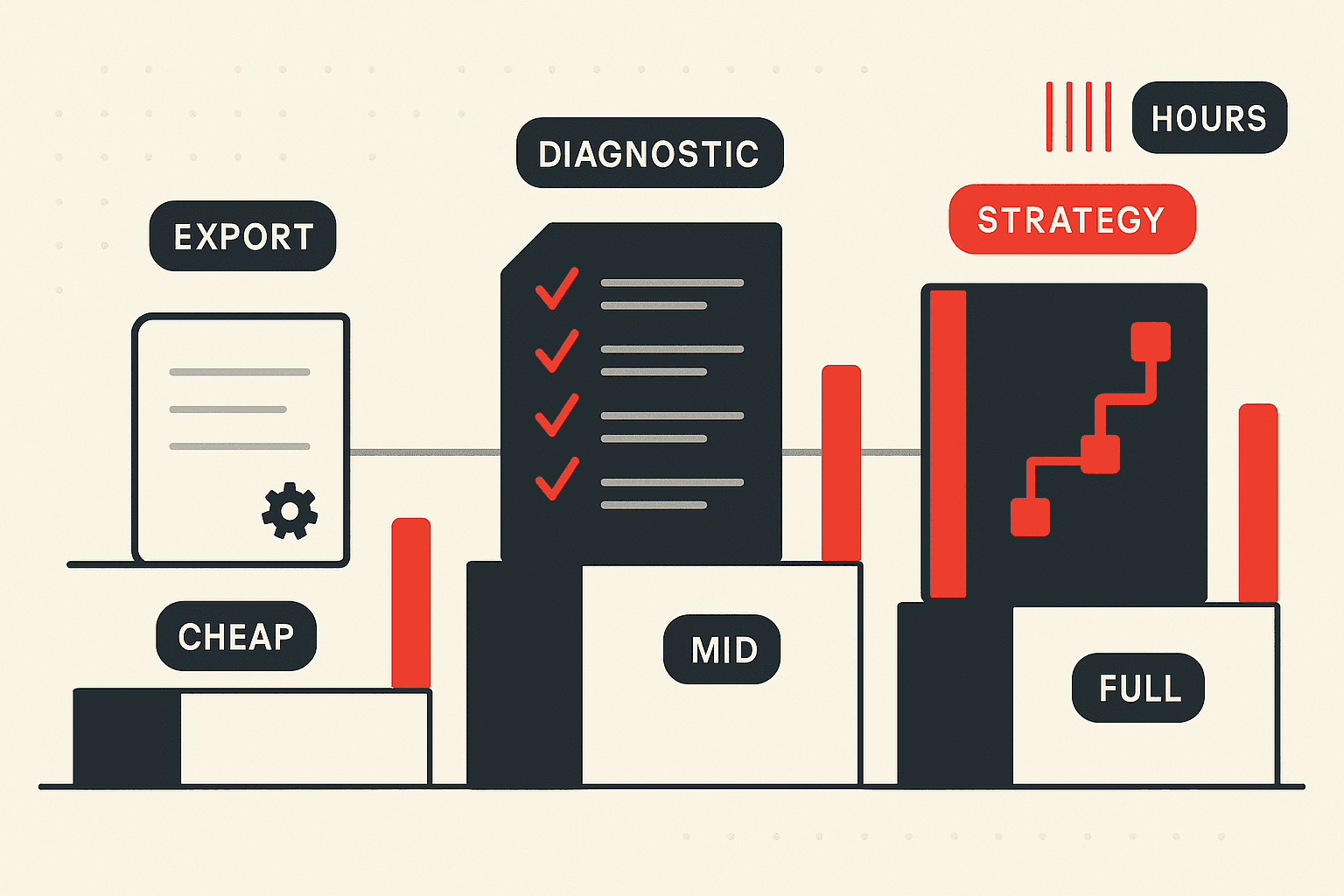
Send the same website to three agencies and ask what an SEO audit would cost. One will quote ₹4,999 and deliver it by tomorrow. One will quote ₹45,000 and take a fortnight. One will quote ₹2,50,000 and ask you three questions about your revenue model before they will even scope it.
All three of them will use the word audit.
This is the single most confusing purchase in Indian SEO, and the confusion is expensive in both directions. Buy at the bottom and you pay for a crawler export that tells you your site has 1,847 issues, of which perhaps nine matter, with no way to tell which nine. Buy at the top without understanding what you are buying and you can spend a quarter's budget on a document that restates what your team already knew. Both outcomes are common, and both come from the same root cause: nobody explains what the money is actually paying for.
So this guide does that. It gives you the real rupee bands for India in 2026 and what each one genuinely buys, then does something none of the pages currently ranking for this query do - it reverse-engineers an audit quote into the hours behind it, so you can price any proposal yourself. It covers the AI-search workstream that most 2026 proposals still leave out, gives you an honest read on free audits, prices the DIY route properly, and ends with a five-step method for setting your own budget.
We sell SEO audits ourselves, so read the numbers with that in mind. We have priced them where we have because of what they cost us to produce, and we will show you that arithmetic rather than ask you to take the band on trust.
The Short Answer: What an SEO Audit Costs in India in 2026
A genuine SEO audit in India costs ₹25,000 to ₹2,50,000 for most businesses. Enterprise, multi-market, and migration-grade audits run ₹2.5L to ₹10L or more. Below ₹25,000 you are almost always buying an automated tool export rather than a diagnostic.
Here are the five bands the market actually clusters into.
| Band | Price | Typical site | What it really is |
|---|---|---|---|
| Free | ₹0 | Any | Automated crawl exported to a branded PDF. A sales asset. |
| Entry | ₹5,000 - ₹25,000 | Under 100 pages | Tool export with light human commentary. Useful for hygiene only. |
| Standard | ₹25,000 - ₹75,000 | 100 - 500 pages | Real technical diagnostic, verified by a human, with a fix list. |
| Full-scope | ₹75,000 - ₹2,50,000 | 500 - 2,000 pages | Technical plus content, links, competitors, AI search, analytics, roadmap. |
| Enterprise | ₹2.5L - ₹10L+ | 2,000+ pages, multi-market | All of the above across templates, markets, languages, and stakeholders. |
The band you belong in is set by four variables, roughly in this order of influence: how many distinct templates your site has (not how many pages), how competitive your category is, how many workstreams you put in scope, and how senior the people doing the analysis are. We will take each of those apart below.
Why the Same Word Covers a 50x Price Range
There is no certification, no standard, and no protected definition. Anybody can call anything an SEO audit. In practice the Indian market sells three genuinely different products under the one label.
Product one is the tool export. Someone enters your URL into Semrush, Ahrefs, or a white-label audit tool, waits, and exports the result to a PDF with their logo on it. Total human involvement: about twenty minutes. This is what almost every free audit is, and it is what a large share of sub-₹15,000 paid audits are too. It is not fraudulent - the data in it is real - but it is undifferentiated. The same tool run by anyone would produce the same file.
Product two is the technical diagnostic. A human runs the crawl, then does the part the machine cannot: verifies which findings are real, checks them against Google Search Console, opens the templates, tests the rendering, and discards the noise. A crawler will happily report two hundred "issues" on a healthy site. Someone has to know that a hundred and eighty of them do not matter. The output is a real fix list, usually prioritised, that a developer can work from. This is the ₹25,000 to ₹75,000 band.
Product three is the strategic audit. Everything in product two, plus content inventory and decay analysis, keyword cannibalisation, backlink profile and toxicity, competitive gap analysis, AI-search and citation visibility, analytics and conversion tracking QA, and - the part that actually justifies the fee - a sequenced roadmap that says what to do first, what it will take, and what it should move. This is the ₹75,000 to ₹2,50,000 band.
The gap between product one and product three is not a quality gradient. They are different objects. One is a file. The other is a decision.
The test that separates them in one question. Ask a prospective auditor: "Of everything you find, how will you decide what goes at the top of the roadmap?" A tool-export vendor will describe severity labels the software assigns. A real auditor will describe a judgement - traffic at risk, revenue exposure, effort to fix, dependency order. If the answer is "the tool marks them critical, high, medium," you know which product you are being sold.
What You Actually Get at Each Price Band
Bands are only useful if you know what falls inside them. Here is the honest inventory.
Free (₹0)
An automated crawl, a site-health score, a list of technical warnings, a backlink count, and a keyword overview. Delivered fast, often within minutes of you filling in a form. The purpose is to open a sales conversation, and the report is tuned for that - it will surface a large number of issues because a large number looks urgent.
Worth taking. Not worth acting on directly. Use it to confirm that something is worth investigating, and to judge how the agency thinks when you get on the call.
Entry: ₹5,000 - ₹25,000
Suitable for a genuinely small site - a local business, a single-location clinic, a young D2C brand with under a hundred URLs. At this price you are buying a tool export with a human skim over the top: someone has read the crawl and written a page or two of commentary and a short fix list.
For a small site that has never been looked at, this can be decent value, because small sites tend to have a handful of obvious problems and obvious problems are exactly what crawlers are good at. What you will not get is competitive context, content strategy, or any view on why your traffic is where it is.
Below about ₹5,000, assume the human step did not happen.
Standard: ₹25,000 - ₹75,000
The first band where you are reliably paying for judgement rather than software. Expect a properly configured crawl, indexation forensics against Search Console, a template-level on-page review, Core Web Vitals and rendering checks, structured data validation, a redirect and canonical review, and a prioritised fix list with effort estimates.
This is the right purchase when your site was recently rebuilt or migrated and you want to know what broke, or when your developer needs a specific, verified work order. See our technical SEO services page for what this workstream covers in full.
What is usually out of scope here: content strategy, link analysis, competitive research, and AI search.
Full-scope: ₹75,000 - ₹2,50,000
The band most growing businesses should be in, and where our own standalone audits sit. Everything in the standard band, plus content inventory and decay, cannibalisation, backlink profile and toxicity, competitor gap analysis, AI-search visibility, analytics QA, and a sequenced six to twelve month roadmap. Delivered as a written document with a live walkthrough, not a deck.
This is what you buy when traffic has been flat or declining for a year and nobody can tell you why, or when you are about to commit real money to a retainer and want an independent read first.
Enterprise: ₹2.5L - ₹10L+
Large catalogues, multiple templates, several markets or languages, a real engineering backlog, and multiple stakeholders who need different versions of the same findings. Log-file analysis becomes mandatory rather than optional. International hreflang and market-level cannibalisation enter scope. So does a migration risk review if one is planned.
The fee here is driven less by page count than by coordination: an enterprise audit has to survive contact with a product team, a platform team, and a marketing team who do not share a roadmap.
The Cost Is Really Hours: How to Reverse-Engineer Any Quote
This is the part no one shows you, and it is the most useful thing in this guide. An audit has almost no cost of goods. There is no media spend, no inventory, no per-unit cost. Ninety-five percent of the price is senior human time. Which means any quote can be checked with one piece of arithmetic:
Audit price ÷ blended senior hourly rate = the hours they have budgeted.
Blended senior SEO rates in India in 2026 sit at roughly ₹2,000 to ₹3,500 per hour at an agency, ₹800 to ₹2,000 for a freelancer, and ₹3,000 to ₹6,000 for an independent senior consultant. Use ₹2,500 as a working reference.
Run the numbers and the market suddenly makes sense:
- A ₹5,000 audit buys two hours. That is enough to run a crawl and export it. It is not enough to read it.
- A ₹45,000 audit buys eighteen hours. That is a real technical diagnostic on a small-to-mid site, and nothing else.
- A ₹1,50,000 audit buys sixty hours. That is a full-scope audit on a mid-market site.
- A ₹4,00,000 audit buys a hundred and sixty hours. That is four person-weeks - enterprise scope, or someone is over-charging.
Now the other direction. Here is what a full-scope audit of a 500 to 2,000 page site actually consumes, workstream by workstream. These are our own delivery ranges.
| Workstream | Hours | At ₹2,500/hr |
|---|---|---|
| Crawl setup, configuration, technical diagnostic | 8 - 14 | ₹20,000 - ₹35,000 |
| Indexation and Search Console forensics | 4 - 6 | ₹10,000 - ₹15,000 |
| Log-file analysis (where logs are available) | 4 - 8 | ₹10,000 - ₹20,000 |
| Template-level on-page and internal linking review | 6 - 10 | ₹15,000 - ₹25,000 |
| Content inventory, decay, cannibalisation | 8 - 14 | ₹20,000 - ₹35,000 |
| Backlink profile and toxicity review | 4 - 6 | ₹10,000 - ₹15,000 |
| Competitive gap analysis | 6 - 10 | ₹15,000 - ₹25,000 |
| AI search and citation visibility audit | 6 - 12 | ₹15,000 - ₹30,000 |
| Analytics and conversion tracking QA | 3 - 5 | ₹7,500 - ₹12,500 |
| Synthesis, prioritisation, roadmap writing | 10 - 16 | ₹25,000 - ₹40,000 |
| Walkthrough, Q&A, handover | 2 - 3 | ₹5,000 - ₹7,500 |
| Total | 61 - 104 | ₹1,52,500 - ₹2,60,000 |
Two things fall out of this table that are worth sitting with.
The single largest line item is not the analysis. It is the synthesis. Ten to sixteen hours - more than any diagnostic workstream - goes into turning several hundred observations into a sequenced plan. This is precisely the step a cheap audit skips, which is why cheap audits produce long lists and expensive audits produce short ones. A findings list is what you have before the work is finished.
Effort scales with templates, not pages. Auditing a 50,000-URL ecommerce catalogue built from six templates is less work than auditing a 400-page site where every page was hand-built differently. Any agency quoting you per URL either does not know this or is hoping you do not. If your quote scales linearly with page count, ask why.
If you want to sanity-check a quote you have in hand, divide it by ₹2,500 and compare the implied hours against that table. It is crude, and it will be right more often than not.
The 2026 Line Item Most Quotes Still Leave Out
Almost every audit template in circulation in India was designed for a world where the only thing that mattered was where you ranked on a page of ten blue links. That world is thinning out. A growing share of buyer research now happens inside ChatGPT, Perplexity, Gemini, and Google's AI Overviews, where there is no page of ten results and being "ranked" is not the mechanism - being retrieved and cited is.
That is a different diagnostic, and it needs its own workstream. A 2026-grade audit should check:
- Prompt-set visibility. Not keywords - prompts. Whether your brand appears when a buyer asks an AI engine the twenty or thirty questions that precede a purchase in your category, and which competitors appear instead.
- Entity consistency. Whether your organisation is described the same way across your own site, your schema, your directory listings, and third-party sources. Inconsistent entities are hard to cite confidently.
- Passage-level structure. Whether your content is written in the formats these systems extract cleanly from - definition blocks, comparison tables, ordered steps, stat-led paragraphs - or in long undifferentiated prose.
- Crawler access. Whether your robots rules and any bot-blocking at the CDN layer permit the crawlers that feed AI systems. This one catches people out constantly: a security team blocks a crawler, and a year later nobody can explain the citation gap.
- Citation gap analysis. Where competitors are being cited in your category and what those sources have in common.
Expect this to add roughly ₹20,000 to ₹60,000 to an audit. Expect, also, to have to ask for it by name - it is not yet standard, and a proposal that does not mention it usually does not include it. Our answer engine optimisation and AI SEO pages cover the mechanics in depth, and if the terminology is new, what AEO actually is is the right place to start.
Ask this before you sign. "Does the audit measure whether we are cited in AI answers, and what prompt set will you use?" The answer sorts the market fast. Some will say it is not applicable to your category. That may even be true - but they should be able to say why, in terms of how your buyers research, not in terms of what their template covers.
What Is a Free SEO Audit Actually Worth?
More honestly than most agency blogs will tell you: a free audit is a sales asset. That is not a scandal - it is a reasonable thing for an agency to offer, and we are not going to pretend otherwise. But it means the document is engineered for a purpose, and the purpose is not to give you an accurate picture of your site.
Free audits are optimised to look alarming. The tools that generate them count issues generously - every missing meta description, every image without alt text, every non-canonical URL - and present the total prominently. A healthy, well-run site will still generate a report with several hundred "issues" on it. The number is not a measure of how much trouble you are in. It is a measure of how many things a crawler can count.
What a free audit genuinely cannot do is tell you which findings matter. That judgement requires someone to look at your Search Console data, understand which templates carry your revenue, and check what your competitors are doing. None of that happens in an automated export, and none of it can, because the tool does not know what your business sells.
So take them. Take three. Then use them the way they are actually useful:
- As a hygiene signal. If four different tools all flag the same indexation problem, that is worth investigating.
- As an agency test. Get on the call and ask what would be different in a paid audit. The specificity of that answer tells you far more about whether they can do the work than the PDF does.
- As a negotiating baseline. If a paid proposal contains nothing the free report did not, you have learned something important.
What you should not do is hand a free audit to your developer as a work order. That is how teams spend six weeks writing alt text while a canonicalisation bug quietly keeps half the catalogue out of the index.
The DIY Route: What It Costs to Audit Your Own Site
Auditing your own site is a legitimate option, and for a small site it is often the right one. But price it properly, because the software is the cheap part.
The tooling. A serious crawler is the one non-negotiable purchase, and it is not expensive. Add a log-file analyser if you have server logs. Add a full backlink and keyword suite only if you also need competitive data - and note that these are the line items that dominate the bill.
| Layer | Typical annual cost | Necessary? |
|---|---|---|
| Google Search Console | Free | Mandatory. More authoritative than any paid tool. |
| Desktop crawler (Screaming Frog, Sitebulb) | ₹20,000 - ₹45,000 | Mandatory for a real technical audit. |
| Log-file analyser | ₹10,000 - ₹15,000 | Only if you can get server logs. |
| Backlink + keyword suite (Ahrefs, Semrush) | ₹1,20,000 - ₹2,50,000 | Only if you need competitive and link data. |
| PageSpeed Insights, Lighthouse, Rich Results Test | Free | Mandatory, and free. |
Software prices move, so treat these as planning figures and check current list prices - but the shape holds: you can run a competent technical audit for roughly ₹35,000 a year in tooling, and the moment you need competitive and backlink data the number jumps by an order of magnitude.
The time. This is the real cost. A full-scope audit is sixty to a hundred hours of focused work, and it is unforgiving of inexperience - the hard part is not producing findings, it is discarding the ones that do not matter. A first-timer will take longer than the ranges above and will, in our experience, over-weight the things crawlers score loudly and under-weight the things that quietly cost money.
The honest verdict. DIY works well when someone on your team has run audits before and simply lacks tooling. It works badly when nobody has, because the failure mode is invisible: you get a plausible-looking list, you work it for a quarter, and you find out later you fixed the wrong things. A useful middle path is to run the crawl yourself and buy a few hours of senior time to interpret it.
Agency, Freelancer, Consultant, or In-House?
Four ways to buy the same nominal thing, with genuinely different economics.
| Model | Typical audit cost | Best for | Main risk |
|---|---|---|---|
| Freelancer | ₹10,000 - ₹60,000 | Small sites, technical-only scope | Depth varies enormously; hard to verify seniority before you buy |
| Agency | ₹50,000 - ₹5,00,000 | Full-scope, multi-workstream audits | The senior who pitched may not be the one who delivers |
| Independent consultant | ₹75,000 - ₹3,00,000 | Strategic reads, second opinions, board-level questions | Limited bandwidth; usually cannot also ship the fixes |
| In-house | ₹35,000 - ₹2,50,000/yr tooling, plus salary and time | Ongoing quarterly audits once capability exists | Blind spots - it is genuinely hard to audit a site you built |
That last risk deserves emphasis because it is chronically underrated. Auditing your own site is a bit like proofreading your own writing. You do not see the missing word, because you know what it is meant to say. The single most valuable property of an external audit is often not superior expertise - it is that the auditor has never seen your site before and therefore experiences it the way a crawler and a stranger do.
If you are weighing agencies rather than models, our guides to choosing an SEO agency in India and the wider SEO agency landscape cover the evaluation criteria in more depth.
Six Things That Should Never Be in Your Audit Invoice
- A guaranteed ranking outcome. An audit is a diagnostic. A diagnostic that promises a result is not a diagnostic.
- A per-page fee. Effort scales with templates, not URLs. Per-page pricing either misunderstands the work or is designed to inflate on large catalogues.
- A line item for running the crawl. That is a cost of doing business, like a doctor billing you for owning a stethoscope.
- Findings with no prioritisation. A list of two hundred issues with no order, no effort estimate, and no owner is a data dump. Prioritisation is the deliverable.
- A recommendation to buy links or bulk directory submissions. If the roadmap's growth plan is purchased links, you have learned something about the agency that has nothing to do with the audit. Our position on why we refuse this work is on the record.
- A deck your developer cannot act on. If the deliverable needs a translation layer before engineering can use it, you bought a presentation.
What Should an Audit Save You?
Set against the ROI, the fee is usually the smaller number - but only if you are honest about the counterfactual.
Take a mid-market Indian ecommerce site spending ₹1,00,000 a month on an SEO retainer. That is ₹12L a year. A ₹1,50,000 audit is twelve and a half percent of one year's retainer spend. The question is not whether ₹1.5L is a lot of money in isolation. It is whether an independent read materially improves how the other ₹12L gets deployed. If it reorders even one quarter of that programme away from work that would not have moved anything, it has paid for itself several times over.
The other side is risk. The findings that most often justify an audit fee outright are the quiet structural ones: a canonicalisation or faceted-navigation problem keeping a large share of a catalogue out of the index, a cannibalisation issue splitting authority across near-duplicate pages, a set of orphaned pages that used to earn traffic and now receive no internal links, or a tracking configuration that has been misattributing organic revenue to direct for eighteen months. Any one of those is worth more than the audit costs, and none of them announce themselves.
Judge it ninety days later on three questions. Did it change what your team worked on? Were the top five findings verifiable once pointed out? Did the fixes move a measurable number? An audit that did not reorder your roadmap did not earn its fee, whatever it cost.
How Long Should It Take?
| Site | Realistic timeline |
|---|---|
| Under 100 pages | 1 - 2 weeks |
| 500 - 2,000 pages | 2 - 4 weeks |
| Enterprise, multi-market, multi-domain | 4 - 8 weeks |
Anything promised inside 48 hours is a tool export, because the crawl is not the slow part. A crawl of most Indian business sites finishes in under an hour. The weeks go into verification, cross-referencing against Search Console and analytics, understanding why the site is built the way it is, and writing a roadmap someone can execute without a follow-up meeting to explain it.
Be equally sceptical of the opposite. An audit that takes three months on a mid-market site has usually stalled, not deepened.
How to Set Your Own Audit Budget in Five Steps
- Count your templates, not your pages. How many structurally distinct page types does your site have - home, category, product, blog, location, landing? Six to eight templates is standard-band work regardless of whether you have 400 URLs or 40,000.
- Decide the scope honestly. Technical only, or technical plus content, links, competitors, and AI search? Technical-only is roughly 40 to 60 percent of full-scope. Buy technical-only if you recently migrated. Buy full-scope if traffic has been flat for a year and nobody can say why.
- Anchor against your annual SEO spend. A reasonable one-off audit lands somewhere between five and fifteen percent of a year's SEO investment. Meaningfully below that and you are buying an export; meaningfully above and you should ask what is in scope that you do not need. Our SEO pricing guide for India sets out the retainer bands to compare against, and what SEO services cost more broadly covers the full picture.
- Convert the quote into hours. Divide by ₹2,500 and compare against the workstream table above. If the implied hours cannot cover the promised scope, the scope is not real.
- Confirm the deliverable format before you sign. Written document or deck? Prioritised or listed? Effort estimates included? Walkthrough included? Handover to your developer included? Is the fee credited against a retainer, and is that credit conditional? Every one of these is negotiable before you sign and none of them are after.
Frequently Asked Questions
How much does an SEO audit cost in India in 2026? Between ₹25,000 and ₹2,50,000 for most businesses, with enterprise and multi-market audits at ₹2.5L to ₹10L or more. Below ₹25,000 you are almost always buying a tool export rather than a diagnostic. The typical full-scope band for a 500 to 2,000 page site is ₹75,000 to ₹2,50,000.
Why do quotes for the same site vary by 50x? Because three different products share one name: an automated tool export, a human-verified technical diagnostic, and a full strategic audit with a roadmap. The first takes twenty minutes of machine time; the third takes sixty to a hundred hours of senior human time. The word audit does not distinguish between them, so you have to.
Is a free SEO audit worth anything? As a sales asset, yes; as a diagnostic, no. It will tell you your site has issues. It cannot tell you which ones cost you money, because that requires someone to look at your Search Console data, your templates, and your competitors. Take it, then judge the agency by what they say would be different in a paid one.
How long does an SEO audit take? One to two weeks for a small site, two to four weeks for a mid-market site, four to eight weeks for enterprise. The crawl takes an hour. Everything else is verification and synthesis.
Should the audit fee be credited against a retainer? It is fair to ask, and common. We credit it against the first three months if you bring us in to ship the fixes. Watch the incentive, though: if the credit is conditional on a twelve-month commitment, the audit is functionally a sales document and its findings will tend to justify the retainer.
What is the difference between a technical audit and a full audit? Technical covers crawlability, indexation, architecture, speed, structured data, redirects, hreflang, and rendering. Full adds content and decay, cannibalisation, backlinks, competitors, AI search, analytics QA, and a roadmap. Technical is usually 40 to 60 percent of the full price because it is one workstream instead of eight.
Can I just audit my own site? For a small site, often yes. Tooling runs roughly ₹35,000 a year for a crawler-led technical audit, and Search Console is free and more authoritative than any paid tool. The real cost is sixty to ninety hours of your team's time and the risk of fixing the wrong things. DIY works when someone has done it before and lacks tooling; it works poorly when nobody has.
Does an audit really need to cover AI search in 2026? Yes, and most quotes still do not include it. Being cited inside ChatGPT, Perplexity, Gemini, and AI Overviews is a different mechanism from ranking, measured against a prompt set rather than a keyword set. Expect it to add ₹20,000 to ₹60,000, and expect to have to ask for it by name.
What should never be in an audit invoice? A guaranteed ranking, a per-page fee, a charge for running the crawl, an unprioritised findings list, a recommendation to buy links, or a deliverable your developer cannot act on without a translation layer.
How do I know afterwards whether it was worth it? Ninety days later, ask three questions. Did it change what your team worked on? Were the top five findings verifiable once pointed out? Did the fixes move a measurable number - indexed pages, impressions on priority templates, Core Web Vitals, AI citations? An audit that did not reorder your roadmap did not earn its fee.
Where to Go From Here
If you want the diagnostic run properly - technical, content, links, competitive, and AI search, delivered as a prioritised roadmap with a walkthrough rather than a PDF you have to interpret - that is exactly what our SEO audit service is. The fee is credited against the first three months if you bring us in to ship the fixes, and we run audits for brands who will not ultimately retain us, because a diagnostic that only works as a sales pitch is not a diagnostic.
If you would rather talk it through before committing to a scope, tell us about your site and we will tell you honestly which band you belong in - including when the answer is the cheap one.
Related Reading on SEO Cost, Audits, and Value
- SEO Pricing in India: 2026 Honest Cost Guide - the retainer bands to compare an audit fee against
- How Much Do SEO Services Cost in India? - the wider pricing picture
- Link Building Cost in India: Agency vs In-House vs Tools - the same three-model analysis applied to links
- Technical SEO Services - what the technical workstream actually covers
- Second-Page SEO Audit: Push Rankings to Page 1 - a focused audit you can run yourself
- Keyword Cannibalisation Audit - one of the highest-value findings in any audit
- Content Decay Audit - the content workstream, in detail
- SEO vs PPC: Which to Invest In First - if you are still deciding where the budget goes
- SEO Statistics India 2026 - the market data behind these numbers
- Digital Marketing Glossary - if any term above was unfamiliar

Aditya Kathotia
Founder & CEO
CEO of Nico Digital and founder of Digital Polo, Aditya Kathotia is a trailblazer in digital marketing. He's powered 500+ brands through transformative strategies, enabling clients worldwide to grow revenue exponentially. Aditya's work has been featured on Entrepreneur, Economic Times, Hubspot, Business.com, Clutch, and more.