

The short answer
AEO stands for Answer Engine Optimization. It is the work of structuring your content so AI answer engines - ChatGPT, Perplexity, Google's AI Overviews, Gemini and Copilot - can find a short, factual, self-contained passage on your page, trust it, and quote it with your brand named as the source.
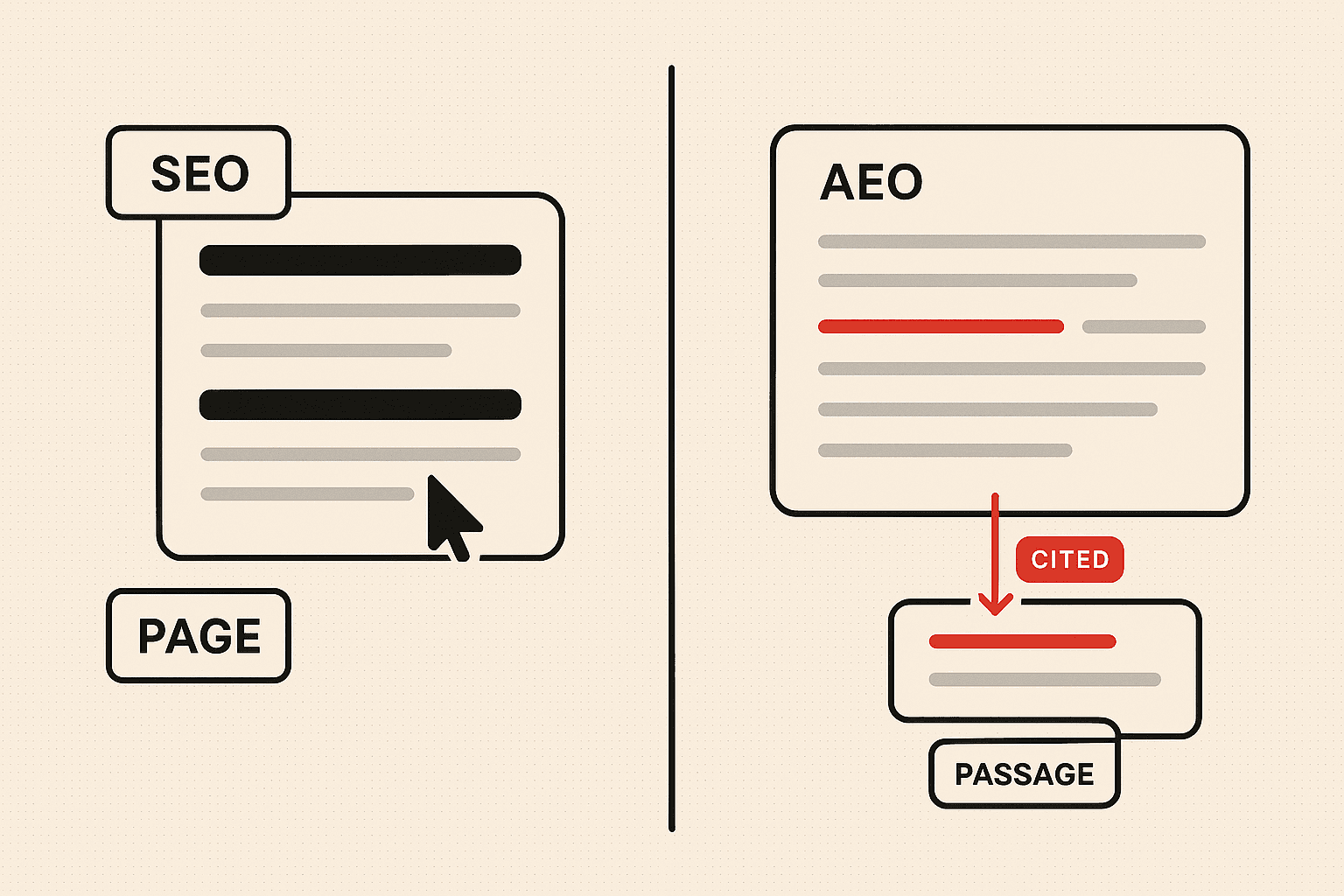
The difference from classic SEO is smaller than the hype suggests and more specific than most explainers admit. SEO optimises a page to win a link somebody clicks. AEO optimises a passage to win a sentence inside the answer, whether or not a click ever follows. Same website, same technical foundations, different unit of work.
That distinction is the whole article. Everything below is what it means in practice.
Why this article exists
Search "what is AEO" and you get a dozen pages that define it identically and then stop. They all say "structure your content so AI can understand it." None of them show you what a restructured passage actually looks like, which changes moved the needle, or which widely-repeated advice turned out to be noise.
We have been doing this work for clients for a while now, and we published what we found when we tracked which of our own pages LLMs actually cited and when we rebuilt a blog specifically to answer the questions LLMs ask. This piece is the entry point to that work: the definition, then the parts nobody puts in the definition.
First, clear up the acronym
Before anything else: AEO means three unrelated things depending on where you are standing.
| Context | AEO means | Relevance here |
|---|---|---|
| Marketing and SEO | Answer Engine Optimization | This article |
| Trade and customs | Authorised Economic Operator | A customs certification scheme, including in India |
| Stock markets | American Eagle Outfitters | The retailer's ticker symbol |
A meaningful share of "AEO full form" searches are people looking for customs certification, not marketing. If you arrived here from that direction, this is the wrong page and no hard feelings.
For the rest of this article, AEO means Answer Engine Optimization.
What an "answer engine" actually is
An answer engine is any system that responds to a question with a written answer instead of a list of links. In practice, the ones that matter commercially right now:
- Google AI Overviews - the AI-written block above the classic results
- ChatGPT - both from its trained knowledge and from live retrieval when it searches
- Perplexity - retrieval-first, with inline citations on almost every claim
- Gemini, Copilot and Claude - same pattern, different retrieval mixes
They differ in one way that matters enormously for how you work on them. Some are retrieval-based: they go and read live web pages when you ask, then quote them. Perplexity and AI Overviews sit here. Others lean on trained knowledge: what the model absorbed during training, which updates on a slow cycle. ChatGPT does both depending on the prompt.
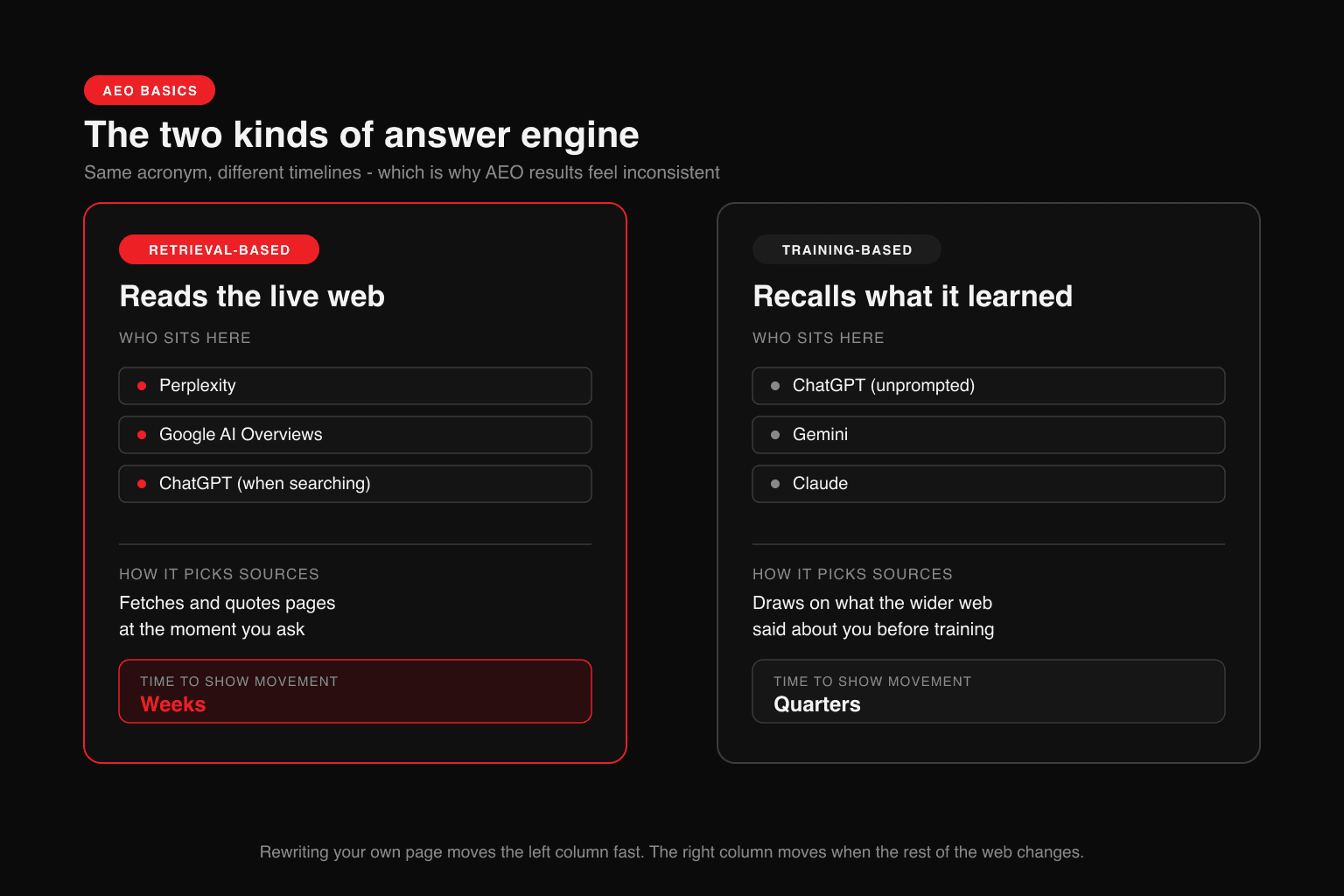
This split explains most of the confusion beginners have about timelines. Restructuring a page can get you quoted by Perplexity in a few weeks, because Perplexity will literally go read the new version. The same rewrite may do nothing for ChatGPT's unprompted knowledge of your brand for months, because that depends on what the wider web says about you, not what your own page says. Two different games, often mistaken for one. We go deeper on each in how to rank on ChatGPT and how to rank on Perplexity.
The core mechanic: passages, not pages
Here is the single idea that makes AEO click.
When an answer engine builds a response, it is not asking "which page is best?" It is asking "which short chunk of text can I lift, that fully answers this, that I can attribute confidently?" It then assembles several such chunks into an answer.
So the thing being ranked is not your page. It is a passage inside your page.
That reframing explains behaviour that otherwise looks random:
- A page can rank #1 on Google and never be cited, because its answer is buried under four paragraphs of preamble and there is no clean chunk to lift.
- A page can rank #14 and be cited constantly, because it contains one crisp, factual, quotable sentence that nothing else on the web states as cleanly.
- Adding 2,000 more words to a page can reduce citations, because it dilutes the extractable passage rather than adding one.
Once you see AEO as passage engineering rather than page optimisation, the tactics stop being a list to memorise and start being obvious.
What a liftable passage looks like
Compare these two answers to "how long does SEO take to work?"
Not liftable:
SEO timelines are one of the most common questions we get, and honestly the answer depends on a lot of things. Every business is different, every industry is different, and anyone who gives you a straight number is probably overselling. There are so many variables at play - your domain history, your competition, your budget, how much content you already have. In our experience working with hundreds of brands across many industries, we have seen results come quickly and we have seen them take a while...
Everything true, nothing quotable. A model reading this cannot extract a claim, because no claim was made. It moves on.
Liftable:
Most SEO programmes show first meaningful movement at three to six months and compounding results from month nine onward. Newer domains and competitive commercial keywords sit at the longer end; established sites fixing technical problems or refreshing existing content often see movement inside eight weeks. The variable that shifts the timeline most is not budget but whether the site already has indexed, credible pages to build on.
Same expertise, same honesty about variability, but it states a number, qualifies it, and stops. That is three sentences a model can quote and attribute. Note that it did not become less nuanced - it became specific about its nuance.
That is the rewrite. There is no trick beyond it.
The five things that actually move AEO
Ranked by what we have seen produce movement, not by what is easiest to write about.
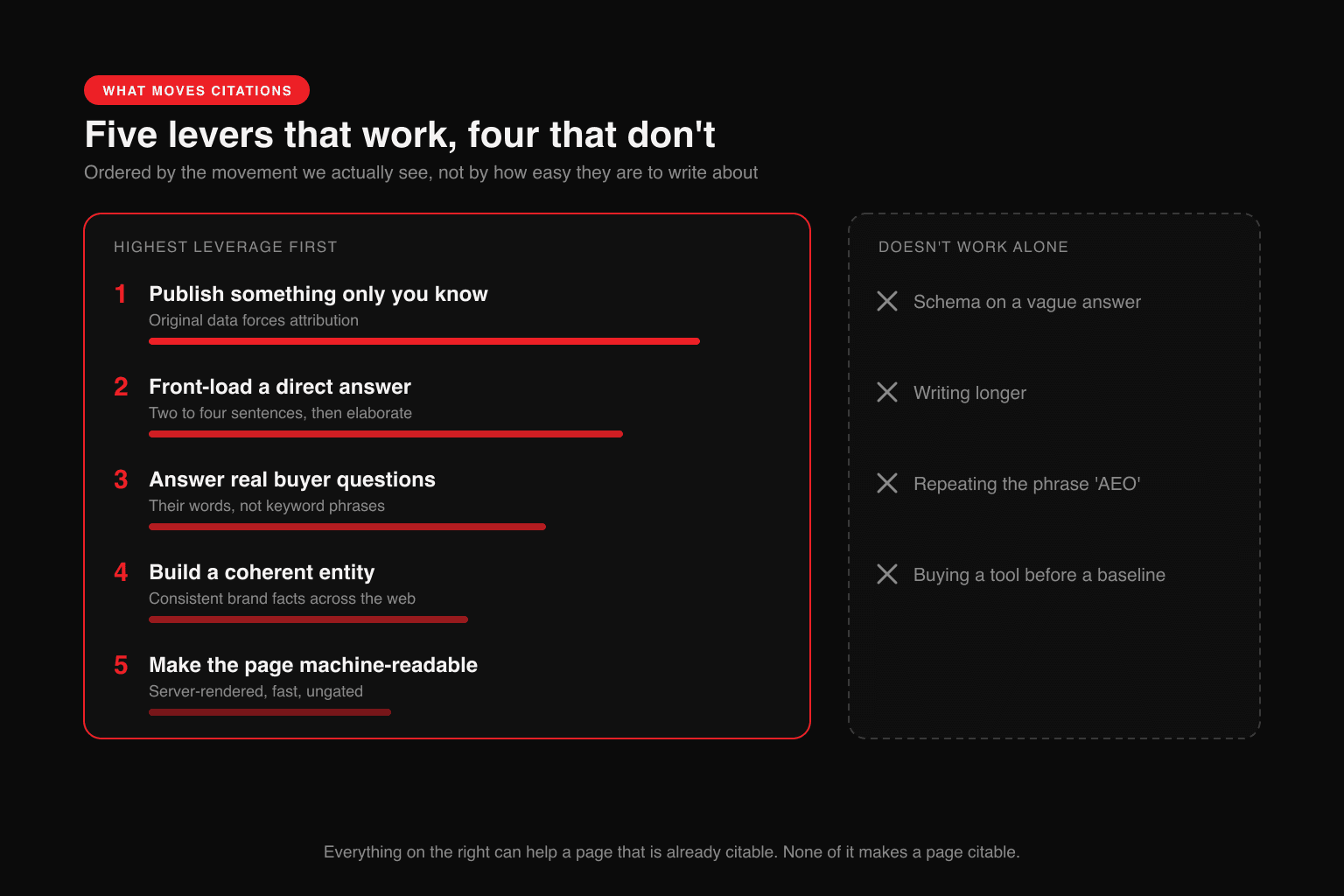
1. Publish something only you know
By a wide margin, the highest-leverage AEO asset is original data. Your own benchmark, your own test result, your own aggregated client outcome, your own survey.
The reason is mechanical. A definition of AEO can be paraphrased from two hundred sources, so a model has no reason to name you specifically. A number that exists on exactly one page in the world forces attribution - if the model wants to use it, it has to point somewhere, and that somewhere is you.
You do not need a research department. One honest number from work you already did beats a 4,000-word guide restating what everyone else published. We wrote up what a real programme of this costs in the real cost of producing AEO content at scale, and the finding that surprised us most is how little original data most competitors have.
2. Front-load a direct answer under every heading
The mechanical fix, and the one with the best effort-to-result ratio.
Under each major heading, write two to four sentences that completely answer the question in that heading, before you elaborate. State the claim, give the key qualifier or number, stop. Then write the long version underneath for the humans who keep reading.
You are not choosing between depth and extractability. You are ordering them correctly.
3. Answer the questions buyers actually ask
Not keyword phrases - questions, in the words people use when talking to an assistant. "Is it worth hiring an agency if I only have a small budget" is a real prompt. "SEO agency pricing India" is a keyword.
The gap between those two is where most AEO opportunity currently sits, because most content teams are still writing for the second. The practical method is unglamorous: pull real questions from sales calls, support tickets, Reddit threads in your category, and the People Also Ask box, then answer each one directly somewhere on your site.
4. Build a coherent entity, not just pages
Answer engines need to know what your brand is before they will recommend it. That means consistent naming, a clear description of what you do repeated consistently across the web, credible third-party mentions, and structured data connecting the dots.
This is the slow, compounding half of AEO and it is why brand-level presence in ChatGPT takes quarters rather than weeks. We covered the mechanics in entity SEO and the knowledge graph and the defensive side in brand SERP defence.
5. Make sure machines can read the page at all
The unglamorous baseline. If your content only appears after JavaScript executes, many AI crawlers never see it. If your pages are slow, retrieval times out. If key content sits behind a form, it does not exist as far as an answer engine is concerned.
Server-rendered HTML, reasonable performance, clean heading structure, no gating on the passages you want quoted. Most sites we audit fail at least one of these, and no amount of clever writing compensates. If you are unsure where you stand, this is the core of a technical SEO pass or a full SEO audit.
Four things that get repeated and do not work on their own
Equally useful to know what to skip.
Adding FAQ schema to a page whose answers are vague. Schema describes structure; it does not create citability. We have never seen markup rescue a buried answer. Fix the passage, then mark it up.
Writing longer. Length correlates with citations only because longer pages sometimes contain more liftable passages. Adding words without adding an extractable claim reliably does nothing.
Stuffing "AEO" and "answer engine optimization" through the copy. Answer engines are matching meaning, not counting phrases. Repetition mostly makes the passage worse to quote.
Buying an AI-visibility tool before you have a baseline. Every one of these platforms sells a measurement you can do by hand: pick twenty buyer questions, run them across the assistants monthly, log whether you were named. Do that manually for a quarter first. The part a tool cannot do for you is deciding which prompts matter to your business, and that is the part that determines everything else. We wrote about how we make that call in which clients are worth a GEO strategy.
AEO, GEO, SEO: the boundary question
People spend a lot of energy on this, so briefly:
- SEO - being found in classic search results
- AEO - being the source quoted inside a direct answer to a specific question
- GEO - Generative Engine Optimization, usually used more broadly for how your brand is represented across generative systems, including open-ended prompts like "best agency for X" where no single factual answer exists
In daily practice the tactics overlap so heavily that the distinction matters more for planning than for execution. We run all three for the same client as one programme, and we described how that works day to day in running SEO, AEO and GEO for one client. If you want the full side-by-side, we have a dedicated breakdown at SEO vs AEO vs GEO, and the definitions of every adjacent term live in our digital marketing glossary.
What is not up for debate: AEO does not replace SEO. Answer engines lean on pages classic search already considers credible. SEO earns you eligibility; AEO earns you the quote. Cutting one to fund the other usually loses both. If you are still weighing whether traditional search is worth investing in at all, we argued that case in is SEO dead in 2026.
Your first week of AEO, without buying anything
A checklist you can actually finish.
- Write down twenty questions your buyers ask before they buy - in their words, from sales calls and support tickets, not from a keyword tool.
- Run all twenty through ChatGPT and Perplexity yourself. Log whether you are mentioned, and who is mentioned instead. This is your baseline and your competitor set, and it costs nothing.
- Pick your five most commercially important pages. Under each major heading, add a two-to-four sentence direct answer before the elaboration.
- Find the vaguest paragraph on each of those pages and make it specific. Add the number, the range, the qualifier you have been hedging around.
- Check that your content is in the HTML. View source on a key page. If your main copy is not there, that is your priority before anything else.
- Publish one number only you have. One honest benchmark from your own work, on its own page, stated plainly.
- Diarise the re-run. Same twenty questions, same engines, thirty days later. Without the repeat, you have a snapshot instead of a signal.
Steps one, two and seven are the ones people skip, and they are the ones that make the rest measurable. We described the full version of this measurement loop in how to track AI brand mentions across ChatGPT and Perplexity.
How to know whether it is working
AEO breaks the reporting habits most teams have, because a citation that produces no click leaves almost no trace in analytics. Three metrics that do work:
Citation rate. Of your fixed question set, what share of answers name you? Tracked monthly, this is the cleanest signal you will get.
Share of voice against named competitors. When you are not cited, who is? That list is more honest than any competitive analysis tool, because it is what your buyers are actually being told.
Quality of inbound conversation. Softer but real. Teams doing this well report that enquiries arrive later-stage - people asking about scope and timelines rather than definitions, because the assistant already handled the definitions. We saw this pattern clearly when we audited fifty D2C brands for AI visibility.
What will not work: expecting AI search to appear as a traffic line in GA4. It largely will not. If that is your only measurement, you will conclude AEO does nothing while it is quietly reshaping who arrives and how ready they are. The numbers behind that shift are collected in our AI search statistics for 2026.
The honest summary
AEO is not a new discipline that replaces SEO, and it is not just SEO with a fresh label. It is a shift in the unit of work: from optimising pages that get clicked to engineering passages that get quoted.
The tactics are less exotic than the discourse suggests. Say something only you can say. Answer the question directly before you elaborate. Use the words your buyers use. Make the page machine-readable. Measure citations as their own thing.
Most competitors in most categories are still doing none of this, which is the actual opportunity. The window where a clearly-written page with one original number can out-cite a much larger brand is open right now, and it will not stay that way.
Want to know where you currently stand? We run AI visibility audits that show which prompts in your category name you, which name your competitors, and what specifically needs to change on your pages. Have a look at how we approach answer engine optimization and AI SEO, or get in touch and we will run your question set for you.

Aditya Kathotia
Founder & CEO
CEO of Nico Digital and founder of Digital Polo, Aditya Kathotia is a trailblazer in digital marketing. He's powered 500+ brands through transformative strategies, enabling clients worldwide to grow revenue exponentially. Aditya's work has been featured on Entrepreneur, Economic Times, Hubspot, Business.com, Clutch, and more.