

Most brands that are invisible on ChatGPT and Perplexity have the same root problem: the AI engines do not believe they exist as a defined entity. Keywords no longer carry the citation. Backlinks no longer carry the citation. The entity does. This is the Entity SEO playbook: the seven assets that compose your knowledge graph footprint, the Wikidata and Wikipedia tactics that move the needle, the schema and sameAs scaffolding that ties it together, and the 60-day rollout sequence we run for clients before any new content or link spend.
A brand that ranks position one on Google for its category query and still does not get mentioned inside the ChatGPT answer to that same query is not having a content problem. It is having an entity recognition problem. The AI engine is generating an answer from an internal model of the world. That model thinks the category contains three or four brands. Your brand is not one of them. Until the model is updated to recognise your brand as a member of the category, no surface tactic will fix the gap.
Entity SEO is the discipline that fixes it. It is the deliberate, structured work of getting Google, Bing, and the AI engines to recognise your brand, your people, your products, and your concepts as named entities in their knowledge graphs, and then reinforcing those entities with consistent metadata across the open web until the engines treat them as canonical references rather than ambiguous strings.
This is the layer underneath everything else. We covered the symptom in The AI Search Gap, the measurement in AI Citation Tracking, and the engine-specific tactics in How to Rank on ChatGPT and How to Rank on Perplexity. This piece is the foundation those layers depend on.
Why Entities Now Beat Keywords for AI Visibility
For two decades, SEO investment was organised around keywords. The unit of work was a query, the unit of measurement was a position number on a results page, and the unit of competition was a competing page that targeted the same query. That model still applies on the traditional organic SERP, but it is structurally inadequate for the AI surface for one reason: AI engines do not return ranked lists, they return synthesised answers, and the answer generation pulls from an internal model of the world rather than from the open web at query time.
That internal model is built on entities and relationships. The model has a record for "CRM software" as a category. It has records for the brands that belong to that category, ranked internally by frequency and authority of mention across the training data. When a user asks "what are the best CRMs for B2B startups," the model retrieves the category record, walks the relationships to retrieve the highest-confidence member brands, applies a freshness and intent filter, and writes an answer that names three or four of those brands. If your brand is not in that category record with sufficient confidence, you do not get named, regardless of how well your landing page ranks on Google for the underlying query.
The same logic applies to Perplexity, Gemini, and Claude. They each maintain different versions of this entity-relationship model, and they each have different blends of training data and live retrieval feeding it. But the core mechanic is constant. The engines reason in entities. The brands that get cited are the brands the engines have recognised as entities.
This is why Entity SEO is the foundation. Every other AI search tactic (schema, content depth, third-party mentions, llms.txt, AEO content patterns) is reinforcing or activating the entity. The entity itself is what the engine is looking for.
The Seven Entity Assets That Compose Your Knowledge Graph Footprint
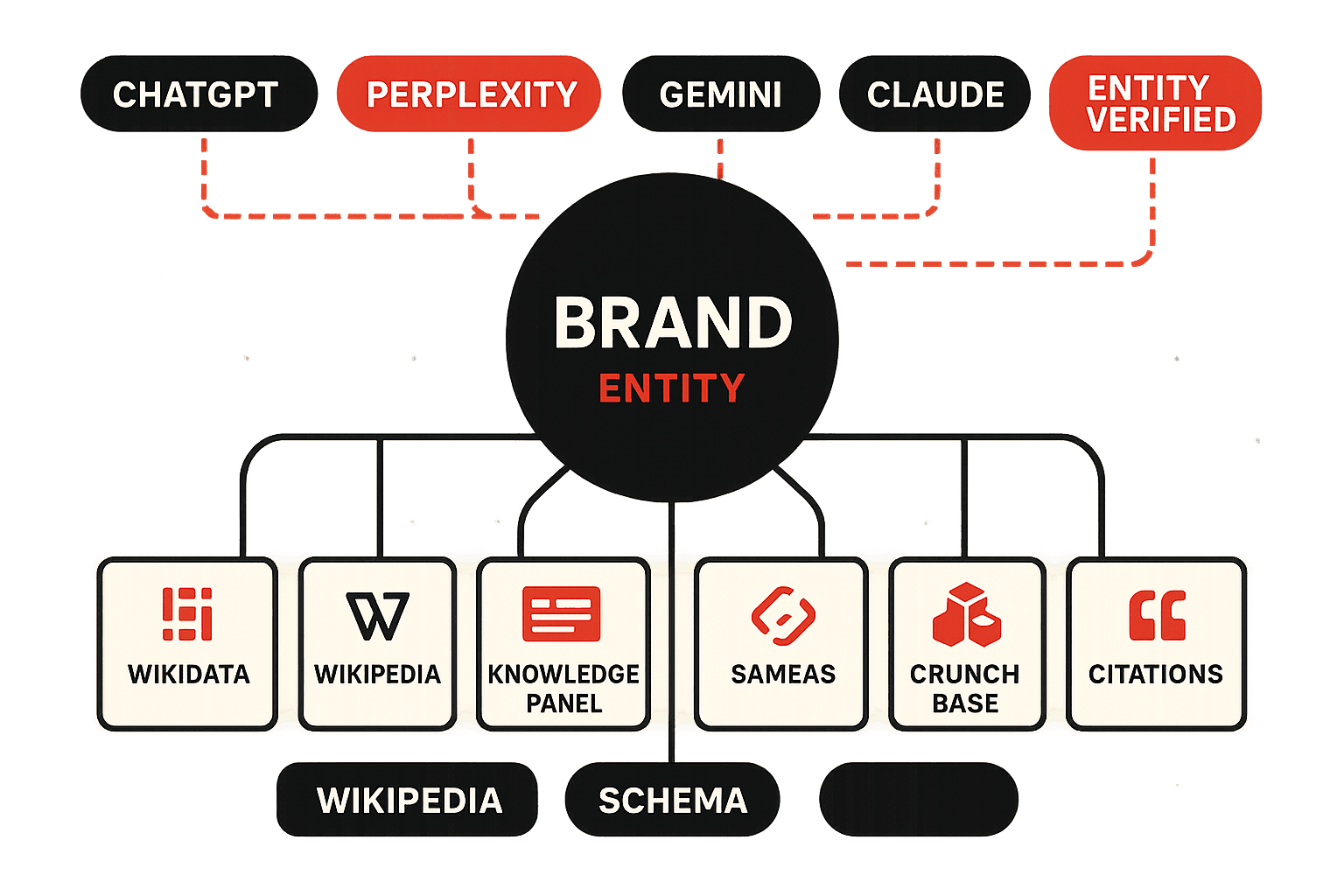
There is no single "knowledge graph" that brands optimise for. There are several overlapping graphs maintained by Google, Microsoft, OpenAI, Anthropic, and the open-source community, and each one is constructed from a different mix of public data sources. Across all of them, the same seven assets are the highest-leverage entity signals in 2026. The diagram below maps them and shows how each one feeds the AI engines.
The seven assets are not equally weighted, and the order in which to attack them depends on what your brand already has. Here is how each one functions, what it costs to build, and how it shows up in AI citations.
1. Wikidata
Wikidata is the structured-data sister of Wikipedia. It is a free, open, machine-readable database of entities and their properties, maintained by the same Wikimedia community but with much lower notability standards. Almost any operating brand with a website and a basic public footprint can have a Wikidata item.
Wikidata is the single highest-leverage Entity SEO move for most mid-market brands in 2026 because it is fast (a competent editor can stand up an item in 30 to 60 minutes), durable (once stable, it persists), and disproportionately consumed by AI engines (Wikidata is in the training data for every major LLM and is also actively queried by some live retrieval systems). A well-formed Wikidata item with five to ten sourced statements and a complete sameAs chain is often the difference between an engine recognising the brand as an entity at all versus treating it as an unresolved string.
The minimum viable Wikidata item: label, description, aliases, instance-of statement, country, headquarters, official website, founder, founding date, industry, and a sameAs block linking to LinkedIn, Crunchbase, X, and your owned site. Cite each statement with a reliable source.
2. Wikipedia
Wikipedia is the strongest single entity asset because every major AI engine pulls Wikipedia content directly into both training data and live retrieval, and because Wikipedia citations carry disproportionate authority in the engines' source-quality scoring.
The trade-off is notability. Wikipedia's notability standards require that a subject be the focus of significant coverage in multiple independent reliable sources. For most mid-market brands, that bar is real and you should not attempt a Wikipedia article unless you can produce four to six pieces of substantive third-party editorial coverage that pass Wikipedia's reliable-sources test. Trying and failing burns the namespace (the AfD discussion becomes a Google result) and rarely succeeds on a second attempt.
When to attempt: founder is a recognised industry voice with named press coverage, brand has been the subject of feature-length pieces in major publications, brand has won category-defining awards from independent bodies, or brand has a 5 to 15 year history with documentable category influence. If two or more of those are true, attempt. Otherwise, build the rest of the entity stack first and revisit Wikipedia in a year.
3. Google Knowledge Panel
The Knowledge Panel is the entity card that appears on the right side of Google's branded SERP. It is rendered from the Google Knowledge Graph, which is constructed from a mix of Wikidata, Wikipedia, structured data on the brand's own site, and confirmed third-party signals.
Two distinct moves are needed. First, get the Knowledge Panel to appear at all (this is downstream of the Wikidata, Wikipedia, schema, and citation work above). Second, claim the Knowledge Panel through Google's claim flow, which lets you suggest edits, manage the displayed image, and link the panel to a verified social presence. A claimed and curated Knowledge Panel is a reliability signal that AI engines do appear to weight, particularly Google's own AI Overviews.
4. Schema and sameAs on Your Owned Site
The owned-site layer of Entity SEO is JSON-LD schema markup with sameAs properties that explicitly link your entity to its external authoritative records. The minimum sameAs target list for a brand entity is Wikipedia (when it exists), Wikidata, LinkedIn company page, Crunchbase, X profile, Facebook page, official YouTube channel, and any industry-specific authoritative database (Bloomberg, Pitchbook, Capital IQ, App Store, Play Store, GitHub for developer tools, ProductHunt for product brands).
The Organization schema goes on the site root or the about page. Person schema (with the same sameAs discipline) goes on dedicated person hub pages for the founder and senior executives. Product schema (where applicable) goes on product pages. We have written about the broader Person hub pattern and the underlying schema discipline is the same one we use across all entity classes.
5. Crunchbase, LinkedIn, and Industry Databases
These are the structured third-party databases that AI engines pull from heavily. A complete and current Crunchbase company entry (founded date, funding rounds, leadership, industry tags, headquarters, employee count band) is a required entity reinforcement asset for any brand serious about AI search. The same applies to a complete LinkedIn company page with consistent metadata and a populated People tab.
For category-specific brands, identify the two to four most authoritative databases in the category (G2 and Capterra for B2B SaaS, ProductHunt for product brands, Bloomberg for finance, ClinicalTrials.gov for healthcare research, NASBA for accounting firms, and so on) and ensure complete current entries on each.
6. Third-Party Brand Citations
Third-party brand citations are mentions of your brand in the body of editorial content on category-relevant publications, where the mention is in a substantive context (a review, a roundup, a category overview, a case study) rather than a syndicated press release.
The volume and quality bar: a mid-market brand needs a steady cadence of four to eight new substantive third-party brand citations per quarter to maintain entity reinforcement signal. The publications that matter are the ones that are themselves cited by AI engines (you can identify these by running the AI citation tracking discipline against your category prompts and noting which publications appear repeatedly in the cited sources). Investment in placements on those publications is structurally higher-leverage than placements on publications that AI engines do not cite.
This is where the Digital PR replaces link building thesis lands operationally. The work is real, ongoing, and not optional for entity reinforcement.
7. Brand SERP Control
The brand SERP (the Google results page for your exact brand name) is the third-party validation surface that engines and humans both use to confirm the entity. A brand SERP that surfaces consistent positive metadata across the top ten results is reinforcing the entity. A brand SERP fragmented across negative content, out-of-date entries, look-alike brand confusion, or thin content is weakening it.
We covered the operational playbook in Brand SERP Defense. For Entity SEO purposes, the headline is that the brand SERP is the visible expression of the underlying entity record, and the engines treat them as connected. A weak brand SERP usually means a weak entity.
Wikidata vs Wikipedia: The Decision Matrix
The single most common Entity SEO mistake we see in initial audits is teams attempting Wikipedia before they have built the surrounding scaffolding, then either failing the AfD (Articles for Deletion) discussion or producing a stub article that gets demoted or deleted within months. The decision matrix below is the version we walk every client through.
The two operational rules that fall out of this matrix:
Rule 1: Wikidata before Wikipedia, always. A clean Wikidata item can be defended even when the brand does not yet meet Wikipedia's notability bar, and it carries the bulk of the AI-engine entity signal that Wikipedia would carry, on a one-day timeline rather than a six-month timeline. Build the Wikidata item first, then revisit Wikipedia 6 to 12 months later when the third-party coverage stack has matured.
Rule 2: If you attempt Wikipedia, hire someone who has done it. Wikipedia editorial culture is specific and unforgiving to first-time editors with promotional intent. The probability of an article surviving its first AfD discussion goes up significantly when the editor has a positive track record on the platform and knows how to navigate the conflict-of-interest disclosure, the reliable-sources guideline, and the notability burden. This is one of the few cases in Entity SEO where bringing in a specialist materially changes the outcome.
The sameAs Chain: The Cheapest Win in Entity SEO
If you have time for one Entity SEO move this quarter, do the sameAs chain. It is fast, it is cheap, and the engines weight it heavily because it is the most reliable signal that the disparate references to your brand across the open web all refer to the same entity.
The sameAs property in JSON-LD lets you explicitly declare external URLs that represent the same entity as the one being marked up on your page. A correctly implemented Organization schema block on your homepage with a complete sameAs array might look like this:
{
  "@context": "https://schema.org",
  "@type": "Organization",
  "@id": "https://www.yourbrand.com/#organization",
  "name": "Your Brand",
  "url": "https://www.yourbrand.com/",
  "logo": "https://www.yourbrand.com/logo.png",
  "sameAs": [
    "https://www.wikidata.org/wiki/Q123456789",
    "https://en.wikipedia.org/wiki/Your_Brand",
    "https://www.linkedin.com/company/yourbrand/",
    "https://www.crunchbase.com/organization/yourbrand",
    "https://x.com/yourbrand",
    "https://www.facebook.com/yourbrand",
    "https://www.youtube.com/@yourbrand",
    "https://github.com/yourbrand"
  ]
}
Three implementation rules. First, the URLs in sameAs must resolve and must contain reciprocal references back to the canonical entity (your homepage URL or your sameAs entry on the external property). One-way claims weaken the signal. Second, all sameAs targets must use canonical URLs (no tracking parameters, no shortened links, no mobile subdomains where a desktop URL is the canonical form). Third, run the markup through Google's Rich Results Test and Schema.org's validator before deploying, since a syntactically broken sameAs array silently fails to be parsed at all.
The Person variant of this schema (used on founder, senior executive, and named-author hub pages) follows the same structure, with sameAs targets pointing to LinkedIn personal profile, X profile, Crunchbase Person profile, GitHub for technical founders, Wikidata Person item, and any industry speaker or contributor database entries. We use this pattern on the Aditya Kathotia hub page and on every author byline schema across the site.
Common Entity SEO Mistakes That Quietly Wreck the Program
Across audits we have run on prospective clients, six mistakes account for the vast majority of weak entity signals. Each one is fixable inside a quarter.
Inconsistent entity metadata across owned and earned properties. Brand name spelled three different ways across LinkedIn, Crunchbase, X, and the website. Founder name listed with and without middle initial across press, conference bios, and Wikidata. Founding date listed differently on the about page and the LinkedIn company page. The fix is the canonical entity sheet described in the FAQ above. Run it once, hold every property to it.
Schema markup published without sameAs. Organization schema with name, logo, and address but no sameAs block is a half-built entity declaration. The engines have nothing to fuse the local entity to its external records with. Add the sameAs block.
Wikidata item left at minimum and never extended. A barebones Wikidata item with three statements does some work but not enough to materially move citations. The minimum target is ten to fifteen well-sourced statements covering the brand's category, geography, leadership, founding history, industry, and external IDs.
Crunchbase profile abandoned after creation. An out-of-date Crunchbase entry with stale leadership, missing recent funding, and an old website screenshot signals to engines that the entity is either dormant or unmanaged. Revisit quarterly.
Knowledge Panel claim missed for years. A Knowledge Panel that is appearing on the brand SERP but is unclaimed (no verified social presence, no managed image, no suggested-edit history) is undermanaged equity. The claim flow takes 30 minutes for a competent SEO and unlocks ongoing entity hygiene.
Wikipedia attempt without coverage stack. Brand attempts a Wikipedia article with two press release citations and no substantive third-party coverage. AfD discussion deletes within two weeks. The brand is now flagged in Wikipedia editor culture as having attempted promotional inclusion. Subsequent attempts are harder. Wait, build the coverage stack, then attempt with confidence.
The 60-Day Entity SEO Rollout We Run for Clients
Most Entity SEO programs deliver their first measurable AI citation lift between 6 and 12 weeks from kickoff, but only if the work is sequenced correctly. Skipping ahead (writing AEO content before the entity is recognised) is the single most common cause of flat first-quarter numbers. The 60-day rollout below is the version we use across our AI SEO services engagements.
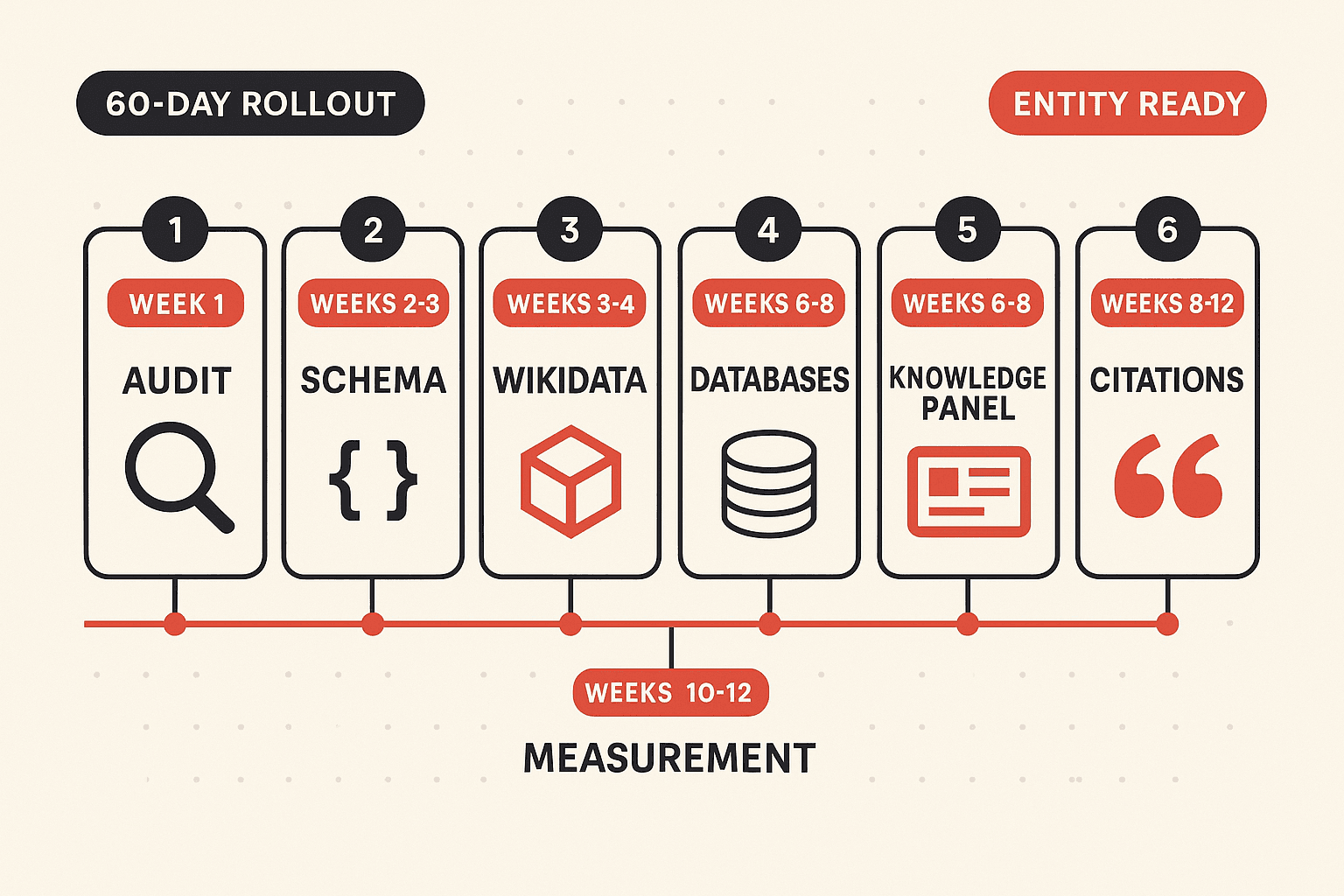
Week 1: Audit and canonical sheet. Brand SERP audit. Existing entity asset audit (does Wikidata item exist, does Knowledge Panel appear, what is the current schema state, what third-party databases have current entries, what is the inconsistency profile across owned and earned properties). Canonical entity sheet drafted and signed off by client leadership. AI citation baseline measurement run for 20 to 50 category prompts using the AI Citation Tracking framework.
Weeks 2 to 3: Owned-site schema layer. Organization schema with full sameAs block deployed on site root. Person schema deployed on founder and senior executive hub pages. Product or Service schema deployed on relevant landing pages. Validation against Rich Results Test and Schema.org validator. Internal review of canonical URL structure to ensure no canonical conflicts.
Weeks 3 to 4: Wikidata. Wikidata item created or extended. Statements added with cited sources covering category, geography, leadership, founding history, external IDs, and any awards or notable coverage. sameAs chain fully populated. Reciprocal links verified across the named external properties.
Weeks 4 to 6: Third-party database hygiene. Crunchbase entry updated or created with current leadership, funding, employee count, headquarters, and industry tags. LinkedIn company page metadata refreshed against the canonical sheet. Category-specific authoritative database entries (G2, Capterra, ProductHunt, Bloomberg, industry trade databases as applicable) updated or created. Founder LinkedIn profiles aligned to the canonical naming and bios.
Weeks 6 to 8: Knowledge Panel claim and brand SERP. Knowledge Panel claim flow completed if the panel is appearing. Brand SERP audit revisited and any displaced or out-of-date entries actively corrected (request removal or update for stale syndicated content, request takedown for content that is no longer accurate, file disambiguation requests where look-alike brand confusion exists). Brand SERP defence content (founder hub, about page, press hub) reviewed against the brand SERP top 10 and gaps closed.
Weeks 8 to 10: Third-party citation outreach. Identify the four to six category-relevant publications that are most cited by AI engines (run the AI citation tracking discipline against your category prompts and note recurring source domains). Outreach program begun for category-relevant editorial placements on those publications, with the entity reinforcement angle prioritised over the link acquisition angle. We covered the broader operational pattern in Digital PR replaces link building.
Weeks 10 to 12: Measurement and iteration. Re-run the AI citation tracking baseline. Compare against week 1 numbers. Identify which engines moved fastest, which prompt sets moved fastest, which entity assets are correlating with the lift. Document the next quarter's priorities (typically: deeper third-party citation work, Wikipedia readiness assessment, expanded Person hub program, and whatever entity reinforcement gaps the measurement surfaced).
How Entity SEO Connects to the Rest of the AI Search Stack
Entity SEO is the foundation, not the whole house. The full stack we recommend for any brand serious about AI search visibility runs in this order, with each layer depending on the one beneath it.
Layer 1: Entity SEO (foundation). Knowledge graph footprint, Wikidata, schema, sameAs, third-party reinforcement. Covered in this piece. Without this layer, the rest of the stack underperforms because the engines do not recognise the brand as an entity worth citing.
Layer 2: Topical authority and content depth. Content silos that demonstrate category expertise across the full intent spectrum. Covered in Topical Authority 2026. The entity gives the engine a record to attach the topical authority to.
Layer 3: Answer Engine Optimization patterns. Page-level structural patterns that make content extractable into AI answers (short answer blocks, definition cards, comparison tables, structured FAQs, citation-friendly source attribution). Covered in Answer Engine Optimization and the engine-specific tactics in How to Rank on ChatGPT and How to Rank on Perplexity.
Layer 4: Measurement and iteration. Structured AI citation tracking with sampled prompts, KPIs, and weekly reporting. Covered in AI Citation Tracking. This is the layer that tells you which of the lower layers is actually moving the needle, so you can reallocate investment quarterly.
A brand investing in layers 2, 3, and 4 without layer 1 is the most common pattern we see in mid-market AI search programs that produce flat results. The fix is almost always to pause new content investment for 30 days, run the Entity SEO foundation work in this piece, and then resume content with the entity layer in place.
What "Done" Looks Like for Entity SEO
The honest answer is that Entity SEO is never done, but it does have an obvious threshold of operational maturity. A brand has crossed the threshold when the following are all true:
- A Wikidata item exists with at least 12 sourced statements and a complete sameAs chain
- The brand SERP shows a claimed Knowledge Panel with curated metadata
- Organization, Person, and Product or Service schema with full sameAs blocks is deployed and validated on the owned site
- Crunchbase, LinkedIn, and the two to four category-specific authoritative databases all have current consistent entries against the canonical entity sheet
- Founder and senior executive hub pages exist with Person schema, full sameAs, and at least one published interview or feature on a recognised category publication in the last 90 days
- A baseline AI citation rate has been measured and is being tracked weekly across the four to five engines that matter for the category
- Quarterly entity hygiene cadence is on the marketing calendar (refresh Crunchbase, audit brand SERP, re-validate schema, reconcile any new third-party mentions)
A brand at this maturity level is operating its entity properly. From here, the marginal AI citation gains come from the higher layers (content depth, AEO patterns, third-party citation cadence), but the foundation under those gains is now solid.
For brands still building toward this threshold, the order of operations is the 60-day rollout above. For brands already at this threshold, the next investment is usually expanded Person hub work for additional named experts inside the company, deeper category-specific database coverage, and a sustained third-party citation cadence aimed at the publications the AI engines actually cite.
If you want help running this work end-to-end (audit, canonical sheet, Wikidata item, schema deployment, Knowledge Panel claim, third-party database hygiene, third-party citation outreach, and AI citation tracking baseline) we run it as a structured 60-day engagement inside our AI SEO services and SEO consulting practice. The same playbook ships across our SEO services retainer for brands that want it bundled with the broader organic search program.
The deal is decided inside the AI answer. The answer cites the entity. Build the entity.

Aditya Kathotia
Founder & CEO
CEO of Nico Digital and founder of Digital Polo, Aditya Kathotia is a trailblazer in digital marketing. He's powered 500+ brands through transformative strategies, enabling clients worldwide to grow revenue exponentially. Aditya's work has been featured on Entrepreneur, Economic Times, Hubspot, Business.com, Clutch, and more. Join Aditya Kathotia's orbit on LinkedIn to gain exclusive access to his treasure trove of niche-specific marketing secrets and insights.