

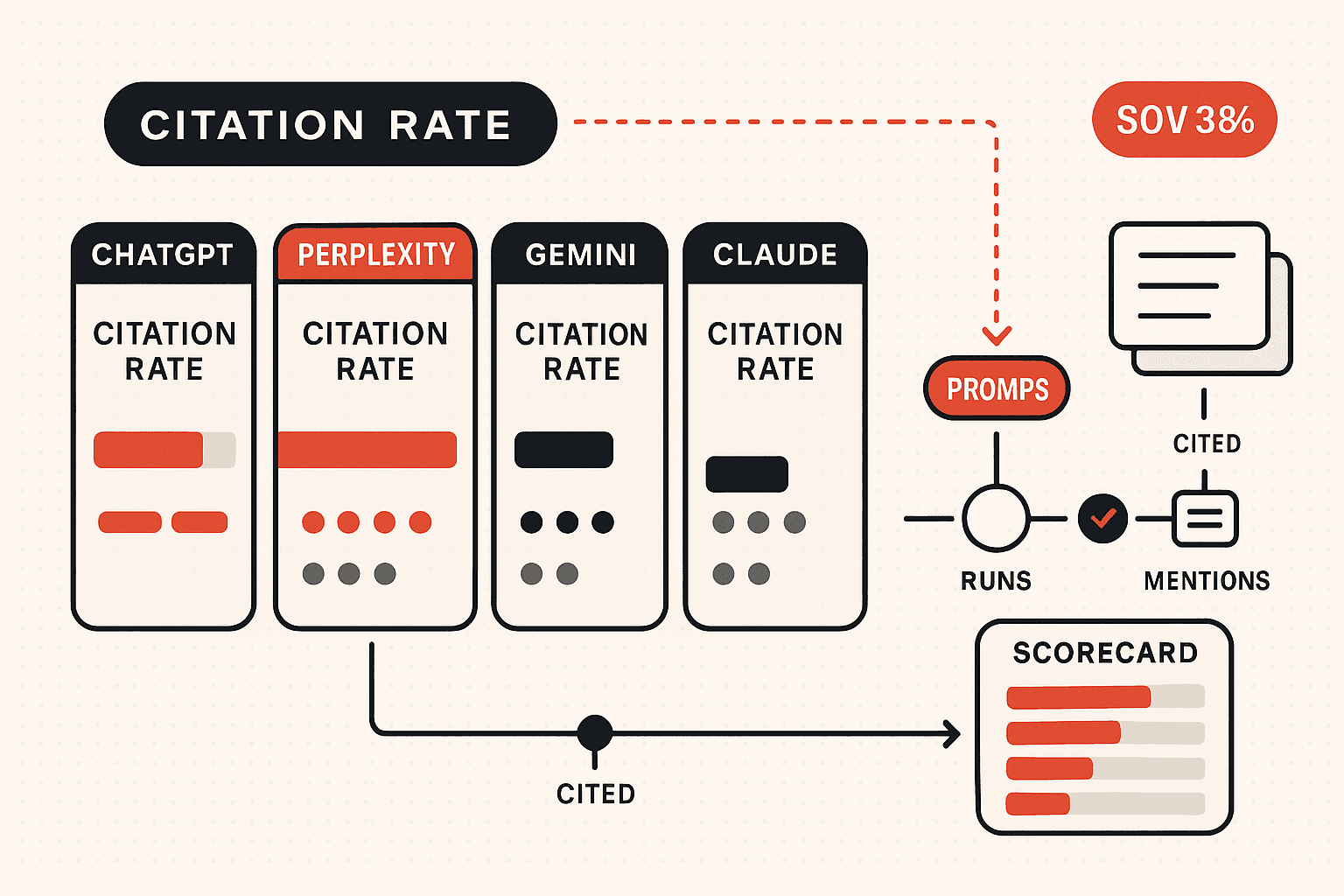
Traditional rank trackers report on the wrong surface. While a brand is celebrating page-one Google rankings, ChatGPT, Perplexity, Gemini, and Claude are answering the same buyer questions without ever mentioning it. The deal is decided inside the AI answer, not on the SERP. This is the AI citation tracking playbook: the four measurement methods (free, spreadsheet, tool, API), the prompt universe that matters, the four KPIs that actually score the AI surface, and the 30-day rollout we run for clients.
Rank tracking on Google was a solved problem by 2018. A brand pointed a tool at a keyword list, the tool reported a position number, and the marketing team argued about which positions to invest in next. The model was clean because the surface was deterministic. The same query returned the same SERP for everyone in the same geography on the same day.
AI search broke that model. The same buyer who used to type "best CRM for B2B startups" into Google now asks the same question to ChatGPT, Perplexity, Gemini, or Claude, and the answer they read is not a list of links. It is a paragraph of synthesised text that names three or four brands in the body, cites two or three sources at the bottom, and never shows a position number. The buyer makes a shortlist decision off that paragraph. The brands inside the paragraph go on the shortlist. The brands not inside the paragraph do not.
Two changes here are quietly destroying SEO programs that have not adapted. First, the same prompt returns slightly different answers on different runs (non-determinism is a feature of how the underlying models generate text, not a bug). Second, there are now at least five major engines (ChatGPT, Perplexity, Gemini, Claude, Copilot) and several smaller ones (You.com, Brave, DeepSeek, Mistral Le Chat) that all sample from different blends of training data, live web search, and partnership data. The single-rank-per-keyword measurement that Google taught us is structurally wrong for this surface.
The fix is AI citation tracking: a structured measurement discipline that samples each engine multiple times per prompt, aggregates the runs into citation rates and share-of-voice scores per engine per prompt set, and rolls up to a weekly brand-level scorecard that sits next to Google Search Console and GA4 in the marketing dashboard.
This piece is the operating manual. It covers the four measurement methods (free manual, spreadsheet, paid tool, custom API), the prompt universe you have to build, the four KPIs that actually matter, the common reporting mistakes that quietly kill the program, and the 30-day rollout sequence we have used for 22 clients between 2025 and early 2026. It assumes you have read or will read the strategy side in How to Rank on ChatGPT, How to Rank on Perplexity, and the underlying mechanic in The AI Search Gap.
Why Rank Tracking Misses the AI Surface
Google ranking and AI citation are not the same signal and are not solved by the same work. The single biggest mistake we see in 2026 audits is a marketing team that assumes high Google rankings translate into AI citations by default. They do not. We have client data on 40 mid-market B2B and D2C brands where the correlation between Google rank position and AI citation rate on the same prompt is weaker than a coin flip on most engines.
There are four structural reasons for the gap.
AI engines do not read the SERP linearly. Google rank tracking assumes the engine looks at the top ten organic results in order. AI engines do not. ChatGPT search mode pulls from Bing's index, weights the result set against the model's training-data prior, and writes a synthesis. Perplexity runs a parallel retrieval against multiple indexes (Brave, Bing, sometimes Google partnership data), scores each candidate source for citation-worthiness, and picks the two to five sources that get cited in the answer. Gemini AI Overviews use Google's index but apply a heavy quality and freshness filter that promotes some sources while completely dropping others. The result is that a page ranking position three on Google can be entirely absent from the AI engine's answer, while a page ranking position fifteen but with stronger entity reinforcement can be the one that gets cited.
Training data weighting beats live search on long-tail queries. A meaningful share of ChatGPT and Claude answers, particularly on definitional and category-level queries, comes from the model's training data rather than live web search. That means brand mentions in older content (Reddit threads from 2022, Wikipedia, Crunchbase, industry trade publications that were heavily crawled before the training cutoff) often beat fresh content from a brand's own site. Rank tracking does not measure training-data presence at all.
Source diversity is engineered into the answer. Perplexity and Gemini both have explicit mechanisms to diversify the source mix in their citations, which means even if a single page ranks position one on Google, it might only be selected for the citation half the time because the engine is intentionally pulling a second or third source from a different publisher. Rank tracking assumes the position-one page wins every time. The AI surface specifically does not work that way.
Brand mention does not require a click. The most important commercial point. An AI engine can name your brand inside an answer paragraph without citing a source URL at all. The buyer reads "the leading vendors in this category are Brand A, Brand B, and Brand C" and adds you to their shortlist. There is no click, no Google rank, no GA4 referral row. The deal moves and nothing in your traditional measurement stack registers the event. Without AI citation tracking, this entire mechanic is invisible to the marketing team.
This is why a separate measurement discipline is required. Rank tracking is not wrong. It is just measuring a different surface that no longer carries the full decision.
The Four AI Citation Tracking Methods, Compared
There are four practical methods for tracking AI citations as of 2026, and which one is right depends on prompt volume, engine coverage requirements, budget, and how much in-house engineering capacity exists. The table below is the comparison we use with clients before recommending a method.
The four methods, expanded.
Method 1: The Free Manual Method
This is the right starting point for any brand that has never tracked AI citations. It costs almost nothing and produces a directionally honest baseline within two hours.
The motion is simple. You sign up for paid accounts on ChatGPT, Perplexity, and Gemini (the free tiers will not give you reliable answers on the live-search mode that matters). You build a prompt list of 20 to 30 high-priority category queries (more on the prompt universe below). You run each prompt three times per engine, in incognito or with personalisation turned off, capturing the answer text and the cited sources into a Google Doc or Notion table. You scan the captured answers for brand mentions, your competitors' mentions, and the cited sources. You roll up to a simple scorecard: how often did each brand appear, what was the sentiment of the mention, and which sources were cited.
The motion takes about two hours the first time. Once a week, you re-run the same prompts and compare week over week. After four weeks you have a meaningful trend line.
Where this method fails. It does not scale beyond 30 prompts per week without burning a team member's time. The number of runs per prompt is too low to produce statistically reliable answers on non-deterministic engines (a brand can be mentioned in 1 of 3 runs and you do not know whether the citation rate is 33 percent or 5 percent). And there is no way to track the same prompt set across more than two or three engines without the manual time becoming prohibitive.
But for the first 30 to 60 days of an AEO program, the free manual method is honest enough to detect the trend that matters: are you moving from "rarely cited" to "sometimes cited" to "frequently cited"? That signal alone is worth the two hours per week.
Method 2: The Spreadsheet Method
The intermediate step. Same prompt-and-capture motion, but you build a structured Google Sheet or Airtable base that codifies the data model and adds basic automation around the manual work.
The data model has four tables. A prompts table (prompt text, intent type, priority, owner, target engines). A runs table (one row per prompt-per-engine-per-run, with timestamps and answer text). A mentions table (one row per brand-mention-in-a-run, with sentiment classification and position-in-answer). A sources table (one row per cited source URL with publisher, owned-vs-third-party flag, and authority score).
The automation layer is light. A few Apps Script or Airtable formulas roll up the citation rate per brand per engine per week. A pivot table produces share of voice. A daily reminder emails the analyst the prompt list.
What this buys over the free manual method is consistency, history, and the start of comparability across engines. You can run 30 to 80 prompts per week sustainably. You can hand the spreadsheet to a successor when the analyst rotates. You can produce a weekly screenshot for the marketing leadership report.
Where it still fails. The runs are still being captured by a human pasting answers into rows, which means sentiment classification is subjective, position-in-answer is hand-coded, and three runs per prompt per engine is the realistic ceiling. The spreadsheet method is the right tool for brands that have done 60 days of free manual tracking and need to scale before justifying a paid tool budget.
Method 3: The Paid Tool Method
This is where most growth-stage brands settle. The 2026 tool landscape now has a recognisable set of dedicated AI citation tracking tools, and the category is maturing fast.
The leading tools, with what each is genuinely good at.
Profound is the most established player. Strong on share-of-voice methodology, prompt-set construction, and aggregation across major engines. Best for B2B and agency programs that need clean executive reporting.
Otterly.ai is the simplest to set up and runs cheaply for smaller prompt sets. Best for early-stage AEO programs and content teams that want a self-serve view without analyst overhead.
AthenaHQ focuses heavily on brand and category share-of-voice with strong competitor benchmarking. Good for brands that are already running AEO and want a competitive lens on the program.
Peec.ai has stronger European coverage and is the right pick for brands targeting EU markets where local-language citation tracking matters.
BrightEdge AI added AI Overview and AI search tracking to the existing enterprise platform. The right pick for brands that already use BrightEdge for Google rank tracking and want one stack.
SE Ranking, Semrush, Ahrefs have all added AI Overview tracking and partial ChatGPT or Perplexity tracking as 2025-2026 product additions. Coverage is shallower than the dedicated tools but workable if you already pay for the base platform.
What the paid tools buy. Higher run counts per prompt (5 to 10 runs is standard, which produces statistically reliable citation rates). Five to seven engine coverage out of the box. Automated sentiment classification with reasonable accuracy. Pre-built share-of-voice and competitor scorecards. Weekly automated reports. Most tools sit between $300 and $2,000 per month for mid-market prompt volumes.
What they do not buy. None of them currently solves vernacular language tracking well, especially for Indian regional languages. None of them perfectly captures the training-data-weighted layer of ChatGPT (the answers that come from the model itself rather than from web search) because that layer is structurally hard to sample. And the prompt set you load in is still the single biggest determinant of whether the dashboard tells you anything useful, which is why even with a paid tool, the prompt universe work below is non-negotiable.
The honest framing: a paid tool is the right call for most brands once the prompt universe has been built and 60 days of manual tracking has clarified what to actually measure. Paying for a tool before that work is done is one of the most common money-wasting mistakes we see in 2026 audits.
Method 4: The Custom API Method
The enterprise method. Build the tracking pipeline yourself using the OpenAI, Anthropic, Google Gemini, and Perplexity APIs (or a hybrid of API and browser-automated sampling for engines like AI Overviews that do not have a clean API).
The structural advantages are real. Run counts per prompt are limited only by your API budget, which means 10 to 50 runs per prompt is feasible for high-priority queries and produces very tight confidence intervals on citation rate. Engine coverage is whatever you decide to build. Vernacular and long-tail markets can be supported natively. Sentiment classification and source-extraction logic can be tuned to your category in ways that no off-the-shelf tool can match.
The structural disadvantages are also real. Setup is a 3 to 8 week engineering project, not a weekend script. Maintenance is ongoing because engine APIs change, rate limits move, and the underlying models update. The sampling logic for engines without clean APIs (Google AI Overviews, Microsoft Copilot in some surfaces) requires browser automation infrastructure that adds operational complexity.
Where the custom API method is genuinely right: enterprise programs that need vernacular language coverage, prompt volumes above 500 per week, or category-specific scoring logic that no tool supports. For everyone else, the paid tool method is the better trade.
We covered the underlying technical mechanic of why engines pull from different surfaces in the Should you block GPTBot, ClaudeBot, PerplexityBot breakdown, which is recommended reading before deciding whether your team can plausibly run the custom API method.
The Prompt Universe Is the Whole Game
The most important thing in an AI citation tracking program is the prompt list. Everything else, including the choice of method, the tool selection, and the dashboard structure, is downstream of the prompt list. A 200-prompt list with the wrong prompts produces a dashboard that makes you feel measured without actually measuring anything that matters commercially.
A useful prompt universe has five layers.
Layer 1: Category-defining queries. The 5 to 15 prompts that describe the category your brand is competing in, with no brand name attached. Examples for a B2B CRM brand: "best CRM for B2B startups," "CRM alternatives to HubSpot," "which CRM integrates with Slack." These prompts are the highest-leverage measurement target because they capture the moment a buyer is asking the AI engine to name the category leaders. If you are not mentioned here, the deal almost never starts.
Layer 2: Solution-mode queries. The 10 to 25 prompts where a buyer describes a problem and asks the engine to recommend a solution. Examples: "how do I track marketing-qualified leads across multiple channels," "what is the best way to score B2B leads automatically." These prompts measure whether your brand appears in the answer to the buyer's underlying problem, not just to the category-name query. Solution-mode citation is harder to win but more durable when you do.
Layer 3: Comparison and alternatives queries. The 8 to 20 prompts that name a competitor and ask for alternatives. Examples: "alternatives to Salesforce for small teams," "competitors of HubSpot," "is Pipedrive better than Salesforce." These prompts measure your ability to be inserted into a comparison conversation that started without you. They are also disproportionately important because the buyer is in active vendor-selection mode.
Layer 4: Brand-and-attribute queries. The 5 to 15 prompts that include your brand name and ask a specific question. Examples: "is Brand X reliable," "does Brand X integrate with Y," "Brand X pricing." These prompts measure whether the AI engine has a coherent and accurate description of your brand, and whether the description aligns with what you want buyers to read. Brand-and-attribute prompts are also a leading indicator of brand SERP defense quality, which we covered in our piece on brand SERP defense.
Layer 5: Long-tail and intent edge queries. The 20 to 60 prompts that cover specific feature, integration, industry, geography, or use-case combinations. Examples: "best CRM for SaaS companies under 50 employees," "CRM for early-stage Indian B2B startups." These prompts produce lower individual citation rates but collectively define the long tail of AI search demand and are the prompts where a newly-entering brand can score first wins.
A well-constructed prompt universe for a mid-market brand has 80 to 150 prompts, weighted heavily toward Layer 1 and Layer 3 in the early days of the program and rebalanced toward Layer 5 once Layer 1 share-of-voice climbs above 30 percent.
The prompt universe gets refreshed quarterly. New competitor entrants enter the comparison prompts. New product features generate new attribute prompts. New geographic markets generate new long-tail prompts. The prompts that have not moved citation rate for two quarters get retired.
The Four KPIs That Actually Score the AI Surface
Most AI citation tracking dashboards in 2026 are overloaded with metrics that look impressive in a screenshot but do not actually drive program decisions. Four metrics carry the whole load.
Citation rate is the entry-level metric. The percentage of runs in which your brand is mentioned at all. Useful because it tells you whether you exist on the surface. Insufficient on its own because a 100 percent citation rate where every mention is negative or where every cited source is a competitor's comparison page is not a win.
Share of voice is the comparative metric. Your brand mentions divided by the total brand mentions across all named competitors per prompt set. Useful because it controls for engine-level variance (some engines name three brands per answer, some name seven, and the ratio normalises both) and because it directly maps to the commercial question of which brand wins the buyer's shortlist. The competitor set is fixed at the start of each quarter and re-baselined each quarter.
Source attribution rate is the structural metric. Of the citations earned, what share come from sources you control (your own site, your owned media properties) versus third-party sources (review aggregators, Reddit, news mentions, competitors who mention you). A healthy program has 30 to 60 percent of citations from owned sources and the balance from earned third-party. Below 20 percent owned, the site is structurally failing to be the canonical answer to category questions, and the work is on-page AEO. Above 70 percent owned, the brand is over-reliant on its own publication and has not earned enough third-party credibility.
Sentiment distribution is the reputation metric. The split of mentions that frame the brand positively, neutrally, or negatively. Most healthy brands run at 50 to 70 percent positive, 25 to 45 percent neutral, and below 5 percent negative. The number we watch most closely is the negative percentage. A creeping climb on negative mentions is almost always traceable to a specific source the engine is reading (a Reddit thread, a particular news story, a one-star review aggregator page) and the fix is targeted reputation work on that source, not a broad content rebuild.
The four together are sufficient. Anything beyond is decoration. Position-in-answer and engine-mix coverage are useful as supporting context but should not crowd the dashboard.
Reporting Cadence and Dashboard Structure
Weekly is the right primary cadence. Quarterly is the right strategy cadence.
The weekly view has three sections. The brand scorecard (citation rate, share of voice, source attribution, sentiment, week-over-week deltas per engine). The movement section (the 3 to 5 prompts that moved most this week and the suspected cause). The action log (what we are doing about each red number).
The quarterly view has four sections. The trend chart (12-week trend line per KPI per engine). The competitive read (which competitors gained share, which lost it). The prompt universe refresh (what prompts to add, what to retire). The strategy review (where to point the next quarter's content, PR, and entity work).
The mistake we see most often. Marketing teams build a beautiful weekly dashboard and then never actually take action on the dashboard. The dashboard becomes a measurement artefact rather than an operating tool. The fix is to attach an action log next to every red KPI: which person owns the fix, by what date, with what expected lift on which prompt set. Without the action log, the dashboard is screenshot fodder.
The 30-Day AI Citation Tracking Rollout
This is the sequence we use with clients who are starting from zero.
Week 1: Build the prompt universe. Cross-functional working session with marketing, sales, and product. Layer 1 to Layer 5 prompts captured into a single sheet. 80 to 150 prompts is the right starting size. Each prompt tagged with intent, priority, and target engine. Competitor set named (3 to 7 brands). Sentiment classification rubric written in plain English.
Week 2: Run the manual baseline. The full prompt set run three times per engine across ChatGPT, Perplexity, and Gemini. Answers captured. Citation rate, share of voice, source attribution, and sentiment scored manually. The week 2 baseline is the report that defines the starting position of the program.
Week 3: Diagnose the gaps. Where is citation rate low and why. Where are competitors winning. Which prompts have no owned-source citations. Which prompts have negative sentiment. The output of week 3 is the action plan: the five to ten highest-leverage moves to make in the next 90 days. The moves typically include content gaps to fill, schema and llms.txt work, earned media to pitch, entity reinforcement, and any reputation work needed on flagged negative sources. The structural side of how those moves work is covered in What is E-E-A-T and What is llms.txt and the topical-authority side in Topical Authority 2026.
Week 4: Stand up the cadence. Either commit to the spreadsheet method for the next 60 days, or decide on the right paid tool and onboard. Either way, the weekly run cadence starts and the first weekly report ships on day 30. Action log goes live next to the dashboard. Owner assigned per red KPI.
At day 90, review the trend. Citation rate should be moving up 3 to 8 percentage points on at least one engine for at least one prompt layer. Share of voice should be moving in the same direction. If neither is moving, the strategy is wrong, not the measurement. Re-open the diagnosis.
We run this exact rollout as part of our AEO and AI search service and Answer Engine Optimization program. The full strategy frame for the broader AI search shift is in SEO vs AEO vs GEO and the underlying statistics for what is at stake are in AI Search Statistics 2026.
Common Mistakes That Quietly Kill the Program
The seven patterns we see most often when we audit an AI citation tracking setup that has been running for 3 to 6 months and not producing strategic lift.
Sampling too few runs per prompt. Non-determinism means 1 to 2 runs per prompt is statistical noise. 3 runs is a directional read. 5 to 10 runs is a reliable rate. Brands that ran the spreadsheet method and never moved to 5 runs are reporting numbers with wide enough confidence intervals that the week-over-week movement is mostly noise.
Prompt list built only by marketing. Marketing knows the category prompts. Sales knows the prompts buyers actually ask before a discovery call. Product knows the feature and integration prompts that decide vendor selection. A prompt list built only by marketing misses Layer 2 and Layer 4 almost entirely.
Confusing engine coverage with engine weighting. Tracking five engines does not mean the dashboard should report them equally. The engines should be weighted by your category's actual engine mix. For B2B SaaS targeting senior buyers, Perplexity and Claude are heavier than their raw user counts. For consumer D2C, ChatGPT and Google AI Overviews are heavier. The weighted-average citation rate is the executive number.
Tracking citation without action. The dashboard with no action log. The audit that produced 14 prompt-level findings and zero shipped fixes. Most programs die here.
Over-rotating on a single bad week. AI engines update. A model retrain can move citation rates 5 to 15 percentage points in a week with no underlying change in the brand's content. The fix is to look at 4-week rolling averages, not single-week numbers, before re-pointing strategy.
No competitor benchmarking. A program that tracks only your brand cannot tell whether a citation rate drop is a brand-specific problem or a category-wide engine shift. Share of voice solves this because the denominator normalises both.
No vernacular coverage when buyers are vernacular. Indian D2C brands serving Hindi-speaking buyers, Indonesian e-commerce serving Bahasa-speaking buyers, Latin American B2B serving Spanish-speaking buyers all need vernacular prompt coverage. Most tools do not handle this. The hybrid manual or API method is required.
The Bottom Line on AI Citation Tracking
The question is not whether to start tracking AI citations. The buyer behaviour is already there. The visibility gap is already there. Brands that wait another quarter will find that competitors who started measuring six months ago are now optimising six months ahead.
The right starting move depends on stage. For a founder-led or pre-Series A brand, the free manual method is sufficient for the first 60 to 90 days. For a growth-stage brand with a marketing analyst, the spreadsheet method bridges the gap to a paid tool. For an established brand with category competitors who have already shipped AEO programs, the paid tool method is the default and the question is which one. For an enterprise brand operating across multiple languages or with category-specific scoring needs, the custom API method is justified.
What all four methods share is the prompt universe, the four KPIs, the weekly cadence, and the action log. Without those four, the tool stack does not matter. With those four, the measurement discipline produces compounding strategic clarity quarter after quarter.
The brands we have run this program for since 2024 are the ones now showing up on category prompts in ChatGPT, getting cited in Perplexity, and named in Gemini AI Overviews. The brands that wait are not invisible because AI search broke. They are invisible because they have not yet built the measurement discipline to find out where they stand.
If you want help building the prompt universe, choosing the right tool, or running the 30-day rollout for your category, that is what we do on the Answer Engine Optimization and AI SEO services programs. We can also fold AI citation tracking into a broader Digital PR program when the bottleneck is earned media coverage rather than on-page AEO. Either way the measurement work has to be in place before the strategy work compounds.
Ready to start measuring
Find out where your brand stands on ChatGPT, Perplexity, and Gemini.
We run the 30-day AI citation tracking rollout as a standalone engagement or as the entry point to a full AEO program. The output: a category-specific prompt universe, your baseline citation rate and share of voice across the major AI engines, the diagnosis of the top 10 gaps, and the 90-day action plan to close them.

Aditya Kathotia
Founder & CEO
CEO of Nico Digital and founder of Digital Polo, Aditya Kathotia is a trailblazer in digital marketing. He's powered 500+ brands through transformative strategies, enabling clients worldwide to grow revenue exponentially. Aditya's work has been featured on Entrepreneur, Economic Times, Hubspot, Business.com, Clutch, and more. Join Aditya Kathotia's orbit on LinkedIn to gain exclusive access to his treasure trove of niche-specific marketing secrets and insights.