

When a prospect hears about your brand and Googles you, the first surface they see decides whether the call happens. On most brand SERPs the brand controls less than half of what the prospect reads. Competitors are bidding on the name, review sites are ranking above the homepage, Reddit threads sit in the top five, and AI Overviews paraphrase whatever the model has read. This is the brand SERP defense playbook we run for clients, the four threat categories you have to neutralise, and the nine plays that consistently work.
There is one search query in any business where the searcher has already named you, has already cleared the awareness barrier, and is one decision short of becoming a customer. That query is your own brand name.
Almost every brand we audit treats that query as won by default. The homepage ranks first, the team assumes the surface is locked, and the SEO program focuses on non-brand traffic. Six months later a buyer types the brand name, sees a competitor ad in the top slot, a "vs alternatives" comparison page in position 2, a one-star review on G2 in position 3, and an AI Overview that summarises the brand using a Reddit thread from 2023. The deal that was already half-closed quietly stalls.
We pulled the data on 60 mid-market brands we have audited between 2024 and early 2026. On the brand SERP for their own name, the median brand owned or favourably influenced 4 of the top 10 organic positions. The other 6 belonged to review aggregators, comparison sites, competitor pages, news mentions, social profiles outside the brand's control, and Reddit. In 22 of those 60 audits, at least one competitor was actively bidding on the brand keyword. In 14 of 60, the knowledge panel either did not exist or contained outdated information. In 11 of 60, the AI Overview on the brand name paraphrased a source the brand did not control.
The opportunity is not subtle. The traffic is already named-intent. The conversion rate is 5 to 20 times higher than non-brand. The defense work is cheap compared to demand generation. The only thing missing is the discipline to treat the brand SERP as a real estate surface that has to be actively defended, not a flag you planted in 2019.
This is the audit framework, the four threat categories, the nine-play defense system, and the 90-day rollout we use to take a brand SERP from "we hope it looks okay" to "we own the surface."
What a Brand SERP Actually Is
A brand SERP is the search results page returned for your exact brand name or a close variant. The brand name is the highest-intent query in your entire portfolio because the searcher has already named you. They have heard about you, been referred to you, read a news mention, or seen an ad. They are now one click from a homepage visit and two clicks from a form submission or a checkout.
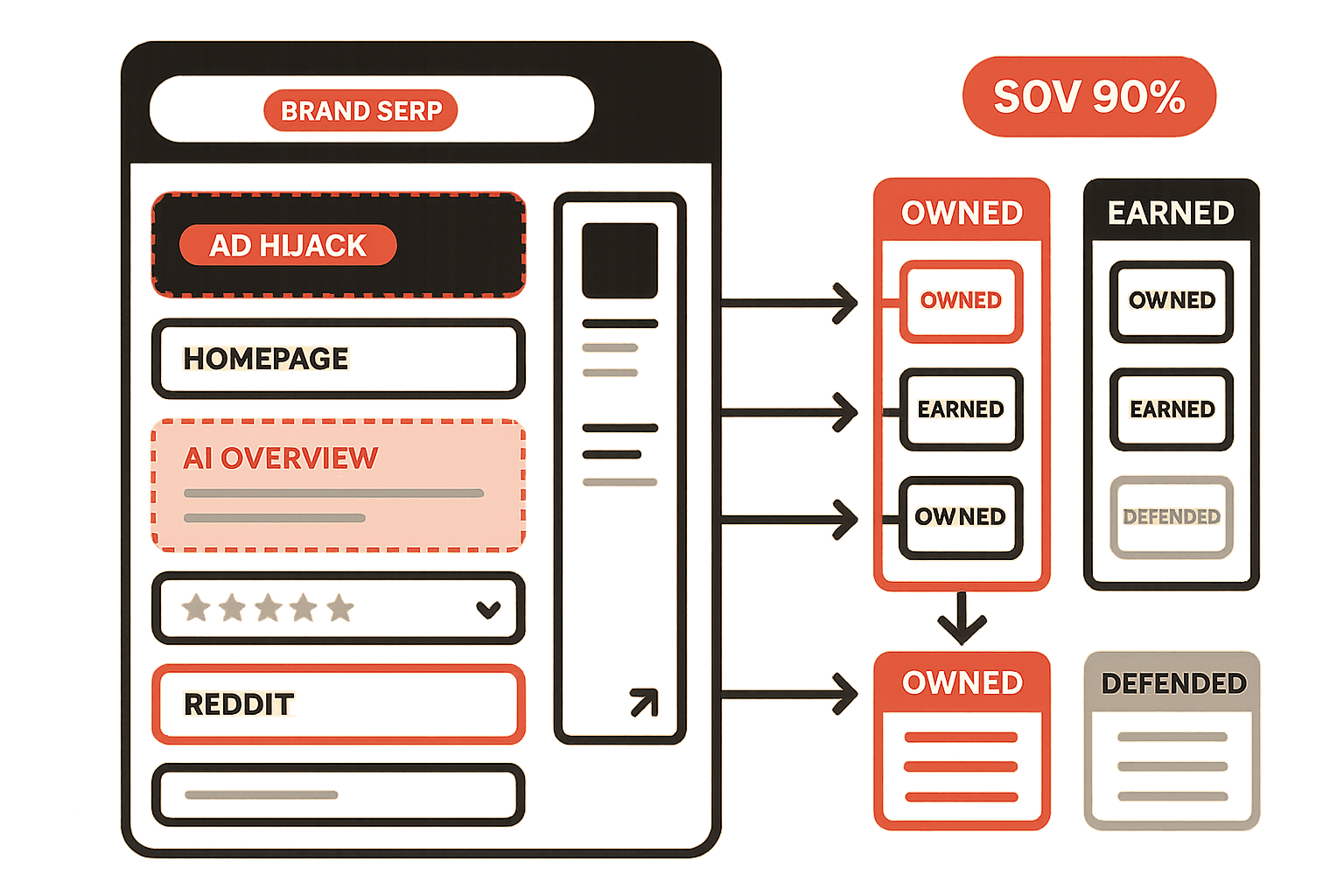
Almost every modern brand SERP contains, in some combination, ten distinct surfaces.
The first audit step is to actually look at your brand SERP, in an incognito window, from the city your buyers live in. Almost every leadership team we work with has not done this in the last 60 days, and the most common reaction when they finally do is "I had no idea this is what we looked like."
The reason most teams miss the brand SERP is that it does not show up in their dashboards. Brand search is reported as one row in Google Search Console with the highest CTR on the site, which makes it look healthy at the aggregate level. The damage is at the SERP composition level: where do the impressions and clicks go after the user sees the page. The aggregate hides which slots leak to competitors, which prospects bounce off a one-star aggregator review, which clicks an AI Overview absorbed without ever reaching your homepage.
The Four Threat Categories on a Brand SERP
Every brand SERP threat falls into one of four categories. Sorting the threats into the right category decides which play to run.
Threat 1: Paid hijacking. A competitor, affiliate, or reseller is running Google Ads on your trademark or brand keyword. The competitor ad sits above your organic result and intercepts a percentage of high-intent clicks before the searcher ever sees your homepage. In our 2026 audits, this happens on 35 to 45 percent of brand SERPs in B2B SaaS, 20 to 30 percent in agency and services, and almost universally in any vertical where comparison-shopping is normalised. The defense is twofold: file a trademark complaint with Google Ads if the bidder is using your name in the ad copy (Google enforces trademark in copy but not in keywords), and run your own brand campaign to control the top ad slot. We covered the bidding mechanics in The SERP Bidding War Trick.
Threat 2: Organic displacement. Third-party domains rank above or interleaved with your owned pages on the brand SERP. The most common displacers are review aggregators (G2, Capterra, Clutch, Trustpilot, Glassdoor), comparison and alternatives pages built by competitors or affiliates, news and PR mentions, Reddit and Quora threads, and YouTube videos. None of these are intrinsically hostile. The defense is to make sure that for every external surface you cannot remove, you control a corresponding owned surface that ranks higher, and that you have claimed your profile on every aggregator that is going to rank anyway.
Threat 3: Knowledge panel and entity drift. Google's knowledge panel for your brand contains outdated, incomplete, or wrong information. The founder is listed as a person who left two years ago. The industry classification is generic. The "Customers also search for" pulls competitor brands you actively lose deals to. The Wikidata entry has an old description. Entity drift compounds because every AI search engine, voice assistant, and structured product feed pulls from the same entity layer, so drift in one source propagates everywhere. The defense is structured entity work: Organization schema with sameAs links, a current Wikidata entry, a verified Google Business Profile, and consistent NAP across business databases. Schema Markup Secrets covers the structural side.
Threat 4: AI summary distortion. AI Overviews, ChatGPT, Perplexity, and Gemini increasingly answer "what is [brand]" or "is [brand] legit" queries with a synthesised paragraph drawn from whatever sources the model considered authoritative. The model often paraphrases a Reddit thread, a four-year-old TechCrunch article, or a competitor's comparison page rather than your About page. The result is a description of your brand that you did not write, that may be subtly wrong, and that the searcher takes as authoritative because it is presented at the top of the page. We covered the broader pattern in The AI Search Gap. Defense for this threat is the slowest and the most important: publish a clear, recent, fact-dense description of your brand on your About page and key entity pages, structure it for citation extraction, and reinforce it through Wikidata, LinkedIn, and trusted third-party mentions.
These four categories are independent. A brand can be perfectly defended against paid hijacking and still be losing deals to AI summary distortion. The audit has to check each one.
The Brand SERP Audit: Six Checks
Before defending anything, audit the actual current state. The audit is fast (90 to 180 minutes for one brand) and surfaces 80 percent of the work.
Check 1: Open your brand SERP in an incognito window from your buyer's city. Use a VPN if your buyers are concentrated outside your IP location. Screenshot the top of the page. Count how many of the top seven visible surfaces (ads + organic + AI Overview + knowledge panel) you directly own or favourably control. The median brand owns 3 to 4 of 7. The defended brand owns 6 to 7.
Check 2: Pull the branded query report from Google Search Console. Filter to queries containing your brand name. Note the impression count, click count, CTR, and average position for your top 10 brand queries. Compare CTR to the SISTRIX or AHRefs benchmark for your category (a healthy brand-name query has 35 to 65 percent CTR for the top organic result). A brand-name query with CTR below 30 percent is leaking clicks somewhere, usually to a competitor ad or a review aggregator.
Check 3: Search "[your brand] alternatives" and "[your brand] vs". These two query patterns indicate buyers in late-stage evaluation. Count how many of the top 10 results are owned by a competitor versus your own pages or neutral reviews. If competitors own more than 5 of the top 10, you are bleeding pipeline to BOFU content gaps. The fix is your own comparison page program, which we covered in Comparison Page SEO.
Check 4: Inspect the knowledge panel. Verify the founder, industry, founding date, headquarters, and the "Customers also search for" set. Check whether the description matches your current positioning. Open your Wikidata entry (search wikidata.org for your brand) and check the same fields. Drift in any of these fields propagates downstream.
Check 5: Run a brand-name AI Overview check. Search your brand name in a logged-out browser on a query Google is known to add AI Overviews to ("is [brand] legit", "what does [brand] do", "[brand] reviews"). If an AI Overview appears, copy the text and identify the cited sources. If the cited sources are not on owned domains, the AI surface is being shaped by external content.
Check 6: Audit competitor brand bidding. Run a paid-search audit on Google Ads (the Auction Insights report for your brand campaign, or SpyFu / Semrush competitive paid keyword report). List every domain that has run a paid ad on your brand name in the last 90 days. For each, note whether they are using your trademark in the ad copy (file a trademark complaint immediately) versus just bidding on the keyword (you defend with your own brand campaign).
The output of the audit is a one-page snapshot: SOV percentage, top three threats, and the priority queue for the 90-day defense rollout.
The Nine-Play Brand SERP Defense System
Brand SERP defense breaks into three groups of plays: surfaces you own, surfaces you earn, and surfaces you actively defend.
Owned surfaces (plays 1 to 3)
Play 1: Homepage and sitelinks. The homepage is the default winner of position 1 on a brand search. The optimisation work is making sure the homepage tells Google clearly what the brand is, who it serves, and what the buyer is most likely to click. The title tag should be "[Brand] - [Primary positioning]" (not "Welcome to [Brand]"), the meta description should restate the value proposition in 150 to 160 characters, the on-page H1 should match the brand's actual positioning, and the internal navigation should be stable. Stable internal navigation is what triggers Google to generate sitelinks: the six (sometimes ten) blue mini-links that appear under the homepage on a brand SERP and that often more than double brand click distribution. Sitelinks cannot be requested; they are generated when Google has high confidence in the link targets. The way to earn them is to keep the navigation consistent, link to the pages from the homepage with descriptive anchor text, and avoid orphaning key pages. We covered the inverse failure case in Orphan Page Audit.
Play 2: Brand entity pages. Five pages anchor your brand entity on the SERP: About, Team, Founder, Contact, and Careers. Each should be marked up with Organization, Person, and ContactPoint schema, sameAs links to LinkedIn / X / Crunchbase / Wikidata, and a current description that matches the brand's positioning. These pages do double duty: they rank for variants of the brand query ("[brand] founder", "[brand] team", "[brand] careers") and they feed the entity graph that knowledge panels and AI Overviews draw on. The founder page is the highest-leverage of the five because founder-name queries are common, the founder's LinkedIn often ranks next to the page, and a strong founder Person entity reinforces E-E-A-T across the entire site. Our own founder hub at Aditya Kathotia is built around this principle.
Play 3: Brand-content micro-cluster. Beyond the homepage and the entity pages, every brand has a predictable cluster of "[brand] + modifier" queries: pricing, login, reviews, alternatives, "is X legit", "is X safe", "[brand] vs [competitor]", "[brand] for [use case]". On most sites, only the first two have dedicated pages. The rest are surrendered to review aggregators and competitor comparison pages. The defense is to publish one owned page per high-volume "[brand] + modifier" query, each with the structure the SERP rewards: a comparison page for "vs" queries, a trust page for "legit" or "safe" queries, a use-case page for "for [use case]" queries. The conversion math on these pages is strong because the searcher has already named you. We covered the broader BOFU comparison architecture in Comparison Page SEO.
Earned surfaces (plays 4 to 6)
Play 4: Aggregator profiles claimed and maintained. Three of the top ten organic positions on a typical B2B brand SERP belong to review aggregators. The defense is not to demote them (Google will not let you) but to claim every profile, complete every field, keep pricing current, respond to every review (good and bad), and make sure the aggregator's snippet of your brand on the SERP reflects your positioning. The aggregators that matter vary by category: G2 and Capterra for SaaS, Clutch and DesignRush for agencies, Trustpilot and Sitejabber for D2C, Glassdoor and AmbitionBox for employer brand, Crunchbase universally. The aggregator profile is also the only surface where competitor reviews appear adjacent to yours, which is why a five-minute reply to every review compounds CTR over 18 months in a way that nothing else does.
Play 5: Wikidata, Wikipedia, and the entity layer. The knowledge panel and the AI Overview both pull from the entity graph. The most editable, highest-leverage node in that graph is Wikidata. Anyone can edit a Wikidata entry, and the quality of your Wikidata entry directly affects what Google's knowledge panel displays. The properties that matter: P31 (instance of), P452 (industry), P112 (founded by), P571 (inception), P159 (headquarters location), P856 (official website), P2002 (X username), P4264 (LinkedIn ID), P3417 (Quora topic). Wikipedia is a separate question: you cannot ethically edit your own Wikipedia entry, but you can build the citation base that a future Wikipedia editor would draw on (press coverage, industry analyst reports, founder interviews). Brands with strong Wikidata and weak Wikipedia coverage still get good knowledge panels; brands with weak Wikidata and strong Wikipedia coverage get inconsistent panels.
Play 6: Press, news, and podcast mentions. Earned media does double duty on a brand SERP. Each strong mention occupies an organic slot when the publication is high authority. Each mention also feeds the source pool that AI Overviews and AI search engines paraphrase. The leverage point is recurrence: a single TechCrunch article from four years ago is a weaker signal than four mid-tier publication articles published in the last 12 months. Founder podcast appearances are unusually high-leverage in 2026 because LLM training pipelines have started weighting transcribed audio content heavily, and a single one-hour podcast appearance can produce a richer entity description in ChatGPT than a year of blog posts. The earned-media side of brand SERP defense is what most teams call digital PR. We covered the playbook in What is Digital PR and the service offering at Digital PR Services.
Defended surfaces (plays 7 to 9)
Play 7: Paid brand defense. An always-on brand search campaign on Google Ads is the cheapest insurance policy on the internet. The campaign bids on your brand name, variants, common misspellings, and "brand + service" combinations. The ad copy controls the top slot of the SERP with a message you wrote, sitelink extensions point to your highest-converting pages, and callout extensions reinforce the positioning. The campaign should be running even if no competitor is currently bidding on your brand, because the cost of running it is trivial relative to the cost of being caught flat-footed when a competitor enters the auction. Two configuration details matter: include negative match for non-brand and competitor terms so the campaign does not leak budget, and structure the bidding so impression share never drops below 90 percent on your exact brand match. The conversion math on a brand campaign is dramatic. We typically see brand CPL at one-fifth to one-tenth of non-brand CPL, with a 3x to 5x higher MQL-to-SQL rate. The campaign also feeds clean conversion data back to Google's algorithm, which improves performance across the rest of the account. For the landing-page side of paid brand defense, our PPC Landing Page Audit breakdown applies directly.
Play 8: Trademark and complaint workflow. Google Ads allows competitors to bid on your trademarked brand name as a keyword, but enforces against the use of your trademark in the ad copy itself. Most competitors who bid on your brand will use your name in the headline because it raises CTR. Filing a Google Ads trademark complaint (the form is at support.google.com/adspolicy/troubleshooter/1722734) removes the brand name from the ad copy and immediately drops the competitor's CTR and Quality Score. The complaint is free, takes 10 minutes, and is one of the highest-ROI 10-minute tasks in marketing. Run the sweep quarterly. The same workflow applies to Meta, LinkedIn, and Bing. Beyond paid ads, the brand should have a DMCA-takedown process for content scrapers republishing the site, and a UDRP process for cybersquatters registering brand-adjacent domains. None of these are glamorous but each removes a hostile surface from the brand SERP over time.
Play 9: AI surface defense. The fastest-moving surface on the brand SERP is the AI Overview, the ChatGPT brand summary, and the Perplexity brand card. Each of these is generated by a model paraphrasing whatever sources it considered authoritative. The defense is to make sure the model has a current, fact-dense, citation-friendly source to paraphrase from, and that source is on a domain you control. Five tactics work: (a) publish a brand-summary block on the About page that begins with a clean definition sentence ("[Brand] is a [category] [serving / for] [audience], founded in [year], headquartered in [city]") and follows with 60 to 120 words of supporting fact density; (b) mark up the About page with Organization, ContactPoint, and (if applicable) Person schema; (c) maintain an llms.txt and a llms-full.txt that explicitly describes the brand and links to canonical sources (we covered the spec in What is llms.txt); (d) publish a structured FAQ on "what is [brand]", "is [brand] legit", "who founded [brand]" so the model has a literal Q-and-A to extract from; (e) reinforce the source pool with recurring earned media in publications that AI training pipelines weight heavily (mid-tier industry publications, peer-reviewed analyst reports, founder podcast appearances). A small number of brands have started actively blocking AI crawlers from their content, but for most brands that strategy is self-defeating because it removes the brand from the AI-citation pool entirely. We covered the trade-offs in Should You Block GPTBot, ClaudeBot, PerplexityBot. The structural answer for most brands is to be present in AI search but to control what the AI is paraphrasing. For the service offering, see Answer Engine Optimization and AI SEO Services.
The 90-Day Brand SERP Rollout
The defense system works when it is rolled out in a specific sequence. Trying to ship all nine plays at once dilutes attention and slows the first wins, which delays leadership confidence in the program.
Days 0 to 14: Audit and fast wins. Run the six-check audit and produce the one-page snapshot. Ship the immediate fixes: homepage title and meta description rewrite, Organization schema deployment with sameAs links, Google Business Profile completion, top three aggregator profiles claimed, brand Google Ads campaign launched with sitelinks and callouts, trademark complaint filed against any current paid bidders using brand in copy. Quick wins are visible inside 7 to 14 days and create the political capital for the longer structural work.
Days 15 to 45: Owned surface expansion. Build out the brand entity pages with the right schema (About, Team, Founder, Contact, Careers). Publish the first three pages of the brand-content micro-cluster: "[Brand] pricing", "[Brand] reviews", and "[Brand] vs [top competitor]". Maintain a steady cadence of two new brand-cluster pages per week through day 45. Each page is short (800 to 1,400 words) but specific, with a single clean answer to the brand-modifier query the searcher is running.
Days 30 to 60: Earned surface and entity reinforcement. Build out the Wikidata entry with full P-property coverage. Submit the brand to the major industry directories and analyst databases that Google trusts for entity validation. Ship a founder-focused PR push: three founder podcast appearances and two earned-media placements in trusted publications. Begin a quarterly trademark-complaint sweep cadence. These actions compound over 60 to 120 days as the entity layer reinforces.
Days 45 to 90: AI surface defense and measurement. Restructure the About page with the AI-citation framework (definition sentence + fact-dense paragraph + Q-and-A block + schema). Deploy llms.txt and llms-full.txt. Run a baseline ChatGPT, Perplexity, and Gemini check on brand queries and capture the descriptions and citations the models are producing today. Re-run weekly through day 90. Stand up the measurement dashboard for the five brand SERP KPIs.
By the end of day 90, a well-executed program will move brand SERP SOV from a typical baseline of 30 to 45 percent to 70 to 85 percent. The remainder is structural and accrues over the next two quarters.
The KPIs That Actually Move the Business
The metric set most brands inherit for brand search is one number from Google Analytics: branded traffic. That number is too aggregated to inform any decision. The five KPIs that matter are these.
Brand SERP share of voice. Of the top 10 organic positions and the top 4 ad slots on the brand SERP, what percentage are surfaces you own or favourably influence. Measure with a screenshot quarterly. A healthy program is 75 to 90 percent. A program at 30 to 50 percent is leaking pipeline.
Brand search CTR to owned landing pages. From Google Search Console, the CTR for your top 10 brand-name queries to the homepage and brand-cluster pages. The benchmark is 35 to 65 percent for the top organic result on a brand-name query. CTR below 30 percent indicates click leakage somewhere, usually to a competitor ad or an aggregator above you.
Paid brand defense CPL ratio. The cost per lead from your brand Google Ads campaign divided by the cost per lead from your non-brand campaigns. A healthy ratio is 0.1 to 0.3 (brand CPL is one-tenth to one-third of non-brand CPL). A ratio above 0.5 means the brand campaign is either misconfigured (wrong negative matches, wrong landing pages) or the brand SERP organic positions are so strong that the paid campaign is mostly catching what would have converted organically.
AI Overview citation rate on brand queries. On the set of branded queries Google has started serving AI Overviews on, what percentage of overviews cite a source you control. Run a manual check monthly on 20 to 30 brand-modifier queries; tools like Profound, Otterly, and our own ChatGPT Citation Tracking Tool automate the broader cadence. A healthy program is 60 to 85 percent cited by owned sources.
Self-reported brand SERP influence on closed-won deals. A single yes-or-no field in your CRM intake form: "did you search for us online before this call." Tagging closed-won deals against this field reveals what percentage of revenue is downstream of the brand SERP and what the cost of a SERP defense gap looks like in dollars. In our 2026 audits, 35 to 70 percent of closed-won deals had a search step in the buyer journey, depending on the category. The brand SERP is therefore the highest-leverage marketing surface in those businesses, often by a factor of 5 to 10 against the surface most of the marketing budget is going to.
The Common Mistakes That Quietly Lose Deals
Brand SERP defense fails in predictable ways. These are the patterns we see most often in audits.
Mistake 1: Assuming organic position 1 means the SERP is defended. Position 1 on a brand search captures 30 to 65 percent of clicks. The other 35 to 70 percent are distributed across the ad block, the AI Overview, the People Also Ask, the knowledge panel, and the rest of the organic results. Position 1 is necessary, not sufficient.
Mistake 2: Refusing to run a paid brand campaign because "we already rank first." This is the single most common mistake we see in mid-market B2B. The brand campaign costs are tiny relative to the conversion math, and the moment a competitor enters the auction, the brand without a defense campaign loses the top slot for as long as it takes the team to react. Run the campaign as insurance, not as offence.
Mistake 3: Treating the knowledge panel as out of your control. Knowledge panels are populated from entity sources you can directly influence: Organization schema, Wikidata, Google Business Profile, social profiles, structured citations. The work is unsexy but the leverage is high because the panel is the first thing a high-intent buyer reads.
Mistake 4: Building "[brand] vs [competitor]" pages only after the competitor builds them. Comparison pages are easier to rank when you publish first. The brand that owns its own "vs" page consistently outranks competitor "vs" pages over 90 to 180 days because the page on the named brand's own domain has stronger entity association. Waiting until the competitor publishes the page is structurally late.
Mistake 5: Ignoring AI Overviews because traffic is still healthy. AI Overview adoption on brand queries is at 18 to 25 percent and climbing. By the time the traffic data shows a problem, the brand description in the AI surface is hardened around whatever sources the model considered authoritative six months ago. The defense work has to happen before the surface is locked in.
Mistake 6: Treating brand SERP defense as a one-time project. Brand SERPs drift. New aggregators appear, new competitors enter the bidding auction, news cycles change the source pool AI models draw from, knowledge panels desync after a refresh. The realistic program is a quarterly audit and a continuous earned-media cadence, not a 90-day project that ends. The brands that compound their brand SERP advantage are the ones that treat it as a recurring operational discipline rather than a launch.
What Brand SERP Defense Looks Like at the Right Standard
A defended brand SERP looks like this. The top ad slot is your own brand campaign. The first three to four organic positions are your homepage (with sitelinks), your About page, your founder or team page, and one brand-content cluster page. The knowledge panel is current and references the correct founder, industry, and "customers also search for" set. The AI Overview, when present, paraphrases a description from your About page and cites your own domain as the source. The aggregator results below the fold link to claimed and well-maintained profiles. The Reddit thread, if there is one, has a measured founder response and a recent positive update. The total surface is 7 to 8 of the top 10 slots either directly owned or favourably influenced by the brand.
That is a SERP that converts. That is also a SERP that almost no brand has, and that almost any brand can build in 90 to 180 days with the playbook above. The cost is small relative to the demand-generation budget that produced the brand search in the first place. The compounding effect is large because every prospect who Googles you in the next five years sees the result of the work.
The brand SERP is the only marketing surface in your business where the buyer has already named you. Defending it is not a luxury. It is the leverage point that decides what percentage of demand you generate actually closes.
Where This Sits in the Broader Stack
Brand SERP defense is one discipline inside a larger entity and authority program. The non-brand side of the same program covers topical authority and content silos (see Topical Authority 2026), traditional and AI search ranking factors (see the AI SEO Services pillar), and the trust-and-expertise signals that underpin both (see What is E-E-A-T). The order we usually recommend is: run the brand SERP audit first (it is the fastest payback), then layer the topical-authority and content-silo work behind it, then sustain both with a recurring earned-media cadence. Each layer reinforces the others. The brand SERP defense work makes the topical-authority work convert better. The topical-authority work makes the brand SERP results more frequent. The earned-media cadence feeds both.
If you want a structured audit of your own brand SERP, a defense priority queue, and a 90-day rollout plan, that is the engagement we run. The audit is short, the fast wins are real, and the structural work is where the compounding sits.
Need a brand SERP audit and defense plan for your own business? Talk to our team about the engagement. We will run the six-check audit, build the threat-and-priority queue, and ship the first 14 days of fast wins inside the first sprint.

Aditya Kathotia
Founder & CEO
CEO of Nico Digital and founder of Digital Polo, Aditya Kathotia is a trailblazer in digital marketing. He's powered 500+ brands through transformative strategies, enabling clients worldwide to grow revenue exponentially. Aditya's work has been featured on Entrepreneur, Economic Times, Hubspot, Business.com, Clutch, and more. Join Aditya Kathotia's orbit on LinkedIn to gain exclusive access to his treasure trove of niche-specific marketing secrets and insights.