

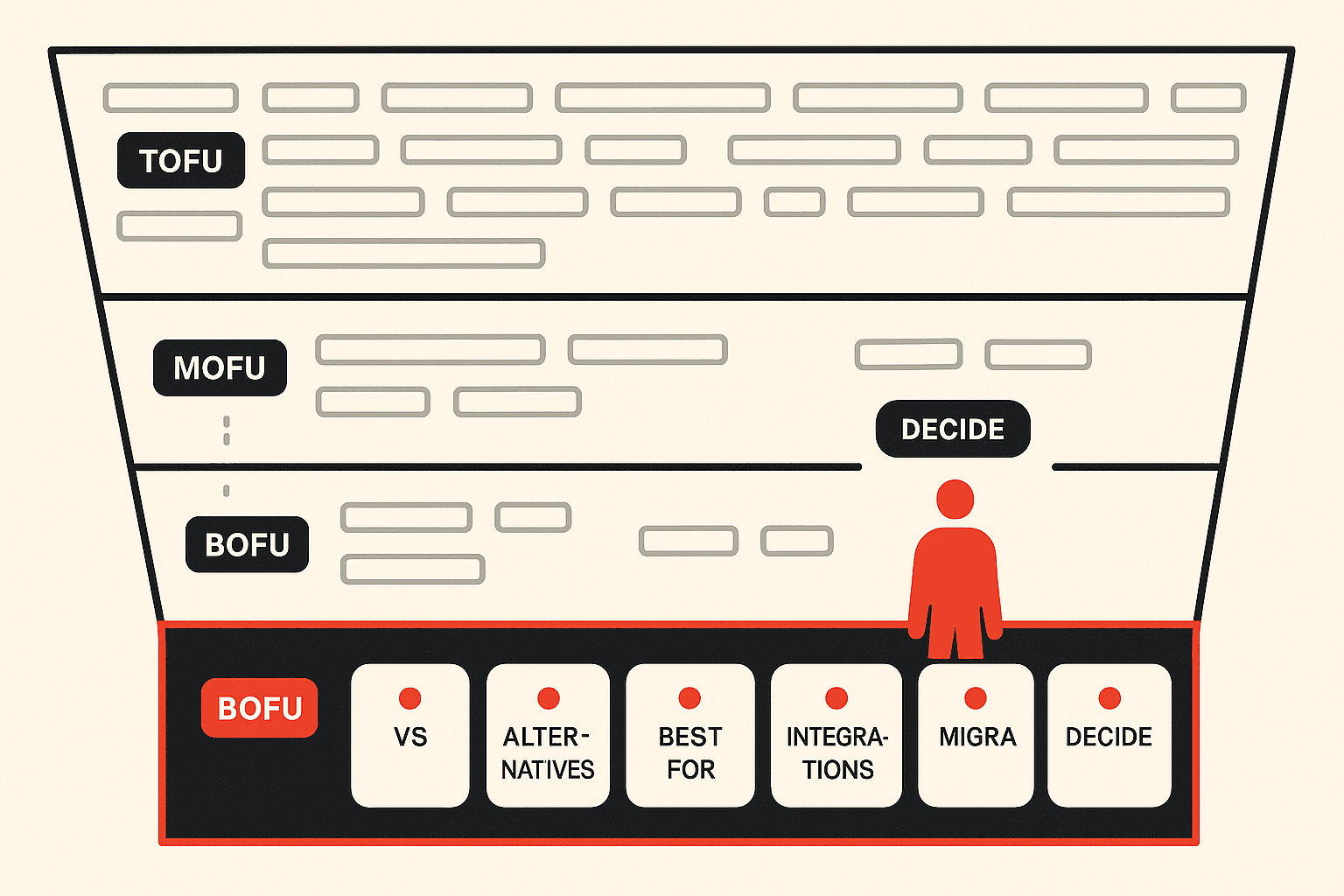
Most brands pour their content budget into the top of the funnel and leave the bottom to their competitors. The pages where buyers actually decide, where revenue actually moves, are an afterthought. Here is the architecture we use when we want to capture the buyer at the moment of choice.
A B2B SaaS founder we worked with in early 2026 had a content engine that looked impressive on paper. Three years of weekly publishing. Roughly 380 indexed posts. A six-figure annual content investment. Organic traffic was up and to the right.
Pipeline contribution from organic was flat.
When we ran the analysis, the gap was obvious within an hour. The site ranked for hundreds of top-of-funnel keywords. It ranked for almost zero of the searches a buyer actually runs in the last week before signing a contract. The phrase "[their product] vs [the obvious competitor]" returned a third-party listicle, two competitor-built pages, and a Reddit thread. The phrase "best alternatives to [the obvious competitor]" returned six listicles and one G2 page. The brand was not present on any of them.
The fix was not more blog posts. The fix was twelve pages built specifically for the bottom of the funnel. Within six months, those twelve pages produced 38 percent of the company's pipeline-attributable organic revenue, despite generating less than 6 percent of total organic traffic.
This is the most consistently underbuilt asset class in B2B and SaaS SEO. It is also the one with the highest revenue per page on almost every site we audit. This piece is the architecture we use to build it, the mistakes we see brands make repeatedly, and the way the pages should be measured once they ship.
What BOFU Comparison Content Actually Is
A BOFU comparison page targets a searcher who is in active evaluation and is comparing two or more specific options. The buyer is no longer asking "what is this category" or "which approach should I take." They are asking "given that I have shortlisted two or three products, which one is the right call for my situation."
This is a small share of total search volume in any category. It is also the most expensive search intent to capture through paid media, because the SERPs at this stage are dense with bidding from your competitors who have correctly identified the value of the click.
The strategic argument for owning these SERPs organically is that the cost of a paid click on a comparison query is between three and twenty times the cost of a top-of-funnel informational click. Owning the organic position eliminates that paid cost while capturing the conversion. We covered the underlying SERP economics in The SERP Bidding War Trick That Doubled Our Clients' Organic CTR, and the same logic applies, only sharper, at the bottom of the funnel.
Why These Pages Convert Five to Fifteen Times Better
The conversion rate gap between BOFU and TOFU content is not subtle. On the engagements we have measured between 2023 and 2026, the typical numbers look like this:
- Top-of-funnel blog posts ("what is [category]"): 0.4 to 1.8 percent organic visitor to lead conversion
- Middle-of-funnel solution content ("how to do [thing]"): 1.1 to 3.2 percent
- Use-case landing pages ("[product] for [specific workflow]"): 3.4 to 6.8 percent
- Comparison pages ("[product] vs [competitor]"): 5.9 to 11.4 percent
- Alternatives pages ("best alternatives to [competitor]"): 4.8 to 9.6 percent
The mechanism is intent. A reader who lands on a "what is" article is most often early in education and has no immediate purchase trigger. A reader who lands on a "vs" page is doing final-mile diligence and is one or two unanswered questions away from a decision. The page does not have to convince them that the category exists, that they have a problem, or that solutions are available. It only has to give them the missing input that lets them pick.
This is also why the keyword volume is misleading. A comparison query with 480 monthly searches will routinely contribute more pipeline than a "guide" keyword with 12,000 monthly searches, because the conversion ratio compresses the volume gap into a revenue advantage. We covered this volume-versus-intent tradeoff in Intent-First SEO: Optimizing for AI's Understanding of Why, Not Just What, and the bottom of the funnel is where the principle pays the largest dividend.
The Six BOFU Page Archetypes
Almost every BOFU page on a B2B, SaaS, agency, or D2C site falls into one of six archetypes. Each has a different keyword pattern, a different competitive landscape, and a different conversion mechanism.
| Archetype | Pattern | Buyer state | Best for |
|---|---|---|---|
| Versus | [You] vs [Competitor] | Two-product shortlist | Direct rival capture |
| Alternatives | Best alternatives to [Competitor] | Open evaluation | Capture searchers who do not know you yet |
| Best for | Best [category] for [use case or segment] | Use-case-driven | Specific verticals or workflows |
| Integration | [Tool A] + [Tool B] integration | Tooling stack already chosen | Capture buyers locked into adjacent products |
| Migration | Switch from [Competitor] to [You] | Active dissatisfaction with current vendor | High-intent capture late in renewal cycle |
| Pricing comparison | [Category] pricing comparison | Budget-driven | Price-sensitive buyers, procurement teams |
The archetypes that produce the most pipeline depend on the category. In SaaS, "versus" and "alternatives" dominate. In B2B services, "best for [specific industry or company size]" tends to outperform. In D2C, integration and use-case pages outperform direct versus comparisons because consumer buying behaviour is less binary. In professional services, the equivalent format is the "[firm type] for [specific situation]" page, which we covered for legal and financial verticals in Local SEO For Lawyers and the broader Local SEO For Businesses pillar.
The discipline is to pick the archetype that matches your buyer's actual decision pattern, not the one your competitors have built. We see SaaS companies build versus pages because every other SaaS has them, when the buyer in their category is actually running a "best for [use case]" search. The result is a page that ranks for a low-volume keyword and never converts. The diagnostic is to read your closed-won notes and find the actual phrasing customers used when they described the moment they decided.
Why Most Brands Ship Comparison Pages Badly
Comparison pages have a higher failure rate than any other content asset class we audit. The pattern is consistent enough that we can predict it from the brief.
The five most common failure modes:
The attack-page problem. The brand wins on every dimension on the page. Every checkmark is in their column. Every weakness column is filled with the competitor's name. Buyers read this as marketing fiction and bounce within fifteen seconds. The page also gets dismissed by AI engines as a self-serving source. The fix is to acknowledge two or three genuine competitor strengths above the comparison table.
The feature-list problem. The page is a wall of feature checkboxes with no buyer-language framing. The reader has to translate "supports advanced webhook routing" into what that actually means for their workflow. Most do not bother. The fix is to lead each row with the buyer's job-to-be-done, not the feature name.
The unverifiable claim problem. The page makes specific claims about the competitor that the competitor would dispute, with no source link, no screenshot, and no last-verified date. This is the single fastest way to invite a legal letter and to lose AI citation eligibility. The fix is to date and source every claim about the competitor and to update the page quarterly.
The buried CTA problem. The page has 2,400 words of comparison content and a contact form at the bottom. By the time the reader reaches the form, they have already opened a new tab to start a competitor's free trial. The fix is to put a soft CTA above the table, a primary CTA after the verdict block, and a secondary CTA in the conclusion.
The cannibalization problem. Eight comparison pages target overlapping keyword variants and compete with each other for ranking. We covered the diagnostic in The Keyword Cannibalization Audit. The fix is one canonical page per competitor pair, with all variant URLs canonicalised or redirected to the primary.
The Architecture That Ranks and Converts
A comparison page that does its job has a specific shape. The shape is consistent across categories because it maps to the order in which a buyer reads the page.
1. Verdict block, above the fold. Two to three sentences that summarise who wins for which buyer. Not "we win for everyone." A specific framing like "Product A is the better fit for teams under 50 with primarily inbound workflows. Product B is the better fit for teams over 200 with complex outbound or multi-region needs." This single block is the most underused conversion lever on comparison pages and is also the highest-leverage signal for AI answer engines, which often quote the verdict block verbatim.
2. The buyer-job-led comparison table. Rows organised by what the buyer is trying to accomplish, not by feature taxonomy. Each row should have a clear winner, a tie, or an explicit note that the answer depends on use case. Avoid all-checkmark rows. Avoid feature jargon without translation.
3. The honest tradeoffs section. A short block that names two or three areas where the competitor is genuinely stronger. This is the single most important credibility lever on the page. Pages that ship without it convert at roughly half the rate of pages that include it. The block should not be apologetic. It should read as a fair operator acknowledging that no product wins every dimension.
4. The "when to pick each" decision frame. A two-column block, sometimes a small grid, that maps buyer scenarios to recommendations. "Pick A if you are X, Y, or Z. Pick B if you are P, Q, or R." This is the highest-conversion section for buyers who arrived undecided.
5. The pricing block. Where pricing is publicly available, include it with a "last verified" date. Where it is not, include a transparent range with attribution and an explicit note that the buyer should confirm with the competitor. Skipping pricing is a credibility cost.
6. The FAQs. Six to ten questions that address the residual objections a buyer brings to the page after reading the comparison. These should be drawn from sales call transcripts, not invented. FAQ content also feeds FAQPage schema, which is the cheapest way to win SERP real estate on comparison queries.
7. The CTA stack. A primary CTA above the table (soft, like "see a demo"), a primary CTA after the verdict block (medium, like "talk to sales"), and a secondary CTA in the conclusion (low-friction, like "join the newsletter"). Do not rely on a single bottom-of-page form.
This sequence is not a creative choice. It is the order in which the buyer's mind processes the page. The verdict tells them they are in the right place. The table validates their existing impressions or surfaces something new. The tradeoffs prove the page is fair. The decision frame gives them a path to a conclusion. The pricing eliminates a friction point. The FAQs handle residual objections. The CTA stack catches them at multiple points instead of a single bottom-of-page choke.
The AEO Citation Premium
In 2026, comparison content gets cited by ChatGPT, Perplexity, Gemini, and Claude at materially higher rates than informational content for buyer-evaluation queries. The mechanism is matchable structure. When a user asks an AI engine "should I pick HubSpot or Pipedrive for a 30-person sales team," the engine retrieves sources that contain a structured answer to that exact question. A blog post titled "What is a CRM" is not retrieved. A page titled "HubSpot vs Pipedrive" with a verdict block, a feature table, and a "when to pick each" section is retrieved.
The citation is not free. AI engines reward specific editorial choices on comparison pages:
- A clear verdict statement in the first 100 words, ideally inside a paragraph the model can quote
- Structured tables that the model can parse and re-render
- Specification or pricing data with attribution and a date
- Honest acknowledgment of competitor strengths (the model is tuned to detect single-sided sources and discount them)
- FAQPage schema with question-and-answer pairs that mirror the buyer query patterns
- Internal links to related comparisons, which signal that the page is part of a content silo rather than a one-off marketing asset
We covered the broader citation mechanics in The AI Search Gap: Why Brands Are Invisible on ChatGPT but Ranking on Google and the foundational definitions in SEO vs AEO vs GEO. The bottom of the funnel is where these mechanics produce the largest commercial return. A comparison page that gets cited by ChatGPT on a buyer-decision query is sitting in the same position as a paid search ad on a high-intent term, with no per-click cost.
The Internal Linking Architecture for a BOFU Silo
A comparison page in isolation underperforms a comparison page that sits inside a tight internal linking silo. The reason is that comparison searches are part of an evaluation cluster. A buyer who searches "[Product A] vs [Competitor]" will often, in the same session, search "best alternatives to [Competitor]," "[Product A] pricing," and "[Product A] reviews." The site that captures the first query and links cleanly to the next three captures the session. The site that captures the first query and dead-ends loses the buyer to whichever competitor builds the cleanest internal architecture.
The pattern we use for a BOFU silo:
- Pillar comparison page (the highest-volume "vs" or "alternatives" page in the cluster)
- Three to six sibling comparison pages (other "vs" pages against the same family of competitors)
- One "best alternatives to [pillar competitor]" page that lists the brand and two to three honestly-described alternatives
- One pricing comparison page for the category
- Two to three integration or migration pages where applicable
- A pricing page for the brand, linked from every comparison page in the silo
- A demo or contact page, linked as the primary CTA from every page in the silo
- Backward links from the relevant solution and feature pages to the comparison silo, so that the silo accumulates authority from the rest of the site
The internal linking discipline is what turns a folder of comparison pages into a compounding asset. We covered the broader silo principle in Topical Authority in 2026: Content Silos That Rank and Get Cited by AI, and the diagnostics for fixing a broken silo in The Orphan Page Audit. A BOFU silo with orphan pages is the single most expensive form of orphaning, because each orphan is a missed buyer at the moment of decision.
Stop Measuring Traffic. Start Measuring SQLs.
The biggest measurement mistake we see on comparison pages is treating them like blog posts and judging them on traffic. A comparison page that ranks for a 240-volume keyword and converts 8 percent of its visitors to a sales-qualified lead is doing more for revenue than a TOFU post that ranks for a 14,000-volume keyword and converts 0.6 percent.
The metrics that matter, in order:
- Sales-qualified leads attributed to the page (the only one that closes the loop on revenue)
- Demo or trial signups
- Conversion rate from organic visitor to lead
- Position for the primary BOFU keyword
- AI engine citation rate on relevant buyer queries
- Page-level pipeline contribution from organic attribution
- Internal click-through rate to the pricing page or demo CTA
Traffic is the seventh thing on the list, not the first. A comparison page that holds position one and converts at 9 percent is winning even if its monthly traffic is two-digit. We covered the broader case for revenue-led measurement instead of vanity metrics in Why Your Blog Traffic Means Nothing (And What to Track Instead), and the same logic applies, only more sharply, at the bottom of the funnel.
A 90-Day BOFU Rollout
For a B2B or SaaS brand starting a BOFU programme from zero, the rollout we use looks like this:
Days 1 to 14: Discovery. Pull the keyword set from DataForSEO across the six archetypes. Cross-check against closed-won and closed-lost transcripts to find the buyer-language phrasings that are actually being used. Identify the three to five competitors that show up most often in deal cycles. Audit the existing site for any partial coverage that should be consolidated rather than duplicated.
Days 15 to 45: Build the first three pillar pages. Pick the three highest-leverage archetype-keyword pairs and build them properly. Each page should follow the architecture above, ship with FAQPage and BreadcrumbList schema, and be linked from at least two relevant solution pages on the site. Do not ship more than three pages in this window. Quality and depth on the first three is what calibrates the template for the rest of the rollout.
Days 46 to 75: Sibling expansion. Build five to seven sibling pages around the pillars. Different competitors, related use cases, integration angles where applicable. Each sibling should link to its pillar and be linked from its pillar.
Days 76 to 90: Measurement and refinement. Set up the attribution to track SQL and pipeline contribution per page. Identify which archetypes are converting fastest in your specific category. Begin the next quarter's planning with the data, not with assumptions.
This sequence ships ten or eleven BOFU pages in 90 days, which is enough surface area to start producing measurable pipeline contribution by month four or five. The temptation to ship 30 pages at once is consistently the wrong call, because the depth penalty on each page is severe and the internal linking architecture cannot keep up with the publishing pace.
For brands without internal SEO and content capacity, this is the kind of sprint our content marketing services team is built to run, in conjunction with the SEO services audit that identifies the pillar opportunities. For SaaS brands specifically, the same playbook with vertical-specific calibration sits inside the SaaS SEO agency engagement, and the fully detailed walkthrough of SaaS BOFU patterns lives in our SaaS SEO Complete Guide.
When You Should Not Build Comparison Pages
A small but important set of cases where comparison pages are the wrong move:
You have not figured out who you actually beat. If your sales team cannot tell you the three competitors you most often win against and the three you most often lose against, you are not ready to build comparison pages. The pages will be generic, the framing will be wrong, and the conversion rate will not justify the investment. Fix the win-loss analysis first.
You operate in a regulated category that prohibits competitive comparison. Some financial services, healthcare, and pharmaceutical sub-categories have explicit advertising restrictions that make comparison pages legally risky. In those cases, the equivalent BOFU asset is a "best [category] for [specific use case]" page that does not name competitors directly.
Your product is genuinely worse than the competitor on most dimensions that the comparison page would surface. This is rare, but when it is true, a comparison page is a marketing accelerant in the wrong direction. The right move is to fix the product gaps first, then build the comparison page with confidence.
Your domain authority is too thin to compete on the relevant SERPs. A site with a Domain Rating below 25 is unlikely to rank for major comparison terms in competitive software categories within a single quarter. The right sequence is to build domain authority first through editorial PR and link acquisition, then layer comparison pages on top of a stronger base. We covered this for early-stage brands in SEO For Startups: How to Build Visibility Without Burning Your Budget.
If none of these conditions apply, the question is no longer whether to build comparison pages. It is how quickly you can ship the first three pillar pages with the architecture above and start the 90-day clock.
The Bottom Line
The bottom of the funnel is where revenue actually moves, and it is the most underbuilt content asset class on almost every site we audit. A comparison page that follows the architecture above, sits inside a clean internal linking silo, ships with the right schema, and is measured against SQLs rather than traffic will outperform almost any TOFU asset on a per-page revenue basis.
The brands that are winning in 2026 are the ones that figured this out two years ago. The brands that are still pouring their content budget into "what is" articles are funding their competitors' BOFU pages by leaving the SERPs uncontested.
If you want a structured audit of your own BOFU coverage and a prioritised build list, that is the entry point of our answer engine optimization and AI SEO services engagements. Either way, the next twelve pages on your editorial calendar should not be more blog posts. They should be the comparison pages that capture the buyers you have already paid to bring to your category.

Aditya Kathotia
Founder & CEO
CEO of Nico Digital and founder of Digital Polo, Aditya Kathotia is a trailblazer in digital marketing. He's powered 500+ brands through transformative strategies, enabling clients worldwide to grow revenue exponentially. Aditya's work has been featured on Entrepreneur, Economic Times, Hubspot, Business.com, Clutch, and more. Join Aditya Kathotia's orbit on LinkedIn to gain exclusive access to his treasure trove of niche-specific marketing secrets and insights.