

SaaS SEO is not a variation on standard SEO. It is a different discipline with a different keyword framework, different content types, and different success metrics. Here is the complete playbook for 2026.
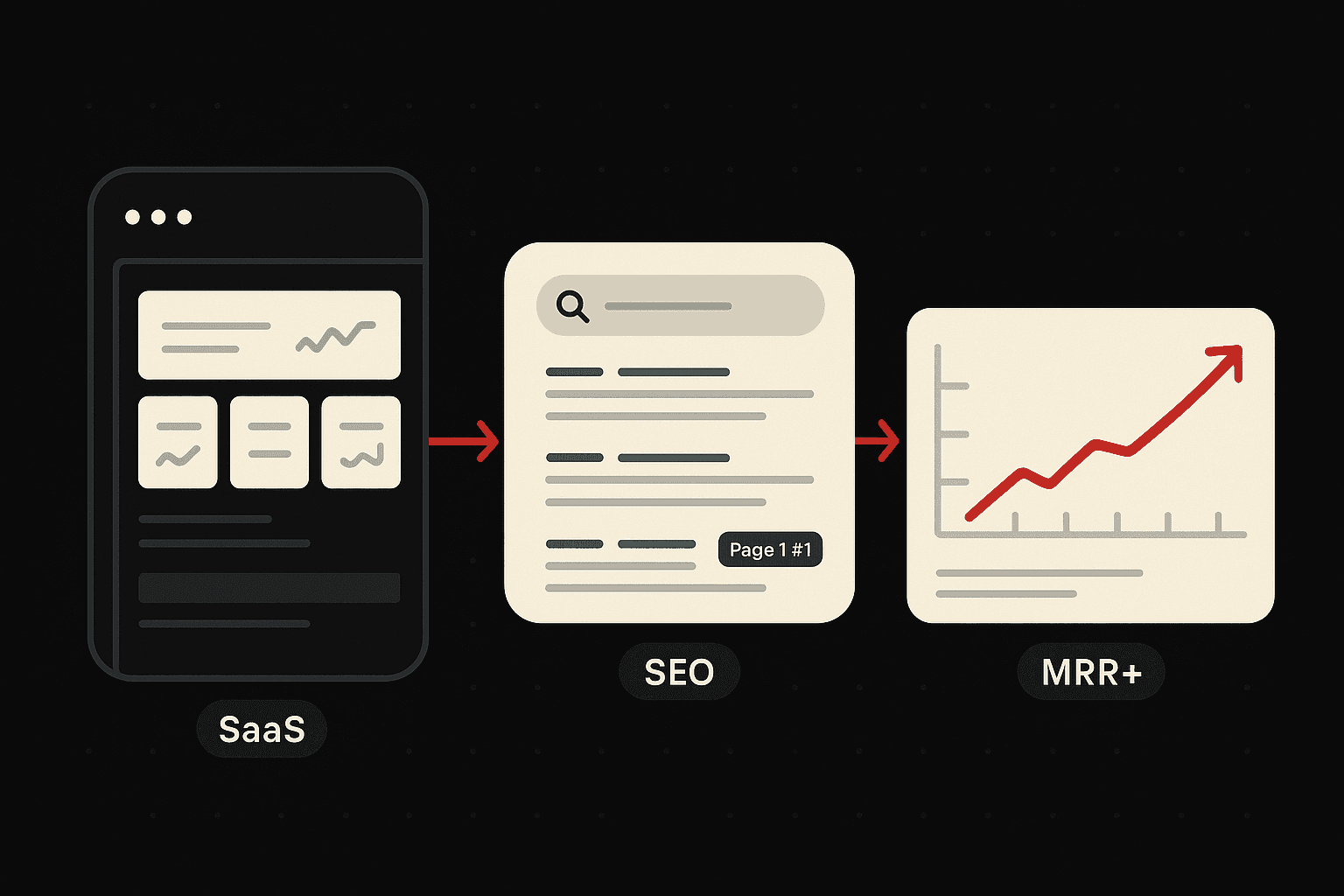
Most SaaS companies approach SEO the same way a media company or ecommerce brand would: publish blog content, build links, optimise pages. Some of it works. Most of it underperforms because it is not calibrated to how SaaS buyers actually search.
A SaaS buyer's search journey looks nothing like a consumer purchase journey. They move through awareness, consideration, and decision phases over weeks or months. The keywords they use at each stage are completely different, and the content that converts them is completely different. A strategy that conflates them - or only addresses one of them - leaves most of the pipeline on the table.
What Is SaaS SEO?
SaaS SEO is search engine optimisation applied specifically to software-as-a-service products. The goal is not just to generate traffic - it is to generate qualified traffic that converts to trials, demos, and ultimately paying customers.
The distinguishing characteristics of SaaS SEO:
- Long buying cycles mean you need to be present at multiple points in the journey, not just at the bottom of the funnel
- Churn economics make customer lifetime value the right metric, not cost per acquisition - which changes how you think about which keywords are worth competing for
- Product-led growth means that trial and freemium users from organic search can be high-LTV if onboarding converts them, making even a modest organic traffic win significant
- Competitive intelligence is visible in real time - you can see exactly what keywords your competitors are ranking for and reverse-engineer their content strategy
Why SaaS SEO Is Different from Regular SEO
The buyer is not shopping on impulse. A consumer buying a pair of shoes might search, browse, and purchase in one session. A business evaluating project management software will research for weeks, involve multiple stakeholders, read reviews, compare alternatives, and request a demo before making a decision. Your content needs to serve them at every stage of that process, not just at the moment of purchase intent. This is precisely why B2B SEO services built for complex sales cycles look very different from standard ecommerce or lead-gen SEO.
Features and integrations are keywords. For a standard ecommerce business, products are keywords. For SaaS, features ("time tracking software"), use cases ("software for freelance invoicing"), integrations ("CRM that integrates with Slack"), and job titles ("project management tool for marketing teams") are all separate keyword opportunities - each with its own audience and search intent.
Comparison and alternative searches have very high commercial intent. Someone searching "[your competitor] alternative" has already decided they want to solve a problem with software in your category. They are in active evaluation mode. These searches convert at extraordinary rates compared to informational queries, yet many SaaS companies do not build content specifically to capture them.
Churn means lifetime value per organic visitor is asymmetric. A customer who finds you through SEO, converts to a paid plan, and stays for three years is worth dramatically more than the acquisition cost implies. Modelling SEO ROI on a 12-month LTV instead of a 3-month window often changes whether a campaign looks like a good investment.
The SaaS SEO Keyword Framework
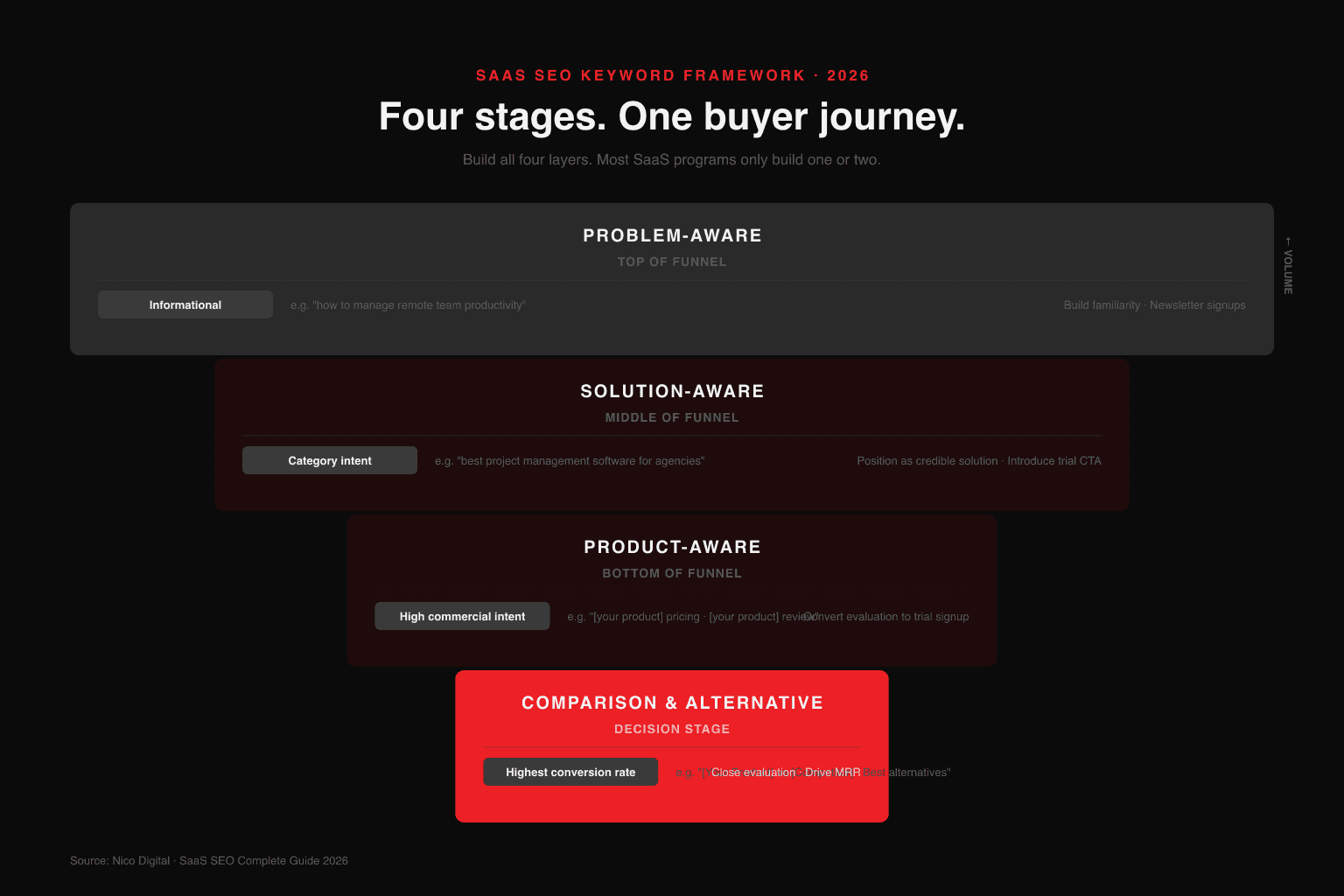
A functional SaaS keyword strategy is organised around the buyer's stage of awareness. Building out all four layers creates a machine that captures demand at every point in the journey.
Problem-Aware Keywords (Top of Funnel)
At this stage, the buyer knows they have a problem but has not decided what kind of solution they need. They are searching for information and validation.
Examples: "how to manage remote team productivity," "why projects keep missing deadlines," "best practices for client reporting"
Content goal: demonstrate expertise, build brand familiarity, appear in the research phase. Conversions at this stage are newsletter sign-ups and returning visitors, not immediate trials.
Keyword characteristics: high volume, low commercial intent, broadly informational. Competitive to rank for, but also the top of the funnel that feeds everything downstream.
Solution-Aware Keywords (Middle of Funnel)
The buyer now knows that software can solve their problem and is researching what that software should do.
Examples: "project management software for agencies," "best time tracking tools for remote teams," "how to automate client reporting"
Content goal: position your product as a credible solution, explain key differentiators, introduce trial CTAs. This is where traffic-to-trial conversion starts becoming meaningful.
Keyword characteristics: moderate volume, clear category intent. Buyers at this stage are building shortlists.
Product-Aware Keywords (Bottom of Funnel)
The buyer is evaluating specific products, including yours. They are searching by brand name, feature name, or specific use case within your category.
Examples: "[your product name] pricing," "[your product name] review," "how to use [your feature] in [your product]"
Content goal: convert evaluation intent to trial. Pricing pages, feature pages, use case pages, and support documentation all serve this function.
Keyword characteristics: low to moderate volume, very high commercial intent. These searches are worth disproportionate SEO investment relative to their volume because conversion rates are high.
Alternative and Comparison Keywords
Some of the highest-converting SaaS keyword categories are comparative: buyers actively comparing tools before making a final decision.
Examples: "[Competitor A] vs [Competitor B]," "best [Competitor] alternatives," "[Your product] vs [Competitor]"
These searches indicate a buyer who is actively deciding. Your content for these searches should be honest, comparative, and specific - buyers who reach comparison-stage content are sophisticated and will quickly disengage from anything that reads like marketing.
Building a SaaS SEO program but not seeing pipeline movement? The most common cause is investing in top-of-funnel content while leaving comparison and alternative pages unbuilt. We audit your keyword coverage and prioritize the content types that drive trial signups. Get a SaaS SEO Audit →
The Highest-Converting SaaS Content Types
Comparison Pages: [Your Product] vs [Competitor]
The most commercially powerful content type in SaaS SEO. A well-structured comparison page captures searchers in active evaluation mode and gives you control over the narrative.
What makes them work: genuine honesty about where each product wins. A comparison page that says your product is better in every way is transparently biased and converts poorly. A comparison that acknowledges specific competitor strengths while clearly articulating where you win builds trust and converts at meaningfully higher rates.
Format: feature comparison table, use-case fit guide, migration information, trial CTA.
Alternative Pages: Best [Competitor] Alternatives
These pages target people who have already decided a specific competitor is not right for them and are now looking for what to use instead. Conversion intent is extremely high.
Best practice: cover multiple alternatives fairly, including yourself, to demonstrate objectivity. Position your product clearly for the specific reasons someone would leave [Competitor], not as a generic alternative.
Integration Pages
If your product integrates with popular tools, every integration is a keyword opportunity: "[Your product] + Salesforce integration," "how to connect [Your product] with Slack," etc.
These pages capture buyers who are already using the connected tool and evaluating which other software fits their stack. High commercial intent, usually low competition.
Use Case Pages
Horizontal SaaS products - tools that serve multiple industries or team types - can multiply their addressable keyword surface by building dedicated pages for each use case: "[Your product] for marketing teams," "[Your product] for agencies," "[Your product] for healthcare companies."
Each use case page targets a narrower, higher-intent audience than a generic homepage. They typically convert at higher rates because the messaging speaks directly to the buyer's context. Vertical SaaS products face a parallel opportunity: a dedicated fintech SEO strategy, for example, targets the specific compliance, regulatory, and trust-related search queries that generic financial software content does not reach.
Link Building for SaaS
SaaS link building works differently from ecommerce or publisher link building because your best link sources are also your potential customers and partners.
Integration partnerships are among the highest-value link opportunities: if you integrate with Zapier, HubSpot, or any established platform, their app marketplace or integration directory page is a relevant, high-authority link. Pursue every integration listing proactively.
Product reviews and comparisons on third-party sites (G2, Capterra, GetApp, Trustpilot) are links and trust signals simultaneously. A strong review profile on these platforms influences both search visibility and purchase decisions.
Original data and research is one of the most scalable SaaS link building strategies. If your product generates data - usage patterns, industry benchmarks, anonymised aggregate insights - publishing that research earns links from journalists, bloggers, and analysts who cite it. The link value compounds over years.
Podcast and newsletter placements in your category are high-relevance links with additional distribution upside. Being featured in a newsletter that your buyers read is both a link and a brand impression at the point of purchase consideration.
How to Track SaaS SEO Success
Standard vanity metrics - total traffic, total keyword rankings - mask what matters. SaaS SEO tracking should tie back to revenue metrics:
- Organic trial signups: how many free trial or freemium signups come from organic search? Tracked via UTM parameters or attribution in your product analytics.
- Organic MRR contribution: of the trials that convert to paid, what share came from organic? This is the number that justifies SEO investment at board level.
- Bottom-of-funnel keyword rankings: are you ranking for [Competitor] alternatives, pricing pages, and comparison terms? These move revenue even at low traffic volumes.
- Organic pipeline from comparison and alternative content: specifically, how do the high-intent content types perform on conversion rate vs. informational content?
Traffic is an input metric. Revenue is the output metric. Build your reporting to show the connection between them, or you will perpetually be justifying SEO spend to stakeholders who see traffic growth and wonder where the customers are. For teams focused on B2B SaaS lead generation, connecting organic attribution directly to demo requests and pipeline stages is the reporting structure that earns continued investment.
Frequently Asked Questions
How is SaaS SEO different from standard SEO?
The core difference is the keyword framework and success metric. Standard SEO often optimizes for a single content type across a single funnel stage. SaaS SEO requires building content across four distinct buyer awareness stages - problem-aware, solution-aware, product-aware, and comparison-stage - each requiring different formats, different lengths, and different CTAs. Success is measured in trial signups and organic MRR, not traffic volume.
What comparison pages should I build first?
Start with the two or three competitors your sales team loses deals to most frequently. These represent active buyer demand where a comparison page earns direct pipeline. After that, build alternative pages for competitors with the highest search volume in your category, even if you rarely compete with them directly. The buyer who searches "best [Competitor] alternatives" may not know your product yet - this page introduces you at the moment of highest purchase intent.
How many backlinks does a SaaS site need to rank for comparison terms?
It varies significantly by keyword competitiveness, but most mid-competition SaaS comparison keywords require 20-50 high-relevance referring domains pointing to the comparison page itself, plus strong site-level authority from integration listings and category directories. The quality and topical relevance of the linking domains matters more than raw count. A link from G2 or a relevant industry publication carries more weight than ten links from unrelated niche sites.
Should SaaS SEO prioritize blog content or landing pages?
Landing pages - comparison, alternative, integration, and use-case pages - should be prioritized in months 1-6 because they produce pipeline faster. Blog content builds topical authority and top-of-funnel presence over a longer horizon. The most effective SaaS SEO programs build both in parallel: landing pages first for near-term pipeline, supported by a content cluster architecture that builds category authority over 12-24 months.
What is the typical organic trial signup rate for a well-optimized SaaS page?
It varies by content type. Bottom-of-funnel comparison and alternative pages with a prominent free trial CTA typically convert 3-8% of organic visitors to trial. Top-of-funnel informational blog content converts 0.5-2%. Use-case landing pages with product-specific messaging tend to fall in the 4-7% range. These benchmarks are industry averages - product category, free trial friction, and onboarding experience all affect conversion significantly.
Conclusion
SaaS SEO done well is a compounding asset that reduces your cost of acquisition over time and builds defensible category authority. The programs that succeed are the ones that prioritize the right keyword framework, invest in comparison and alternative content early, and report on pipeline rather than traffic.
The difference between a SaaS SEO program that justifies investment in year one and one that takes three years to show ROI is almost always the same: the winning program built bottom-of-funnel content first and connected organic attribution to trial signups from day one.
Our SaaS SEO agency works specifically with B2B and product-led growth companies to build that asset systematically. If you are looking for an SEO agency India-based team that understands SaaS buying cycles and pipeline attribution, that is the conversation worth having.
SaaS product with organic traffic but no trial signups? That is a keyword framework and content-type problem, not a traffic problem. We audit your coverage across all four buyer stages and build the comparison and alternative pages that move pipeline. Get a SaaS SEO Strategy Call →

Aditya Kathotia
Founder & CEO
CEO of Nico Digital and founder of Digital Polo, Aditya Kathotia is a trailblazer in digital marketing. He's powered 500+ brands through transformative strategies, enabling clients worldwide to grow revenue exponentially. Aditya's work has been featured on Entrepreneur, Economic Times, Hubspot, Business.com, Clutch, and more. Join Aditya Kathotia's orbit on LinkedIn to gain exclusive access to his treasure trove of niche-specific marketing secrets and insights.