

Ask three different people what link building costs in India and you will get three answers that do not even share a decimal point. One quotes ₹500 a link. One quotes ₹1,00,000 a month. One says they do it themselves with a ₹20,000 tool subscription. They are all telling the truth, because they are answering three different questions.
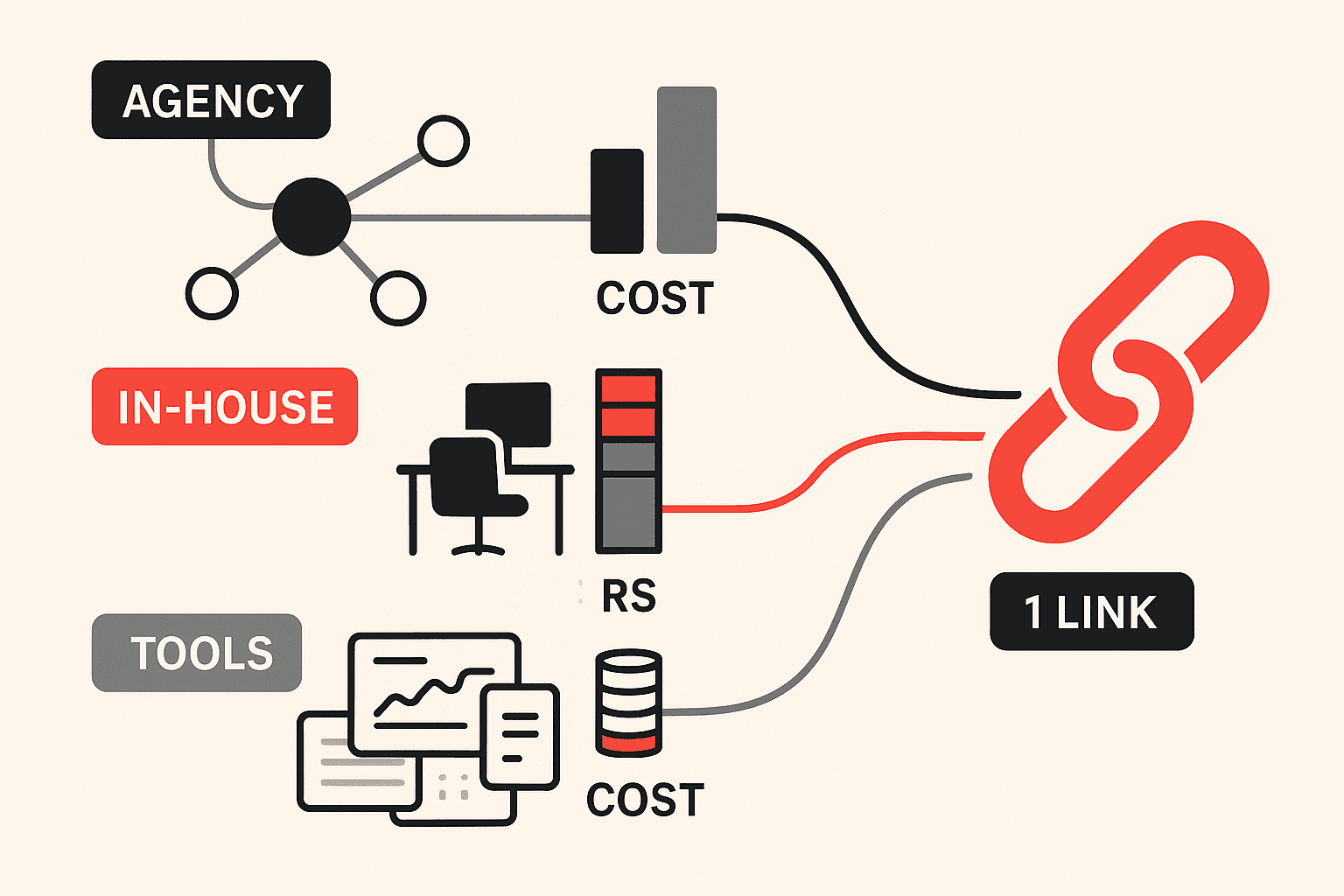
That is the thing nobody explains clearly. "Link building cost" is not one number, because links are bought three fundamentally different ways: you hire an agency, you build a team in-house, or you buy tools and do it yourself. Each has a completely different cost structure, and comparing a per-link agency price to an in-house salary to a tool subscription is like comparing the price of a taxi ride to the cost of owning a car to the price of a bicycle. They all move you, but the maths behind each is unrelated.
This guide gives you the real 2026 numbers for all three models in Indian rupees: what a single backlink actually costs by the authority of the site it sits on, what an honest monthly retainer buys, and the true loaded cost of building links in-house that most founders underestimate by roughly half. By the end you will be able to say not just "what does link building cost" but the far more useful "which of the three models is cheapest for a business at my stage" and estimate your own budget with numbers you can defend.
Why "Link Building Cost" Has Three Different Answers
Before any number means anything, you have to fix which model you are pricing. The three are not interchangeable, and the cheapest one changes depending on how many links you need and for how long.
- The agency model. You pay a monthly retainer or a per-link fee to a specialist firm. The price includes their tools, their existing relationships with publishers, and trained outreach staff, all shared across many clients. You are renting capacity.
- The in-house model. You hire one or more people whose job is to build links, buy the tools they need, and manage them. You are buying capacity and owning it, along with all the fixed costs that come with a headcount.
- The tools-and-DIY model. You (or an existing marketer) buy software that finds link opportunities and manage outreach yourself. The software is cheap; your time is not, and it is the hidden line item that makes "DIY is free" the most expensive myth in SEO.
Hold these three in mind, because every price below belongs to one of them, and the entire point of this article is to help you pick.
What a Backlink Actually Costs in India (2026)
Start with the atomic unit: one link. Whether you go agency, in-house, or DIY, you are ultimately paying to place a link on someone else's website, and the price of that single link is set almost entirely by one thing - the authority and relevance of the site it sits on, measured by metrics like Domain Rating (DR).
The chart below shows indicative per-link price bands in India for 2026, grouped by the authority tier of the linking site. Treat these as planning ranges, not quotes. A link's real price also moves with how relevant the site is to your niche and how it is placed.
Two things about this table matter more than the numbers themselves.
First, the curve is steep, not linear. A DR 80 link is not twice a DR 40 link; it can be ten times the price, because the top tier is not "a bigger version of the same thing." A cited mention in a national business publication is earned through a journalist relationship, an original data angle, and weeks of pitching. That is digital PR, not a rate-card purchase, which is why it sits in its own bracket. We break the mechanics down in how digital PR replaced link building.
Second, anything far below this floor is a warning, not a bargain. The global SERPs for this topic are full of providers quoting ₹300 to ₹1,000 per link and packages promising hundreds of backlinks for a few thousand rupees. Those are not the same product priced cheaper. They are private blog networks, directories, and comment links - a different, and dangerous, category we cover further down.
Option 1: Hiring a Link Building Agency in India
For most brands, an agency is the default and usually the right first move. You are renting a machine that already exists: the tools, the publisher relationships, the trained outreach staff, and the content capability to earn links. You do not build any of it; you pay a monthly fee to use it.
Indian agency link building splits into three honest tiers:
| Tier | Monthly retainer | What you realistically get |
|---|---|---|
| Entry / local | ₹15,000–₹30,000 | A handful of low-to-mid DR links, often blog-network or directory-heavy. Tread carefully - many at this price cut corners on quality. |
| Quality / mid-market | ₹40,000–₹1,00,000 | 4–10 genuinely editorial links a month on relevant DR 40-70 sites, with content included and live-link reporting. The sweet spot for most growing brands. |
| Premium / PR-led | ₹1,00,000–₹3,00,000+ | Digital-PR placements on national and DR 80-plus publications, original-data campaigns, and links most competitors cannot buy at any menu price. |
The great advantage of the agency model is shared cost. One Ahrefs or Semrush licence, one outreach platform, one email-finding tool, and one seasoned outreach specialist are spread across dozens of clients, so your slice of that overhead is a fraction of what it would cost you to own outright. That is why a ₹40,000 to ₹1,00,000 retainer frequently buys more real links than a single in-house hire costing twice as much.
The watch-out is that "link building agency" is an unregulated label. The same phrase covers a boutique running genuine editorial outreach and a reseller drop-shipping PBN links from a spreadsheet. Price alone will not tell them apart, which is why the vetting questions in how to choose an SEO agency in India apply directly here: ask what a "link" means in the contract, whether content is included, and to see live URLs of links they built last quarter.
Not sure whether an agency retainer or a per-link model fits your stage? Our team maps a link building plan to your actual competition and budget - the quality bar you need, the volume that moves your rankings, and whether digital PR or steady editorial outreach earns it fastest. See our link building services or talk to us directly.
Option 2: Building Links In-House — The Real Loaded Cost
This is where the maths surprises people. "We'll just hire someone to do links" sounds cheaper than an agency retainer until you add up what that someone actually costs and how many links they realistically produce.
A capable link building or outreach specialist in India earns roughly ₹40,000 to ₹55,000 a month in salary. But salary is only the visible part of the cost. Once you load in the parts nobody puts on the offer letter, the real monthly figure looks like this.
Read that effective cost carefully: around ₹12,000 to ₹17,000 per quality link, before content. That is squarely inside the agency range, not below it - and it comes with fixed costs an agency retainer does not. If output dips because your one specialist is on leave, ramping, or job-hunting, you still pay the full ₹85,000. You have converted a variable cost into a fixed one.
So when does in-house actually win? Only at sustained high volume. If you genuinely need 12 or more quality links every month, month after month, for a year or more, a full-timer becomes fully utilised and the per-link cost drops below what an agency charges for the same volume. Below that threshold, you are paying for capacity you cannot fill. In-house also makes sense when link building is so core to your model (a marketplace, a publisher, a link-dependent affiliate business) that owning the muscle is strategic rather than tactical.
For everyone else - which is most brands - a lone in-house hire is the expensive option dressed up as the cheap one.
Option 3: Tools and DIY — Cheap Software, Expensive Time
The third model is the one founders reach for when both an agency retainer and a salaried hire feel too heavy: buy the software, do it yourself. The software genuinely is affordable relative to the other two options.
| Tool category | Typical monthly cost | What it does |
|---|---|---|
| Backlink/SEO suite (Ahrefs, Semrush) | ₹10,000–₹25,000 | Finds link prospects, analyses competitor backlinks, tracks your profile |
| Outreach + email finder | ₹3,000–₹10,000 | Finds contact emails, runs and tracks outreach sequences |
| Content / assets | Variable | The posts, data, or tools that actually earn the link |
Call it ₹15,000 to ₹40,000 a month for a real stack. That looks like a bargain next to ₹85,000 in-house or a ₹1,00,000 retainer - until you notice the line the tool bill does not include: the labour.
Tools do not build links. They find opportunities and organise outreach. Someone still has to research targets, write personalised pitches, follow up, negotiate, create the content the link points to, and place it. That is a slow, skilled job, and if you or an existing marketer does it, the "free" time is being taken from something else - usually the actual product or the actual business. A founder spending ten hours a week on cold outreach is not saving money; they are spending the most expensive hours in the company on a task an agency does for a fraction of the blended rate.
DIY-with-tools works in exactly two situations: you are very early and pre-revenue with more time than money, or you have an existing content and PR person with spare capacity and the skill to do outreach well. Outside those cases, the tool subscription is real and the time cost is realer, and the model quietly becomes the priciest of the three when you value your hours honestly.
The Three Models Side by Side
Here is the comparison the whole article has been building toward. The right column is the one that actually decides your choice.
| Agency | In-house | Tools / DIY | |
|---|---|---|---|
| Typical monthly cost | ₹15,000–₹3,00,000+ | ≈ ₹85,000 loaded (1 hire) | ₹15,000–₹40,000 (tools only) |
| Effective cost per quality link | ₹8,000–₹45,000+ | ₹12,000–₹17,000 (+ content) | Tool cost + your time |
| Time to first links | 2–4 weeks | 2–3 months (hire + ramp) | Slow; depends on your hours |
| Cost type | Variable, scalable | Fixed, whether used or not | Low fixed + heavy time |
| Best for | Most brands; needs flexibility | Very high sustained volume | Pre-revenue or spare in-house capacity |
| Biggest risk | Vetting quality varies wildly | Single point of failure; under-utilisation | Founder time drain; slow output |
The pattern is clear. Agency is the default for most businesses because it is variable, fast to start, and spreads overhead. In-house wins only at high, sustained volume. DIY wins only when your time is genuinely free. Any answer that ignores which of these describes you is guessing.
What Decides Where You Land in the Range
Within any model, the same four levers decide whether you pay the top or the bottom of the range. Understanding them is how you avoid overpaying and, just as importantly, how you avoid underpaying into junk.
- Domain authority of the linking site. The single biggest price driver. A link from a DR 75 publication is worth - and costs - many times a DR 30 blog, because search engines weight the trust it passes accordingly.
- Topical relevance. A link from a site in your exact niche is worth more than a higher-DR link from an unrelated one. A fintech link from a finance publication beats a fintech link from a generic lifestyle blog, and good providers charge for that relevance because it is harder to source.
- How the link is placed. An editorial link inside real, relevant content is the gold standard. A link in an author bio, a footer, a sidebar, or a comment is worth far less, and any provider padding a package with those is inflating the count, not the value.
- How much original work it required. A link earned by original research, a data study, or a genuinely useful free tool commands the highest prices because it is the hardest to replicate - and it is exactly the kind of asset AI answer engines cite. This is the logic behind treating link building as an ongoing content-led programme, not a one-off buy.
The Cheap-Links Trap: Why ₹500 Backlinks Cost More
Every SERP for link building pricing has them: providers advertising links at ₹300 to ₹1,000, or packages promising 200 backlinks for ₹5,000. The temptation is obvious when a single quality link costs more than a hundred of these. Resist it, because the price you see is not the price you pay.
Links at that level are one of three things: private blog network (PBN) links from sites built solely to sell links, spun-content directory submissions, or comment and profile links dropped across the web. Google's link-spam systems - now largely automated - identify and devalue these patterns continuously, so in the best case you have simply bought nothing. In the worse case, a manual action or an algorithmic hit drags down the rankings of the site those links point to.
Then comes the real bill: cleanup. Auditing a toxic backlink profile, disavowing bad links, and clawing back lost rankings costs far more in time and fees than building a modest number of genuine links would have. We have seen brands spend six figures recovering from a cheap-links decision that "saved" them ₹20,000. A small number of real, relevant, editorial links beats hundreds of cheap ones on every metric that matters - rankings, referral traffic, and whether an AI engine trusts you enough to cite you. When you compare link building quotes, the cheapest number in the room is usually the most expensive one over a year.
How to Estimate Your Own Link Building Budget in 5 Steps
You now have every number you need. Here is how to turn them into a defensible budget for your specific business.
- Fix your model first. Decide honestly whether you are an agency, in-house, or DIY case using the side-by-side table. Most brands under 12 quality links a month land on agency. Do this before you look at any price.
- Assess your competition, not a quota. Look at what the sites currently outranking you have in their backlink profiles - a suite like Ahrefs or Semrush shows this. Your target is to close the gap in quality and relevance, not to hit a round number of links.
- Set a quality bar, then let volume follow budget. Pick the DR and relevance you need from the levers above. A local business may target DR 40-60 relevant links; a competitive national brand needs DR 60-plus and PR placements. Never buy on volume alone.
- Do the per-link maths. Multiply the links you need by the per-link range for your quality bar. Six DR 40-60 links a month at ₹8,000-₹20,000 is a ₹48,000-₹1,20,000 monthly range - which immediately tells you whether an entry, mid, or premium retainer fits.
- Budget content separately. Whichever model you choose, the links point to something. Factor in the cost of the guest posts, data studies, or assets that earn them. This is the line that in-house and DIY estimates almost always forget, and it is often 20-40% on top of the link cost itself.
Run those five steps and you will walk into any provider conversation knowing your model, your quality bar, your volume, and your ceiling - which is exactly the position from which you never overpay.
Frequently Asked Questions
How much does link building cost in India in 2026?
There is no single price, because link building is bought three different ways. Buying links individually, a quality editorial backlink in India costs roughly ₹3,000-₹8,000 on a DR 20-40 site, ₹8,000-₹20,000 on DR 40-60, ₹20,000-₹45,000 on DR 60-80, and ₹45,000 to over ₹1,50,000 for premium editorial or digital-PR placements on DR 80-plus sites. On a monthly retainer, entry-level Indian agencies charge ₹15,000-₹30,000, quality mid-market programmes ₹40,000-₹1,00,000, and premium or PR-led link building ₹1,00,000-₹3,00,000+. Building in-house, one full-time specialist plus tools has a true loaded cost of roughly ₹85,000 per month and realistically earns five to eight quality links, about ₹12,000-₹17,000 per link before content.
What is a good price for a single backlink in India?
Price should track the linking site's authority and how the link is placed, not a flat rate. As a 2026 guide: ₹3,000-₹8,000 buys a contextual link on a genuine DR 20-40 site, ₹8,000-₹20,000 on DR 40-60, and ₹20,000-₹45,000 on a strong DR 60-80 publication. Editorial links earned through digital PR on national news or DR 80-plus sites run ₹45,000 to over ₹1,50,000 each because a journalist places them, not a rate card. Anything advertised at ₹300-₹1,000 per link is almost always a PBN, directory, or comment link that carries real penalty risk.
Is it cheaper to hire a link building agency or build links in-house in India?
For most brands under a very high monthly link volume, an agency is cheaper per link and far cheaper to start. An in-house link builder has a true loaded cost of around ₹85,000 per month once you add benefits, tools, and management time, and a single person realistically produces five to eight quality links a month while they ramp - ₹12,000-₹17,000 per link before content. An agency spreads a shared tool stack, an existing publisher network, and trained staff across many clients, so a ₹40,000-₹1,00,000 retainer usually buys more placements than a lone hire. In-house only wins on cost at consistently high volume that keeps a full-timer fully utilised.
Why do link building prices vary so much?
Because the word "link" covers wildly different assets. A directory listing and a cited paragraph in the Economic Times are both technically backlinks, but one takes minutes and the other takes a journalist relationship, original data, and weeks of pitching. Four things move the price: the authority of the linking domain, how relevant that site is to your niche, whether the link is editorially placed inside real content or dropped in a footer or comment, and how much original work the placement required.
Are cheap backlinks worth buying in India?
No. Links advertised at ₹300-₹1,000 each, or bulk packages promising hundreds of backlinks for a few thousand rupees, are almost always PBNs, spun-content directories, or comment and profile links. Google's link-spam systems devalue these automatically and, in a manual-action scenario, can penalise the site they point to. The real cost of cheap links is the cleanup: disavowing toxic links and recovering lost rankings costs far more than doing it properly. A smaller number of genuine, relevant, editorial links outperforms hundreds of cheap ones on every metric that matters.
How many backlinks do I need per month?
Fewer than most packages imply. Link building is about authority and relevance, not volume, so the right number depends on your competition, not a quota. A local service business in a single city often needs only three to six genuinely good links a month to move. A competitive national D2C or SaaS brand may need eight to fifteen quality links a month sustained over a year. The trap is buying a package sold on quantity, which pushes providers toward the cheap end of the quality curve to hit the number.
What is included in a link building retainer in India?
A proper retainer covers more than the links themselves: prospecting and vetting target sites, creating or pitching the content that earns the link, outreach and relationship management, placing the link in relevant context, and monthly reporting on live links with their authority and relevance. Weaker retainers quietly exclude content creation, so you pay separately for every guest post, or they count low-value directory and profile links toward the number. Before you sign, ask exactly what a "link" means, whether content is included, and to see a sample of links built in the last quarter with live URLs.
Does link building still work in the age of AI search?
Yes, and arguably more than before. Links remain a core trust signal for Google's rankings, and they matter for AI answer engines too: ChatGPT, Perplexity, and Google's AI Overviews lean heavily on sources widely cited across the web, which is exactly what a strong backlink profile signals. The shift is in what kind of link earns its keep. Editorial mentions from authoritative, topically relevant publications do double duty - improving rankings and increasing the chance an AI engine cites you. Bulk, low-quality links do neither. The bar for a valuable link has risen, and so has the value of a genuinely good one.
Want a link building budget built around your business, not a package price? We assess your competitors' backlink profiles, set the quality and relevance bar that will actually move your rankings and AI-search visibility, and tell you honestly whether an agency, in-house, or hybrid model fits your stage and budget. Explore link building services or request a proposal.
Cross-Linked Resources for Links, Authority, and Cost
Pricing is the first decision; earning links that compound is the work. These guides cover the surrounding programme:
- Link Building Services for a managed, anti-PBN programme with editorial and digital-PR placements
- Digital PR Services for the top-tier editorial links that a rate card cannot sell
- How Digital PR Replaced Link Building on why the highest-value links are earned, not bought
- The Importance of Regular Link Building on treating links as an ongoing programme rather than a one-off buy
- Reddit SEO & Link Building for a channel most competitors ignore
- D2C SEO Without a PR Budget for the links an ecommerce brand can earn before it pays for any
- How Much Do SEO Services Cost in India for the full-service pricing picture links sit inside
- How to Choose an SEO Agency in India for vetting a link building partner before you sign
- SEO Services for the complete organic growth engine that backlinks power

Aditya Kathotia
Founder & CEO
CEO of Nico Digital and founder of Digital Polo, Aditya Kathotia is a trailblazer in digital marketing. He's powered 500+ brands through transformative strategies, enabling clients worldwide to grow revenue exponentially. Aditya's work has been featured on Entrepreneur, Economic Times, Hubspot, Business.com, Clutch, and more. Join Aditya Kathotia's orbit on LinkedIn to gain exclusive access to his treasure trove of niche-specific marketing secrets and insights.