

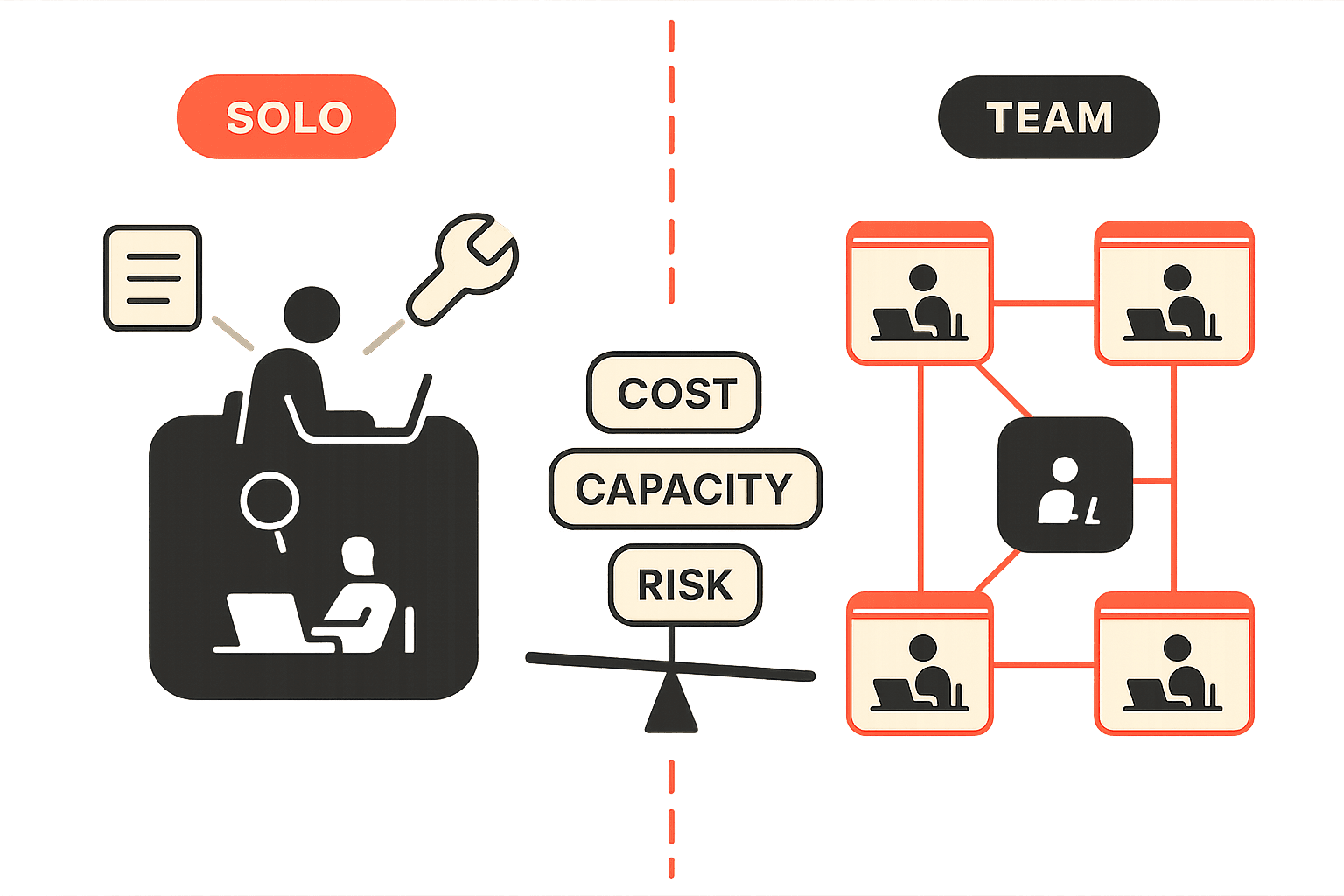
Picking between an SEO freelancer and an SEO agency is one of those decisions that looks like a budget question and is actually a risk question. Most businesses frame it as "how little can I spend to get rankings," compare a freelancer's quote against an agency's retainer, and choose the smaller number. A year later, a meaningful share of them are not further ahead - they have a handful of published posts, no measurable revenue lift, and a contractor who has gone quiet because a bigger client came along.
The honest truth is that a freelancer and an agency are not two grades of the same thing. They solve different problems. A freelancer is a specialist pair of hands. An agency is a coordinated system. The right choice depends on how complex your work is, how much of your revenue depends on it, and how much risk you can absorb if delivery stalls. Get that match right and either option can be excellent. Get it wrong and even the more expensive option will disappoint you.
This guide breaks the decision down the way we would for a brand that asked us directly - including the cases where the answer is "you do not need us yet, hire a freelancer." We run an SEO agency ourselves, so treat the self-interest as declared; the framework below is the same one we would apply if we were on your side of the table.
The short answer
Hire a freelancer when your scope is narrow and well-defined, your budget is tight, and you have someone in-house who can brief and manage them. A single skilled contractor is excellent for a one-off audit, a steady content cadence, a specific technical fix, or early-stage local SEO.
Hire an agency when your work spans several disciplines at once, when SEO has become a revenue channel you cannot afford to have stall, and when you need continuity and accountability that do not depend on one person staying healthy and engaged. An agency bundles multiple specialists, project management, and tooling into one accountable relationship.
Consider a consultant - or a consultant-plus-execution hybrid - when you have execution capacity but lack senior direction. This middle path is often the most cost-effective way for a growing brand to get expert strategy without paying a full agency retainer.
Everything below is the reasoning behind those three sentences.
What you are actually choosing between
Before the comparison, get the definitions straight, because the words get used loosely.
An SEO freelancer is an individual you contract directly. They are usually strong in one area - content, technical SEO, or link building - and lighter in the others. You manage them, you brief them, and the relationship lives or dies on that one person's capacity and reliability.
An SEO agency is a team. When you hire one you are buying several specialists at once - writers, technical SEOs, link acquisition, and increasingly AI-search specialists - plus a project manager who coordinates them and a layer of accountability above any single contributor. You pay more per month because the price bundles all of that into one number.
An SEO consultant sits between the two. A consultant sells judgement - strategy, audits, prioritisation, oversight - usually without owning day-to-day execution. They tell you and your team what to do and check that it was done well. Our own SEO consultant engagements work exactly this way: set the direction, then review the work whoever executes it.
The freelancer-versus-agency question is really three questions stacked together: cost, capacity, and risk. Take them one at a time.
The cost comparison, honestly
Cost is where most decisions get made and where most of them go wrong, because people compare the sticker prices instead of the cost per outcome.
Here are realistic market ranges as of 2026. Treat them as orientation, not quotes - actual pricing varies with scope, market, and seniority.
| Engagement | India (per month) | Global (per month) | What you get |
|---|---|---|---|
| Freelancer (part-time) | INR 15,000 - 50,000 | USD 500 - 2,000 | One specialist, one focus area, you manage |
| Consultant (advisory) | INR 40,000 - 1,00,000 | USD 1,000 - 4,000 | Strategy and oversight, you or others execute |
| Agency (retainer) | INR 40,000 - 1,50,000+ | USD 1,500 - 7,500+ | Multi-discipline team, PM, tooling, accountability |
| In-house hire (loaded) | INR 60,000 - 1,50,000+ | USD 3,000 - 8,000+ | One full-time employee plus tools and overhead |
The freelancer line is genuinely cheaper per month. What it does not show is that the agency number is buying four or five people's partial time, the tools they run, the manager coordinating them, and the fact that work continues when any one of them is unavailable. You are not comparing two prices for the same thing - you are comparing a pair of hands against a system.
The cheapest option is rarely the cheapest outcome. A freelancer at a fifth of the agency price who delivers nothing measurable for a year has cost you the whole year, not a fifth of it. For a deeper breakdown of what SEO actually costs and why, see our guide on how much SEO services cost in India and our SEO pricing reference.
Where a freelancer wins
A good freelancer is not a downgrade. For the right brief they are the better choice, full stop.
- Narrow, well-defined scope. A one-time technical SEO audit, a fixed monthly content cadence, schema implementation, or a specific migration task - all of these are clean handoffs that one skilled person does well.
- Tight budgets in the early phase. When SEO is a bet you are still validating, paying a fifth of an agency retainer to test the channel is sensible. Prove the channel works before you scale the spend.
- You have in-house management. If someone on your team can write a clear brief, review the output, and own priorities, a freelancer is a force multiplier rather than a risk.
- Deep single-discipline work. The best freelancers are often more specialised than a generalist agency contributor - a content SEO who only does content, or a technical SEO who lives in Core Web Vitals and crawl budgets.
The pattern: freelancers excel when the work is bounded and the management lives with you.
Where an agency wins
An agency earns its premium when the work stops being a single task and becomes a programme.
- Multi-discipline work running in parallel. Real SEO growth usually needs technical SEO, content, and link building moving at the same time, plus AI-search optimisation now that a growing share of buyer research starts inside ChatGPT, Perplexity, and Google's AI Overviews. One person rarely does all of these well.
- Continuity that survives a holiday. When SEO is a real revenue channel, you cannot afford for it to stall because one person is ill, overloaded, or has left. A team absorbs that. A freelancer cannot.
- Accountability above the individual. If quality slips with a freelancer, there is no manager to escalate to. With an agency there is a layer above any single contributor whose job is to keep delivery on track.
- Scale, up and down. A retainer flexes with the brief - heavier during a migration or a launch, lighter in a steady quarter - without you hiring or firing anyone.
The pattern: agencies win when the work is complex, business-critical, and needs to keep moving regardless of any one person's availability. If you are weighing agencies specifically, our guide to the best SEO agency in India lays out the evaluation criteria.
The third option most people skip: the consultant
The freelancer-versus-agency framing hides a third path that is often the smartest for a growing brand: hire a consultant for direction and use cheaper hands - a freelancer, an in-house junior, or your existing team - for execution.
This works because the expensive, hard-to-find skill in SEO is judgement: knowing what to prioritise, what to ignore, and what will actually move revenue. Execution is more commoditised. A consultant sets the strategy, your team or a freelancer executes it, and the consultant reviews the work. You get senior thinking without paying a full agency retainer for execution you could source more cheaply.
It is also the natural bridge when you have outgrown a single freelancer but are not ready for a full agency engagement. Our own SEO consultant work is built around exactly this hybrid.
When to move from a freelancer to an agency
If you already work with a freelancer and you are wondering whether you have outgrown them, these are the signals. Any one of them is worth a conversation; two or more usually means it is time.
- Your scope now spans technical, content, links, and AI-search - and you can see the freelancer is strong in one and stretched in the others.
- SEO has become a revenue channel you cannot afford to have stall. The cost of a quiet month is now measured in lost pipeline, not lost rankings.
- You are spending more time managing the freelancer than the work justifies. Management overhead is a real cost; when it rivals the work itself, the economics have flipped.
- Stakeholders or investors need reporting and accountability that a single contractor cannot reliably provide.
If you have outgrown the capacity but not the budget, remember the consultant-plus-execution bridge before you jump to a full retainer.
The 12 questions to ask before you hire either
The diligence is the same whether you are interviewing a freelancer or an agency. The red flags do not get bigger or smaller with company size - they just hide differently.
- Can you show outcomes tied to revenue or qualified traffic - not just ranking screenshots?
- Who specifically will do the work, and do they stay after the contract is signed?
- How do you approach AI search - AEO, citations inside ChatGPT and Perplexity, AI Overviews - not just classic Google rankings?
- What will you not do? An honest answer here is one of the strongest trust signals there is.
- How do you handle technical SEO - schema, Core Web Vitals, crawl and indexation issues?
- What does your reporting look like, and how often will I see it?
- Do I keep access to my own analytics, Search Console, and any tools the work runs through?
- How is the work scoped and priced - and what triggers a change in scope or cost?
- What is your link-building approach? (Walk away from anyone selling bulk-link packages.)
- What happens if I want to leave - notice period, handover, who owns the deliverables?
- Can you show work in my sector or a comparable one?
- What would the first 90 days look like, concretely?
If either a freelancer or an agency cannot answer most of these clearly, that is your answer. Guaranteed rankings, bulk-link packages, rock-bottom pricing for ongoing work, and vague reporting are red flags regardless of who is sitting across the table.
How to actually decide
Strip it back to three questions and answer them honestly:
- How complex is the work? One bounded task points to a freelancer. Several disciplines running together point to an agency.
- How much does your revenue depend on it? Experimental and low-stakes points to a freelancer. Business-critical points to an agency, where continuity is the whole value.
- Who manages it? Strong in-house management makes a freelancer viable. No internal bandwidth points to an agency that manages itself - or a consultant who manages the people you do have.
If your answers split - say, the work is complex but the budget is freelancer-sized - that split is exactly the signal to consider the consultant-plus-execution hybrid rather than forcing a binary choice.
Where Nico fits - and where we don't
We are an agency, so the honest version: if your need is a single bounded task and you have someone to manage it, a strong freelancer will serve you well and cost you less. We would say so on a call. There is no point selling a retainer to a brand that needs one audit.
Where we earn the engagement is the opposite case - multi-discipline programmes where technical SEO, content, links, local SEO, and AI-search optimisation need to move together, where SEO is a revenue channel you cannot afford to have stall, and where you want senior direction without building the whole function in-house. For brands that want strategy first and execution second, the consultant route gives you our judgement at a lighter weight.
If you are not sure which bucket you are in, that is a useful conversation in itself - and often the answer is "freelancer now, agency later." Either way, tell us what you are trying to do and we will tell you honestly which option fits, even when it is not us.
The bottom line
An SEO freelancer and an SEO agency are not better or worse than each other - they are built for different jobs. A freelancer is a specialist pair of hands for narrow, well-defined work on a tighter budget. An agency is a coordinated system for complex, revenue-critical programmes that cannot afford to stall. A consultant bridges the two when you have hands but need direction.
Match the choice to your scope, your budget, and your tolerance for risk - not to whichever number is smaller on the quote. Make that match well and either path can compound into real growth. Make it badly and you will pay for it in the most expensive currency in SEO: a wasted year.

Aditya Kathotia
Founder & CEO
CEO of Nico Digital and founder of Digital Polo, Aditya Kathotia is a trailblazer in digital marketing. He's powered 500+ brands through transformative strategies, enabling clients worldwide to grow revenue exponentially. Aditya's work has been featured on Entrepreneur, Economic Times, Hubspot, Business.com, Clutch, and more.