

Search for an Amazon agency in India and you will find roughly the same page fifteen times. A hero claiming market leadership, a ROAS figure with no denominator, a logo wall, and a promise to bring your ACOS down. The listicles ranking above them are mostly written by agencies who placed themselves at number one.
What none of those pages contain is the thing a buyer actually needs, which is a method for telling the good ones apart.
This guide is the buyer's side of that conversation. It is written from the position of someone scoping the work rather than someone selling it, and it starts with an uncomfortable claim that the rest of the article proves with arithmetic: the promise that almost every Amazon agency leads with is close to worthless. There is a version of your account where ACOS improves, TACOS improves, every number on the monthly report moves in the direction you were told to want, and your business makes less money than it did before.
If you understand why that is true, you can evaluate a shortlist in about an hour. If you do not, you will pick on the basis of the deck.
What the Indian market actually searches for
Before the evaluation criteria, look at the shape of the market, because it explains why the pages you are reading are so thin.
This is a live pull of India search data, ordered by monthly volume, with keyword difficulty where the dataset provides it.
| Query | Monthly searches (India) | Difficulty | Intent |
|---|---|---|---|
| amazon rufus | 1,000 | 32 | Informational |
| amazon ads agency | 390 | 3 | Commercial |
| amazon advertising agency | 390 | 5 | Commercial |
| amazon agency | 320 | 21 | Navigational |
| amazon marketing agency | 260 | 9 | Commercial |
| amazon seo services | 260 | Low competition | Commercial |
| amazon sponsored products | 260 | 48 | Commercial |
| amazon ppc agency | 170 | Low competition | Navigational |
| amazon acos | 170 | 46 | Navigational |
| amazon listing optimization | 140 | 56 | Informational |
| amazon ppc management | 110 | 50 | Navigational |
| amazon agency near me | 110 | 51 | Navigational |
| amazon a9 algorithm | 90 | 58 | Informational |
| amazon seo agency | 70 | Low competition | Commercial |
| tacos amazon | 70 | Low competition | Navigational |
| best amazon agency | 50 | Low competition | Commercial |
| amazon advertising agency india | 50 | Low competition | Navigational |
| amazon marketing agency india | 50 | 47 | Navigational |
| amazon ppc agency india | 30 | Low competition | Navigational |
Source: DataForSEO, India, pulled August 2026. Difficulty is scored 0 to 100, where higher means more competitive. For scale, "amazon seller central india" draws roughly 8,100 searches a month at a difficulty of 48, which is the closest available proxy for how many active sellers are in the market.
Three things fall out of this, and each one should change how you shortlist.
The country-specific agency terms are tiny. "Amazon ppc agency india" draws about thirty searches a month. "Amazon advertising agency india" and "amazon marketing agency india" draw about fifty each. Set against a seller base large enough to generate 8,100 monthly searches for Seller Central, that tells you something specific: almost nobody finds their Amazon agency through search. They find them through category referrals, through Amazon's own service provider network, through a founder's WhatsApp group. If you are searching, you are already in a minority, and the pages built to catch you were built for very little traffic - which is exactly why they are so shallow.
The largest term on the list is not an agency term at all. "Amazon rufus" draws about 1,000 monthly searches at a difficulty of 32, roughly two and a half times the biggest agency query on the board. The Indian market is more curious about Amazon's AI shopping assistant than about who might manage its campaigns. We come back to that later, because it is the part of this category that is actually changing.
The vocabulary is split down the middle of the loop. "Amazon acos" pulls 170, "amazon listing optimization" 140, "amazon ppc management" 110, "amazon a9 algorithm" 90, "tacos amazon" 70. Sellers are researching the paid side and the organic side as though they were separate subjects. They are not, and that misconception is the single most expensive thing in this article.
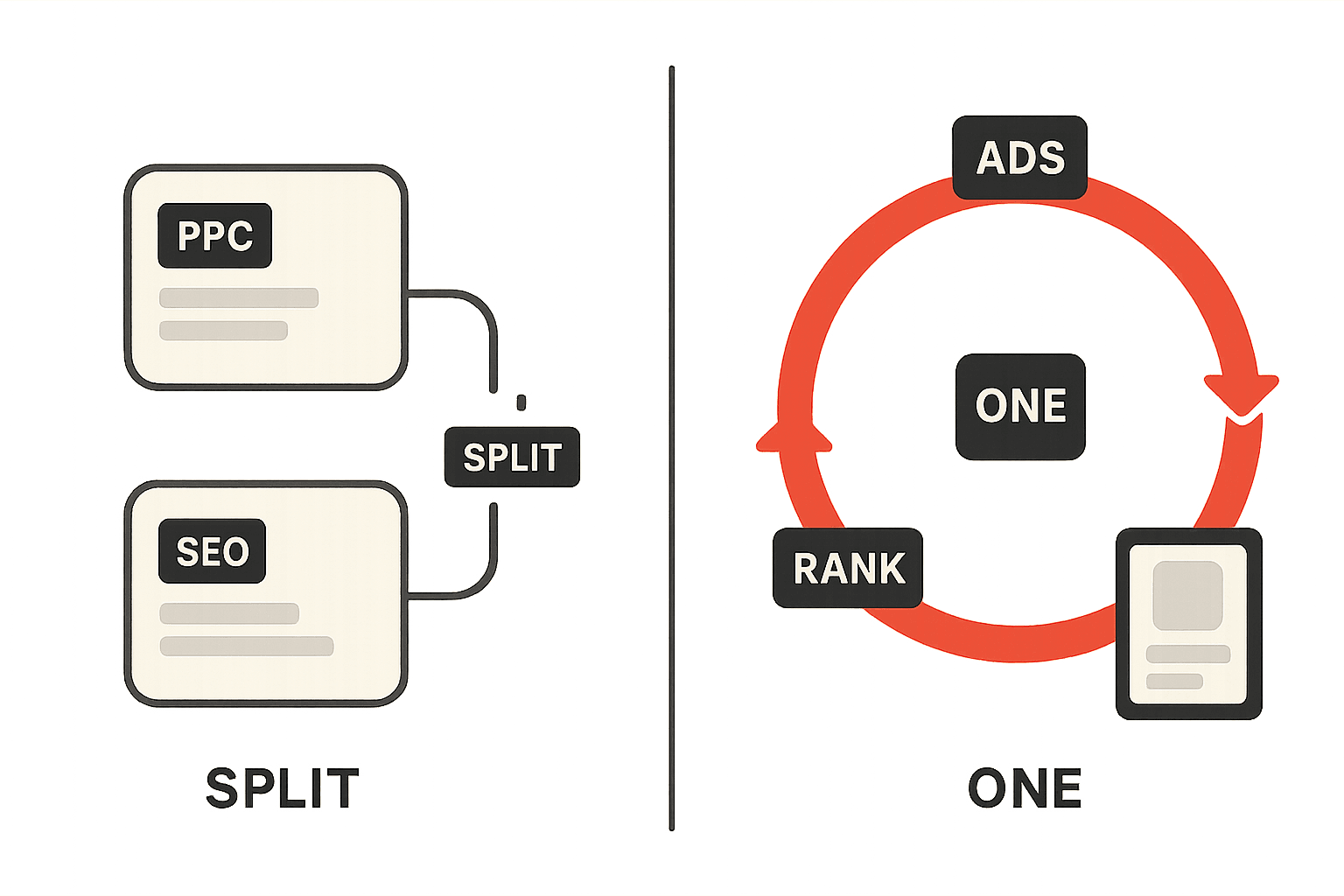
The loop that most sellers pay two vendors to break
Here is the mechanic that governs everything else.
On Amazon, advertising and organic ranking are not two channels that happen to sit on the same site. They are one system with a feedback loop running through it.
You spend on Sponsored Products. Those ads generate sales at a particular rate for a particular search term. The ranking algorithm reads that sales velocity, along with the conversion rate and the relevance signals around it, and moves your organic position on that term. Higher organic position means more organic sales at zero media cost, and it also means your ads compete from a stronger relevance position, which lowers what you pay for the next click. Cheaper clicks buy more velocity. The loop turns again.
Run that loop well for two quarters and the ratio of your revenue that arrives without media cost climbs steadily. That is the entire game. Everything an Amazon agency does is either feeding this loop, or is overhead.
Now consider what happens when you hire one vendor for listings and content, and a different vendor for advertising - which, because of how the category markets itself, is what a great many Indian brands have done.
The ads vendor buys traffic to a listing it does not control. When that traffic fails to convert, the honest fix is a listing fix, which is somebody else's scope. So the ads vendor does the only thing available to it: narrows targeting, cuts the terms that convert poorly, and reports a healthier ACOS on a smaller budget.
The listings vendor rewrites titles, bullets and backend terms, and then waits for a ranking movement that will not arrive, because rank on a competitive term needs velocity and velocity comes from the budget the other vendor is busy cutting. So it reports keyword position changes on low-volume terms that never turn into revenue.
Both vendors are behaving rationally. Both reports survive scrutiny. Neither is accountable for the only outcome you care about. This is why, when we look at a stalled Amazon account in India, the highest-leverage change is very often not a tactic at all - it is putting one team on the hook for one number.
If you take one thing from this article, take that. When you evaluate Amazon SEO and Amazon advertising providers, evaluate whether they can hold both halves of the loop, and be openly sceptical of anyone who wants only one half while insisting the other half is fine.
The retail-readiness gate
The second reason Amazon budgets underperform has nothing to do with the agency's skill and everything to do with what they were pointed at.
Advertising a listing that is not retail-ready is a subsidy to your competitors. You pay for a click, the shopper reads the page, the page fails to answer the question that brought them, and they go back to results and buy from someone else. You paid for their discovery. Worse, you have just taught the ranking algorithm that shoppers who see your product do not buy it, which suppresses the organic position the campaign was supposed to earn.
Any agency worth hiring audits this before it touches a media budget. Use the same list to audit the agency.
- Inventory cover is healthy and there is no realistic stock-out inside the campaign window. Going out of stock mid-flight destroys accumulated rank and is expensive to rebuild.
- The buy box is yours and not contested by a reseller or an unauthorised listing. Ads on a listing whose buy box you lose are simply a donation.
- The title carries the primary search term in natural language, front-loaded, without the padding that pushes it to the character limit and reads like a keyword list.
- The image set is complete and compliant - main image on pure white, then use-case, scale, detail, packaging and a comparison or infographic frame. Image quality is a conversion lever, not a design preference.
- The bullets answer objections, not specifications. The objections are already written down for you in your own negative reviews and in the questions section.
- A+ content is live if you hold Brand Registry, and it addresses the fit, sizing, compatibility or usage questions that drive returns.
- Backend search terms are populated with the synonyms, misspellings and transliterated variants that do not belong in customer-facing copy, and are not simply a repeat of the title.
- Reviews clear your category's floor. Every category has a rating and volume threshold below which paid traffic converts badly regardless of copy. Find yours before you fund a campaign.
- Price sits inside the expected band for the category. No amount of bid management fixes a product priced outside what the segment will pay.
- Variations are correctly parented so that review counts and browse relevance consolidate instead of fragmenting across near-identical child listings.
An agency that takes your media budget without walking this list is selling activity. An agency that opens the conversation by walking this list, and is willing to tell you that two of your five hero products should not be advertised at all yet, is worth a second meeting. The same discipline underpins any serious ecommerce SEO engagement, on or off marketplace.
The ACOS trap, with the arithmetic
Now the claim from the introduction. Here is a worked example using round numbers.
Take a seller whose product retails at ₹1,000. Cost of goods, referral fee and fulfilment together come to ₹620, leaving a contribution margin of 38 percent before advertising. Break-even ACOS on an incremental sale is therefore 38 percent.
Baseline month. Ad spend ₹3,00,000 producing ₹10,00,000 of ad-attributed sales, so ACOS is 30 percent. Total marketplace sales, paid and organic together, are ₹25,00,000, so TACOS is 12 percent. Contribution after ad spend is 38 percent of ₹25,00,000 minus ₹3,00,000, which is ₹6,50,000.
Now the ACOS optimiser. A new agency arrives, promises to bring ACOS down, and does. It switches off discovery and broad-match campaigns, stops defending contested category terms, and concentrates spend on branded and bottom-of-funnel keywords that were going to convert anyway. Spend falls to ₹1,50,000 and ACOS improves to 22 percent, so ad-attributed sales are about ₹6,80,000. But the velocity that was holding organic rank on the category terms is gone, so organic positions slip and total sales fall to ₹19,00,000. TACOS is now 7.9 percent. Contribution after ad spend is 38 percent of ₹19,00,000 minus ₹1,50,000, which is ₹5,72,000.
Look at what that report says. ACOS improved from 30 to 22. TACOS improved from 12 to 7.9. Ad spend halved. Every headline metric on the dashboard moved in the direction you were told to want, and the business earned 12 percent less money.
Now the profit optimiser. A different agency takes the same account and pushes in the other direction. It funds discovery, defends the contested head terms, and accepts a worse efficiency ratio in exchange for velocity. Spend rises to ₹4,00,000 and ACOS worsens to 34 percent, producing about ₹11,75,000 in ad-attributed sales. But the velocity lifts organic rank on the terms that matter, organic sales climb with it, and total sales reach ₹33,00,000. TACOS is 12.1 percent, essentially unchanged. Contribution after ad spend is 38 percent of ₹33,00,000 minus ₹4,00,000, which is ₹8,54,000.
ACOS got worse. TACOS was flat. Profit rose 31 percent.
This is not an argument that spending more is always right. Push the profit optimiser far enough and it runs past the point where incremental sales stop covering their own media cost, and then contribution falls again. The argument is narrower and more important: efficiency ratios and profit are different quantities that can move in opposite directions, so any contract that rewards the ratio can pay an agency to shrink your business.
Ask every shortlisted agency for a single figure, monthly: total marketplace sales multiplied by your contribution margin, minus total ad spend. If they resist because margin data is sensitive, that is a solvable problem - give them a margin band rather than a per-SKU cost sheet. If they resist because they would rather be measured on ACOS, you have learned what you needed to know. The same principle applies to how you should judge any performance marketing programme, on Amazon or off it.
The five fee models and what each one quietly optimises for
Every commercial structure creates an incentive. Most sellers pick a fee model on the basis of what feels safe rather than what it rewards.
| Model | How it is quoted | What it quietly optimises for | Where it breaks |
|---|---|---|---|
| Percentage of ad spend | Commonly around 8-15% of monthly media in the Indian market | Larger media budgets | The month your account needs less spend and more listing work |
| Flat retainer | A fixed monthly fee against a scoped number of hours | Predictable delivery inside the scope | Launches, festival peaks and anything needing a burst of effort |
| Percentage of marketplace revenue | Often low-to-mid single digits of GMV | Your top line | Margin problems, and revenue the agency did not cause |
| Base plus performance | A retainer plus a component tied to an agreed metric | Whichever metric you name, so name it carefully | A vague or unattributable metric, or a bonus tied to ACOS |
| Commission only | A share of sales, no fixed fee | Harvesting demand that already exists | Brand-term bidding and credit-claiming; almost nothing gets built |
Indicative market observation, not a Nico Digital rate card.
A few notes that matter more than the table.
Percentage of ad spend is the most common model and the most quietly misaligned. It is not that agencies on this model are dishonest. It is that when the correct recommendation is "pause this campaign and fix the listing", the model charges the agency money for making it. Over a year, that pressure shows up in the work.
Commission-only is the model that sounds safest and usually is not. An agency carrying all the risk will manage that risk by going after the sales that are easiest to claim, which means your own brand terms and your existing repeat buyers. You end up paying a commission on demand you already owned.
Base plus performance is the right answer for most serious engagements, with one condition. The performance component has to be tied to contribution after ad spend, or to incremental new-to-brand revenue, and never to an efficiency ratio. A performance bonus attached to ACOS is a contract that pays an agency to make your account smaller, as the arithmetic above demonstrates.
Whatever the model, insist on two clauses: you own the advertising account and the Seller Central access, and all campaign structures, search-term harvests and negative keyword lists transfer to you on exit. An agency that resists either is pricing in the cost of your leaving, which tells you what they expect the relationship to be.
What the first six months should actually look like
Vague timelines are how underperformance gets absorbed. Ask for the plan in this shape, and hold the agency to the shape rather than to a revenue promise.
| Window | What should be happening | What proves it |
|---|---|---|
| Days 1-30 | Retail-readiness audit, campaign architecture rebuild, search-term harvest from your own historical data, negative keyword hygiene, tracking and attribution set up | A prioritised fix list with owners and dates, and a campaign map you can read without a translator |
| Days 31-60 | Listing and A+ rewrites shipped on priority SKUs, structured attributes completed, bid strategy split by campaign purpose rather than run on one rule | Before-and-after conversion rate on the rewritten listings, not just impressions |
| Days 61-90 | The loop starts turning: organic rank movement on priority terms that traces back to specific paid velocity | Organic rank and organic units on named terms, plotted against the spend that fed them |
| Months 4-6 | Category-level movement, share of revenue shifting from paid to organic, event calendar planned in advance | Falling TACOS at flat or growing total sales, and rising contribution after ad spend |
Notice what is not in the first thirty days. Revenue growth. Almost everything that looks like improvement in month one is cleanup - cutting spend that was already wasted. That is real and worth having, but it is finite, it happens once, and an agency that presents it as growth is setting up a second quarter it cannot repeat. The distinction between cleanup and growth is exactly the one that a good paid media audit makes explicit.
Twelve questions for the shortlist, and the answers that should worry you
This is the part to bring to the meeting. Each question is followed by the response that should move the agency down your list.
1. Which of my listings would you refuse to advertise right now, and why? Worrying answer: none, all of them look fine. Every catalogue has SKUs that are not retail-ready. An agency that cannot name yours has not looked.
2. Who owns the listing copy if I hire you for ads? Worrying answer: that sits with your other vendor or your internal team, we just run media. This is the split-loop problem, stated openly.
3. Show me an account where you increased ACOS deliberately, and what happened to profit. Worrying answer: we always bring ACOS down. That is either untrue or an admission that they optimise the ratio rather than the business.
4. What is your reporting line on contribution after ad spend? Worrying answer: we report ACOS, ROAS and spend. Those are inputs. You are buying an outcome.
5. How do you handle mixed-language and transliterated search terms in this category? Worrying answer: a blank look, or an answer that only references English keyword tools. In India this is a live source of cheap, converting volume.
6. What happens to my organic rank if we pause ads for a month? Worrying answer: nothing, they are separate. This is the single fastest way to identify someone who does not understand the mechanic.
7. Which categories have you worked in that are structurally like mine? Worrying answer: a logo wall spanning every vertical. Referral fee structure, return rates, review dynamics and price sensitivity vary enormously by category, and pattern recognition does not transfer as freely as decks imply.
8. What does your team do about Rufus and AI-assisted shopping queries? Worrying answer: nothing yet, or a buzzword with no practice attached. You are not looking for a finished playbook here, you are testing whether they are paying attention.
9. Who specifically will work on my account, and what else are they on? Worrying answer: the senior person in the room, who you will never see again after signing. Ask for names and account loads.
10. What is the exit process? Worrying answer: hesitation. Account ownership, structure handover and negative keyword lists should be a one-line answer.
11. What in my current setup would you not change? Worrying answer: everything needs rebuilding. Total rebuild pitches are a sales posture, and they destroy accumulated campaign history that has real value.
12. What would make you tell me to stop spending on Amazon? Worrying answer: nothing. There are catalogues, margins and category positions where the honest recommendation is to fix the product economics or the channel mix first. An agency that cannot describe that scenario has never given the advice.
Amazon India is not Amazon US
A significant share of the playbooks circulating in this market are imported, and several of the assumptions inside them do not survive the journey.
Cash on delivery and returns change your maths. RTO and return rates on COD orders make your realised contribution margin lower than your modelled one. Every ACOS target quoted in a US case study assumes margin conditions you may not have, which is why the break-even ACOS should be calculated from your own numbers before any target is agreed.
Referral fees vary widely by category. Two brands with identical revenue can have very different room to advertise. Any target set without reference to your specific category's fee structure is a guess.
Search is mixed-language. A substantial share of Indian marketplace queries are typed in transliterated Hinglish or in regional phrasing, and English-first keyword tools underreport them. This is one of the few remaining places where cheap converting volume is sitting unclaimed, and it is invisible to an agency running an imported process.
Brand Registry gates more than people expect. A+ content, Sponsored Brands, Sponsored Display and much of the useful analytics sit behind it. An unregistered brand is playing a different game with a smaller toolkit, and getting registered is often a higher-return project than any campaign change.
Amazon Business is a real channel that most consumer sellers ignore. GST-invoiced B2B demand behaves differently, converts differently, and has materially less competition for attention.
The event calendar concentrates the year. Great Indian Festival and Prime Day compress a disproportionate share of annual volume into a few windows. Inventory, pricing and budget for those need planning months out, not weeks - and bid behaviour inside those windows follows its own rules.
If you sell on your own site as well, none of this replaces the direct-to-consumer side of the business. It sits alongside it, and the brands that do best treat marketplace and owned channel as one portfolio - which is the argument behind our D2C practice and the reason ecommerce PPC and marketplace advertising should be planned together rather than in separate meetings.
Rufus, and what AI-assisted shopping changes
The most-searched term in the entire dataset above was not an agency term. It was "amazon rufus", at roughly 1,000 monthly searches in India at a difficulty of 32.
Rufus is Amazon's AI shopping assistant. It answers natural-language questions - will this fit, is this suitable for, what is the difference between - by reading listing text, structured attributes and review content, and surfacing products in response. Functionally it behaves less like a keyword matcher and more like an answer engine that happens to live inside a store.
That has a direct and slightly ironic consequence for listing strategy. Listings optimised as keyword bags perform badly with an assistant, because they contain terms but not claims. A title padded to the character limit and five bullets repeating the same phrase in different orders give a model almost nothing to extract. A listing that states plainly what the product is, who it suits, what it fits, what it is made from and what it explicitly does not do gives an assistant answers it can use.
So the work that wins here is not new work. It is the completeness of your structured attributes, the honesty and specificity of your bullets, and genuine coverage of the objections that already appear in your own review section. The same shift that answer engine optimisation describes for the open web is arriving on the marketplace, and the tactics rhyme: structure, specificity, and answering the actual question. If you want the off-Amazon version of this argument, how to rank on ChatGPT covers the mechanics in detail, and our AI SEO practice is built around it.
Ask your shortlist question eight above. You are not expecting a finished Rufus playbook from anybody in August 2026. You are checking whether they noticed.
In-house, freelancer, or agency
One variable dominates this decision, which is monthly media spend, and a second modifies it, which is how many marketplaces and geographies you sell across.
| Situation | Usually the right call | Why |
|---|---|---|
| Under roughly ₹1L a month in media, single marketplace | Trained in-house owner or a specialist freelancer | Agency fees are a large share of total spend at this level, and the work is tractable for one focused person |
| ₹1L to ₹10L a month, one or two marketplaces | Agency | You are buying pattern recognition across categories and tooling you cannot yet justify buying alone |
| Above ₹10L a month, multi-marketplace or multi-geography | Hybrid: internal owner plus agency execution | Internal holds strategy, margin and inventory; agency brings execution capacity and competitive intelligence |
| Any level, nobody owns it | Fix that first | The unowned account is the actual problem, and no vendor choice solves it |
Bands are indicative and shift with category and margin.
The failure mode at every level is the last row. Amazon added to the responsibilities of someone whose main job is something else will underperform regardless of which box you tick. The equivalent trade-off on the search side is covered in SEO agency vs freelancer, and the reasoning transfers almost unchanged.
Red flags worth walking away from
- A guaranteed ACOS number in the pitch. ACOS is an outcome of your margin, category and competitive set. Guaranteeing it before seeing your data means guessing, or means planning to hit it by shrinking the account.
- ROAS figures without a denominator or a time period. A 12x ROAS on a branded campaign is not an achievement.
- Screenshots as case studies. Ask what the total sales line did, not what the campaign did.
- Reluctance to let you own the ad account. There is no legitimate reason for this.
- A total rebuild pitched before any audit. Campaign history has genuine value and burning it is a cost, not a strategy.
- Any mention of review manipulation, incentivised reviews or listing sabotage. Beyond the ethics, these carry suspension risk that you, not the agency, will carry.
- No named team. You are buying people's attention. Find out whose.
How to actually run the shortlist
A workable process, in about two weeks.
- Shortlist three, not seven. More than three and you will decide on presentation quality.
- Send the same brief to each, including your category, your contribution margin as a band, your current spend, your current total sales and your three biggest SKUs. Vague briefs produce generic pitches you cannot compare.
- Ask each for a written point of view before any meeting. One page. What they think is wrong, what they would do first, what they would not touch. This is the single most discriminating step in the process, and it costs you nothing.
- Run the twelve questions in a live conversation, not over email. You are listening for whether the answers are reasoned or recited.
- Score on the loop. Can they hold listings and ads together? Will they report contribution? Do they own the number?
- Start with a paid diagnostic rather than a twelve-month retainer. A scoped audit with a fix list is a cheap way to see how somebody thinks, and it is the same logic behind buying an SEO audit before an SEO retainer.
Where to go from here
If you are in the middle of this decision and want a second opinion on a proposal that is already in front of you, that is a short conversation rather than a pitch. Tell us what you have been quoted, including the fee model and the metrics the agency proposed to be judged on, and we will tell you plainly what that structure is going to optimise for over twelve months - including the cases where the honest answer is that the proposal in your hand is a good one.
If you want the scope of the work itself, Amazon SEO services covers the listing, content and organic ranking side, Amazon advertising covers Sponsored Products, Brands, Display and DSP, and ecommerce PPC covers the same discipline across your own store and the other channels feeding it.
And if the harder question underneath all of this is whether marketplace is even where your next rupee should go, SEO vs PPC: which to invest in first and PPC vs SEO cost in India work through the sequencing with the same arithmetic-first approach used above.
Related Reading on Marketplace and Ecommerce Growth
- Amazon SEO Services - the listing and organic ranking side of the loop
- Amazon Advertising Agency - Sponsored Products, Brands, Display and DSP
- Ecommerce PPC Services - paid media across store and marketplace together
- Ecommerce SEO Agency - the off-Amazon half of the catalogue problem
- Ecommerce SEO Checklist 2026 - the technical baseline for your own store
- Amazon Prime Day Bid Adjustment - how event windows change bidding
- The Hidden SERP Squeeze - what is happening to ecommerce results off-marketplace
- Google Shopping Product Listings - the other feed-driven channel worth owning
- Checkout UX Best Practices - the conversion end of the same funnel
- 10 Performance Marketing Metrics - what to report instead of vanity ratios
- Reduce Customer Acquisition Cost - the margin argument in full
- Google Ads Audit: Cut Wasted Spend - separating cleanup from growth
- When Performance Max Works for Ecommerce - the automation trade-off
- tCPA vs tROAS vs Max Conversions - bid strategy by objective
- CRO Agency India - fixing conversion before buying more traffic
- SEO Agency vs Freelancer - the same build-or-buy decision on the search side
- Answer Engine Optimisation - the discipline behind the Rufus section
- How to Rank on ChatGPT - the off-marketplace version of assistant visibility
- SEO Statistics India 2026 - market context for everything above
- Digital Marketing Glossary - if ACOS, TACOS or new-to-brand were unfamiliar

Aditya Kathotia
Founder & CEO
CEO of Nico Digital and founder of Digital Polo, Aditya Kathotia is a trailblazer in digital marketing. He's powered 500+ brands through transformative strategies, enabling clients worldwide to grow revenue exponentially. Aditya's work has been featured on Entrepreneur, Economic Times, Hubspot, Business.com, Clutch, and more. Join Aditya Kathotia's orbit on LinkedIn to gain exclusive access to his treasure trove of niche-specific marketing secrets and insights.