

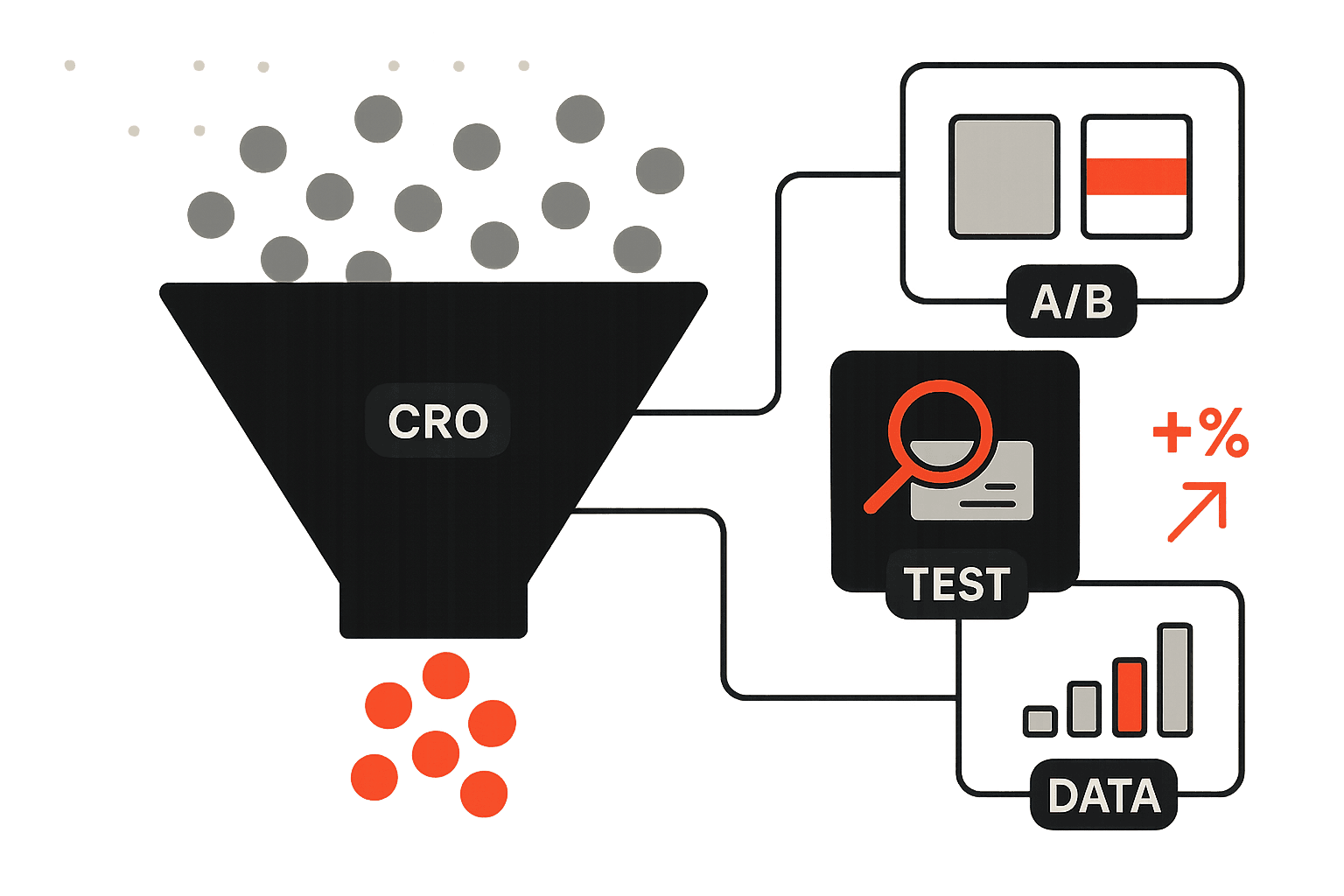
Most businesses have a traffic problem in their heads and a conversion problem on their site. They pour budget into SEO and paid ads to bring more people in, while the page those people land on quietly leaks nine out of every ten of them. A conversion rate optimisation (CRO) agency exists to fix the leak - to make the traffic you already earn and already pay for convert more often, so every ranking, every click, and every rupee of media spend works harder.
This guide is written for the person deciding whether to hire one. It explains what a CRO agency genuinely does (and what "CRO" too often means in practice), how the testing loop works, what conversion rate optimisation costs in India in 2026, how to evaluate a partner without paying for guesswork dressed up as strategy, and where the discipline is heading now that a growing share of traffic arrives pre-informed from AI search. If you run demand through PPC or SEO and suspect your site is not turning enough of it into revenue, this is the layer you are missing.
The Short Answer
A CRO agency increases the percentage of your website visitors who take a valuable action - buy, book, enquire, or subscribe - without requiring more traffic. It does this through a research-driven experimentation loop: analysing where and why visitors drop off, forming hypotheses about the cause, running A/B or multivariate tests to prove which changes actually lift conversions, and iterating on what wins. The output is tested, statistically validated improvements to your funnel and a clear line to the revenue they produced - not a slide deck of "best practice" opinions. In India, expect a one-time audit at roughly Rs 40,000 to Rs 1.5 lakh and ongoing programmes at roughly Rs 75,000 to Rs 3 lakh per month, priced mainly by how many experiments you run.
What Conversion Rate Optimisation Actually Is
Conversion rate optimisation is the systematic practice of increasing the share of visitors who complete a desired action. The maths is unforgiving in the best way. If 10,000 people visit your site each month and 2 percent convert, you get 200 customers. Lift that rate to 2.6 percent and you get 260 - a 30 percent increase in customers on identical traffic, identical ad spend, and identical rankings. Nothing else in marketing has that leverage, because you are not paying again for the audience; you are extracting more value from the audience you already have.
The word that matters in that definition is systematic. CRO is not "make the button bigger" or "try a new hero image because it feels fresher." It is a method for replacing opinion with evidence. Every serious change is a hypothesis that gets tested against the current version, measured against a real conversion goal, and kept only if the data says it genuinely won. That discipline is what separates conversion rate optimisation from ordinary redesign - and it is what most businesses are actually buying when they hire a CRO agency, even if they think they are buying "a better website."
The danger is that "CRO" has become a label many agencies bolt onto design work without the underlying rigour. A real CRO engagement produces experiments, significance thresholds, and revenue attribution. A fake one produces a prettier page and a confident story about why it should work better. The rest of this guide is largely about telling those two apart.
What a CRO Agency Does, Step by Step
A good CRO agency runs a repeatable loop. The specifics vary by tool and vertical, but the shape is remarkably consistent across every serious programme.
1. Research and diagnosis. Before touching a single element, the agency finds out where visitors leave and, crucially, why. This means quantitative analysis (funnel drop-off in Google Analytics, device and traffic-source breakdowns, page-speed and Core Web Vitals) combined with qualitative research (heatmaps, scroll maps, session recordings, on-site surveys, and sometimes moderated user testing). The goal is to locate friction with evidence, not to guess.
2. Hypothesis formation. Each friction point becomes a testable statement: "Because mobile users abandon the checkout at the address step, simplifying that form to a single screen will increase completed purchases." A hypothesis names the problem, the proposed change, the expected effect, and the metric that will prove or disprove it.
3. Prioritisation. You will always find more to test than you can test at once. Agencies use frameworks like PIE (Potential, Importance, Ease) or ICE (Impact, Confidence, Effort) to rank hypotheses so the highest-leverage experiments run first. This is where experience earns its fee - knowing which of forty possible tests is worth running in the next sprint.
4. Test design and build. The winning hypotheses are built as experiments - A/B tests (one variant against the control), or multivariate tests where traffic volume allows - using a testing platform. Designers and developers create the variant; analysts define the sample size and significance threshold needed for a trustworthy result.
5. Run and measure. The test runs until it reaches statistical significance, not until someone likes the early numbers. Calling a test too early is one of the most common ways businesses fool themselves into shipping a change that does nothing.
6. Analyse and iterate. Winners are shipped to 100 percent of traffic and the revenue impact is documented. Losers and inconclusive tests are just as valuable - they tell you the hypothesis was wrong and redirect the next cycle. Then the loop repeats, each round informed by the last.
The deliverables that fall out of this loop typically include a conversion research report, a prioritised testing roadmap, the experiments themselves (design, build, and QA), a testing calendar with monthly velocity targets, and a results report tying wins to revenue. If an agency's proposal is heavy on "redesign" and light on "experiment," "significance," and "roadmap," you are looking at design work wearing a CRO costume.
What CRO Costs in India
Pricing for conversion rate optimisation in India spans a wide range because the work itself does. The single biggest driver is testing velocity - how many experiments you run per month - followed by the number of conversion points, templates, and platforms in scope. Here is where the numbers realistically land in 2026.
Two honest warnings on price. First, the floor is real: genuine experimentation needs enough traffic, proper analytics instrumentation, and senior analyst time, so anything marketed as "CRO" for a few thousand rupees a month is almost always unvalidated design tweaks, not tested experiments. Second, the ceiling is justified only by velocity and rigour - a Rs 3 lakh retainer that ships two tests a quarter is worse value than a Rs 1 lakh one that ships three a month. Ask any agency exactly how many experiments they commit to monthly and what happens to the fee if they miss that number. For a broader view of how agency pricing works in India, our take on SEO pricing in India applies the same "pay for output, not opacity" logic to the adjacent discipline.
How to Choose a CRO Agency in India
Because "CRO" is so easy to claim and so hard to verify from the outside, evaluation matters more here than in almost any other marketing discipline. Use these seven questions - they are designed to expose the difference between a testing engine and a redesign shop.
- "Show me a real test - hypothesis, control, variant, result, and significance." A genuine CRO agency has a portfolio of experiments with numbers, including the ones that lost. If they can only show you before-and-after screenshots of pretty pages, they do design, not CRO.
- "How many experiments will you run per month, and is that in the contract?" Testing velocity is the engine of results. A specific, contractual number separates operators from storytellers.
- "How do you decide what to test first?" You want to hear a prioritisation framework (PIE, ICE, or their own scored version), not "we start with the homepage because that is what everyone sees."
- "How do you avoid calling tests early?" The right answer involves pre-calculated sample sizes and significance thresholds set before the test launches. Vague answers here are a serious red flag.
- "How will you measure impact on revenue, not just conversion rate?" A conversion-rate lift that comes with a lower average order value can be a net loss. Good agencies model revenue per visitor, not vanity percentages.
- "What research do you do before you propose changes?" If the proposal jumps straight to redesign without heatmaps, recordings, analytics, or user research, you are buying opinions.
- "Do you optimise for where my traffic actually comes from - including AI search?" Increasingly, buyers arrive from AI answers already informed. Most agencies have no view on this; the ones building for the next decade do.
These are the same principles we apply to picking any marketing partner - our guide on how to choose an SEO agency in India walks the equivalent checklist for the acquisition side, and the two decisions should be made together.
Agency, Freelancer, or In-House?
There is no universally right structure - the answer depends on your traffic, testing volume, and how mature your programme is.
| Model | Best for | Trade-off |
|---|---|---|
| Freelancer / consultant | A one-time audit or a lean early-stage programme on a tight budget | Limited capacity and tooling; hard to sustain high testing velocity |
| CRO agency | Businesses that want a full research-test-iterate engine without hiring the team | Monthly retainer; you rely on the agency's process and priorities |
| In-house team | High-traffic businesses running many tests continuously at scale | Only economical once volume keeps specialists fully utilised - usually enterprise |
A common and sensible path is to start with an agency to build the programme, the instrumentation, and the testing discipline, then bring parts of it in-house once your volume justifies dedicated headcount. The mistake is hiring a single junior "CRO person" in-house before you have the traffic, tools, or process to make them productive - they end up doing unvalidated redesigns, which is the exact thing CRO is supposed to replace. We wrote about the reverse lesson - what building an internal system taught us about our own funnel - in what an in-house CRM taught us about our sales funnel.
CRO by Business Type
The discipline is universal but the emphasis shifts by model.
- Ecommerce and D2C. The money is in the product-page-to-checkout journey: page speed, product imagery, trust badges, shipping clarity, and above all a frictionless checkout. Small changes here compound across thousands of sessions. Our piece on checkout UX best practices covers the highest-leverage fixes, and this discipline pairs directly with ecommerce PPC and ecommerce SEO so the traffic you buy and earn actually converts.
- B2B and SaaS. Lead-generation pages live or die on form friction, message-to-market match, and proof. The classic wins are shorter forms, sharper value propositions, and social proof placed at the moment of hesitation - the kind of change we documented in how a single HTML tag increased conversions by 19%. If your growth runs on B2B lead generation, CRO is what turns those leads from a trickle into a pipeline.
- Paid-traffic landing pages. When you are paying per click, every point of conversion rate is money. Message match between ad and landing page, load speed, and a single clear action are the levers - we break down the most common failures in our PPC landing page audit of conversion killers. Proper conversion tracking underpins all of it; see enhanced conversions and first-party data for getting the measurement right.
The Mistakes That Waste CRO Budgets
Most failed CRO programmes fail for a small number of repeatable reasons. Watch for these in any agency you consider - and in your own team.
- Testing without research. Running A/B tests on random ideas is a slow, expensive lottery. Research-led hypotheses win far more often.
- Calling tests early. Ending a test the moment a variant looks ahead, before it reaches significance, ships noise as if it were signal. This is the single most common way businesses fool themselves.
- Optimising the wrong metric. Lifting click-through on a button while ignoring completed purchases, or lifting conversion rate while average order value quietly falls, produces reports that look good and revenue that does not move.
- Redesigning instead of testing. A full redesign changes hundreds of variables at once, so when conversions move you have no idea which change did it - and no way to repeat the win.
- Ignoring mobile separately. Mobile and desktop visitors behave differently and often need different fixes; a blended view hides the biggest problems.
- Treating CRO as a project, not a programme. The compounding value comes from continuous cycles. A one-time sprint captures a fraction of the available gain.
Where CRO Is Heading: Optimising for AI-Referred Traffic
Here is the shift most CRO agencies have not caught up to. A rapidly growing share of high-intent traffic now arrives from AI answer engines - ChatGPT, Perplexity, Gemini, and Google's AI Overviews - rather than from a blue-link search result. Those visitors behave differently. They frequently land already-informed, having read an AI summary of your category, your product, or even your pricing before they ever reach your page. The page's job changes: it no longer has to explain the basics the AI already delivered; it has to reassure, prove, and convert.
That changes what is worth testing. For AI-referred traffic, trust signals, concrete proof, transparent pricing, and a single frictionless next step matter more than long educational copy. It also means the conversion layer and the answer engine optimisation layer are two halves of one system - the work that earns the AI citation and the work that converts the resulting click should be run by the same team, tested together, and measured end to end. This is exactly where we go deeper than a traditional CRO shop: because we run the AI SEO programmes that generate those visits, we can segment AI-referred traffic and optimise specifically for how it behaves. Most agencies cannot, because they never earned the citation in the first place.
Where Nico Digital Fits
We approach conversion rate optimisation as a revenue discipline, not a redesign service. That means research before opinion, tested experiments over "best practice," revenue-per-visitor over vanity metrics, and a testing velocity we are willing to commit to. It also means we run CRO in the same room as the channels that feed it - SEO, PPC, and the AI-search layer - so the traffic we help you earn and buy is optimised end to end rather than handed off and forgotten. For D2C and ecommerce brands, that is the difference between a busy site and a profitable one; for B2B brands, it is the difference between traffic and pipeline.
If your site is getting traffic but not enough of it is converting, that gap is almost always the highest-ROI place to invest next, because you have already paid for the audience. It is cheaper to convert 30 percent more of the visitors you already have than to buy 30 percent more visitors.
The Bottom Line
A CRO agency is worth hiring when you have traffic you are not fully monetising and you want a disciplined, evidence-led system for fixing that - not a prettier website. Judge any agency on its experiments, its testing velocity, its prioritisation method, and its honesty about what your traffic can statistically support. Expect a real audit at roughly Rs 40,000 to Rs 1.5 lakh and a real programme at roughly Rs 75,000 to Rs 3 lakh a month, priced by how many experiments actually ship. And weight heavily toward a partner who understands where your traffic now comes from - including AI search - because the conversion problem and the visibility problem are increasingly the same problem.
If you want to see where your funnel is leaking and what the highest-leverage fixes would be, talk to us about a conversion audit - no deck, no pressure, just a clear read on what your existing traffic could be worth.

Aditya Kathotia
Founder & CEO
CEO of Nico Digital and founder of Digital Polo, Aditya Kathotia is a trailblazer in digital marketing. He's powered 500+ brands through transformative strategies, enabling clients worldwide to grow revenue exponentially. Aditya's work has been featured on Entrepreneur, Economic Times, Hubspot, Business.com, Clutch, and more. Join Aditya Kathotia's orbit on LinkedIn to gain exclusive access to his treasure trove of niche-specific marketing secrets and insights.