

Why Checkout Abandonment Is Mostly Structural, Not Behavioral
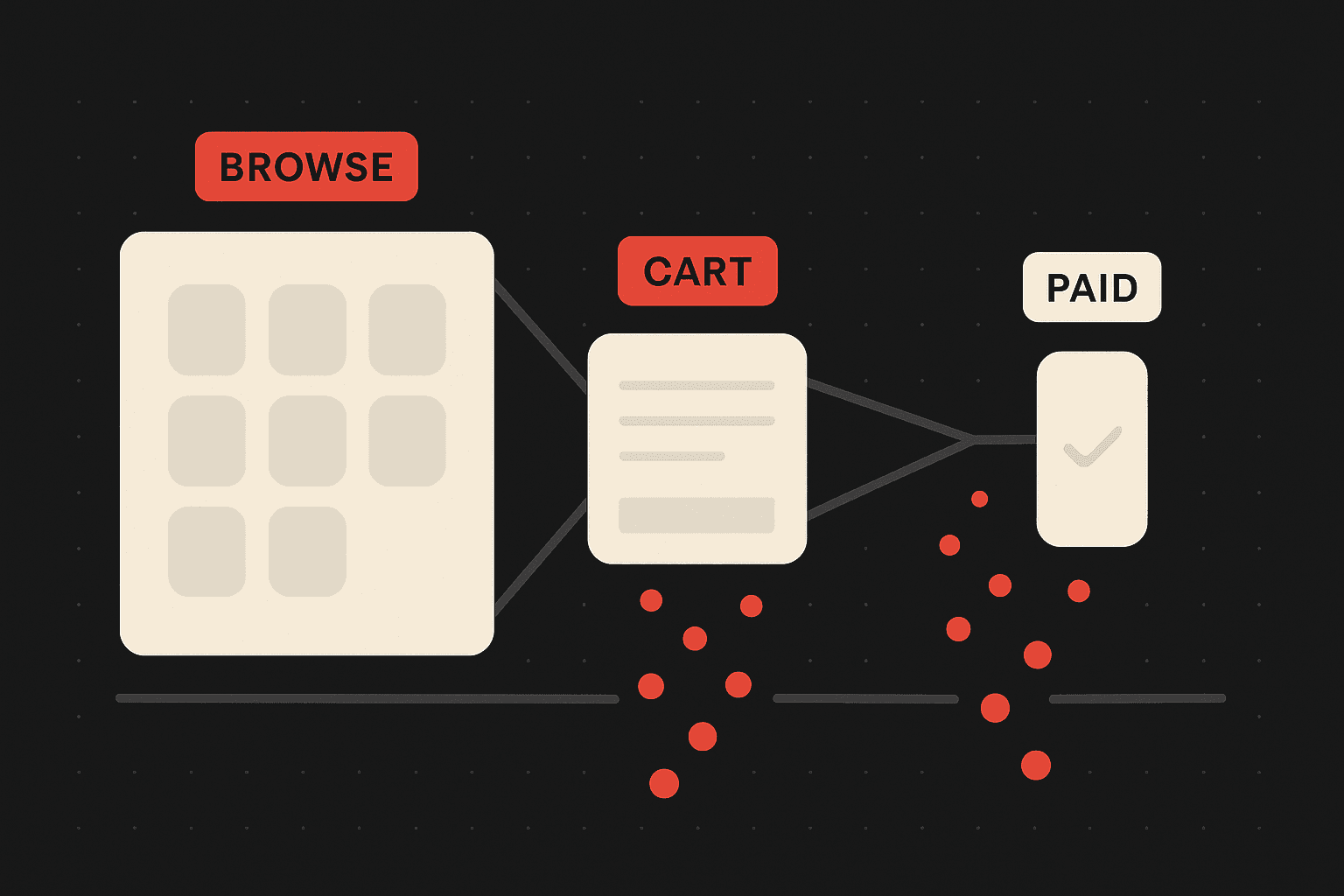
The instinct when analyzing checkout abandonment is to attribute it to customer indecision: they weren't ready to buy, wanted to compare prices, or got distracted. However, research consistently shows that a substantial majority of abandonment events are triggered by friction in the checkout process itself, not by a change in purchase intent.
The most cited reasons include unexpected costs at checkout, forced account creation, lengthy checkout processes with excessive form fields, payment security concerns, and lack of preferred payment methods. Each represents a design decision that is fixable.
The useful reframe: checkout UX work primarily removes reasons to leave rather than adds reasons to buy. The customer already wants the product. The design's job is to avoid creating an obstacle between that intent and the completed transaction.
According to Baymard Institute research, approximately 70% of online shopping carts are abandoned globally - and the rate is even higher in India, where mobile checkout friction, limited payment options, and COD dependency create additional structural challenges.
Is your checkout abandonment above 60%? We'll audit your checkout flow, identify the top 3 friction points costing you revenue, and give you a prioritized fix list - free. Request Your Checkout Audit →
Reducing Friction Before Payment
1. Guest Checkout: Eliminate the Account Wall
Requiring account creation before purchase is the single most damaging structural decision a checkout process can make. Research shows 25% to 35% of users will abandon rather than create an account, even when account creation takes under two minutes.
The resistance reflects psychological friction: users are being asked to create a brand relationship they may not plan to maintain, remember a new password, and accept marketing communications before completing an already-decided purchase.
Implementation strategy: Provide a clearly visible guest checkout option alongside sign-in options. Present account creation prompts after successful order confirmation, when customer experience is most positive and likelihood of future engagement is highest. Offer social login via Google or Facebook as an additional option.
2. Form Architecture: Every Unnecessary Field Has a Cost
Form length and conversion rate have a near-linear inverse relationship. Each additional required field introduces abandonment probability that compounds across the checkout process.
Key optimizations:
- Eliminate fields without operational necessity (phone numbers, second address lines)
- Auto-populate billing addresses from shipping addresses via checkbox
- Implement address auto-complete using Google Places API or equivalent
- Apply conditional logic to hide irrelevant fields based on user selections
3. Single-Page vs. Multi-Step: Match Complexity to Transaction Type
Neither single-page nor multi-step checkout is universally superior. The right choice depends on transaction complexity and cognitive load.
Single-page checkout works for:
- Low-complexity transactions with few product variables
- Minimal customization requirements
- Returning customer bases that complete checkout quickly
Multi-step checkout works for:
- Configurable products
- Delivery options affecting pricing
- Gift messaging requirements
- Complex tax calculations
A visible progress indicator is non-optional in multi-step implementations. It shows customers where they are and what remains, reducing abandonment from uncertainty.
4. Cost Transparency: Show the Full Price Before Checkout
Hidden costs trigger abandonment disproportionate to the amount. A customer expecting ₹850 for a product who encounters ₹220 in shipping experiences this as a betrayal of the implied agreement, not neutral information.
Solution layers:
- Display shipping estimates on product pages
- Confirm estimates on cart pages
- Ensure checkout pages only confirm already-known totals
- Show free shipping thresholds and current cart proximity to them (reduces abandonment and increases average order value)
India-Specific Payment Optimization
This section is critical for Indian ecommerce and represents the biggest gap most checkout audits miss.
5. Payment Methods: Match Indian Buyer Behavior, Not Industry Averages
The payment landscape in Indian ecommerce differs fundamentally from Western markets. Checkout completion rates are directly tied to offering the payment methods Indian shoppers actually use.
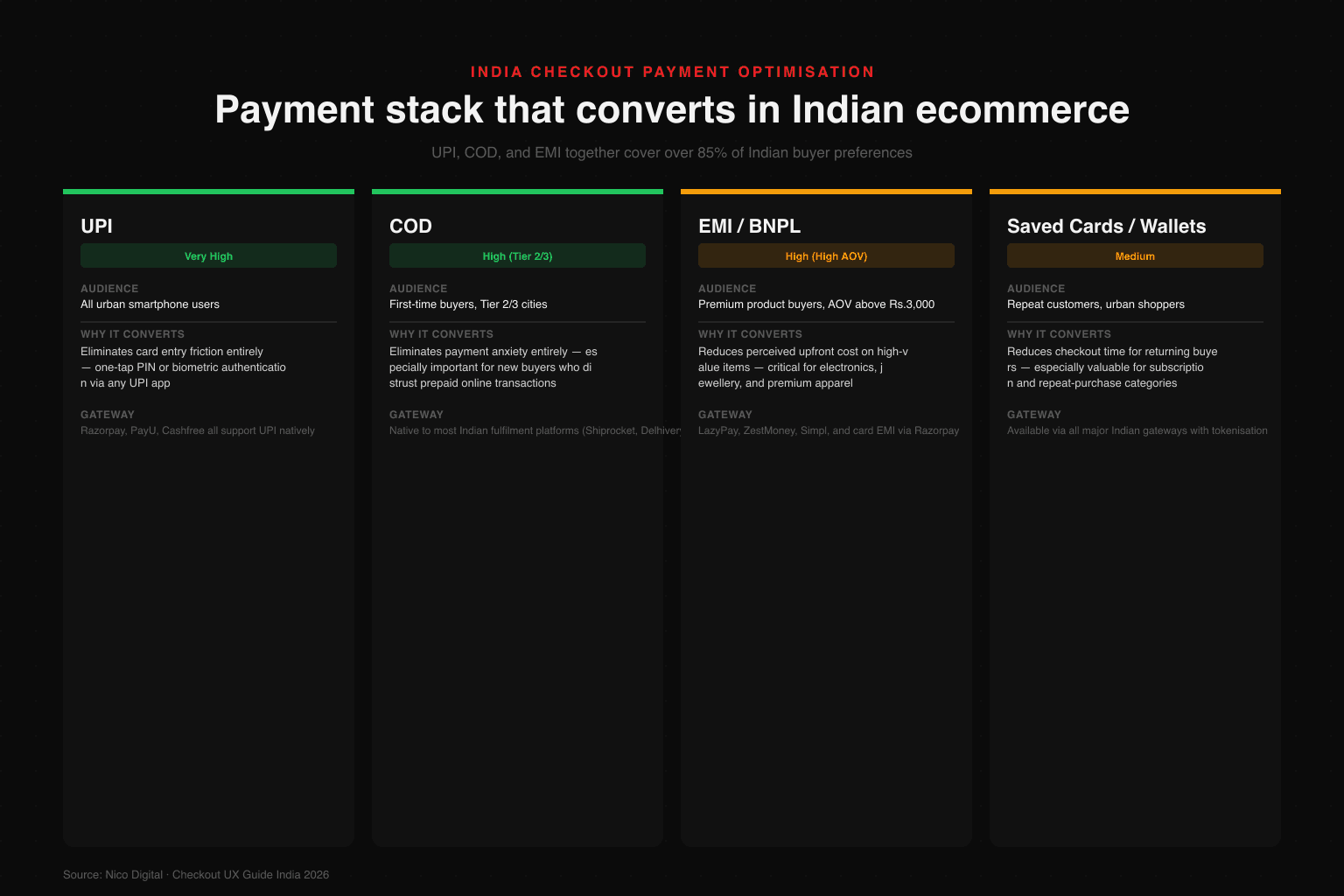
The Indian payment stack your checkout must support:
UPI (Unified Payments Interface): UPI is now the dominant digital payment method in India, with over 14 billion monthly transactions. Integration via Razorpay, PayU, or Cashfree enables one-tap UPI payment that eliminates card entry entirely. For mobile shoppers, this is the single highest-impact payment addition available.
Cash on Delivery (COD): Despite its operational cost, COD remains the highest-converting option for first-time buyers and shoppers in tier-2 and tier-3 cities where trust in online payments is still building. Removing COD without understanding your buyer mix is a common conversion mistake. If you must reduce COD dependency, offer a small prepaid incentive (₹50 discount or faster delivery) rather than removing the option outright.
EMI options: For products priced above ₹3,000, no-cost EMI through Bajaj Finserv, ZestMoney, or credit card EMI schemes reduce perceived upfront cost significantly. Indian shoppers are highly EMI-aware and will abandon a ₹8,000 purchase if the only option is full upfront payment.
Buy Now Pay Later (BNPL): Simpl, LazyPay, and similar BNPL options are growing rapidly, particularly for urban Gen Z buyers. If your average order value is ₹500-₹2,000 and you're targeting younger shoppers, BNPL integration is worth evaluating.
Net Banking: Still used by a meaningful segment of older buyers who don't trust UPI. Include coverage across major Indian banks (SBI, HDFC, ICICI, Axis, Kotak).
Wallets: Paytm Wallet retains meaningful usage, particularly for repeat purchases.
6. Trust Signals: Place Them Where Anxiety Is Highest
Trust signals are most effective when placed at moments where purchase anxiety peaks - typically at the payment information step, not uniformly across the page.
Placement strategy:
- SSL certificates, security badges, and encryption notices appear immediately adjacent to card entry fields
- Return policy and refund terms appear at final confirmation, where commitment hesitation peaks
- Customer reviews and trust indicators appear earlier, during product evaluation phase
- For Indian shoppers specifically, displaying "100% safe checkout" with recognizable payment partner logos (Razorpay, PayU) near the payment step meaningfully reduces payment anxiety
Reducing Friction at the Point of Decision
7. Real-Time Shipping and Delivery Information
Delivery timing uncertainty deters time-sensitive buyers. Implementation requires capturing shipping addresses before presenting delivery estimate options.
Key elements:
- Location-based delivery estimates at shipping options step
- Specific delivery dates rather than date ranges
- Multiple shipping options with transparent pricing for customer self-selection
- Avoid defaulting to most expensive options to encourage selection
8. CTA Design: The Button That Completes the Transaction
The final purchase button must be immediately findable and clearly communicate its action and impact.
Text optimization: Generic terms like "Submit" underperform. "Place Order," "Complete Purchase," or "Pay Now ₹X" communicate action and remove final price uncertainty. Including the order total in button text increases completion rates.
Visual treatment:
- Highest visual prominence on the page relative to other interactive elements
- Higher contrast than secondary actions
- Sufficient size for comfortable mobile tap targets (minimum 44px height)
- Adequate surrounding whitespace to prevent accidental activation
- Above-the-fold placement on mobile (where scrolling creates friction)
9. Error Messages: Specific, Constructive, and Immediate
Vague or delayed error messages generate disproportionate abandonment. Users who have successfully completed most fields are at high abandonment risk when encountering unexplained errors.
Implementation strategy:
- Inline validation catches errors as fields are completed, not at submission
- Red field highlighting with specific instructional text: "Card number must be 16 digits" rather than "Invalid card"
- Error visibility without scrolling
- Instructional tone: "Please enter a valid email address" outperforms accusatory language
10. Microcopy: The Small Words That Do Heavy Lifting
Text on and around form elements, buttons, and trust indicators does substantial persuasive work. Categories worth optimizing include:
- Field labels and placeholder text (clear and specific, not generic)
- Helper text near security-sensitive fields: "Your card details are never stored on our servers"
- Urgency or scarcity signals where accurate: "Only 3 remaining at this price"
- Post-CTA reassurance: "You'll receive an order confirmation within 2 minutes"
Critical constraint: Urgency and scarcity language must be authentic. Customers trained to distrust perpetually "limited" messaging will discount such signals and undermine other trust elements.
Recovery and Optimization
11. Cart Recovery: The Revenue You Can Recover After Abandonment
Well-optimized checkout still experiences abandonment. Meaningful recovery is possible through systematic mechanisms.
Abandoned cart emails: Sent within one hour of abandonment (significantly outperforms 24-hour timing). Include product images and direct cart recovery links. For Indian ecommerce, WhatsApp cart recovery messages often outperform email - open rates on WhatsApp exceed 90% versus 20-30% for email.
Exit-intent popups: Most effective when offering concrete incentives (discount, free shipping, guarantee) rather than simply asking users not to leave. Segment offers by cart value or abandonment step for relevance.
Retargeting campaigns: Show specific products users viewed or abandoned. Attribution should be evaluated carefully, as retargeting captures users who may have returned anyway; incrementality requires proper measurement. Brands running paid recovery flows through specialist ecommerce PPC services can layer audience segmentation and incrementality testing that most in-house teams lack the tooling to execute.
12. Testing and Continuous Optimization
No checkout design is finished. Systematic testing compounds improvements in conversion rate over time.
High-leverage testing variables:
- CTA text and design
- Form field sequence
- Default shipping selection
- Trust signal placement
- Payment option presentation order (UPI first vs. card first for Indian audiences)
Analytical tools:
- Heatmaps and session recording (Hotjar, Microsoft Clarity): Reveal hesitation patterns, attempted interactions with non-interactive elements, and CTA button discovery difficulty
- Funnel drop-off analysis in GA4: Identify which specific multi-step checkout stages lose highest user proportions, directing testing toward highest-leverage intervention points
The Mobile Checkout Problem Deserves Its Own Consideration
Every checkout UX element amplifies in difficulty on mobile: form field accuracy diminishes with touchscreen input, payment entry becomes more error-prone, progress indicators are harder to read on smaller screens, and buttons can become dangerously small.
Mobile now drives majority e-commerce traffic in most categories, with more shoppers starting checkout on mobile than desktop. However, far fewer complete purchases. This gap represents one of the biggest optimization opportunities in e-commerce.
In India, the mobile checkout gap is even more pronounced. Over 70% of Indian ecommerce traffic is mobile, but the checkout completion rate on mobile typically runs 30-40% lower than desktop. For Indian D2C brands, closing this gap is the single highest-leverage conversion opportunity available.
Mobile-specific interventions:
- Keyboard type optimization (numeric keyboards for card and phone fields)
- Appropriate autocomplete attributes on address fields
- Autofill support for saved payment methods
- UPI deep links that open the user's preferred UPI app directly
- Digital wallet payment options that eliminate card entry entirely
- Larger tap target sizes across all interactive elements
Testing on actual devices rather than emulators surfaces issues that wouldn't appear in desktop-first design cycles.
Frequently Asked Questions
What is the biggest cause of cart abandonment on mobile in India?
The three largest causes are: payment friction (no UPI or preferred payment method), slow checkout page load speed on mobile networks, and excessive form fields that are difficult to complete on a small keyboard. Fixing UPI integration and reducing form fields to the minimum required typically produces the fastest improvement in mobile checkout conversion.
How do I set up an abandoned cart email for a Shopify India store?
Shopify's built-in abandoned checkout emails are a starting point, but for India-specific optimization, configure the recovery email to trigger within 60 minutes (not the default 10 hours), include the cart contents with images, and add a WhatsApp recovery option via a Shopify app like SuperLemon or Interakt. Segment the recovery sequence by cart value - high-value carts warrant a discount offer; low-value carts can use urgency messaging alone.
How do I reduce cart abandonment on a Shopify store in India?
The highest-priority changes for Shopify India stores are: enable UPI payment via Razorpay or Cashfree, add COD as an option if your margin supports it, remove mandatory account creation, display shipping costs before checkout, and configure a 60-minute abandoned cart WhatsApp or email sequence. These five changes will produce measurable improvement within the first 30 days.

12-Point Checkout Audit Checklist
Before your next development sprint, check each of these:
- Guest checkout option is visible and frictionless
- Form fields are minimized - no unnecessary data collection
- UPI is integrated via Razorpay, PayU, or Cashfree
- COD is available (or removal has been tested with conversion data)
- EMI options are visible for products priced above ₹3,000
- All costs (shipping, taxes) are visible before the payment step
- Trust badges appear adjacent to payment fields
- Delivery date is shown as a specific date, not a range
- CTA button includes the total order amount
- Error messages are inline and instructional
- Abandoned cart recovery triggers within 60 minutes
- Mobile checkout is tested on actual devices across network conditions
Conclusion
A checkout abandonment rate above 60% is not a customer problem - it is a design problem. The twelve fixes in this guide address the structural friction points that prevent intent from converting to transaction.
For Indian ecommerce specifically, the payment stack is the single most impactful variable. Getting UPI, COD, and EMI right will produce faster improvement than almost any other checkout change.
Start with the audit checklist above, prioritize the payment and form friction issues, and implement a systematic recovery sequence for the abandonment that remains. The compound effect of these changes - applied consistently and tested rigorously - is the difference between a checkout that converts 3 in 10 carts and one that converts 5.
Is your checkout abandonment above 60%? We'll audit your checkout flow, identify the top 3 friction points costing you revenue, and give you a prioritized fix list - free. Request Your Checkout Audit →

Aditya Kathotia
Founder & CEO
CEO of Nico Digital and founder of Digital Polo, Aditya Kathotia is a trailblazer in digital marketing. He's powered 500+ brands through transformative strategies, enabling clients worldwide to grow revenue exponentially. Aditya's work has been featured on Entrepreneur, Economic Times, Hubspot, Business.com, Clutch, and more. Join Aditya Kathotia's orbit on LinkedIn to gain exclusive access to his treasure trove of niche-specific marketing secrets and insights.