

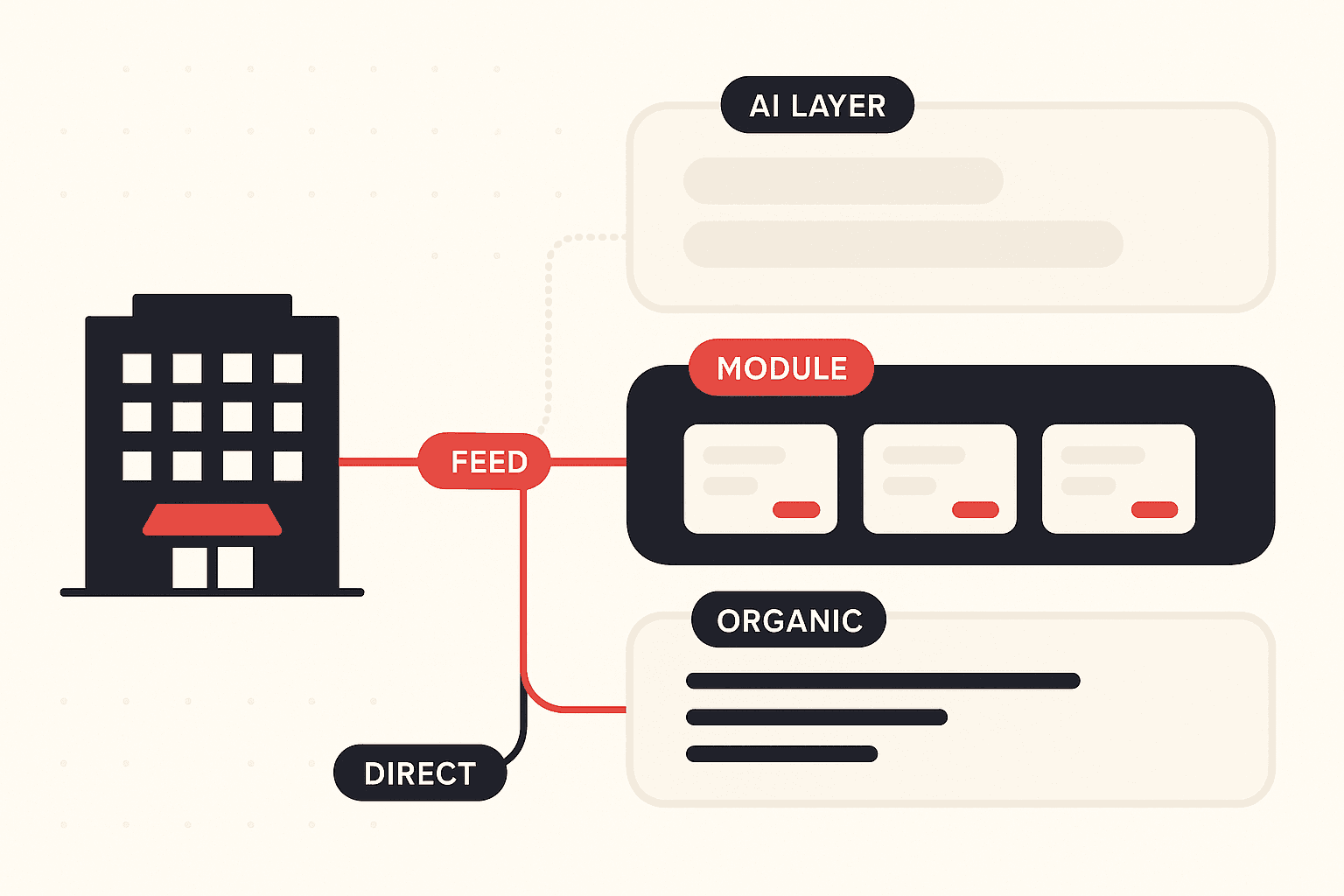
Search "hotels in Udaipur" and count what stands between a traveller and your property. An AI Overview summarising the city. A hotel module with dates, filters and live nightly rates. Booking.com. MakeMyTrip. A Tripadvisor listicle. Agoda. Somewhere below all of that, if the traveller is still scrolling, your website.
You are paying for every one of those intermediaries. Published commission ranges run roughly 10 to 25 percent on Booking.com and 15 to 30 percent for independent properties on Expedia, with the larger chains negotiating themselves down. On a property doing meaningful annual room revenue, a few points of channel mix is a salaried position. Most hoteliers know this. What they do not know is that almost every guide telling them how to fix it was written by a company whose product connects them to those same OTAs.
The short version
Hotel search is not one ranking problem. It is three separate surfaces, each controlled by a different mechanism, and most hotel SEO budget is spent on the one that matters least.
The hotel module - the unit with dates and rates - is populated from Google Hotel Center via a real-time feed sent by an approved connectivity partner. No amount of content or schema puts you there. The organic web results below it are won with pages that are specific in ways an OTA listing structurally cannot be: amenity, occasion and proximity pages. The AI answer layer above everything is won with extractable structure and third-party corroboration.
The most repeated advice in the category - add Hotel schema markup and your rates and star rating will appear in search - is contradicted by Google's own documentation. There is no Hotel rich result. Start by fixing that misconception, because a great deal of wasted hotel SEO spend flows directly from it.
Who teaches hotels SEO, and why it matters
Pull the first page of results for "seo for hotels" and look at who is publishing, not what they say.
SiteMinder. Mews. RoomRaccoon. RMS Cloud. Cvent. Hotel Tech Report. These are channel managers, property management systems, booking engines and the trade press that covers them. They produce genuinely competent content and they rank because they have topical authority in hospitality and the domain strength to match.
They also have a structural conflict, and it is worth naming plainly rather than cynically. A channel manager's product exists to distribute your inventory to OTAs efficiently. Its commercial interest is in you being connected to more channels, not fewer. That does not make its SEO advice dishonest - most of it is fine as far as it goes. It does mean the advice reliably stops short of the strategic question a hotelier actually needs answered, which is how much of your distribution should be intermediated at all, and what you would have to build to change that ratio.
The result is a page-one consensus that is heavy on tactics and silent on channel economics. Nine guides will tell you to compress your images. None will tell you that your rate feed's historical price accuracy is a documented ranking signal for the surface that carries most of your booking traffic.
There is one more tell on that SERP. A Reddit thread from r/localseo ranks on page one, and its opening question is essentially "hotel Google Business Profiles do not behave like other businesses - what do I do?" That question is the actual state of practitioner knowledge in this category, and none of the vendor guides answer it directly.
The schema myth that will not die
Here is the claim, quoted from the AI Overview that currently sits at position one for "seo for hotels":
Structured Data (Schema): Implement Hotel Schema markup to display rich snippets like star ratings, pricing ranges, and reviews directly on search pages.
Now check it against Google's own structured data documentation. Google's search gallery lists the rich result types that Google actually supports. There are 25 of them: Article, Breadcrumb, Carousel, Course list, Dataset, Discussion forum, Education Q&A, Employer aggregate rating, Event, Image metadata, Job posting, Local business, Math solver, Movie, Organization, Product, Profile page, Q&A, Recipe, Review snippet, Software app, Speakable, Subscription and paywalled content, Vacation rental, and Video.
Hotel is not on that list. The only lodging-adjacent entry is Vacation rental, which covers vacation properties rather than hotels.
So Google's AI Overview is confidently telling hoteliers to do something that Google's own developer documentation does not support. That is not a subtle discrepancy. It is the single most consequential piece of advice in the category, repeated across dozens of guides, and it is wrong about the mechanism.
To be precise about what schema still earns you, because the correction is not "skip structured data":
| What you were told | What is actually true |
|---|---|
| Hotel schema puts your nightly rate in Google | Rates come from a Hotel Center feed via a connectivity partner |
| Hotel schema puts your star rating in the SERP | There is no Hotel rich result; star ratings in the module are Google's own property data |
| Schema is how you get into the hotel pack | The hotel pack is a distribution integration, not a content output |
| Structured data is therefore pointless for hotels | False - Organization, BreadcrumbList and FAQPage are all supported and worth shipping |
Ship structured data for entity clarity, breadcrumbs and FAQ eligibility. Just stop expecting it to do a job that a rate feed does. If your current agency has been billing schema work as the path to rate visibility, that is a conversation worth having, and a technical SEO audit is the cleanest way to establish what is actually deployed on your site today.
Surface 2: how a rate actually reaches Google
This is the part the content-marketing guides skip, because it is a distribution problem rather than a marketing one.
Google Hotel Center is the platform that manages the rates and availability used in both hotel ads and free booking links. Properties cannot push rates into it unaided. You connect through one of Google's approved integration partners - in practice your channel manager, booking engine or PMS - which transmits real-time rates and availability as a structured feed.
Google's documented requirements are specific enough to be actionable. The feed price must be updated at least as often as prices change on your website. Price accuracy needs to hold above roughly 95 percent. The landing page has to pass a quality review. And Google states that the signals determining which free booking links are shown include consumer preference, the value offered to the user, landing page experience, and the historical accuracy of the prices provided to Google.
That last signal deserves emphasis, because it is where properties quietly lose eligibility. A feed that quotes a rate your booking engine will not honour when the traveller clicks through does not merely annoy that traveller. It degrades a documented signal over time. Hotels running stale feeds, or feeds that omit taxes and fees inconsistently, are training Google to show them less.
Three practical actions follow:
- Confirm you are connected at all. A surprising number of independent properties are not in Hotel Center, and assume the OTA listings that appear for their brand name are the ceiling. Ask your channel manager directly whether free booking links are live for your property.
- Audit feed-to-booking-engine parity. Have someone book a real stay through the free booking link and check the rate they land on matches the rate quoted, taxes and fees included.
- Fix the landing page the link points at. Google reviews it. If the free booking link deposits travellers on a slow, generic homepage instead of a dated availability view, you are failing a documented signal and wasting the click.
None of this is content work. All of it outranks content work in expected value.
Surface 1: where the winnable demand actually lives
Now the part SEO can genuinely move. And the first thing to accept is that the queries you daydream about are not the queries you can win.
"Hotels in Udaipur" draws about 60,500 searches a month in India. "Hotels in Goa" about 33,100. "Five star hotels in Delhi" about 27,100. Those numbers are seductive and they are almost entirely unwinnable for a single property, because the SERP for them is built from aggregator inventory. Competition index on "hotels in Goa" is 94 out of 100. You are not going to out-authority Booking.com on a query whose entire user need is comparison across inventory you do not have.
Look instead at what the same traveller searches when they have already decided what kind of stay they want.
Read the middle block again. "Wedding venues near me" pulls roughly 246,000 US searches a month. A hotel with a banquet hall and a lawn is a wedding venue. Most such hotels have a single generic "Events" page with a contact form and three photographs, and have never once considered that the query exists.
That is the whole opportunity in one example. An OTA listing for your property is assembled from structured inventory fields - room types, amenity checkboxes, a star rating, a stock description. It cannot tell a traveller that the lawn seats 220 under cover in monsoon, that the pet policy has no weight limit, that the airport transfer runs until 2am, or that the long-stay rate includes a kitchenette from night seven. You can. That specificity is not a nice-to-have; it is the only durable structural advantage you hold over an aggregator with a hundred times your domain authority.
Build these page types, roughly in this order:
| Page type | Example query | Why an OTA cannot match it |
|---|---|---|
| Amenity + city | "pet friendly hotel in [city]" | Checkbox on their listing; a real policy page on yours |
| Occasion / function | "wedding venue in [city]", "conference hall in [city]" | They do not sell event space at all |
| Stay type | "extended stay", "day use", "workation" | Rate logic they cannot express in a listing |
| Proximity / landmark | "hotel near [convention centre]" | Generic distance field vs. actual transit guidance |
| Neighbourhood guide | "where to stay in [district]" | Requires local knowledge, not inventory |
| Brand defence | "[your hotel] official website" | You should own your own name outright |
That last row is not glamorous but it is the highest-margin traffic on the list. "Book direct hotel" carries a $13.74 CPC in the US on only about 90 searches a month, which tells you exactly how valuable the intent is when it appears. Meanwhile "makemytrip hotels" draws 14,800 monthly searches in India - a reminder of how completely OTA brands have colonised the consideration stage. Your own brand SERP is the one piece of that battlefield you can actually take, and the approach is the same as any other brand SERP defence programme.
Seasonality is a content calendar, not a footnote
The keyword data carries a scheduling instruction most hotels ignore.
"Hotels with rooftop pool" runs at about 720 searches a month in November and about 8,100 in July - an eleven-fold swing. "Hotel with jacuzzi in room" moves the opposite way, peaking near 33,100 in January and February and falling to about 4,400 by July. Same category, inverted curves, because one is a summer product and the other is a winter one.
The operational consequence is that a page published in peak season has already missed the season. Indexation, ranking and the accumulation of engagement signals take months. If you want the rooftop-pool page working in July, it needs to exist and be maturing by March. Most hotels build the summer page in June, watch it underperform, and conclude that SEO does not work for them.
Map your own amenity and occasion pages against their demand curves, then backdate each build by a full quarter. This is ordinary content marketing discipline applied to a category where the seasonality is unusually violent.
The Google Business Profile reality for hotels
The Reddit thread ranking on page one asks the right question, so here is the direct answer.
For most local businesses, a location query returns the familiar three-pack of map listings, and local SEO work - profile completeness, categories, review velocity, proximity - moves you within it. For hotel queries, Google typically returns the hotel module instead: a dated, rate-bearing, filterable unit populated substantially from Hotel Center data rather than from your profile alone.
This does not make your Google Business Profile worthless. It makes it a different instrument. Your profile still carries your brand knowledge panel, your photographs, your review corpus, your Q&A, and your direct website link - all of which matter enormously for travellers searching your property by name, which is the highest-converting traffic you get. What it will not do is insert you into the rate comparison unit that most cold booking traffic flows through.
So run both, and stop expecting one to do the other's job. Profile work for brand capture and reviews. Feed work for module presence. If you also operate restaurants, a spa or event space as distinct destinations, those may warrant their own treatment under a broader local SEO programme, because a hotel restaurant genuinely does compete in the standard three-pack even when the hotel does not.
Rate parity: why "book direct and save" is usually the wrong pitch
Many OTA agreements contain rate parity provisions, and enforceability varies considerably by jurisdiction - several European markets have restricted or banned wide parity clauses while others have not. Read your own contracts rather than acting on a blog post's generalisation, this one included.
The SEO consequence is what matters here: for a large share of properties, undercutting the OTA on published rate is either contractually constrained or commercially unwise. Which means the direct-booking proposition cannot be built on price, and any agency that builds your landing pages around "cheapest rate guaranteed" may be writing copy you cannot honour.
What you can differentiate on is everything an OTA listing has no field for. Room selection rather than room type. Late checkout. Loyalty credit. Flexible cancellation. Bundled breakfast or airport transfer. A named human who answers the phone. Early access to inventory. These are value differentials rather than price differentials, and they are also, conveniently, exactly the kind of specific, concrete detail that both human travellers and AI answer engines respond to.
Write your direct-booking pages around those. Then make sure the booking engine actually delivers them, because the fastest way to destroy a direct channel is to promise a perk the confirmation email does not mention.
Surface 3: the AI answer layer
An AI Overview now occupies position one for the very query that describes this article's subject. That is not a curiosity; it is the shape of travel research generally, because trip planning is exactly the kind of multi-constraint, comparison-heavy task that people have moved into conversational tools fastest.
Three things determine whether a property gets surfaced.
Structural extractability. Models lift passages that stand alone. A page with clean headed sections, a short definitional answer near the top, and a comparison table gives an engine something to quote. A page of atmospheric brochure prose about "an oasis of tranquility" gives it nothing. This is the core of answer engine optimisation, and hotels are unusually badly positioned for it because hospitality copywriting convention actively rewards vagueness.
Named entities and specifics. Distances, neighbourhood names, landmark proximity, seasons, policies, capacities, transit options. "Fifteen minutes from the convention centre, ten from the metro, airport transfer until 2am" is citable. "Conveniently located" is not.
Third-party corroboration. AI engines weight community and editorial consensus heavily for travel. Note that a Reddit thread ranks on page one of the SERP analysed above - for a B2B marketing query, which tells you how much weight forum content is carrying in this space generally. A property discussed consistently across forums, local press and travel editorial will be surfaced far more often than one that only describes itself. That is earned coverage work rather than on-page work, which is why digital PR and community-led visibility belong in a hotel's search budget rather than in a separate brand line item.
If you want the mechanics of how individual engines assemble and cite answers, we have covered ranking on ChatGPT and ranking on Perplexity in depth, and the distinctions between SEO, AEO and GEO if the terminology is still muddy.
Technical foundations that actually matter here
Generic technical advice applies to hotels as it does to everyone, so this section covers only what is category-specific. For the general programme, our technical SEO breakdown is the fuller treatment.
Booking engine handoff. Most hotel booking engines are third-party applications on a subdomain or an entirely different domain. Every one of those transitions is a place where tracking breaks, session state is lost, and the traveller sees a visual discontinuity that reads as "am I still on the right site?" Audit the handoff as a conversion problem first and a technical one second.
Image weight. Hotels are the most image-heavy category in local commerce and routinely ship 4MB hero galleries. This is the one piece of generic advice that genuinely is disproportionately important here.
Availability calendars and crawlability. Dated availability views generate effectively infinite URL permutations. Left uncontrolled, they consume crawl budget and generate near-duplicate pages at scale. Parameter handling and canonical discipline on these views is not optional at any real property size.
Multilingual and multi-currency. International inbound is core hotel demand, and hreflang implementation on a property site with a third-party booking engine is genuinely difficult. Worth treating as its own workstream under international SEO rather than as an afterthought.
Review schema honesty. Do not mark up reviews you have aggregated from OTAs as your own first-party reviews. It is a manual action risk and the mechanism does not deliver what people expect from it anyway.
Measure displaced commission, not rankings
The reporting most hotels receive from SEO vendors is a ranking table. It is close to useless, because a hotel can hold position three for a destination term and book nothing, while a single wedding-venue page quietly fills a shoulder season.
Measure four things instead:
- Direct share of room revenue, tracked monthly against your own baseline. This is the only number that matters strategically.
- Commission displaced, calculated as incremental direct room nights multiplied by your blended OTA commission rate. This is what converts SEO from a cost line into a P&L argument.
- Free booking link impressions and clicks, from Hotel Center - the surface most reporting ignores entirely.
- Brand SERP integrity, meaning what share of your own branded search results you control versus what OTAs and third-party listings occupy.
Rankings on destination head terms belong nowhere in that list. If your current reports lead with them, you are being shown the metric that is easiest to move rather than the one that pays for the engagement.
Common mistakes
- Optimising the homepage and nothing else. The homepage ranks for your brand name. It will never rank for "pet friendly hotel in [city]" because it is not about that.
- Believing schema controls the rate module. Covered above at length, because the belief is near-universal and expensive.
- Skipping Hotel Center entirely. Many independents have simply never asked their channel manager whether free booking links are switched on.
- Building seasonal pages in season. Three months too late, every year.
- Competing on destination head terms. Volume you cannot convert is not opportunity.
- Ignoring the restaurant, spa and event business. These are separate search markets that often behave like ordinary local businesses, with ordinary local-pack dynamics you can win.
- Treating brand defence as vanity. It is the cheapest direct revenue available to you.
- Buying an SEO package rather than scoping against channel economics. A property at 40 percent direct share has a completely different problem from one at 90 percent OTA dependence.
Your first 90 days
Days 1 to 30 - establish the actual position. Confirm whether you are connected to Hotel Center and whether free booking links are live. Test a real booking through one and verify rate parity between feed and booking engine, taxes included. Audit your brand SERP and record what occupies it. Pull your current direct-versus-intermediated revenue split - you cannot show improvement against a baseline you never wrote down.
Days 31 to 60 - fix the mechanism, then build the first pages. Repair whatever the feed audit surfaced, because that has the shortest path to revenue. Bring the free booking link landing page up to a dated availability view that passes review. Then build the two highest-value amenity or occasion pages you can genuinely support - usually events and one distinctive amenity - written with the specificity an OTA listing cannot carry.
Days 61 to 90 - extend and earn. Add proximity and neighbourhood pages. Restructure your key pages for extractability: short definitional answers, headed sections, comparison tables where a traveller is genuinely choosing between options. Begin earned coverage in local press and travel editorial. Publish the seasonal pages whose demand curve peaks in month four to six, not the ones peaking now.
At the end of that quarter you should be able to state your direct share, your commission displaced, and which of the three surfaces you have actually moved. If you cannot, the programme was not measured properly.
Want to know which of the three surfaces is costing you most?
We audit hotel and hospitality search across all three - Hotel Center feed health, organic page architecture, and AI answer visibility - and report findings against displaced commission rather than ranking positions.
Request a hotel search auditWhere this goes next
The structural trend in this category is that the comparison layer keeps moving further from your website. First it was OTAs, then the hotel module, now AI assistants that will happily shortlist three properties without a traveller visiting any of their sites.
That sounds like bad news for hotel SEO and largely is not, for one reason: every one of those layers is assembled from source material, and the properties that supply the most specific, most structured, most corroborated source material get assembled into the answer. The hotel that has written honestly about its pet policy, its event capacity, its transit access and its long-stay terms is legible to every layer. The hotel with a beautiful homepage and an oasis of tranquility is legible to none of them.
If you run a property or a group and want this assessed properly rather than guessed at, our SEO services and AI search visibility work covers all three surfaces, and we are happy to tell you when the answer is a channel-manager conversation rather than an SEO engagement. Travel agencies and tour operators face a related but genuinely different architecture, which we have covered separately in SEO for travel agencies. Properties in metro markets may also want to look at how we approach Mumbai and Kolkata specifically.

Aditya Kathotia
Founder & CEO
CEO of Nico Digital and founder of Digital Polo, Aditya Kathotia is a trailblazer in digital marketing. He's powered 500+ brands through transformative strategies, enabling clients worldwide to grow revenue exponentially. Aditya's work has been featured on Entrepreneur, Economic Times, Hubspot, Business.com, Clutch, and more.