

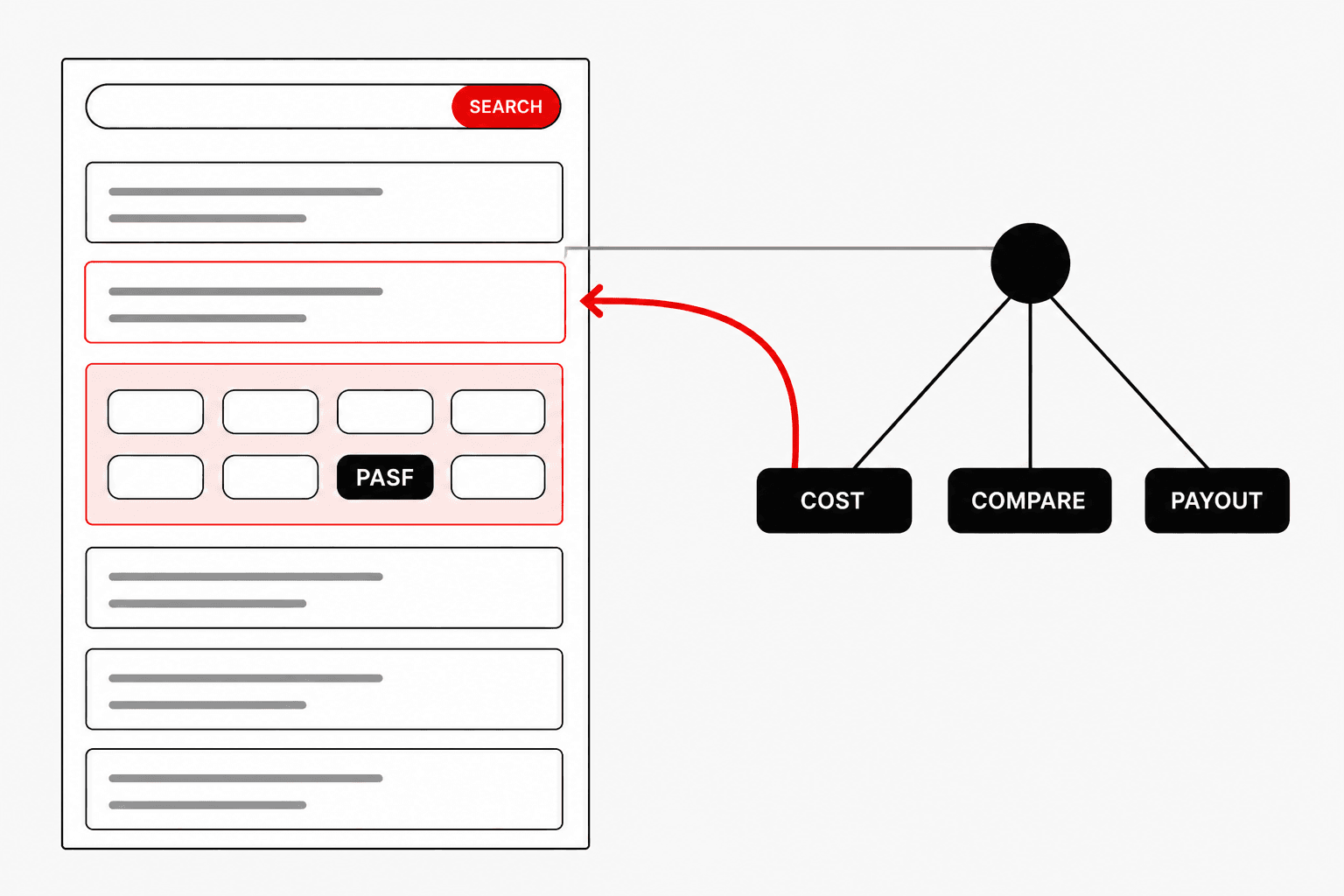
People Also Search For (PASF) is a box of six to eight suggested queries that Google shows beneath a search result, most reliably when you click that result and then return to the results page within a few seconds. Those suggestions are what other people searched for on the same topic, often after visiting the same page you just left. That makes PASF the only SERP feature that tells you, result by result, what a ranking page failed to answer.
Most keyword research treats the SERP as a list of ten links. The SERP is actually three feedback systems layered on top of each other: People Also Ask, People Also Search For and Related Searches. They look similar and are routinely confused, but they measure different things and belong in different parts of a content plan. This guide separates them, shows how to harvest PASF without paid tools, and works through an India example in a category where the difference is worth money.
PASF, PAA and Related Searches: Three Signals, Not One
| Feature | What it contains | Where it appears | What triggers it | Tied to | Best used for |
|---|---|---|---|---|---|
| People Also Ask (PAA) | Questions with expandable answers lifted from web pages | Main results column, usually within the top five positions | The query itself | The query | FAQ sections, H3 structure, featured-snippet targeting |
| People Also Search For (PASF) | Six to eight plain search queries, no answers | Under a specific result; also in knowledge panels for entities | Clicking a result and returning to the SERP quickly | The clicked result | Finding what a competing page missed, sub-topic discovery, keyword variants |
| Related Searches | Eight plain search queries | Bottom of the results page | The query itself, always shown | The query | Topic neighbourhood, adjacent pages, naming conventions |
Source: live Google India desktop SERP for "term insurance", captured via the DataForSEO SERP API on 13 November 2026, plus Google's documented behaviour for each feature. Google has periodically tested relabelling Related Searches as People Also Search For, so always check what a box is attached to, not just its heading.
The distinction that matters is the trigger. PAA and Related Searches respond to the query. PASF responds to a result. If you search "term insurance", click the second organic result and come back, the PASF box under that result reflects how people refined their search after that particular page. Click the fifth result instead and you get a different set. That per-result specificity is why PASF is the most under-used feature in Indian keyword research: it is a free content-gap report on every page that currently outranks you.
How to Harvest PASF Without Paid Tools
The manual method takes about 20 minutes per seed keyword and produces data no keyword tool gives you by default.
- Search the seed term from an incognito window with location set to the market you target. Indian SERPs differ from US ones, and Mumbai differs from Kolkata on local intent.
- Click the first organic result, wait two or three seconds, then press back. A PASF box should appear directly beneath the result you left. If it does not, try again with a slightly longer dwell. Google is more likely to show it when the bounce looks like dissatisfaction rather than a mis-click.
- Record the box, labelled with the result's URL. Spreadsheet columns: seed, result position, result URL, PASF query. Six to eight rows per result.
- Repeat for results two through ten. You now have 50 to 80 queries, many overlapping, each attached to the page that failed to satisfy the searcher.
- Deduplicate and count. A PASF query that appears under five different results is a sub-topic the whole first page is weak on. That is your opening.
- Cluster by intent. Group into informational (what is, how does, meaning), comparison (vs, difference, which is better), transactional (buy, calculator, premium, price) and local (near me, in Mumbai). Each cluster maps to a content decision.
If you want to scale this, browser extensions that overlay search volume on the SERP will capture PASF as you click, and SERP APIs return a people-also-search item when Google serves it. The data is identical; the tools only save the clicking. The one thing no tool changes is step 3: always attach the PASF set to the result that triggered it, because that attachment is the whole point.
From Harvest to Content Structure
PASF earns its keep when it changes how a page is built, not just which keywords it lists.
- High-frequency PASF queries become H2 sections. If "term insurance vs life insurance" shows up under six of ten results, the ranking pages are not answering it well enough, and a dedicated section with a direct one-sentence answer at the top can win the featured snippet and the AI Overview citation.
- Comparison and calculator queries become tools or tables. Searchers bouncing to "premium calculator" want numbers. A real table of indicative premiums by age band answers the intent on the page instead of sending the reader back to Google.
- Transactional PASF variants become your commercial page's keyword set. They are how buyers actually word the purchase, which is often not how your product team words it.
- Queries that appear under only one result tell you about that competitor, not the topic. Keep them for the teardown, not the content plan. Our SERP competitor teardown workflow picks up from there.
Pages built this way also do better in AI search, because answer engines reward comprehensive, sectioned coverage of a topic's sub-questions. The mechanics of that are in our guide to what AEO is and how it works.
A Worked India Example: "term insurance"
We pulled the live Google India desktop SERP for "term insurance" on 13 November 2026. The page carried an AI Overview citing HDFC Life, Policybazaar, PNB MetLife, IndiaFirst Life and Axis Max Life, nine organic results dominated by insurers, a four-question PAA block and eight Related Searches. The PAA block asked, among others, "What happens when term insurance expires?" and "Which insurance company in India offers the best term plans?" The Related Searches were: term insurance calculator, best term insurance, difference between term insurance and life insurance, term insurance advantages and disadvantages, types of term insurance plans, types of term insurance in India, term insurance benefits, and a Quora variant of "what is term insurance".
That is the query's neighbourhood. Now the click-back pass. PASF is not present in a static SERP capture because it only renders after a click, so the harvest has to be done live, result by result. An illustrative pass through the top results in this category typically returns refinement clusters such as: a cost cluster (1 crore term insurance premium, term insurance for 30 year old, premium per month), a comparison cluster (term insurance vs ULIP, term plan vs endowment, best term insurance company in India), an eligibility cluster (term insurance without medical test, term insurance for smokers, NRI term insurance) and a payout cluster (claim settlement ratio, what if I survive the term, return of premium). Treat those as illustrations of the shape, not a dataset; your own pass will return the live set for the day you run it.
The content decision writes itself from the overlap. Related Searches say the topic is defined by calculators, comparisons and types. PASF, harvested live, tells you which of those the current top pages leave unanswered strongly enough that readers go back to Google. In our experience with fintech and BFSI content, the eligibility and payout clusters are the ones most insurers bury or omit, which is exactly why they keep appearing as refinements. A page that answers "what happens if I survive the term" in its first sentence under a dedicated heading is competing against pages that make the reader hunt for it.
Two mistakes waste the harvest. Treating PASF as a keyword list, when ten variants at 80 searches each are one page with ten well-labelled sections, not ten pages. And doing it once: PASF shifts with the season and with what ranks, so a quarterly pass on your money pages is the minimum.
Frequently Asked Questions
What does People Also Search For mean on Google?
People Also Search For (PASF) is a box of six to eight suggested searches that Google shows beneath a result, most often when you click a result and then return to the results page. The suggestions are queries that other searchers ran in the same session or on the same topic. Google surfaces them because the click-back suggests the page you visited did not fully answer you, so it offers the refinements other people used. The same label also appears in knowledge panels for entities, where it lists related people, brands or products.
What is the difference between People Also Search For and People Also Ask?
People Also Ask (PAA) is a set of questions with expandable answers pulled from web pages, shown in the main results column. People Also Search For (PASF) is a set of plain search queries, not questions and not answers, tied to a specific result you clicked and bounced from. PAA tells you what questions the topic raises; PASF tells you how searchers reworded their query when a specific page fell short. For content planning, PAA feeds your FAQ and H3 structure, while PASF feeds keyword variants, sub-topics and the gaps in whatever currently ranks.
Is People Also Search For the same as Related Searches?
No, although Google has tested merging the labels. Related Searches sit at the bottom of every results page, are tied to the query itself and appear regardless of what you clicked. PASF appears under a specific result after a click-back and is tied to that result. In practice, Related Searches describe the neighbourhood of a topic, while PASF describes the follow-up intent of people who tried one particular page and were not satisfied, which makes PASF the sharper signal for finding what competing pages are missing.
How do I find People Also Search For keywords?
Manually: search a seed term, click a top result, return to the results page within a few seconds and note the box that appears under that result. Repeat for each of the top five to ten results. Faster: use a browser extension or an SEO tool that captures SERP features, or a SERP API that returns PASF items where Google serves them. Whichever route you take, record the PASF set per result, not per query, because the set changes depending on which page you bounced from.
Do People Also Search For keywords have search volume?
Usually yes, but often low individually. PASF queries are real searches other people ran, so most of them register in keyword tools, though many will show under 100 searches a month in India. Their value is cumulative and structural: a cluster of ten PASF variants with 50 to 500 searches each tells you the shape of the topic and the sub-intents one page must cover, even if no single variant justifies its own page.
Can PASF data help with AI search and AI Overviews?
Yes. AI Overviews and answer engines reward pages that cover a topic's sub-questions comprehensively in clearly structured sections. PASF is a free map of those sub-questions as real searchers phrase them. Covering the PASF cluster in dedicated H2 and H3 sections, each with a direct answer in the first sentence, is one of the most reliable ways to become the page an AI system cites for the whole topic rather than one narrow query.
Want this done across your money pages, with the gaps already mapped to a content plan? PASF harvesting and SERP-feature mapping are part of the keyword research phase in every SEO engagement we run. See how our SEO services work or read how AEO builds on this.

Aditya Kathotia
Founder & CEO
CEO of Nico Digital and founder of Digital Polo, Aditya Kathotia is a trailblazer in digital marketing. He's powered 500+ brands through transformative strategies, enabling clients worldwide to grow revenue exponentially. Aditya's work has been featured on Entrepreneur, Economic Times, Hubspot, Business.com, Clutch, and more.
More in SEO
- SEO for Immigration Consultants: The Trust-First Playbook
- Is Your Brand AI-Recommendable? Our GEO Audit Framework
- Best SEO Company in Guwahati: 8 Agencies by Brief (2026)
- Best SEO Company in Mumbai: 8 Agencies Compared (2026)
- Best SEO Company in Noida: 8 Agencies Compared (2026)
- Local SEO Checklist 2026: 52 Steps for Indian Businesses