

Every agency now sells a GEO audit, and most of them are a crawler report with a new name. They check your schema, your robots rules, your headings, maybe whether you have an llms.txt file, and they hand you a score. None of that tells you the one thing a buyer cares about: when someone asks ChatGPT or Perplexity who to hire, or what to buy, in your category, does the answer name you?
We have been running a different kind of audit for clients for most of this year, built around that question. Internally we call the output an AI-recommendability score. It has six pillars, adds up to 100, and separates two things most audits blur together: being mentioned by an AI engine and being recommended by one. This post publishes the whole framework, including the weights and the scoring rules.
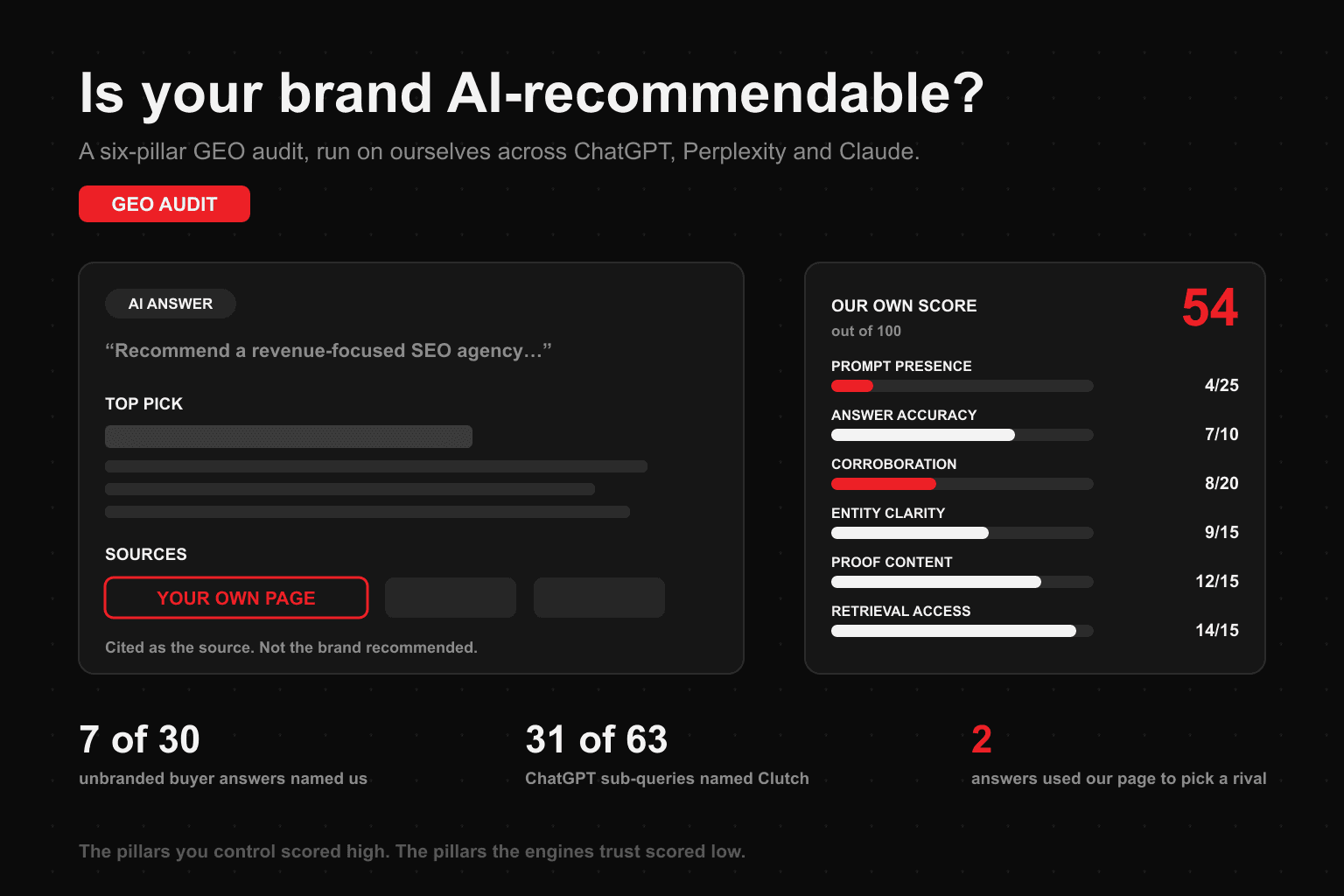
To make sure it was not just a nice-looking rubric, we ran it on ourselves first. On 13 October 2026 we sent 33 live prompts through ChatGPT, Perplexity and Claude: 10 unbranded buyer questions about the market we sell into, plus one branded accuracy check. We scored 54 out of 100. We were named in 7 of 30 unbranded answers. In two of them, the engine cited our own buyer's guide as its source and recommended a different agency. That one finding changed how we think about content, and it is a finding no page-level audit tool would ever have surfaced.
If you lead marketing for a brand whose buyers research in AI assistants, which is now most brands, here is what you will get from this piece: the six-pillar framework with point weights, the mention-tier scoring method, our own unvarnished results, a one-week plan to run the audit yourself, and the KPIs worth tracking afterwards.
Short answer: what a GEO audit should measure. A useful GEO audit scores outcomes and causes. Outcomes: how often and how strongly AI engines recommend you on unbranded buyer prompts (25 points), and how accurately they describe you when asked by name (10 points). Causes: third-party corroboration in the sources engines actually query (20), entity clarity (15), extractable proof content (15), and crawler and retrieval access (15). Score 80 or more and you are AI-recommendable. If you want us to run it on your brand, see our answer engine optimisation service.
Why most GEO audits measure the wrong thing
Search "GEO audit" in India today and the first page is almost entirely free tools: paste a URL, get a score out of 100. We looked at what they check. Overwhelmingly it is page-level hygiene: structured data present, AI crawlers allowed, headings shaped like questions, content readable without JavaScript, an llms.txt file. Those things matter. We score them ourselves. But they are inputs, and they are the inputs you already control.
The problem is that an AI recommendation is mostly decided by things outside your website. When an engine answers "which agency should I shortlist" or "which sunscreen is best for oily skin", it searches the web, reads what other sites say, and picks the brands that independent sources agree on. A perfect technical score with no corroboration produces a brand the engine can describe but has no reason to choose. Our own result is the clearest proof we have: the three on-site pillars scored 35 of 45, the off-site and outcome pillars scored 19 of 55.
So the framework below starts from the outcome, tests it directly, and only then works backwards to causes. This is the same separation we argue for in SEO vs AEO vs GEO: the layers overlap in technique but differ in what "winning" means. For classic SEO, winning is a position. For GEO, winning is being the name in the answer.
The AI-recommendability framework: six pillars, 100 points
The six pillars split into two groups. The first two measure what the engines actually do with your brand. The last four measure the reasons they do it. Weighting the outcomes at 35 points keeps the score honest: you cannot reach "recommendable" on technical hygiene alone.
| Pillar | Points | What it answers | How it is scored |
|---|---|---|---|
| 1. Prompt presence | 25 | Do engines choose you for unbranded buyer questions? | Share of recommendation across a prompt battery, weighted by mention tier |
| 2. Answer accuracy | 10 | When asked about you by name, do engines get you right? | Facts (5), tone and hedging (3), provenance of numbers (2) |
| 3. Third-party corroboration | 20 | Do sources the engines trust say you are good? | Engine-queried directories (8), reviews (4), independent lists (4), communities (4) |
| 4. Entity clarity | 15 | Can engines resolve your brand to one unambiguous entity? | Schema and sameAs (5), Wikidata or knowledge graph (4), name and domain disambiguation (3), founder or key-person entity (3) |
| 5. Proof content | 15 | Is there content worth citing that also proves your claims? | Prompt-matched pages (5), sourced claims (5), comparison and decision content (5) |
| 6. Retrieval access | 15 | Can the engines reach and read you? | AI crawlers allowed (5), server-rendered content (4), Bing index and IndexNow (3), llms.txt (3) |
Pillar 1: Prompt presence (25 points)
This is the pillar that makes the audit a GEO audit. You build a battery of unbranded prompts - the questions buyers ask before they know your name - and run each on at least three engines with web search on. "Best SEO agency in India for a mid-sized D2C brand." "Which sunscreen works under a helmet in Mumbai humidity." "Recommend a fintech SEO agency." Branded prompts prove nothing here, because any engine can read your homepage.
The battery should cover your segments the way buyers actually slice them: by service, industry, city, buyer type and budget. Ten to fifteen prompts per market is enough. We explain how to phrase prompts the way engines decompose them in how to rank on ChatGPT.
The part almost everyone skips is grading the strength of each mention. A brand listed eleventh in "other names you might see" is not in the same position as the brand an engine calls its top pick. We grade every response into one of five tiers:
| Mention tier | Definition | Points |
|---|---|---|
| Primary pick | Named as the main or first recommendation, with reasons | 3 |
| Shortlisted | Named in a shortlist of roughly two to six options, with a rationale | 2 |
| Footnote | Named in passing, in a long "also consider" list, or without reasons | 1 |
| Cited, not named | Your URL is a source, but you are not among the recommendations | 0.5 |
| Absent | Neither named nor cited | 0 |
Share of recommendation is the points earned divided by the maximum possible (responses x 3). Convert it to the 25-point pillar linearly. Above 50 percent means you are a default answer. Between 20 and 50 percent is competitive. Below 20 percent means you are occasionally present and rarely chosen.
We also log the competitors that appear in your place, because the same table tells you who the engines consider your category's reference brands.
Pillar 2: Answer accuracy (10 points)
Run one or two branded prompts per engine: "What is [brand], what does it offer, and is it any good?" Then score three things. Facts (5 points): are the founding year, location, services, leadership and positioning right? Tone (3 points): does the engine recommend you plainly, or hedge with phrases like "the evidence is thin" or "claims should be independently verified"? Hedging is a corroboration signal leaking into the answer. Provenance (2 points): where did the numbers come from? Engines will happily repeat a revenue estimate or employee count from a data-broker page you have never seen, and buyers read it as fact.
Pillar 3: Third-party corroboration (20 points)
This is the heaviest cause pillar because it is the one engines lean on hardest when choosing between brands. The trick is not to guess which sources matter. Read the fan-out queries. When an engine searches before answering, tools like DataForSEO's AI Optimization API expose the sub-queries it ran. Those sub-queries are a literal list of the sources the engine went looking for. In our test, more than half of ChatGPT's sub-queries were aimed at one directory. That tells you exactly where corroboration has to exist.
Score directory presence on the sources the engines queried (8 points), review volume and recency on those sources (4), independent editorial lists or articles that name you without you writing them (4), and community discussion on Reddit, Quora or niche forums (4). Our six-month Reddit experiment covers the community layer in detail, and Reddit SEO and digital PR are the two programmes we use to build it.
Pillar 4: Entity clarity (15 points)
Engines need to resolve "your brand" to one thing. Score Organization schema with a complete sameAs chain (5 points), a Wikidata item or knowledge-panel presence (4), name and domain disambiguation - does the engine ever confuse you with a similarly named company or guess the wrong domain (3) - and a defined founder or key-person entity connected to the organisation (3). The mechanics are in our entity SEO guide, and what schema actually moved in AI answers is covered in schema markup for AI search.
Pillar 5: Proof content (15 points)
Score whether you have pages that match the wording of your buyer prompts (5 points), whether your claims carry sources an engine can verify (5), and whether you publish comparison and decision-stage content engines can lift into an answer (5). Note the second criterion. An unsourced claim such as "150 percent average traffic growth" gets repeated with a caveat attached, which drags pillar 2 down with it. Formats that get extracted most often are covered in the content formats LLMs cite.
Pillar 6: Retrieval access (15 points)
The hygiene pillar, and the one tools already measure well. Score AI crawlers explicitly allowed in robots rules - GPTBot, OAI-SearchBot, PerplexityBot, ClaudeBot, Google-Extended (5 points), meaningful content server-rendered rather than JavaScript-dependent (4), Bing indexation and IndexNow, since several engines retrieve through Bing (3), and an llms.txt file (3). We give llms.txt points but not many: it is cheap, but there is little evidence any engine depends on it. Our llms.txt explainer covers the trade-off, and a technical SEO audit covers the rest of this pillar.
We ran the framework on ourselves. We scored 54.
An audit framework that has only been applied to clients is a sales tool. So before publishing this, we ran it on Nico Digital, with the same rules we use for clients.
Method. We wrote 10 unbranded prompts that mirror how our buyers actually ask: best SEO agency in India for a mid-sized D2C brand; agencies that get brands cited in ChatGPT and AI Overviews; a revenue-focused SEO agency in Kolkata; fintech SEO agencies; an SEO shortlist for B2B SaaS; white-label SEO providers for agencies; top GEO agencies in India; an ecommerce SEO agency in Mumbai; Indian agencies doing SEO for US and UK clients; and an AI SEO agency for a healthcare brand. We added one branded prompt asking what Nico Digital is and whether it is any good. Each ran through ChatGPT (gpt-5.4), Perplexity (sonar-pro) and Claude (claude-sonnet-5) with web search on, via DataForSEO's AI Optimization API, on 13 October 2026. We planned Gemini as the third engine, but its endpoint returned rate-limit errors for every model that day, so we swapped in Claude rather than publish a two-engine audit. Total cost was under five US dollars.
One honest caveat. This was a single run of each prompt. Our 90-day citation tracking study found that one check of the same prompt disagrees with itself about 39% of the time, so for client audits we run every prompt three times and grade the majority answer. Read our 54 as a dated snapshot, not a permanent verdict. The direction of the findings, though, was consistent across engines, which is why we trust them.
The scorecard
| Pillar | Score | Evidence from the audit |
|---|---|---|
| 1. Prompt presence | 4 / 25 | 16 of 90 tier points (17.8%). Named in 7 of 30 unbranded answers; primary pick twice |
| 2. Answer accuracy | 7 / 10 | All three engines got founding year, HQ, services and positioning right. Two of three hedged that the evidence was mostly our own site. One repeated a third-party revenue estimate we have never published |
| 3. Corroboration | 8 / 20 | A Clutch profile exists and engines found it, but answers described public evidence as thin. Independent roundups naming us barely surfaced |
| 4. Entity clarity | 9 / 15 | Strong Organization and Person schema with a full sameAs chain. No Wikidata item. ChatGPT searched a wrong domain variant for our brand |
| 5. Proof content | 12 / 15 | Deep, prompt-matched service and guide pages. Headline performance claims are unsourced, and engines flagged them for verification |
| 6. Retrieval access | 14 / 15 | Every major AI crawler explicitly allowed, server-rendered pages, IndexNow, llms.txt live |
| Total | 54 / 100 | Visible, not recommended |
That is a slightly humbling number for an agency that sells this work. It is also the most useful audit we have run this year, because four findings fell out of it that no tool would have produced.
Finding 1: Engines recommend you for the exact words you own
Both primary picks came from one prompt: "Recommend a revenue-focused SEO agency in Kolkata." ChatGPT called us its "best single recommendation" and Claude its "top recommendation", and both quoted our positioning back almost word for word. "Revenue-focused" is in our tagline. Kolkata is our headquarters. The prompt matched our self-description, and the engines rewarded the match.
Now look at the other end of the grid. Five prompts returned nothing on any engine: agencies for AI Overviews, a B2B SaaS shortlist, white-label SEO, offshore SEO for US and UK clients, and healthcare AI SEO. We have dedicated pages for B2B SaaS, white-label SEO and healthcare. Having a page did not get us recommended. In those segments, no independent source connects our name to the segment, so the engines had no reason to pick us over the brands that are connected.
The lesson for any brand: your positioning language is a retrieval asset. Write down the five to ten phrases buyers use to describe the outcome they want, make sure the same phrases appear consistently on your site and in how third parties describe you, and put those exact phrasings into your prompt battery.
Finding 2: Your best content can recommend your competitors
This is the finding that changed our content plan. On the Kolkata prompt, Perplexity cited two of our pages - our Kolkata SEO agency page and our Kolkata SEO agency buyer's guide - and recommended a different agency. On the GEO prompt, it cited our roundup of GEO companies in India and recommended a table of other firms. Claude, answering the same GEO question, added an explicit caveat that many GEO rankings "come from blog posts published by the agencies themselves".
That is the engines telling you how they read self-published lists: as useful information about the category, but discounted evidence about the publisher. A buyer's guide earns the citation. It does not, on its own, earn the recommendation. This is not a reason to stop writing buyer's guides - they are among our most-cited pages - but it is a reason to stop treating citation counts as a proxy for recommendation. Track the two separately. We now report a "cited, not named" rate for every client, and it is often the most actionable number in the audit.
Mid-audit check: are you cited or recommended? Pick your three most important buyer prompts and run them in Perplexity today. Click the sources. If your pages appear as sources but your brand is not in the answer, you have a corroboration problem, not a content problem. Our SEO audit service now includes the full six-pillar GEO audit with the prompt battery, fan-out analysis and a ranked fix list.
Finding 3: The fan-out queries tell you where corroboration must live
ChatGPT ran 63 fan-out sub-queries across our 10 unbranded prompts. 35 of them were site: searches aimed at a specific domain, and 31 mentioned Clutch - queries like "site:clutch.co GEO agency India" and "Clutch top SEO agencies India B2B SaaS". Clutch pages accounted for 19 of ChatGPT's 102 citations. Perplexity exposes no fan-out queries, but its citations tell a similar story from a different angle: 14 citations to the Semrush agency directory and 11 to LinkedIn. Claude ran only 19 sub-queries, all plain category searches, and leaned on roundup articles.
For an agency, then, the corroboration that matters to ChatGPT lives mostly on one directory. For a D2C brand it might be Amazon reviews, Nykaa, a subreddit or two comparison publishers. For a SaaS company it might be G2 and Capterra. The point is that you do not have to guess. The engine shows you its shopping list, and your corroboration budget should follow it. This is the most underused artefact in GEO work, and it is why we run audits through an API rather than by typing into chat windows. The method for tracking it over time is in AI citation tracking.
We also logged who appeared instead of us. The most-named agency appeared in 16 of the 30 unbranded answers, the second in 11, the third in 10. We came fourth at 7. Those three brands share something we lack at the same depth: years of directory reviews and independent roundups naming them. Their sites are not technically better than ours. Their corroboration is.
Finding 4: Branded answers were accurate, but hedged
On the branded prompt, all three engines got the facts right: founded in 2011, headquartered on Park Street in Kolkata with a Mumbai office, the right service lines and the right industries. That is pillar 4 and pillar 6 doing their job. Clean schema, a founder hub and crawlable pages produce accurate descriptions.
But the tone gave the corroboration gap away. ChatGPT's verdict on whether we are a good agency was "maybe, but the public evidence I found is thin". Perplexity noted that the evidence was "weighted toward Nico Digital's own website" and that our headline traffic claim "should be independently verified". Claude repeated a revenue figure from a third-party data listing that we have never published and cannot vouch for. Accurate facts with a hedged verdict is the signature of a brand in the 40 to 59 band: the engine knows exactly who you are and still is not willing to vouch for you.
How to run the audit on your own brand in one week
You do not need us to do this, though we are happy to. Here is the sequence we follow, compressed into five working days.
- Day 1 - Build the battery. Write 10 to 15 unbranded prompts in buyer language, spread across your segments. Pull phrasing from sales-call notes, Search Console queries and People Also Ask. Add one or two branded prompts. Freeze the list; you will reuse it monthly.
- Day 2 - Run the engines. Run every prompt on at least three engines with web search on, ideally three times each, because single checks are noisy. Use an API (DataForSEO's AI Optimization endpoints, or a paid AI visibility tracker) so you capture the full answer, the citations and the fan-out queries. Save the raw responses.
- Day 3 - Grade outcomes. Grade every unbranded response into a mention tier, compute share of recommendation, log every competitor named, and score the branded answers for facts, tone and provenance. That gives you pillars 1 and 2.
- Day 4 - Score causes. Mine the fan-out queries and citation domains for the sources the engines trust, then check your presence on each. Audit schema, sameAs, Wikidata and name disambiguation. Map each buyer prompt to the page that should answer it and check whether claims are sourced. Check robots rules, rendering, Bing indexation and llms.txt. That gives you pillars 3 to 6.
- Day 5 - Rank the fixes. Sort gaps by points available multiplied by how quickly you can close them. Corroboration gaps on engine-queried sources almost always top the list. Retrieval-access gaps are usually the cheapest to close.
The GEO audit checklist
- 10 to 15 unbranded buyer prompts written in real buyer language, covering every segment you sell into
- Every prompt run on at least three engines with web search on, with raw responses saved
- Every response graded by mention tier, with share of recommendation calculated
- Competitors logged per response, with the three most-named identified
- "Cited, not named" responses listed with the cited URL for each
- Branded answers checked for facts, hedging language and third-party numbers
- Fan-out sub-queries and citation domains tallied per engine
- Presence and review depth checked on every engine-queried directory or marketplace
- Organization schema validated, with a complete sameAs chain
- Wikidata item checked, and created if you meet notability guidelines
- Name and domain disambiguation checked (does any engine confuse you with someone else?)
- Each buyer prompt mapped to a page that answers it in the same wording
- Every headline claim on key pages linked to a source or a case study
- Robots rules checked for GPTBot, OAI-SearchBot, PerplexityBot, ClaudeBot and Google-Extended
- Key pages confirmed to render without JavaScript
- Bing Webmaster Tools indexation confirmed, with IndexNow wired up
- Score recorded and the identical battery scheduled for monthly re-runs
Tools worth using (and what they will not do)
- DataForSEO AI Optimization API - what we used. Runs prompts on ChatGPT, Perplexity, Claude and Gemini programmatically and returns answers, citations and fan-out queries. Cheap enough for monthly batteries.
- AI visibility trackers - the paid platforms that run prompt sets on a schedule and chart share of voice. Good for monitoring. Check whether they grade mention strength or only count mentions.
- Free GEO audit tools - useful for pillar 6 and parts of pillars 4 and 5. They do not run buyer prompts with judgment, so do not treat their score as a GEO audit.
- Perplexity itself - the fastest manual check, because it shows sources inline. Our Perplexity ranking guide explains what it rewards.
- Google Search Console and Bing Webmaster Tools - for prompt phrasing ideas and to confirm the indexation that retrieval depends on.
- Schema validators and Wikidata - for pillar 4.
The KPIs to track after the audit
| KPI | What it tells you | Target direction |
|---|---|---|
| Share of recommendation | Strength-weighted presence across your battery | Up, monthly |
| Primary-pick count | How often you are the default answer | Up |
| Cited, not named rate | Content earning citations without earning the recommendation | Down |
| Hedged-verdict count | How often branded answers qualify their endorsement | Down |
| Engine-queried source coverage | Share of the engines' preferred sources where you have a strong presence | Up, quarterly |
| Competitor share | The most-named rival's share of recommendation versus yours | Gap closing |
Measure them on repeated runs, not single checks. Our 90-day AI citation tracking study found that a single check disagreed with itself 39% of the time, and that 63% of all citations pointed at domains the brand does not own - which is exactly why corroboration coverage sits in this table next to share of recommendation.
Mistakes we see in almost every GEO audit
- Testing branded prompts only. "ChatGPT knows who we are" is not visibility. Every engine can read your homepage.
- Counting mentions without grading them. A footnote in a list of fifteen and a top pick both count as "mentioned" in most dashboards.
- Treating citations as recommendations. Our own audit had two citations that pointed buyers to competitors.
- Running one engine. Three of our ten prompts produced a recommendation on one engine and nothing at all on the other two.
- Changing the prompt set every month. Then the trend line measures your prompt edits, not your progress.
- Fixing hygiene first because it is easy. Retrieval access is worth 15 points. If you already allow AI crawlers and render server-side, the next 30 points are off your site.
- Publishing unsourced claims. Engines repeat them with a caveat attached, which turns a proof point into a trust problem.
What we are changing after scoring ourselves
We built a plan from our own audit, as we would for a client. In order of points available:
- Corroboration on the sources ChatGPT queries. Deepen our Clutch profile with recent, segment-specific client reviews, starting with the five zero-mention segments. Get listed in the agency directory Perplexity leaned on. This is pillar 3, and it has the most points on the table.
- Segment-level independent mentions. Pursue roundups, podcasts and contributed articles that tie our name to white-label SEO, B2B SaaS and healthcare specifically, so independent sources connect the brand to those segments.
- Source every headline claim. Link each performance number on our service pages to the case study it comes from, so engines can verify it rather than caveat it.
- Entity cleanup. Create a Wikidata item if we meet the notability guidelines, and add our primary domain consistently to every third-party profile so no engine guesses a wrong domain variant again.
- Re-run the battery monthly and publish the movement.
None of these is a website change. That is the point. The audit told us our site is in good shape and our reputation layer is not, which is the opposite of what a page-level GEO tool would have said.
Where this fits in your AI search programme
A GEO audit is a diagnosis, not a strategy. Once you have the score, the work splits along the pillars: corroboration is a digital PR and community job, entity and access work is technical SEO, and proof content is a content marketing job. Our AI SEO services run all three as one programme. If you want the market context first, the AI search statistics for 2026 show how quickly buyer research is moving into these engines, and the digital marketing glossary defines every term used here.
If you want to know whether a full GEO programme is worth it for your business at all, read which clients are worth a GEO strategy first. And if you sell to consumers, the companion piece we audited 50 D2C brands for AI visibility shows what this looks like across a whole category, where 38 of 50 brands never appeared at all.
Frequently Asked Questions
What is a GEO audit?
A GEO (generative engine optimization) audit measures whether AI assistants such as ChatGPT, Perplexity, Claude and Google's AI Overviews recommend your brand when buyers ask category questions, and diagnoses why they do or do not. The outcome half runs unbranded buyer prompts across several engines and scores how often and how strongly you are recommended, plus how accurately branded answers describe you. The input half scores corroboration, entity clarity, proof content and crawler access. Our framework weights these six pillars to 100 points.
What does it mean for a brand to be AI-recommendable?
A brand is AI-recommendable when an assistant names it as a suggested option for an unbranded buyer question, not merely when it can describe the brand if asked by name. In our framework a score of 80 or more is AI-recommendable, 60 to 79 is a contender, 40 to 59 is visible but rarely recommended, and below 40 is effectively invisible.
How is a GEO audit different from an SEO audit?
An SEO audit checks whether your pages can rank in a list of links. A GEO audit checks whether you are chosen inside a generated answer. It adds live prompt testing across engines, off-site corroboration scored against the sources the engines actually query, and an accuracy check. In our own audit the on-site pillars scored 35 of 45, while the off-site and outcome pillars scored 19 of 55.
How many prompts do you need for a reliable GEO audit?
Ten to fifteen unbranded prompts per market on at least three engines, plus one or two branded prompts. That gives 30 to 45 scored responses, enough to see a pattern. Re-run the identical battery monthly so changes reflect your work, not a new prompt set.
Which AI engines should a GEO audit cover?
At minimum ChatGPT, Perplexity and one of Gemini, Claude or Google AI Overviews, chosen by where your buyers research. The engines behave differently: in our test ChatGPT's sub-queries leaned heavily on Clutch, Perplexity on LinkedIn and an agency directory, and Claude on roundup articles.
What is a good AI visibility score?
In our mention-tier method, above 50 percent share of recommendation means you are a default answer, 20 to 50 percent is competitive, and below 20 percent means you are rarely chosen. We scored 17.8 percent on our own battery.
Can GEO audit tools replace a manual audit?
They can replace the tedious parts but not the judgment. Most free tools score page-level signals, which covers only two or three of the six pillars. They generally do not grade mention strength, check accuracy, separate citation from recommendation, or read fan-out queries.
Why does an AI engine cite my page but recommend a competitor?
Because the engine used your page as information about the category rather than as evidence about you. Self-published buyer's guides and listicles are cited often but discounted as proof of the publisher. The fix is to earn corroboration on sites the engine does trust.
How often should you run a GEO audit?
Run the full six-pillar audit quarterly and the prompt battery monthly, plus after any event that changes how sources describe you: a rebrand, a new directory profile, a burst of reviews or a press placement.
Want your own AI-recommendability score? We will run the full six-pillar audit on your brand: a custom unbranded prompt battery across three engines, mention-tier grading, fan-out analysis of the sources your category's engines trust, and a ranked fix list with the points each fix is worth. Request your GEO audit

Aditya Kathotia
Founder & CEO
CEO of Nico Digital and founder of Digital Polo, Aditya Kathotia is a trailblazer in digital marketing. He's powered 500+ brands through transformative strategies, enabling clients worldwide to grow revenue exponentially. Aditya's work has been featured on Entrepreneur, Economic Times, Hubspot, Business.com, Clutch, and more. Join Aditya Kathotia's orbit on LinkedIn to gain exclusive access to his treasure trove of niche-specific marketing secrets and insights.