

A working checklist, not a reading list. Fifty-two steps, eight sections, ordered by when to do them. Print it, split it across your team, and tick items off.
Almost every local SEO checklist on the internet was written for a business in Ohio. It tells you to claim your Yelp listing, join the local chamber of commerce, and get on Apple Maps. None of that is wrong. It is just not the shape of the problem if your customers are searching from Andheri, Salt Lake or Koramangala.
In India the local search landscape has three features that most checklists ignore entirely. Addresses are messy, and Google's verification process treats them accordingly. A layer of home-grown directories - Justdial, Sulekha, IndiaMART and a dozen vertical equivalents - sits between you and the customer with far more authority than any US directory has in its own market. And when a buyer asks an AI assistant for a recommendation, that assistant is much more likely to be reading one of those directories than reading your website.
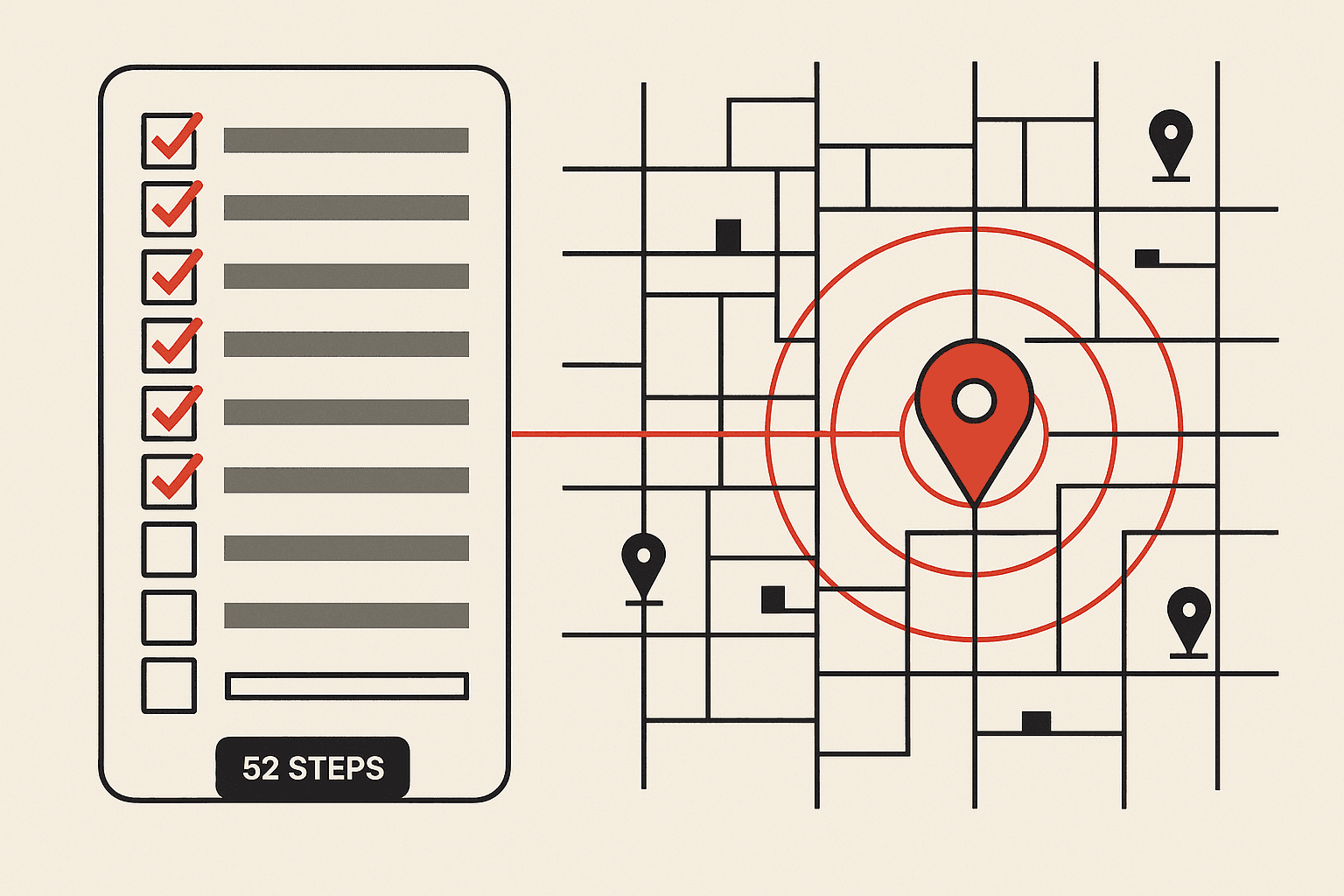
This checklist is the build sequence we run for local clients, adapted so a business owner can work through it without an agency. It covers fifty-two specific items across eight sections. Not every item applies to every business, and the sections are deliberately not equal in size, because the leverage is not equally distributed. If you want the strategic layer behind it - how proximity, prominence and relevance interact, and which ranking factors carry the most weight - that lives on our local SEO pillar. This page is the execution.
How to use this checklist
Three rules before you start.
Do not work through it top to bottom in one sitting. The sequencing is the point. Sections one to three are profile-side work that moves visibility in days and needs no developer. Section four needs website access and moves things in weeks. Sections six and seven compound over months and are wasted effort if the first three are half-done.
Not every item applies to you. A service-area business without a walk-in address skips roughly seven items. A single-location business skips the multi-location coordination items. Mark those "N/A" rather than leaving them blank, so a later audit does not flag them as gaps.
Tick items only when they are actually true. The most common failure mode in a self-run local SEO programme is a checklist that says a profile is optimised when only four of its eleven fields are filled. If you are unsure whether an item is done, it is not done.
Section 1: Foundations and eligibility (5 items)
This section decides whether the rest of the checklist can work at all. Google's local index is an index of verified business entities, not of websites, and businesses that fail here spend months wondering why good work produces nothing.
1. Confirm you are eligible for a Google Business Profile. You need in-person contact with customers, either at a location they visit or at locations you travel to. A pure online business, a virtual office you do not staff, and a coworking hot desk are all ineligible. Businesses that get verified on an ineligible address are suspended later, usually at the worst possible moment.
2. Decide storefront or service area, and commit. A storefront shows its address publicly. A service-area business hides the address and lists the areas it travels to. Hybrid businesses - a salon that also does home visits, a workshop that also collects vehicles - show the address and add service areas. Getting this wrong is the most common cause of a profile ranking in the wrong places or not at all.
3. Fix the address format before you submit it. Indian addresses break Google's parser constantly. Use the exact format that appears on your utility bill or GST registration: building name, street, locality, city, state, pincode, in that order, with no abbreviations you invented. Do not put your locality in the business name field to compensate. Do not put a landmark in the street line. Write it once, correctly, and reuse that exact string everywhere for the rest of the checklist.
4. Prepare for video verification. Postcard verification has become unreliable in India and video is now the common route for many categories. Before you start, have ready: exterior signage with the business name visible, the street or building entrance, the interior with equipment or stock in use, and proof of management such as a keyed entry, a till, or business documents. Businesses fail video verification because they attempt it unprepared, not because they are ineligible.
5. Take ownership of profiles that already exist. Search your business name, your phone number, and your address in Maps. Google auto-creates listings from user contributions and from directory data, so there is a good chance a partial listing already exists, sometimes with a wrong category and an old phone number. Claim it rather than creating a second one. If someone else controls it - a former agency, an ex-employee, a web developer who set it up years ago - start the ownership request now, because the process takes weeks.
Section 2: The Google Business Profile build (11 items)
The largest section, and correctly so. For a single-location business the profile is the single highest-leverage surface in local search, and the difference between a half-built profile and a complete one is usually the difference between ranking and not.
6. Set the primary category with precision. This is the most important item on the entire checklist. The primary category determines which searches you are eligible for. Search your main service in Maps, look at the three businesses in the pack, and check what they are categorised as. If your revenue comes from hair services, "Hair Salon" beats "Beauty Salon". If it comes from emergency callouts, "Emergency Plumbing Service" beats "Plumber". Changing this field is free and often moves visibility within days.
7. Add secondary categories, but only real ones. Secondary categories extend your reach without diluting the primary signal, so add every category you genuinely serve. Do not add categories you do not serve to widen the net - it is a common suspension trigger and it dilutes relevance for the searches you actually want.
8. Use your real business name, with nothing appended. "Sharma Dental Clinic" is compliant. "Sharma Dental Clinic - Best Dentist in Andheri" is not, and it is trivially reportable by any competitor. Keyword-stuffed names still rank in some Indian categories, which is precisely why they get reported and suspended. Use the name on your signage.
9. Fill every field, not the required ones. Business description, opening date, website, phone, appointment link, and every applicable attribute. Attributes carry more weight than owners expect because they map to filters searchers use: wheelchair accessible, has parking, women-led, accepts UPI, open on Sunday. Each one is a relevance signal and a conversion signal at once.
10. Build out the services list properly. Add each service as a separate entry with its own name and description, using the words your customers use rather than internal jargon. This section is heavily read for relevance and it is empty on most Indian profiles. A clinic with fifteen listed services with descriptions is eligible for far more queries than one with none.
11. Set hours honestly, including special hours. Wrong hours are the fastest way to earn a one-star review. Set regular hours accurately, add special hours for Diwali, Holi, Puja, Eid, regional new year and any long weekend when your hours change, and set them ahead of time rather than on the day. Businesses that mark special hours correctly get a small trust benefit and avoid the "temporarily closed" flag that user reports can trigger.
12. Upload real photos, and keep uploading them. Exterior with signage, interior, team, work in progress, and products. Photos taken on a phone in the actual premises outperform stock photography, which is often detected and removed. Set a monthly cadence rather than a single bulk upload - freshness is part of the signal, and a profile with photos from three years ago reads as dormant.
13. Seed and answer the Q&A section. Anyone can ask a question on your profile and anyone can answer it, including a competitor. Post the ten questions you get asked most on the phone, answer them from the business account, and check the section monthly for questions you have not answered. Unanswered questions and wrong crowd-sourced answers sit on your profile indefinitely.
14. Post weekly, and treat posts as answers. Google Posts are short-lived and will not carry your rankings, but they are read, they occupy space in your profile, and they are one of the few places you can respond to what is happening this week. Offers, new services, seasonal availability, answers to a common question. Weekly is enough.
15. Turn on messaging and connect WhatsApp where it fits. For a large share of Indian buyers, WhatsApp is the default contact channel and a phone call is the fallback, not the reverse. If your business can staff it, enable messaging and route it somewhere a human actually reads. An unanswered message on a profile is worse than no messaging at all, and Google will disable the feature if response times are poor.
16. Tag your profile website link so you can measure it. Add UTM parameters to the website link on the profile so profile-driven sessions are separable from organic search in your analytics. Without this, the traffic your profile generates is invisible in reporting and you will underestimate the value of everything in this section.
If you only have an afternoon, do items 6, 10 and 11. Primary category, services list, and hours. In our audits those three fields are wrong or empty on the majority of Indian profiles, and all three can be fixed by the owner in under an hour.
For the deeper mechanics of this section - how relevance, distance and prominence combine, what the profile fields actually feed, and the monthly maintenance routine - see our full guide to Google Business Profile optimisation for the local pack.
Section 3: Reviews and reputation (6 items)
Reviews are the prominence signal you control most directly, and the one most Indian businesses treat as luck. Volume matters less than most owners assume. Recency and content matter more.
17. Fix the baseline before asking for anything. If your current rating is below four stars, work out why before you drive more reviews to it. A steady flow of new reviews onto an unresolved service problem produces a larger sample of the same complaint. This is a service fix, not a marketing fix.
18. Build a one-tap review link and put it where the customer already is. Generate the short review link from your profile and attach it to the moments the customer is already engaged: the WhatsApp confirmation after a job, the invoice, the payment receipt, a QR code at the counter. Do not ask by email if your customers do not read email.
19. Ask at the point of highest satisfaction. Immediately after the work is done and the customer has said something positive is the moment. A week later is a different, much lower-converting request. Train whoever is present at that moment to ask.
20. Aim for consistent velocity, not a burst. Five to ten reviews a month sustained beats fifty in one week and then nothing. Google weights recency, and a burst pattern followed by silence looks unnatural. This item is the highest-leverage ongoing task in the entire checklist and it never gets ticked off permanently.
21. Reply to every review, including the bad ones. Reply to positive reviews briefly and specifically. Reply to negative reviews without arguing, with a route to resolve it offline. Replies are visible to every future customer reading the profile, and the reply is often more persuasive than the review. Prospects read how you handle complaints, not whether you have any.
22. Never buy reviews or run incentive schemes. Paid review networks are widely marketed to Indian small businesses and they are a liability. Detection has improved, removals are retroactive, and the downside is a filtered profile that loses reviews you legitimately earned alongside the ones you bought. Discounts in exchange for reviews violate the policy even when the review is honest.
Section 4: The website and on-page layer (9 items)
Everything so far lives on Google's property. This section is what you own, and it is the layer that decides whether local demand converts into a customer or into a competitor's phone call.
23. Publish a NAP block that matches your profile exactly. Name, address and phone in HTML text, not inside an image, in the footer of every page and in full on the contact page. Use the exact address string from item 3. A single mismatch - "Rd" on the website, "Road" on the profile - is a small inconsistency; twelve of them across the web is a real problem.
24. Add LocalBusiness schema, using the most specific type available. Use the narrowest type that fits: Dentist, Plumber, HealthClub, RealEstateAgent, and so on, rather than the generic LocalBusiness. Include name, address, geo coordinates, telephone, opening hours, price range if you publish one, and sameAs links to your profile and social accounts. This is the single most machine-readable statement of who and where you are, and it is read by more than Google. If you want the wider structured-data picture, our technical SEO services page covers the implementation side.
25. Build one genuinely distinct page per location. Each location gets its own URL with its own address, its own hours, its own team, its own photos, its own reviews and its own map. Pages that differ only by a swapped city name are the most common cause of location pages failing to rank, and they are trivially detectable.
26. Write locality pages only where you can say something specific. If you serve six localities in a metro, six near-identical pages will not help you. Build a page for a locality when you can write about the work you actually do there - the building types, the common problems, the response times, named projects. Two strong locality pages beat twenty thin ones.
27. Set title tags and H1s in the pattern people search. "Service + Locality + Business Name" is the pattern that matches how local queries are typed. "Emergency Electrician in Salt Lake | Sharma Electricals" reads naturally and matches the query. Reserve the homepage for the primary service and city rather than a brand-only title.
28. Embed a working map on the contact and location pages. An embedded Google map on the location page is both a usability feature and a corroborating signal. Add a directions link that opens the native maps app on mobile, because that is what a person standing outside your building actually needs.
29. Make the phone number tappable and the WhatsApp link one tap. A local search is a high-intent search, often on mobile, often in a hurry. A phone number that is not a tel: link, a WhatsApp button that opens a web page instead of the app, or a contact form as the only route are each a measurable conversion loss on traffic you worked hard to earn.
30. Get mobile performance to a passing baseline. Local search skews heavily mobile and Indian mobile connections are not uniformly fast. Core Web Vitals passing on mobile, images compressed and correctly sized, and no layout shift as the map or reviews widget loads. This is website work, not profile work, and it is where a technical SEO audit usually finds the fastest wins.
31. Link the local pages into your site properly. Location and locality pages that are only reachable from the sitemap are effectively invisible. Link them from the header or footer, from the relevant service page, and from any blog content about that area. Internal links are how you tell Google which of your pages is the local one.
Section 5: The Indian directory and citation layer (8 items)
This is the section that global checklists get most wrong, and it is worth explaining why it deserves eight items rather than the usual two.
We asked four AI engines - ChatGPT, Gemini, Perplexity and Claude - the same fifteen local buyer questions, first about Indian cities and then about Austin, Manchester and Dubai, and logged all sixty answers and 1,050 citations. The gap between the two sets was the most striking finding in the study.
Thirty-seven percent of the sources those engines read for Indian questions were third-party directories. On identical questions about other markets, six percent. Justdial alone appeared in more than half of every Indian answer. The full methodology and per-engine breakdown are in the study: we tested four AI engines on fifteen local business searches.
The practical consequence is that in India your directory listings are not a legacy citation chore. They are a significant share of what an assistant reads when a buyer asks about your category. An out-of-date Justdial listing is not a minor inconsistency - it may be the version of your business the buyer is shown.
32. Write the canonical NAP string once and store it. One document, one exact version of name, address and phone, plus your website URL, categories, hours and description. Everyone who ever creates a listing for you copies from that document. This one habit prevents most citation drift.
33. Claim and complete Justdial. Given the citation data above, this is the highest-priority directory in India by a distance. Claim the listing rather than leaving the auto-created version, correct the category, fill the services, and check the phone number - Justdial listings frequently carry a routing number rather than yours.
34. Claim Sulekha and IndiaMART where they fit your category. Sulekha for local services, IndiaMART for anything with a B2B or supply dimension. Both are heavily indexed and both auto-create listings from scraped data, so there is often something to correct rather than create.
35. Claim your vertical directory. Almost every Indian category has one that outranks the general directories: Practo for healthcare, Zomato and Swiggy for food, Urban Company for home services, 99acres and MagicBricks for real estate, Shiksha and Collegedunia for education, BookMyShow for venues. Find the one that ranks for your category in your city and treat it with the same care as Justdial.
36. Set up Bing Places and Apple Business Connect. Lower traffic than Google, disproportionate influence. Apple Maps drives iPhone navigation and Siri, and Bing's index feeds several AI assistants, which makes both worth the thirty minutes they take.
37. Audit for duplicates and suppress them. Search your business name, phone number and address separately in Maps, Justdial and Google. Duplicate listings split your reviews and confuse the entity. Old addresses, an office and a warehouse listed as two businesses, and a listing from a shop you closed are all live problems.
38. Add the industry and membership listings that actually exist. Trade association directories, your local chamber, franchise or dealer locators if you are part of a network, and any supplier "where to buy" page. These are usually the cleanest local links a business can get, and unlike general directories they carry a relevance signal.
39. Re-verify the whole set quarterly. Directory data decays. Numbers get replaced with call-tracking numbers, hours revert to defaults, and categories get reset by moderation. A quarterly pass through the list you built in item 32 takes an hour and catches drift before it compounds.
Section 6: Local content and links (6 items)
This is the slowest-compounding section and the one most businesses skip. It is also what separates a business that holds a pack position from one that gets displaced the moment a better-resourced competitor shows up.
40. Build one strong page per service, not one page for everything. A single "Our Services" page listing twelve services will not rank for any of them. Each service that generates real revenue deserves its own page with its own depth. This is the same architecture we use on our own local SEO for small business and vertical pages, and it is the highest-return content work in local SEO.
41. Write for the questions people actually ask before buying. What does this cost, how long does it take, do you come to my area, what happens if it goes wrong, what do I need to have ready. These are the questions asked on the phone every day, they have search volume, and almost nobody publishes real answers to them. Our content marketing services team builds these from call transcripts rather than keyword tools, because the phrasing matters.
42. Publish work you have actually done, locally. Before and after, the problem, what it took, roughly how long, in a named locality. Case content is the most convincing thing on a local website and the most under-produced. Two per quarter is enough.
43. Earn local links from local institutions. Sponsorships of a school event, a residents' association, a local sports club, a charity drive. A supplier's dealer page. A local news mention of something you actually did. These are the links that count for local prominence, and they are earned by participation rather than outreach. Where a broader authority programme makes sense, our link building services page explains what we will and will not do.
44. Write in the language your customers search in. A significant share of Indian local queries are typed in transliterated Hinglish or in a regional language. You do not need a full translation programme to benefit; you need the terms your customers actually use to appear naturally in your page copy, your services list and your review replies. Listen to how people phrase it on the phone.
45. Get listed on the "best in city" pages that rank for your category. Search "best [your service] in [your city]" and look at what ranks. Usually it is a listicle on a local publication or an industry blog. Getting included in those is a link, a citation and a referral source at once, and they are among the pages AI assistants read most often when asked for recommendations.
Section 7: The AI and answer-engine layer (4 items)
Short section, deliberately. Most of what makes a business visible to AI assistants is the work in sections two, four and five. This section is verification and the one genuinely new task.
46. Run your buyer's real questions through the assistants and log the answers. Take the ten questions a customer would actually ask - "best paediatric dentist in Koramangala", "emergency electrician near Andheri East open now" - and run them through ChatGPT, Gemini, Perplexity and Claude monthly. Record whether you appear, in what position, what source the engine used, and what it said about you. This is the only local visibility signal that no rank tracker reports. Our guides to ranking on ChatGPT and ranking on Perplexity cover the engine-specific mechanics.
47. Fix what the assistants get wrong at the source. When an assistant states something false about your business - wrong hours, a closed location, a service you no longer offer - trace it to the page it read. In India that page is most often a directory listing, which is why section five matters. Correcting the source is the only durable fix; the assistant will re-read it.
48. Structure your pages so a machine can lift an answer. A clear question as a heading followed by a direct answer in the first two sentences, tables for comparisons, lists for processes. This is not a trick, it is the same structure that helps a hurried human. Our answer engine optimisation page has the format detail.
49. Track being recommended separately from being cited. These are different outcomes. An assistant can read your page and then recommend a competitor. Log both columns in item 46, because a rise in citations with flat recommendations means your content is useful but your prominence signals - reviews, directory presence, third-party mentions - are not competitive yet.
Section 8: Measurement and maintenance (3 items)
50. Track local rank on a grid, not as a single number. Local pack position changes with where the searcher is standing. A single "rank 3" figure is close to meaningless. Grid-based tracking checks your position from a matrix of points across your service area and shows you the shape of your visibility, including the part of the city where you are invisible. This is the one paid tool worth buying.
51. Report on actions, not impressions. Calls, direction requests, messages, website clicks from the profile, and form submissions from the location pages. Profile views are a vanity metric; direction requests are a person deciding to visit you. Set the UTM tagging from item 16 up first or none of this separates cleanly.
52. Put the recurring items on a calendar. Reviews weekly. Posts, photos, Q&A and hours monthly. Citation re-verification, AI prompt audit and locality page review quarterly. Full re-audit annually or immediately after any address, phone, name or website change. Local SEO decays quietly, and the businesses that hold their positions are the ones that made the maintenance a routine rather than a project.
Where to start if you are behind
If you are starting from a half-built profile and no website work, the sequence that produces the fastest visible movement is narrow.
| Priority | Do this | Items | Realistic effect |
|---|---|---|---|
| 1 | Fix category, services and hours | 6, 10, 11 | Days to two weeks |
| 2 | Complete the rest of the profile | 8, 9, 12, 13 | Two to four weeks |
| 3 | Start the review routine | 18, 19, 20, 21 | Compounds from month two |
| 4 | Claim Justdial and your vertical directory | 33, 35 | Month one to two |
| 5 | Schema, NAP block and location page | 23, 24, 25 | Month two to three |
Everything else in this checklist is real work with real returns, but those five moves are where a business with limited time gets the most back. If your local pack visibility is flat despite the profile being complete, the constraint is usually prominence - reviews and third-party presence - rather than anything on your website.
What this checklist will not fix
Two honest limits.
Proximity is not on this list because you cannot change it. Google's local ranking is built on relevance, distance and prominence, and distance is set by where your premises are and where the searcher is standing. A business in a suburb will not rank in the pack for searches made in the city centre, however good its profile is. What you can do is dominate the radius you are actually in, and use the website and content layer - sections four and six - to compete for the searches where proximity matters less.
And a checklist does not substitute for a category decision. If you are in one of the saturated metro categories - dentistry in South Delhi, salons in Bandra, coaching in Kota - fifty-two well-executed steps put you in the competitive set, not automatically in the top three. At that point the differentiator is review velocity, genuine local links, and depth of content, all of which take longer than the profile work and none of which have shortcuts.
Want the fifty-two steps run for you, with the grid-rank baseline and the directory audit done first? Our local SEO team starts every engagement with exactly this audit - and if the profile work is all you need, we will tell you that.
Frequently asked questions
Can I do local SEO myself, or do I need an agency?
Most of this checklist is work an owner or a single in-house marketer can do. Sections one, two, three and five - eligibility, the profile build, reviews and directories - are roughly thirty of the fifty-two steps, need no developer, and account for the majority of local pack movement for a single-location business. What genuinely needs help is the website layer, and multi-location businesses hit coordination problems without a DIY answer. A single-location business can self-execute perhaps eighty percent of the value here.
How long does local SEO take to show results in India?
Profile changes move fastest - category, services and hours corrections can shift visibility in days to two weeks. Review velocity compounds over two to three months. Website and citation work is slowest at three to six months, partly because Indian directory moderation queues can run for weeks. Expect early movement in weeks, meaningful pack presence in one to three months, a defensible position at six.
What is the single most important item on this checklist?
Item 6, the primary category. It decides which searches you are eligible for, it is wrong on a large share of Indian profiles, it costs nothing to change, and it often moves visibility within days. After that, item 20 - consistent review velocity - carries the most weight, because Google weights recency and a competitor who stopped collecting reviews is beatable.
How many of these steps apply to a service-area business?
Around forty-five. Service-area businesses skip the storefront-specific items in section two. Everything else applies, and two items matter more than they would for a storefront: defining service areas honestly rather than listing every pincode in the city, and building genuinely distinct pages for each area, since thin duplicated area pages are the most common reason service-area businesses fail to rank.
Do Indian directories like Justdial still matter in 2026?
More than they did. In our study of four AI engines across fifteen local questions, thirty-seven percent of the sources read for Indian queries were third-party directories against six percent for the same questions asked about other markets, and Justdial appeared in more than half of every Indian answer. The direct clicks may be modest; the influence on what an assistant tells a buyer is not.
How often should I re-run this checklist?
Build it once, then maintain it. Reviews weekly, profile freshness monthly, citations and locality pages and AI prompts quarterly, full re-audit annually or immediately after any address, phone, name or website change - all four break local signals invisibly until traffic drops.
What is the best local SEO tool for an Indian business?
For a single location, the free stack is enough: Google Business Profile Insights, Search Console and GA4. The one paid category worth the money is grid-based local rank tracking, because a single rank number hides how your visibility varies across a city. Listing management software helps multi-location businesses, though Indian directory coverage is weaker than US coverage, so expect to maintain Justdial, Sulekha and IndiaMART by hand.
Does local SEO help with ChatGPT and other AI assistants?
Yes, through structured data rather than rankings. Assistants lean on Google Business Profile data, directory listings, review platforms and pages with clean LocalBusiness schema - which is exactly what sections two, four and five build. The genuinely distinct task is item 46: running your buyer's real questions through the assistants on a schedule, because being cited as a source and being recommended as a choice are different outcomes.
Where to go next
If you want the strategy behind the steps - how proximity, prominence and relevance actually interact and which ranking factors carry the most weight - read the local SEO pillar. If your category has its own playbook, we have written them: dentists, law firms, plumbers, electricians, gyms, salons, restaurants and food brands and real estate.
City-specific: SEO in Kolkata, SEO in Mumbai, and the broader digital marketing picture in Kolkata. For the AI layer, start with the AI engine study and then AI SEO services.
And if you would rather have someone look at the profile before you spend three months on it, an SEO consultant can usually tell you in an hour whether your problem is the profile, the website, or the category you are in.

Aditya Kathotia
Founder & CEO
CEO of Nico Digital and founder of Digital Polo, Aditya Kathotia is a trailblazer in digital marketing. He's powered 500+ brands through transformative strategies, enabling clients worldwide to grow revenue exponentially. Aditya's work has been featured on Entrepreneur, Economic Times, Hubspot, Business.com, Clutch, and more. Join Aditya Kathotia's orbit on LinkedIn to gain exclusive access to his treasure trove of niche-specific marketing secrets and insights.