

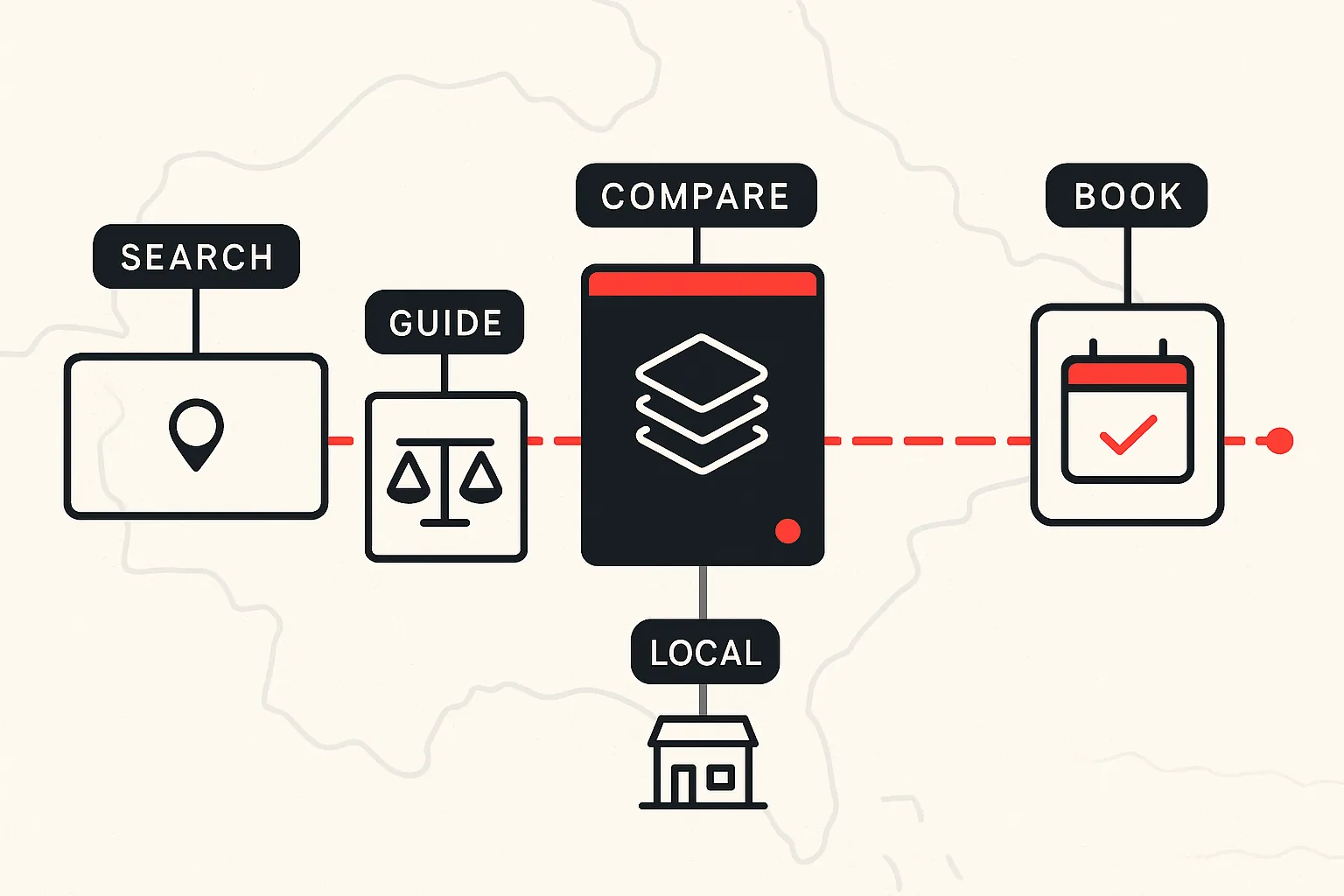
A traveller in Pune types "Bali honeymoon package from Pune" into Google. Before your agency's page gets a single look, the screen fills with an AI Overview summarising the trip, then MakeMyTrip, then Booking.com, then a Reddit thread, then two competitors who built a page for exactly that query. By the time your homepage appears, the searcher has already shortlisted three providers. You never entered the consideration set, and you will never know it happened.
This is the real problem with SEO for travel agencies. It is not that travel is hard to rank for. It is that most agencies build the wrong pages, target traffic instead of bookings, and surrender the highest-intent moments of the journey to aggregators and ad platforms by default. The cost is not abstract. Every package query you do not rank for is a booking you either pay Google Ads to win or lose to a competitor who did the SEO work.
This playbook fixes that. By the end, you will know which pages actually produce bookings, what to put on them, the schema that makes search and AI engines understand your trips, and a 90-day sequence to start winning organic bookings instead of renting every one from an ad auction. It is written for travel agencies, tour operators, and DMCs that sell real trips to real people, in India and beyond.
The short version
SEO for travel agencies works when it is built around booking intent, not destination traffic. Win the local pack with a fully-optimised Google Business Profile, build origin-plus-destination package pages for the queries travellers actually convert on, structure those pages with TouristTrip and FAQ schema so search and AI engines can extract them, and feed them with top-of-funnel destination guides through internal links. Avoid competing with OTAs on broad transactional terms. Beat them with specificity, trust, and depth on the long-tail, where a specialist out-converts a templated aggregator every time.
Why travel SEO is a different game
Most SEO advice assumes you are competing against businesses your own size. In travel, you are competing against the most authoritative commercial domains on the internet, plus an AI Overview that answers the query before anyone scrolls.
Three forces make travel search structurally different:
The OTA wall. Booking.com, Expedia, MakeMyTrip, Agoda, and their peers have spent billions building domain authority and inventory depth. On broad transactional queries ("hotels in Goa", "flights to Dubai"), you will not outrank them, and you should not try. Their templated pages, however, are shallow on curation, local knowledge, and trust. That is your opening.
AI Overviews and answer engines. Travel is one of the most AI-Overview-saturated categories in search, because trip planning is exactly the kind of synthesise-and-summarise task these systems are built for. If your pages are not structured for extraction, the AI Overview answers the traveller using someone else's content and your click disappears. Winning here is a discipline of its own, which is why answer engine optimisation now sits alongside traditional SEO rather than beneath it.
A long, research-heavy journey. Travellers read eight to twelve pages before booking a significant trip. That long journey is a gift to specialists, because it creates dozens of micro-moments where a well-built page can enter the consideration set: the comparison, the itinerary, the "is it safe", the "best time to go", the visa question. Aggregators own the booking click. You can own everything that leads up to it.
The agencies that win do not fight on the OTA's terms. They build a deep, specific, trust-rich presence across the parts of the journey aggregators ignore, then convert that attention into bookings on pages built for exactly that purpose.
Map intent to page types before you write a word
The single biggest mistake in travel SEO is publishing destination content with no booking architecture underneath it. You rank for "best beaches in Goa", get traffic, and convert none of it, because that searcher is dreaming, not buying. Fix this by mapping every query to the page type that matches its intent.
Here is the mapping that should govern your whole site:
| Search intent | Example query | Page type | Goal |
|---|---|---|---|
| Informational | "best time to visit Bali" | Destination guide | Capture early demand, link down to packages |
| Commercial | "Bali vs Maldives for honeymoon" | Comparison page | Shape the shortlist in your favour |
| Transactional | "Bali honeymoon package from Pune" | Package / itinerary page | Convert the booking |
| Local | "travel agency in Pune" | Local service page + GBP | Win the provider choice |
| Trust | "[your brand] reviews" | About, reviews, case pages | Close the deal |
When every page knows its job, internal links do the rest: guides feed comparisons, comparisons feed packages, packages feed enquiries. That is the topical structure AI engines also reward, and it is the foundation of topical authority that ranks and gets cited.
Win the local pack first (it moves fastest)
If your agency has a physical office or a defined service city, local SEO is the highest-return, fastest-moving work you can do. The local pack and "near me" results reward signals you can influence in weeks, not months.
Google Business Profile is your most valuable travel page, and it is not on your website. Claim and verify it, then populate it completely:
- Set the primary category to "Travel Agency" and add relevant secondary categories (Tour Operator, Honeymoon, Corporate Travel) that match what you actually sell.
- Write a description that names your destinations, audiences, and origin cities in natural language.
- Upload real, geotagged photos of trips, your team, and your office. Templated stock kills trust and ranking.
- Keep hours, phone, and booking links accurate. A single wrong detail tanks conversion.
- Build review velocity. Steady, recent, replied-to reviews are one of the strongest local ranking factors. Ask every happy traveller, every trip, with a direct link.
The mechanics of why this works, and how the local pack actually ranks, are covered in depth in our breakdown of Google Business Profile and local pack ranking. For the full system across location signals, citations, and on-page local targeting, see our local SEO services.
On your website, build a real local service page for each city you serve, with the city in the title, genuine local detail (origin-city packages, local pickup, nearby airport context), embedded map, and your NAP details consistent with the GBP. Thin "we serve [city]" doorway pages do not work and risk a penalty. Depth does.
Build package and itinerary pages that actually convert
These are your money pages, and most travel agencies build them badly or not at all. A booking-intent searcher typing "Maldives package from Delhi" does not want a brochure. They want to know what is included, what it costs, how long it is, what the days look like, and why they should trust you over the agency ranking above you.
A package page that ranks and converts contains:
- A specific, intent-matched title and H1 that names the origin, destination, audience, and duration where relevant. "5-Day Maldives Honeymoon Package from Delhi" beats "Maldives Packages" on both ranking and conversion.
- An answer block in the first 100 words stating duration, price range, what is included, and best season. This is what an AI Overview extracts and what a scanning traveller reads first.
- A day-by-day itinerary with real detail. Generic "Day 1: Arrival" filler signals a templated page. Specific, knowledgeable itineraries signal a specialist.
- Inclusions and exclusions, clearly tabled. Travellers compare on this. Make it scannable.
- Trust elements: real reviews, photos from actual trips, your licensing and affiliations, a named human to contact.
- An honest price or price range. Pages that hide all pricing convert worse and get fewer AI citations. You do not need a checkout, but a range and "request a custom quote" beats a black box.
- FAQ section answering the real questions for that trip (visa, safety, best season, what to pack), marked up with FAQPage schema.
Because travel inventory is large, this is where many agencies need ecommerce-style architecture: faceted navigation, canonical discipline across filter combinations, and crawl management so Google indexes your valuable package pages and not ten thousand filter permutations. The principles are the same ones we apply in ecommerce SEO, and getting them wrong is one of the most common technical failures on large travel sites.
Get the technical foundation right
Travel sites are technically demanding. They are large, image-heavy, often built on booking engines that generate messy URLs, and frequently slow. Technical debt here directly suppresses bookings.
The priorities, in order:
Site speed and Core Web Vitals. Travel pages are image-dense and travellers are often on mobile data. Compress and lazy-load imagery, serve modern formats, and keep your Largest Contentful Paint under control. Slow travel pages lose both rankings and bookings.
Crawl and index hygiene. Booking engines and faceted filters spawn endless URL variations. Use canonical tags, robots directives, and a clean XML sitemap to point Google at your real package and destination pages, not the infinite filter combinations. This is the single most common large-site travel SEO failure.
Structured data. Ship the right schema so search and AI engines understand your business and your trips:
TravelAgency(a LocalBusiness type) on your homepage and contact page.BreadcrumbListsitewide for clear hierarchy.TouristTripandTripon itinerary and package pages, with destination, duration, and itinerary detail.FAQPageon pages with genuine Q&A.ReviewandAggregateRatingonly where you have real reviews. Faking these is a manual-action risk.
Schema is also a CTR lever: rich results stand out in a crowded travel SERP. We cover the mechanics in schema markup for rich snippets. For a full technical foundation across speed, crawl, and structured data, our technical SEO services exist for exactly this kind of large, complex site, and a one-time SEO audit is usually the right first step to find what is actually holding the domain back.
Win AI search, because travel lives there now
Trip planning has moved into ChatGPT, Perplexity, Gemini, and Google AI Overviews faster than almost any other category. Travellers ask "plan me a 7-day Kerala itinerary for a family with young kids" and act on the answer. If your agency is not in that answer, you are invisible at the exact moment of intent, a gap we documented in why brands are invisible on ChatGPT but ranking on Google.
The practical moves: lead every destination and package page with a clean answer block, name specific entities (places, hotels, durations, seasons, origin cities), use comparison tables, and mirror real traveller questions in your FAQs. Because AI engines weight community consensus heavily for travel, genuine presence in Reddit threads and travel forums matters as much as your own pages. The tactical detail for each engine is in our guides on how to rank on ChatGPT and how to rank on Perplexity, and the broader programme is our AI SEO services. You can only manage what you measure, so track citations the way you track rankings, using the approach in our piece on measuring brand mentions in ChatGPT and Perplexity.
Plan content around seasonal demand
Travel demand is profoundly seasonal, and travel SEO has a long lead time. These two facts collide painfully if you publish reactively. A page for "Christmas in the Alps" published in November will not rank until next year. You have to publish into the future.
Build a content calendar that works backwards from booking windows:
- Map your booking seasons. When do travellers actually book each trip? Honeymoon planning peaks months before the wedding season. Summer Europe bookings start in winter. School-holiday family trips book in advance.
- Publish three to six months ahead of the booking window so pages have time to index, rank, and accrue links before demand spikes.
- Refresh, do not rebuild. Update last year's seasonal pages with current prices, dates, and details rather than publishing duplicates. Refreshing preserves accumulated ranking equity. Letting a strong page decay is one of the most expensive mistakes in travel content, and the fix is a disciplined refresh cycle, as we lay out in our content decay audit framework.
This forward-publishing discipline is what separates agencies that ride seasonal demand from those who notice it too late every single year.
Earn the authority that makes it all rank
Great pages on a weak domain still struggle. Travel is a competitive, high-CPC category, and links plus trust are what let your booking pages outrank larger sites.
The travel-specific link plays that work:
- Destination expertise content that journalists and bloggers genuinely cite: original data on travel trends, detailed destination guides, seasonal price analyses.
- Digital PR built on the data and stories only an operating agency has, which is far more durable than buying links. Our view on why this replaced old-school link building is in how digital PR replaced link building, and the service itself is digital PR services.
- Partnerships with hotels, DMCs, tourism boards, and complementary local businesses for genuine, relevant links.
- Reviews and citations across travel directories and platforms, which build both authority and the trust signals that convert.
For the full editorial-link strategy that earns rather than buys authority, see our link building services. Avoid the cheap, spammy travel link packages that flood your inbox. In a YMYL-adjacent category like travel, where people spend significant money on your recommendation, low-quality links are a liability, not a shortcut.
Common mistakes that cost travel agencies bookings
- Chasing destination traffic with no booking pages underneath it. Ranking for "best beaches in Bali" with nowhere to convert is a vanity metric.
- Competing head-on with OTAs on broad transactional terms you cannot win, instead of owning the specific long-tail you can.
- Templated, thin package pages with generic itineraries that signal a low-effort site to both Google and travellers.
- Ignoring the Google Business Profile, the single highest-ROI travel asset for any agency with a location.
- Publishing seasonal content too late to rank for the season it targets.
- Letting strong pages decay instead of refreshing them each cycle.
- No schema, so search and AI engines cannot understand or extract your trips.
- Treating AI search as optional in the one category where travellers have moved into it fastest.
The tools that matter
You do not need a bloated stack. You need clarity on demand, competition, and your own performance.
| Job | Tools |
|---|---|
| Keyword and demand research | Google Keyword Planner, Ahrefs or Semrush, DataForSEO |
| Local SEO | Google Business Profile, a local rank tracker |
| Technical health | Google Search Console, Screaming Frog, PageSpeed Insights |
| AI search visibility | Manual prompt audits, AI citation tracking |
| Measurement | GA4, Search Console, a booking or CRM system |
The tools are commodities. The judgement about which queries to chase and which pages to build is where an experienced partner earns their keep. If you want that judgement applied to your specific destinations and margins, our SEO services and SEO consulting are built for exactly this.
Measure bookings, not just rankings
Rankings and traffic are leading indicators. Bookings are the point. Track a layered set of metrics so you can see the funnel working before revenue arrives:
- Leading: indexation and crawl health, keyword rankings for package and local queries, local pack presence, AI Overview and AI citation appearance.
- Engagement: organic sessions to package and destination pages, time on itinerary pages, enquiry-form starts.
- Outcome: organic enquiries, enquiry-to-booking rate, bookings attributed to organic, and cost per booking versus your paid channels.
That last comparison is the one that reframes the whole investment. When you can show that an organic booking costs a fraction of a Google Ads booking, the case for sustained SEO investment makes itself. Until then, you are renting every traveller from an ad auction that gets more expensive every year, the exact dynamic we unpack in our comparison of when to invest in PPC versus organic search.
Your first 90 days
You cannot do everything at once. Sequence it so the fastest-moving wins fund the slower-compounding ones.
Days 1 to 30: Foundation and fast wins. Audit the site for technical and crawl issues. Fully claim and optimise your Google Business Profile and start a review-generation habit. Identify your ten highest-intent package queries by demand and winnability. Fix the worst technical problems.
Days 31 to 60: Build the money pages. Create or rebuild your top ten package and itinerary pages with answer blocks, real itineraries, clear pricing ranges, trust elements, schema, and FAQs. Build or upgrade local service pages for each city you serve. Set internal links from any existing destination content into these pages.
Days 61 to 90: Authority and AI. Launch your seasonal content calendar publishing ahead of booking windows. Begin a digital-PR and link-earning programme around your destination expertise. Optimise your best pages for AI extraction and start tracking AI citations. Review leading indicators and double down on what is moving.
By day 90 you will not have arrived, travel SEO compounds over quarters, but you will have a booking-oriented architecture in the ground, a local presence that converts, and the first leading indicators pointing in the right direction.
Where this goes next
The travel agencies that win the next few years will not be the ones with the biggest ad budgets. They will be the ones who built a deep, specific, trust-rich organic presence across the booking journey, structured it so both Google and AI engines can understand and cite it, and compounded that authority quarter after quarter while competitors kept renting clicks.
That is the entire game: own the moments aggregators ignore, build pages for bookings rather than traffic, and treat AI search as the front door it has already become. If you want a partner to build that system for your destinations and your margins, talk to our team and we will scope it to the bookings it is meant to produce.

Aditya Kathotia
Founder & CEO
CEO of Nico Digital and founder of Digital Polo, Aditya Kathotia is a trailblazer in digital marketing. He's powered 500+ brands through transformative strategies, enabling clients worldwide to grow revenue exponentially. Aditya's work has been featured on Entrepreneur, Economic Times, Hubspot, Business.com, Clutch, and more.