

There is a specific complaint that comes up in almost every AI search conversation we have with a marketing team, and it goes like this: we rank first for the query, our page is more thorough than anything else on the results page, and Google's AI Overview cites three other sites and not us.
The advice available for that situation is unhelpful in a particular way. Search for how to rank in AI Overviews and you will find a dozen articles, most of them from tool vendors, all listing roughly the same seven to twelve tips. Answer the question directly. Use headings. Add schema. Build topical authority. Keep content fresh. The tips are not wrong. They are just aimed at different problems, presented as though they were one problem, which means most teams pick the two that are easiest to implement and change nothing about their actual situation.
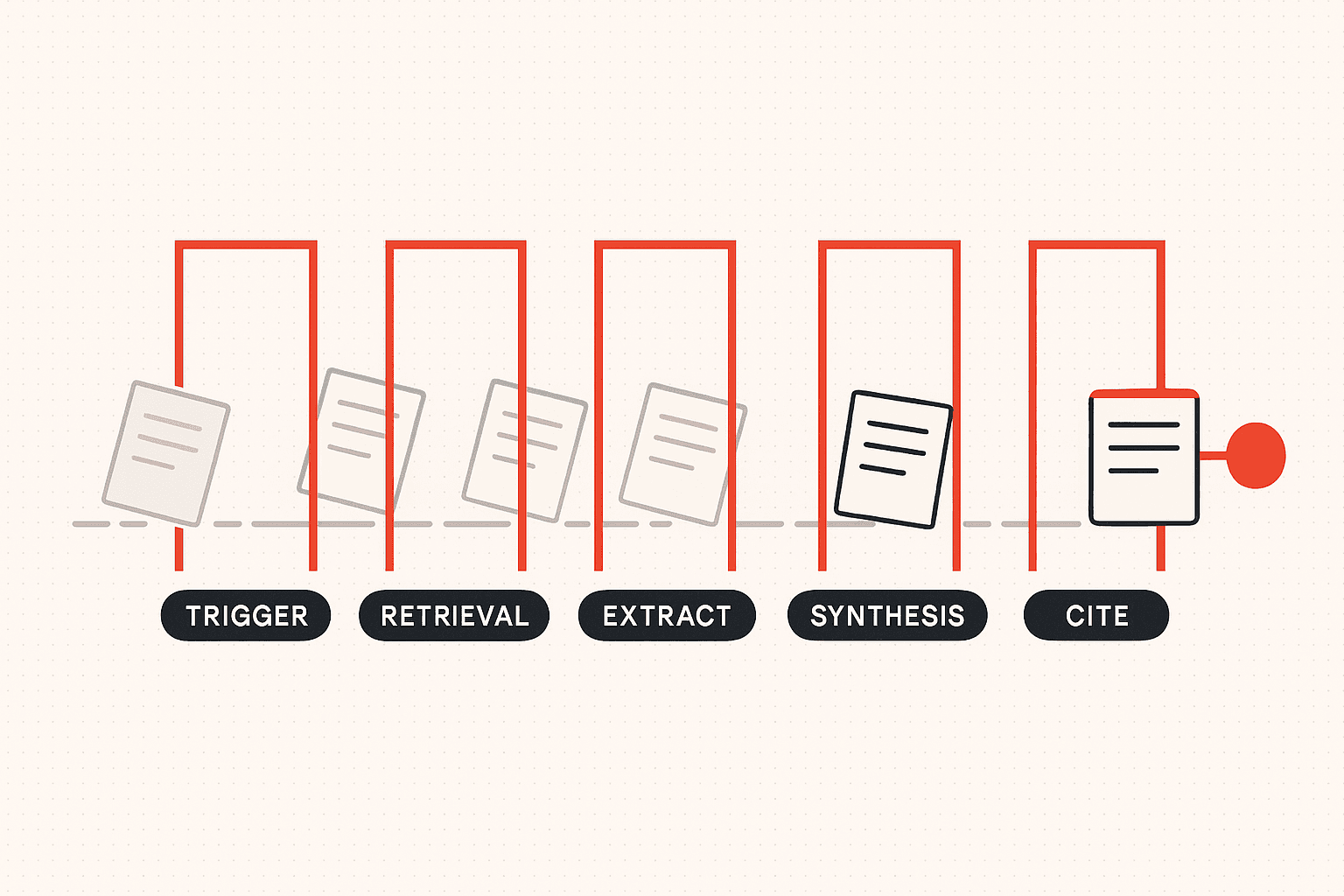
A page can fail to earn an AI Overview citation at five separate points, and the five failures look identical from the outside. You are not cited. That is all you can observe. But the page that is not cited because the query never generates an Overview needs completely different work from the page that is not cited because its answer is buried in paragraph nine, which needs completely different work again from the page that is not cited because it says exactly what four other pages already say.
This article is the diagnostic we run before touching a page. It maps the five gates, gives you the observable symptom at each one, and tells you what to actually change. If you want the background on what AI Overviews are and how the underlying system works, we cover that separately in Google AI Overviews explained. This piece assumes you already know what they are and want to know why your page is not in one.
The Short Answer
To rank in AI Overviews you have to clear five gates in order: the query must trigger an Overview, your URL must enter the retrieved candidate pool, your page must contain a self-contained forty to sixty word passage answering the specific question, that passage must carry a claim the synthesised answer actually needs, and the citation must attach to the correct URL. Most pages fail at exactly one gate. Diagnose which one before optimising anything.
The Five Gates Between Your Page and a Citation
An AI Overview is not a ranking. It is the output of a pipeline, and a citation is what happens when your URL survives every stage of that pipeline. Understanding the stages is what makes the difference between targeted work and cargo-cult optimisation.
Gate 1: Does the query trigger an Overview at all
Before anything else, check whether the query you care about generates an Overview. A significant share of queries do not, and the composition shifts constantly as Google adjusts coverage. Navigational queries rarely trigger one. Highly transactional queries where the user clearly wants to buy often do not. Queries where the answer is genuinely contested or where Google's own quality thresholds are not met get suppressed.
This matters more than it sounds, because teams routinely spend a quarter optimising for AI Overview visibility on a keyword set that mostly does not produce Overviews. If forty of your fifty target queries return no Overview, the correct strategic response is not to optimise harder. It is either to accept that this keyword set is a classic organic play and treat it that way, or to expand the target set toward the question-shaped, comparison-shaped and definition-shaped queries where Overviews reliably appear.
The check is manual and takes an afternoon. Pull your commercially important queries, run them in a clean browser session from the locations you sell into, and mark which produce an Overview. That list is your actual playing field. Everything downstream applies only to it.
Gate 2: Is your URL in the candidate pool
Overviews are generated from retrieved sources, and retrieval leans heavily on the same systems that produce organic rankings. In practice this means pages that rank on the first page for the query, or for a close long-tail variant of it, are the ones that enter the pool. Pages sitting on page three do not get cited because they are never candidates.
There are two nuances worth knowing. The first is that the variant matters as much as the query. We regularly see pages cited for a broad query because they rank strongly for a narrower question that Google treats as semantically adjacent, which is why question-shaped subheadings on a page can pull citations for queries the page does not rank for directly. The second is that community sources are over-represented relative to their organic positions. Reddit threads appear as Overview citations at a rate their ranking alone would not predict, which is part of why we treat Reddit visibility as a distinct workstream rather than a nice-to-have.
If you are failing at gate two, the honest answer is that AI-specific tactics are not your problem. You need ordinary search visibility first: intent match, internal linking, crawl health, and the fundamentals covered in a proper technical SEO pass. Formatting a page beautifully for extraction accomplishes nothing if the retrieval step never surfaces it.
Gate 3: Is there an extractable passage
This is where most well-ranking pages fail, and it is the gate that generates the "I rank first and I am still not cited" complaint.
A page can be authoritative, comprehensive and correct while containing nothing a model can lift. The answer exists, but it is distributed - the definition is in the introduction, the qualifying condition is in section four, and the practical number is inside a case study near the end. A human reader assembles this without noticing. An extraction step looking for a coherent block that answers the query on its own finds nothing usable and moves to a candidate that has one.
The fix is structural rather than editorial. Somewhere on the page, ideally high, there needs to be a heading phrased close to the question a user would actually type, followed immediately by roughly forty to sixty words that answer it completely without depending on anything above or below. Not a teaser. Not the first half of the answer with the rest after a chart. The whole claim, self-contained, in one block.
We go deeper on which structures get lifted and which get skipped in the content formats LLMs cite, and the same principle drives our approach to answer engine optimization generally.
Gate 4: Does the synthesised answer need your claim
Suppose you cleared the first three gates. The query triggers an Overview, you rank fourth, and your page has a clean self-contained passage under a matching heading. You are still not cited, and three competitors are.
This is a necessity problem. The synthesiser is assembling an answer from several candidates, and it has no reason to pull your sentence when four other pages carry the same sentence and one of them has stronger signals attached. Being correct is not sufficient when correctness is commodity.
What breaks the tie is carrying something the other candidates do not: a measured number from your own work, a specification, a price or cost range, a date-stamped observation, a named exception to the general rule, or a documented process with steps specific enough that they could only come from having done it. This is where genuine first-hand experience converts into visibility rather than remaining a claim in an about page. It is also why we run original audits and publish the results rather than restating consensus - work like our audit of fifty D2C brands for AI visibility exists partly because differentiated claims are the only reliable currency at this gate.
The uncomfortable implication is that a large amount of competent, accurate, well-optimised content is structurally uncitable. If your page says what everyone says, formatting will not rescue it.
Gate 5: Does the citation attach to the right URL
The last gate is the smallest and the easiest to fix. Sometimes the brand is cited but the link points at the homepage, a category page, or an older article covering the same ground. Sometimes two of your own pages compete and the weaker one gets the citation.
The causes are mundane: canonical tags pointing at the wrong version, near-duplicate pages covering the same question, internal linking that signals the wrong page as the authority on a topic, or an entity that Google has not clearly associated with the specific URL. This is ordinary information architecture work, and it is worth doing because a citation landing on the wrong page wastes a visibility win you already earned. Our writing on entity SEO and the knowledge graph covers the association side of this in more depth.
The Diagnostic: Find Your Failing Gate
The whole point of the model above is that it converts an unanswerable question - why are we not cited - into a sequence of answerable ones. Run it in order and stop at the first no.
Running this on a real page takes about twenty minutes. Running it across a fifty-query panel takes a day and produces something far more useful than a generic optimisation backlog: a count of how many of your pages fail at each gate. That distribution decides your strategy. A portfolio failing mostly at gate two needs an SEO programme. A portfolio failing mostly at gate three needs a formatting sprint that can be finished in three weeks. A portfolio failing mostly at gate four needs a research budget, which is a very different conversation with a CFO.
If you would rather not build the panel yourself, this is precisely the scope of our SEO audit service - we run the gate diagnostic across your commercial query set and hand back the distribution with the sequenced fix list.
Passage Engineering: What an Extractable Block Looks Like
Gate three is the one most teams can fix fastest, so it is worth being concrete about what changes.
The transformation is almost never about writing better. It is about relocating and consolidating what is already there. Below is the pattern we apply, expressed as the difference between a page that does not get lifted and one that does.
| Dimension | Not extractable | Extractable |
|---|---|---|
| Heading | "Our Approach to Pricing" | "How much does an SEO audit cost in India?" |
| Position of answer | Paragraph four, after context | First sentence under the heading |
| Length of answer block | 15 words, or 300 words | 40 to 60 words, one block |
| Dependency | Refers to "the framework above" | Stands alone with no back-reference |
| Specificity | "Costs vary by scope" | Names the range and the variable that drives it |
| Format | Narrative prose | Claim first, then qualification |
| Follow-on | Jumps to a new topic | Expands the same claim for readers who need depth |
Two things about this table are worth stating explicitly, because they get missed.
First, the extractable version is not shorter overall. The page still carries the full depth underneath. What changes is that the answer is stated completely before the depth begins, rather than being assembled from it. You are not trading thoroughness for extractability - you are ordering them correctly.
Second, the heading rewrite matters more than most teams expect. Headings phrased as internal-facing labels rather than as user questions are one of the most common blockers we find, and changing them is a fifteen-minute edit with no content risk. When we rebuilt a client blog around the questions readers actually ask rather than the topics we wanted to cover, the heading layer was the single highest-yield change, which we documented in how we rebuilt a blog for LLM questions.
A practical constraint: apply this to one clear question per page. Pages that try to make eight different passages extractable end up with none of them dense enough to lift. If a page genuinely owns eight questions, it is probably two or three pages.
The Schema Question, Answered Honestly
Structured data comes up in every AI Overview conversation and it deserves a straight answer rather than the usual hedging.
Schema does not cause citation. There is no markup that instructs an Overview to quote you, and adding more schema types to a page does not increase its odds in any direct way. What schema does is make a page's subject, entity and key claims machine-legible, which reduces the friction at retrieval and extraction and helps disambiguate which entity a page belongs to. That is real value, and it is second-order value.
The practical position we take with clients is this. Article and Organization markup should be correct on every page, because they are the ones that tie content to a publisher entity. FAQPage markup is worth adding where the page genuinely contains those questions and answers, and is worth avoiding where it does not, because inflated FAQ blocks create maintenance debt and no upside. Product, Service and HowTo markup should be present where they describe what the page is actually about. Beyond that, additional schema types are not a lever, and a team that has already implemented these correctly should stop optimising schema and go work on gate three or gate four instead.
Our fuller treatment of implementation is in schema markup and rich snippets.
What Does Not Work
Some widely repeated tactics do not survive contact with the mechanism described above. Naming them saves budget.
Adding an llms.txt file to influence Google. The file is a proposal aimed at other AI systems, and Google has not indicated it uses one for retrieval or citation. It has legitimate uses for other engines - we maintain one ourselves and explain the reasoning in what llms.txt is - but treating it as an AI Overview lever is a category error.
Writing longer articles. Length dilutes passage density. A 6,000 word article with no self-contained answer block is less extractable than a 1,200 word article with one, and the effort spent on the extra 4,800 words bought nothing at gate three.
Publishing many thin question pages. Blanketing a topic with fifty short question-and-answer pages produces fifty pages that individually rank too poorly to enter retrieval. You fail at gate two fifty times.
Authority language without authority. Phrases like "according to industry experts" are not signals. The thing that functions as an authority signal is a specific, checkable, attributable claim.
Chasing Overview presence on queries that do not produce Overviews. Covered at gate one, and worth repeating because it is the most expensive mistake on this list in wasted quarters.
Measuring This Without a Perfect Tool
Measurement is genuinely hard here and the honest framing helps. Overviews are generated per query and vary by location, session and time, so no tool can give you complete coverage. What you can build is a stable, comparable signal.
Run a fixed panel. Choose thirty to fifty queries that matter commercially, check them monthly in a clean browser session from each market you sell into, and record three fields per query: Overview present, your domain cited, competitors cited. Because the panel is fixed, month-over-month movement is meaningful even though absolute coverage is incomplete.
Read Search Console for the second-hand signal. The pattern that indicates an Overview has appeared above you is stable or rising impressions paired with falling click-through rate on informational queries. That combination is diagnostic enough to act on, and it is the same reading discipline we describe in diagnosing a Search Console traffic drop. Bear in mind that Google's removal of the num=100 parameter changed what your rank tracking data actually represents, a shift we unpack in how to fix your SEO data stack.
Watch the downstream metric, not just the page. Citations that do not produce a click still enter the buyer's consideration set, and that surfaces as branded search volume and direct traffic rather than as organic sessions on the cited URL. If your reporting only counts sessions to the cited page, you will conclude the channel does not work when it may be working exactly as expected. The methodology for tracking mentions across engines is covered in AI citation tracking.
A 30-Day Sequence
If you are starting from nothing, this is the order that produces signal fastest without committing to a large programme up front.
| Week | Work | Output |
|---|---|---|
| 1 | Build the query panel. Check Overview presence across your commercial query set from each target market. | The real playing field: which queries are in scope at all. |
| 2 | Run the gate diagnostic on in-scope queries. Record failing gate per page. | A distribution showing where your portfolio actually fails. |
| 3 | Ship gate 3 fixes only. Rewrite headings as questions, hoist and consolidate answer blocks. | 10 to 20 pages restructured, no new content written. |
| 4 | Re-check the panel. Scope the gate 4 work: what original claim can each page carry? | First movement data, plus a research backlog with owners. |
The reason gate three comes first is not that it is the most important gate. It is that it is the cheapest to fix and the fastest to read a result from, which means it tells you within a month whether the underlying diagnosis was right before you commit research budget to gate four.
The KPIs Worth Reporting
Four numbers, tracked monthly against the fixed panel:
- Overview presence rate - the share of your panel queries that produce an Overview. This is context, not performance, but it moves and you need to know when it does.
- Citation share - the share of Overview-producing panel queries where your domain is cited. This is the headline.
- Competitive citation gap - which competitors are cited on queries where you are not, tracked as a named list rather than a count.
- Branded search and direct traffic trend - the downstream signal that catches value the cited-page session count misses.
Resist the temptation to add a fifth. The measurement here is imprecise enough that more numbers create false confidence rather than better decisions.
Where This Sits in a Wider Programme
AI Overviews are one surface. The same underlying discipline - specific claims in extractable blocks, attached to a clear entity, on pages that already rank - drives visibility in ChatGPT and Perplexity too, though the retrieval mechanics differ enough that the tactics diverge. We cover those separately in how to rank on ChatGPT and how to rank on Perplexity, and the distinctions between the three disciplines in SEO vs AEO vs GEO.
Whether this deserves budget at all depends on your category. Some businesses have buyers who never touch AI search, and for them this is a 2027 problem. The framework we use to make that call is in which clients are worth a GEO strategy, and the adoption data we anchor those decisions to is maintained in our AI search statistics reference. If the terminology in any of this is unfamiliar, the digital marketing glossary carries definitions for the entity, retrieval and extraction concepts used above.
Start With the Diagnostic, Not the Tips
The reason AI Overview advice feels unsatisfying is that it answers a question nobody has. Nobody needs a list of twelve things that correlate with citation. They need to know which one of those twelve applies to their page, and the tips format cannot tell them.
So do the boring thing first. Take ten pages that matter commercially, run them through the five gates, and write down where each one stops. You will almost certainly find the failures cluster - most portfolios fail predominantly at one or two gates - and that clustering tells you what your next quarter should contain far more reliably than any best-practice list.
Then fix one gate, on a handful of pages, and re-check. The discipline of changing one thing and reading the result is what separates teams that understand their AI search position from teams that have simply done a lot of AI search work.
If you would rather have the diagnostic run for you across your full commercial query set, that is the work our AI SEO team does. Tell us which queries matter and we will come back with the gate distribution, the failing pages, and the sequence to fix them.

Aditya Kathotia
Founder & CEO
CEO of Nico Digital and founder of Digital Polo, Aditya Kathotia is a trailblazer in digital marketing. He's powered 500+ brands through transformative strategies, enabling clients worldwide to grow revenue exponentially. Aditya's work has been featured on Entrepreneur, Economic Times, Hubspot, Business.com, Clutch, and more. Join Aditya Kathotia's orbit on LinkedIn to gain exclusive access to his treasure trove of niche-specific marketing secrets and insights.