

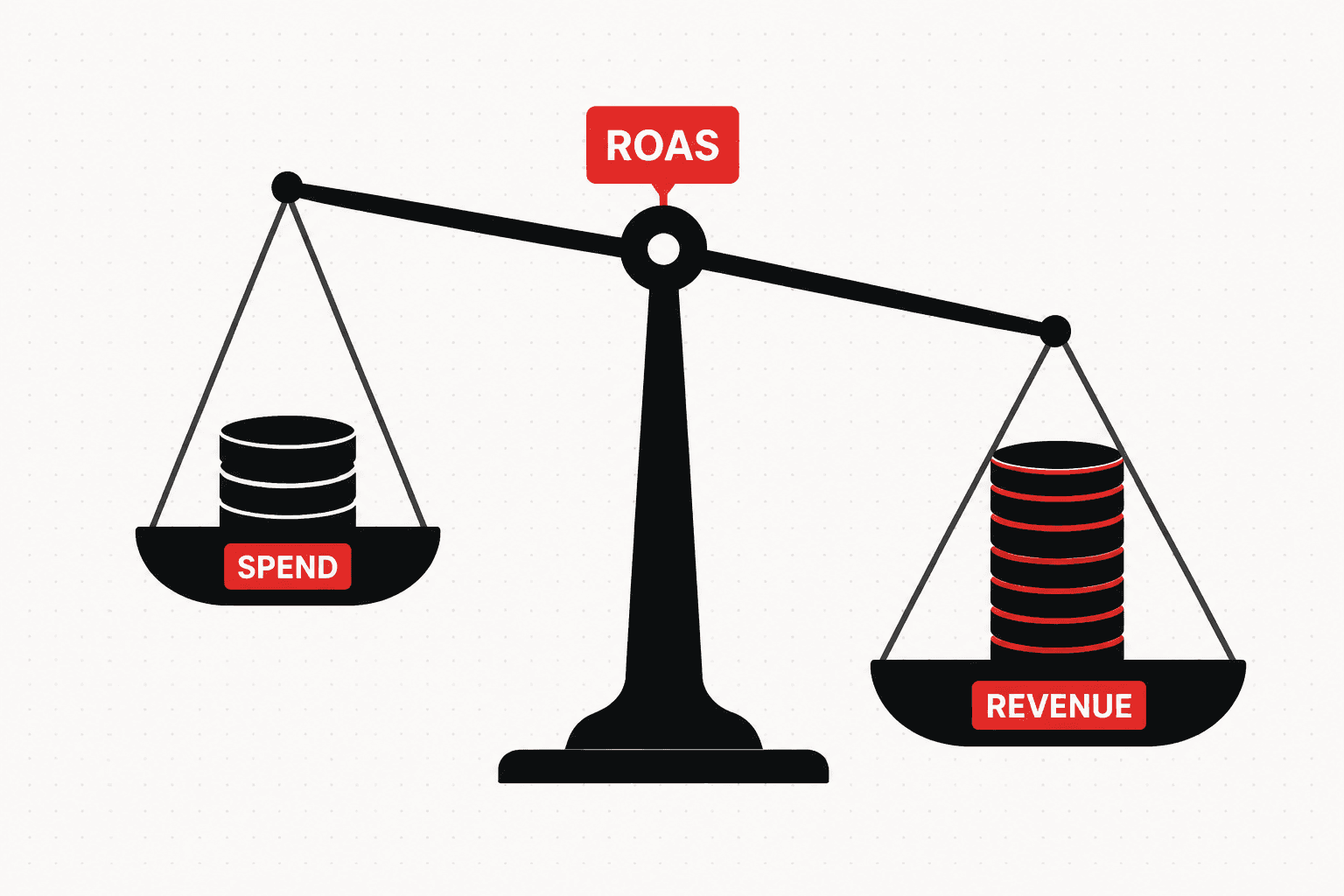
ROAS means return on ad spend: the revenue your ads bring in for every rupee you spend on them. The formula is one line:
ROAS = Revenue from ads ÷ Ad spend
Spend ₹50,000 on ads, earn ₹2,00,000 in sales from them, and your ROAS is 4. You will see it written as 4x, 4:1 or 400 percent. All three mean the same thing: ₹4 of revenue back for every ₹1 of media.
That is the whole definition. The harder question, and the one that decides whether a campaign makes money, is what ROAS your business needs. A 4x ROAS can be excellent for a skincare brand and a steady loss for an electronics store. The rest of this guide covers why, with the break-even formula, a worked rupee example and category benchmarks.
How to Calculate ROAS: A Worked Example
Take an Indian D2C store running Google Shopping for one month.
| Line | Amount |
|---|---|
| Ad spend | ₹50,000 |
| Orders attributed to the ads | 160 |
| Average order value | ₹1,250 |
| Revenue from ads (160 x ₹1,250) | ₹2,00,000 |
| ROAS (₹2,00,000 ÷ ₹50,000) | 4.0x, or 400% |
Two rules keep the number honest. First, match the periods: revenue and spend must cover the same dates. Second, match the attribution: Google Ads and Meta each count conversions using their own attribution windows, so the same order can be claimed by both platforms. Adding each platform's ROAS together overstates what your ads earned. Check platform ROAS against the orders your store actually shipped.
Now the part the dashboard leaves out. Suppose this store keeps 30 percent of every rupee after product cost, shipping, packaging, payment gateway fees and returns. That 30 percent is the contribution margin.
The ₹2,00,000 of revenue leaves ₹60,000 of contribution. Subtract the ₹50,000 of ads and the campaign made ₹10,000. The dashboard says 4.0x. The business made 20 paise of profit per rupee of media. Both numbers are true, and only one of them pays salaries.
ROAS vs ROI vs POAS vs MER
Four ratios get used interchangeably in Indian performance marketing, and they answer four different questions.
| Metric | Formula | What it counts | Best used for | Blind spot |
|---|---|---|---|---|
| ROAS | Ad revenue ÷ ad spend | Revenue the platform attributes to ads | Steering bids and budgets inside one platform | Ignores product cost, delivery, returns and fees |
| ROI | Net profit ÷ total investment | Profit against total cost, including team, tools and agency | Deciding whether marketing pays back as a whole | Slow to calculate, hard to use day to day |
| POAS | Contribution profit ÷ ad spend | Profit after variable costs, per rupee of media | Comparing campaigns and SKUs with different margins | Needs margin data per product, which most stores never map |
| MER | Total revenue ÷ total marketing spend | All revenue against all marketing, every channel | A blended health check that no platform can inflate | Cannot tell you which channel or campaign is working |
In the example above: ROAS 4.0x, POAS 1.2x, and ROI on the ad spend of 20 percent (₹10,000 ÷ ₹50,000). If the same store did ₹10 lakh of total revenue that month across all channels on ₹2.5 lakh of total marketing spend, its MER would be 4.0. A POAS above 1.0 means a campaign covers its own media cost; below 1.0, every extra order loses money.
Break-Even ROAS: The Number That Matters
Break-even ROAS is the ROAS at which an order exactly pays for its own advertising. The formula:
Break-even ROAS = 1 ÷ Contribution margin
Work out the margin per order first. A store with a ₹1,500 average order value might carry ₹600 of product cost, ₹150 of shipping and packaging, ₹30 of payment gateway fees at 2 percent, and a ₹120 allowance for returns and RTO. That is ₹900 of variable cost, leaving ₹600, a 40 percent contribution margin.
Break-even ROAS = 1 ÷ 0.40 = 2.5x. Below 2.5x, every order the ads buy loses money. Above it, the campaign is profitable on the first order. Repeat purchases can justify running below break-even for new customers, but only if you know your repeat rate, and only as a deliberate choice.
The same arithmetic, applied by margin band, from our ecommerce SEO vs PPC ROI breakdown:
| Contribution margin | Break-even ROAS | Typical Indian categories |
|---|---|---|
| 15% | 6.7x | Electronics, appliances, mobile accessories |
| 25% | 4.0x | Fashion and footwear after returns and RTO |
| 35% | 2.9x | Home, kitchen, decor |
| 40% | 2.5x | Mid-margin D2C |
| 50% | 2.0x | Beauty, skincare, personal care |
| 60% | 1.7x | Supplements, wellness, own-brand consumables |
Category margins are indicative. Calculate yours from your own P&L.
What Is a Good ROAS?
A good ROAS is one comfortably above your break-even ROAS, which is why no single benchmark works. Published medians help you see where the market sits, though. These figures come from the benchmark table on our ecommerce PPC services page, each with its source:
- Google Search (ecommerce, brand and non-brand): 4.9x median, Topgrowth Marketing DTC panel of 28 brands, September 2025 to August 2026, updated September 2026.
- Google Standard Shopping: 4.1x median, same panel.
- Performance Max (retail): 3.9x median in the same panel; a Visionary Marketing audit of 240 accounts (published April 2026) put the ecommerce median at 3.4x.
- Meta Ads (ecommerce, all campaign types): 1.9x, Triple Whale 2025 data across roughly 35,000 brands, as reported by Eightx, May 2026.
These are mostly global DTC panels, not India-only data. The useful exercise is to set them beside break-even ROAS by category.
| Category | Indicative margin | Break-even ROAS | Published Shopping ROAS | Published Meta ROAS |
|---|---|---|---|---|
| Electronics | 15% | 6.7x | 3.8x | 1.9x |
| Fashion and apparel | 25% | 4.0x | 6.1x | 2.2x |
| Home and appliances | 35% | 2.9x | 4.5x | 2.2x |
| Beauty and skincare | 50% | 2.0x | 6.1x | 1.6x |
| Health and wellness | 60% | 1.7x | Not published | 1.5x |
Sources: Shopping ROAS from Foundry CRO, "Google Shopping Benchmarks by Category 2026", April 2026; Meta ROAS from Triple Whale 2025 data as reported by Eightx, May 2026. Margins are indicative ranges.
Two readings stand out. A median electronics Shopping campaign at 3.8x sits well below a 6.7x break-even, so electronics sellers need margin-aware bidding or a repeat-purchase case to justify paid search at all. And Meta's lower ROAS across every category is not a verdict against Meta: it reaches people earlier, before they search, so a share of the sales it starts are later credited to Google or to direct visits.
Target ROAS Bidding in Google Ads
Target ROAS is the Smart Bidding strategy that asks Google to hit an average conversion value per rupee of spend. Google expresses it as a percentage: ₹5 of conversion value per ₹1 of spend is a 500 percent target. Google's help page on Target ROAS (checked November 2026) recommends at least 15 conversions in the past 30 days for Search and Shopping, and reporting conversion values for four weeks or one to two conversion cycles, whichever is longer, before you set a target.
Three practical rules:
- Set the floor at break-even. A target below break-even ROAS instructs Google to buy unprofitable orders efficiently.
- Start near what the campaign already does. If it runs at 3.5x, a 600 percent target will throttle volume overnight. Move in steps and allow one to two conversion cycles between changes.
- Pass real values. Target ROAS is only as good as the conversion value you send. Sending revenue when margins vary by SKU means Google optimises for turnover, not profit.
Choosing between Target ROAS, Target CPA and Maximize Conversions depends on account shape; our guide to tCPA vs tROAS vs Max Conversions covers when each one fits.
Frequently Asked Questions
What does ROAS mean?
ROAS stands for return on ad spend. It is the revenue a campaign brings in for every rupee spent on ads, calculated as revenue from ads divided by ad spend. ₹2,00,000 of revenue from ₹50,000 of spend is a ROAS of 4, written 4x or 400 percent. It measures revenue, not profit.
How do you calculate ROAS?
Divide the revenue attributed to your ads by what you spent on those ads over the same period. ROAS = ad revenue ÷ ad spend. Multiply by 100 to express it as a percentage, which is how Google Ads asks for a Target ROAS: a 4x ROAS is a 400 percent target.
What is break-even ROAS?
Break-even ROAS is the ROAS at which an order exactly pays for its own advertising. It equals 1 divided by your contribution margin, the share of revenue left after product cost, shipping, packaging, payment fees and returns. A 40 percent margin breaks even at 2.5x; a 25 percent margin needs 4x.
What is a good ROAS in India?
Any ROAS comfortably above your break-even ROAS. The widely quoted 3x to 4x is profitable for beauty or supplements with 50 to 60 percent margins, roughly break-even for fashion after returns, and loss-making for electronics, where a 15 percent margin needs about 6.7x just to break even.
What is the difference between ROAS and ROI?
ROAS divides revenue by ad spend and ignores every other cost. ROI divides profit by the total investment. A campaign can show a 4x ROAS and a thin or negative ROI once product cost, delivery, returns and fees are counted. Use ROAS to steer campaigns and ROI or POAS to judge whether they make money.
What is a good Target ROAS to set in Google Ads?
Start near the ROAS the campaign already achieves and never below your break-even ROAS, then raise it in small steps. Google recommends at least 15 conversions in the past 30 days for Target ROAS on Search and Shopping, and reporting conversion values for at least four weeks before you set a target.
Running campaigns without knowing your break-even ROAS? We map contribution margin by product, set Target ROAS floors that protect profit, and rebuild Shopping, Performance Max and Meta catalogue campaigns around POAS rather than revenue. See our ecommerce PPC services.

Aditya Kathotia
Founder & CEO
CEO of Nico Digital and founder of Digital Polo, Aditya Kathotia is a trailblazer in digital marketing. He's powered 500+ brands through transformative strategies, enabling clients worldwide to grow revenue exponentially. Aditya's work has been featured on Entrepreneur, Economic Times, Hubspot, Business.com, Clutch, and more. Join Aditya Kathotia's orbit on LinkedIn to gain exclusive access to his treasure trove of niche-specific marketing secrets and insights.
More in Performance Marketing
- CPM Meaning: Cost Per Mille Explained With India Benchmarks
- Meta Ads Library: How to Research Competitor Ads in India
- UTM Parameters: How to Tag Links and Read Them in GA4
- What Is SEM? Search Engine Marketing Explained for India
- Paid Advertising Platforms in India: 12 Compared by Cost and Fit
- ChatGPT Ads in India: How They Work, Costs and Setup